78% of law firms are invisible to AI recommendations despite having search visibility. Traditional law firm SEO can place a firm in results, but it cannot establish that an AI system will include the firm in a high-intent shortlist.
That distinction defines the modern selection problem. Prospective clients increasingly research legal issues before they contact an attorney, then verify the firm through its website, biographies, reviews, directories, and other independent sources. A firm can rank for a valuable query and still disappear at the moment an AI system synthesizes those sources into a recommendation.
Law Firm SEO Today: Visibility Is Not Selection
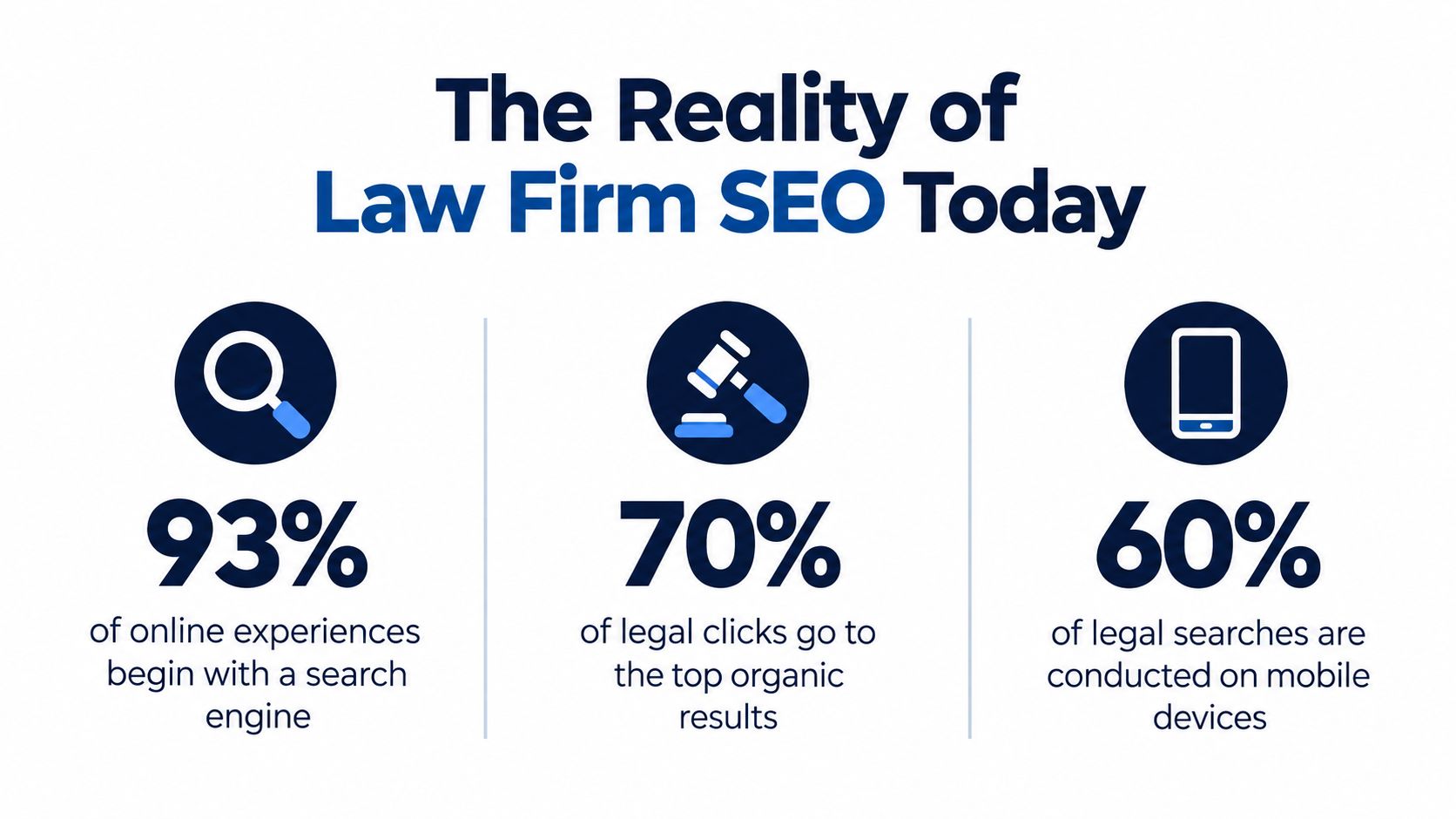
Legal consumers increasingly research online before contacting an attorney. The 2024 Martindale-Avvo Legal Consumer Report found that 92.4% of legal consumers were likely or very likely to research their legal issue online before contacting an attorney. It also found that 93.3% of consumers who discovered an attorney through a search engine conducted additional research before deciding whether to hire that attorney.
These figures define two separate stages. Search visibility places a firm in the consumer's consideration set. Selection depends on whether the firm's online representation remains coherent, relevant, and credible under further examination. A practice page may describe one focus, an attorney biography may emphasize another, and a directory profile may contain outdated credentials or incomplete jurisdiction information. The prospective client, or an AI system acting as an information intermediary, must reconcile those signals.
Practical rule: A ranking is an entry point into evaluation, not evidence that evaluation will end in a consultation.
The 78% CitationOS diagnostic finding shows the same separation from the AI side. Across 116 firms and 16 months of diagnostics, 78% were invisible to AI recommendations. The finding concerns the selection layer rather than indexing alone. Search visibility can coexist with AI absence when external sources do not consistently confirm a firm's identity, expertise, geography, or fit for a specific legal problem.
The selection moment changes the measurement problem
The Selection Moment occurs when a system converts a broad legal question into a finite recommendation. A user might ask which firms handle a particular dispute in a particular jurisdiction. The system evaluates available descriptions, credentials, reviews, and geographic signals before naming or omitting firms.
For an individual firm, the outcome is binary. A firm can receive impressions without appearing in the recommendation. It can attract branded searches without being associated with the relevant case category. It can publish substantial content without providing enough corroborated evidence for an AI system to treat it as a reliable option.
Rankings therefore provide an incomplete performance measure. Leadership should track two distinct outcomes:
- Discovery: Can search engines and users find the firm for relevant non-branded and local queries?
- Selection: Do AI systems represent the firm accurately and include it when the query signals high intent?
Conventional SEO still has a defined function. SEO helps systems discover you. Generative engine optimization helps systems extract and understand you. AI recommendation intelligence measures whether AI trusts and recommends you. These functions form a progression from retrieval to interpretation to recommendation authority.
Consumer research makes trust part of SEO
Legal consumers do not stop at the first result. They compare evidence across practice-area pages, attorney profiles, office details, reviews, and third-party references. Those sources determine whether initial visibility survives scrutiny.
That process exposes the limits of generic publishing programs. Loosely related articles can generate visits while leaving key questions unresolved: which attorneys serve which jurisdictions, what matters the firm handles, and why its experience applies to the user's problem. High-volume traffic can therefore conceal weak intake quality and limited recommendation authority.
A law firm's search presence must remain consistent across the full evaluation chain. It needs a discoverable site, clear service-market architecture, accurate local identity, and a corroborated professional record. Without those elements, a firm may win the search result and lose the decision.
Technical Architecture and Entity Consistency
Search engines and AI systems cannot reliably associate expertise with a firm whose identity changes across pages and external records. Technical SEO therefore includes entity control. The firm must maintain one stable representation of its name, offices, lawyers, jurisdictions, and practice areas across the sources that shape both organic rankings and the AI Selection Moment, when a system decides which firms to represent or recommend.
Build one authoritative identity record
Create a canonical identity record before editing markup, profiles, or location pages. It should specify the firm's exact business name, address, telephone number, jurisdiction, office structure, attorney relationships, and core practice descriptions. The official website becomes the reference point for the Google Business Profile, bar-directory records, reputable legal directories, office pages, attorney biographies, and contact information.
The record must describe the firm as it operates, not as it wishes to appear for every possible search. A location should correspond to a real office or a genuine service market. A practice description should identify work the firm actually handles. Each attorney should connect to a stable biography page and the correct organization.
Audit important sources against that record. Check abbreviations, office names, suite details, phone formatting, jurisdictions, practice terminology, and lawyer-firm relationships. A duplicate location profile can divide signals between records. An office page for a market the firm does not serve creates geographic ambiguity. An outdated biography weakens the association between an attorney and the practice area the firm wants systems to recognize.
The audit should answer four questions:
- Identity: Does each source use the same business name and official contact details?
- Geography: Does every location represent a real office or a defensible service market?
- Practice scope: Do the descriptions identify the same categories of legal work?
- People: Are attorneys connected to stable biography pages and the correct firm?
- Evidence: Do external records support, rather than contradict, the firm's credentials?
Separate city pages created only to capture place names add URLs without adding evidence. Each location page needs accurate contact information, a legitimate service rationale, and a clear relationship to the firm's office or jurisdictional coverage. Otherwise, the site gives search engines and AI systems more pages to reconcile and less information with which to form a precise entity.
Use structured data as context, not a ranking promise
Organization markup can clarify administrative details and help Google distinguish an organization in search results. LocalBusiness markup can describe a qualifying physical location. Neither mechanism replaces accessible pages, accurate profiles, relevant content, or consistent professional information.
Google's Organization structured-data guidance recommends using applicable properties, validating implementation with the Rich Results Test, testing deployed pages with URL Inspection, and submitting a sitemap. The LocalBusiness documentation also addresses claiming and verifying the Business Profile and explains that structured data should clarify page meaning, not promise visibility.
A defensible implementation sequence is:
- Crawl the site and profiles. Record differences in names, addresses, phone numbers, jurisdictions, offices, and practice descriptions.
- Resolve the source record. Establish the correct identity before changing markup or publishing new pages.
- Connect entities. Link the organization, offices, attorneys, and practice areas through stable internal URLs.
- Validate the markup. Test representative pages with Google's validation tools and inspect how deployed URLs render.
- Check accessibility. Confirm that pages are indexable, usable on mobile devices, and represented in the sitemap.
- Monitor local actions. Compare local impressions, calls, directions, profile activity, and qualified consultations by location.
Structured data reduces ambiguity when it accurately reflects visible information. It cannot repair duplicate listings, inaccessible pages, conflicting credentials, or a poor client experience. The entity authority framework describes the broader principle: authority depends on consistent representation of one identifiable organization across connected sources.
Treat technical maintenance as governance
Entity consistency decays after office openings, name changes, attorney additions, practice-priority revisions, and website migrations. Each event can create conflicting records. A quarterly review of identity fields, attorney relationships, location pages, and directory profiles provides a control point for correcting those conflicts.
Apply the same control to claims about experience and outcomes. Legal advertising rules and professional obligations govern what the firm publishes. Technical governance must preserve accurate evidence, not manufacture authority. Clean architecture gives search and AI systems a reliable record to interpret, increasing the chance that organic visibility converts into accurate representation at the AI Selection Moment. It cannot create credibility where the firm has supplied no supporting record.
Building Citation Presence and Narrative Depth
A law firm's online footprint should operate as a corroborated professional record. The firm's website states its services and positioning. Independent sources confirm where it operates, which attorneys belong to it, and how its expertise is described. Citation presence measures whether relevant references exist and align. Narrative depth measures whether those references contain enough specific, consistent information for search and AI systems to form a precise representation.
Mention volume does not establish authority. A directory may list a name and phone number without connecting the firm to a dispute category. A publication may mention an attorney without identifying the relevant jurisdiction. A review may praise service without naming the practice area. Each reference has limited interpretive value when isolated. A connected set of sources, using the same identity, services, attorneys, and jurisdictions, gives systems stronger evidence to interpret.
Map demand before publishing
Clio's aggregated U.S. consumer research found that 57% of people who had shopped for a lawyer searched independently. Online search engines and lawyer websites each accounted for 17% of discovery methods, while 39% first searched independently and 45% first sought a referral, according to the Clio Legal Trends research.
These historical U.S. benchmarks do not establish a universal current conversion rate. They do show why demand mapping should precede content production. Organize queries into three functional groups:
- Problem intent: Terms such as “injury lawyer” identify the legal problem or service need.
- Jurisdiction intent: Terms such as “Florida malpractice attorney” identify the location and legal market.
- Decision intent: Questions about fees, credentials, outcomes, consultation logistics, and fit indicate evaluation.
Each group requires a different evidence path. Problem terms need a clear explanation of the service and the matters the firm accepts. Jurisdiction terms need accurate local and legal scope. Decision terms need accessible information about attorneys, process, fees where appropriate, and next steps. This structure also gives AI systems distinct facts to associate with the firm when a user reaches the selection moment.
Create service-market evidence
Build one authoritative practice-area page for each genuine service and market combination. Each page should identify the legal problem, jurisdictions served, relevant attorneys, matters handled, and circumstances that indicate when a prospective client should seek advice. Connect it to attorney biographies, representative matters, frequently asked questions, jurisdictional explainers, and a clear contact path.
Internal links provide the evidence structure. They let a reader or system move from a general service description to the people and information supporting it. A medical malpractice page should connect to the attorneys who handle that work, the jurisdictions in which they practice, and explanations that demonstrate legal relevance without unsupported promises.
Evidence should answer three separate questions: What does the firm handle? Where does it handle it? Which verifiable people and sources support that claim?
Attorney biographies require the same precision. They should connect names to admissions, jurisdictions, practice areas, professional roles, publications, and representative experience where the firm can substantiate those details. Broad claims that appear nowhere else create ambiguity. A system has limited grounds to trust a description found only on a self-authored page. It has stronger grounds when the description aligns with authoritative external records.
Audit the external narrative
Review directories, bar records, professional publications, reviews, community references, and other reputable sources for attributes that can affect selection. The audit should identify missing sources, contradictory descriptions, stale biographies, duplicate profiles, and unexplained differences in office or jurisdiction information.
A local citation audit should examine more than name, address, and phone number. It should test whether external sources support the firm's intended practice-area associations and whether those sources refer to the same organization. A correct phone number cannot repair a fragmented professional identity, and a complete profile cannot resolve conflicting attorney or jurisdiction records on its own.
The 2025 U.S. survey cited in the Legal Consumer Report coverage found that consumers used multiple online sources when researching lawyers. It reported that 86.7% used Google, 28.1% used ChatGPT, 24.7% used Facebook, 24.3% used Yelp, and 20.1% used Reddit, while more than 94% of ChatGPT users also used Google. The same survey reported that roughly seven in ten consumers used multiple online sources before hiring.
These figures are U.S.-specific, but the structural implication extends beyond any one channel. One optimized website does not control the full selection narrative. Search engines and AI systems can combine a firm's site with external records, reviews, professional profiles, and published references. Consistency across those sources determines whether they reinforce one identifiable entity or remain disconnected fragments.
Measure quality, not mention volume
Track whether citations improve the precision of the firm's representation. Ask whether the firm appears for its intended practice area, whether the correct attorneys are associated with it, whether the correct jurisdiction is named, and whether supporting sources are cited when an answer recommends the firm. Review whether the descriptions preserve the firm's actual scope instead of introducing services, locations, or credentials that the firm does not claim.
The objective is a defensible pattern of agreement. Citation presence supports discoverability. Narrative depth supports interpretation. Entity authority emerges when both are accurate and connected. That authority links traditional organic visibility to the AI Selection Moment, where a system must decide which firm fits a user's legal problem and how to describe its recommendation. Consistent evidence gives the system more than a name to retrieve. It gives it a qualified entity to select.
Monitoring for AI Selection Layers
Generative engine optimization and answer engine optimization improve how systems extract and interpret information. AI recommendation intelligence measures the next question: whether those systems select, cite, and describe the firm accurately. This distinction connects conventional organic visibility to the AI Selection Moment, when a system chooses which firm fits a user's legal problem.
A firm can improve page structure, clarify practice areas, and publish stronger attorney biographies without knowing whether an AI system includes it in recommendations. Website analytics cannot reveal every omission. Search rankings cannot show whether a generated answer names the correct jurisdiction, associates the right attorney, or connects the firm to the intended legal matter.
Measure the selection outcome
CitationOS uses the AI Visibility Index, or AVI, to assess AI presence and authority. Its dimensions include citation presence, narrative depth, top-3 rate, and AI recommendation authority. Together, these measures distinguish simple inclusion from a defensible competitive position.
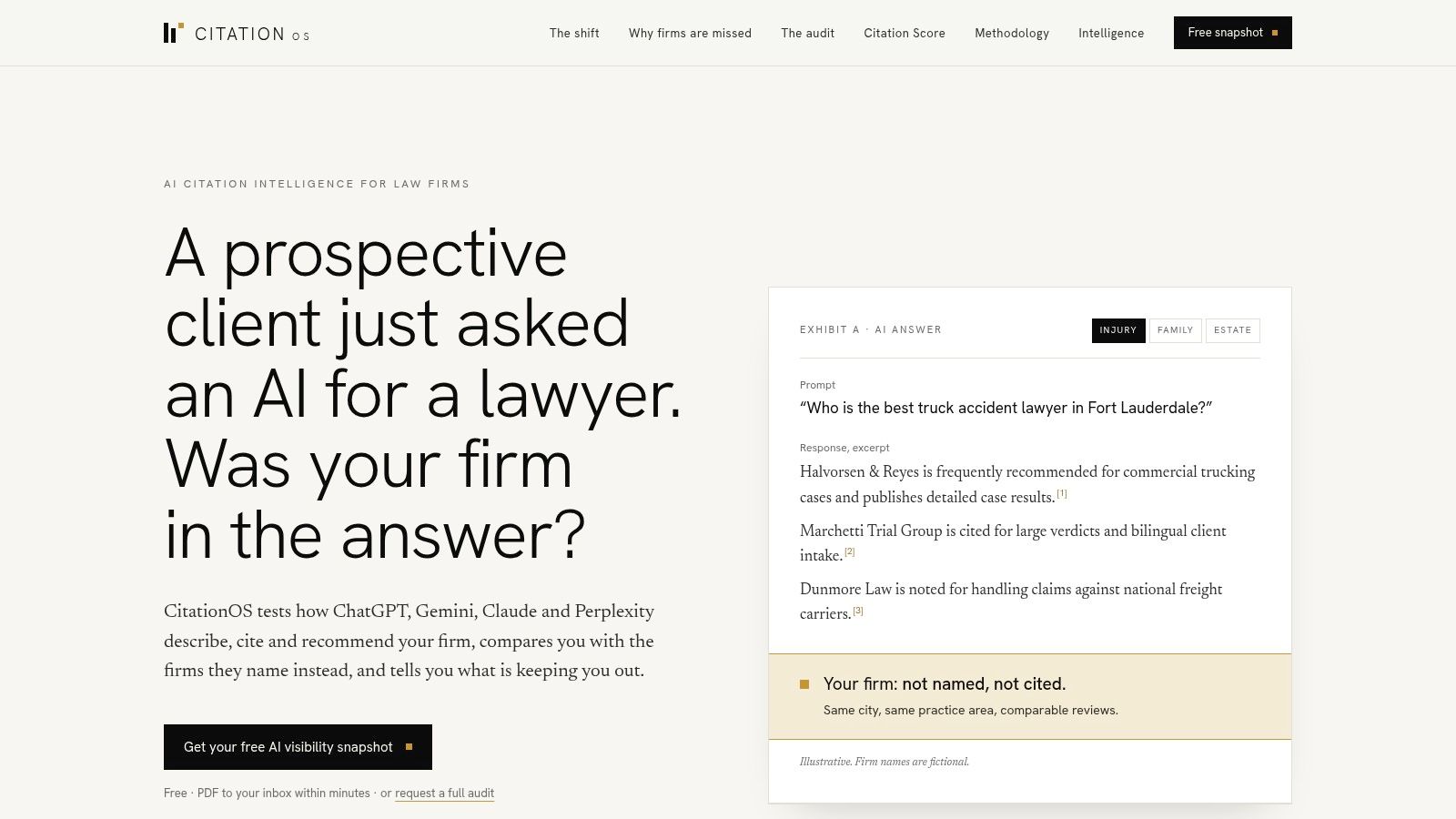
A practical diagnostic starts with a defined set of high-intent queries. For a query such as “best medical malpractice firms in Tampa,” record whether the firm is named, whether the answer identifies its medical malpractice work and Tampa market, and whether the system cites a Florida Bar profile or only the firm's own page. Record which firms appear in the leading recommendations, then compare the supporting evidence. A competitor can appear despite having a thinner public record if the system receives clearer or more consistent signals from available sources.
A structured AI brand monitoring program makes this process repeatable through a fixed query set, recorded responses, and cited evidence tracked across systems. The record should include the query date, answer text, named sources, detected inaccuracies, and the firm's position among recommendations. One generated answer is an observation, not proof of performance. Outputs vary with query wording, context, source availability, and time.
Treat fluent answers as outputs requiring verification
The Generative AI Risk Management Framework profile treats generative AI reliability as a measurement and risk-management problem. For law firms, appearing in an answer does not establish accurate representation. Fluent wording can conceal an incorrect practice area, jurisdiction, attorney association, or evidentiary basis.
Leadership should inspect five attributes separately:
- Name accuracy: Does the system identify the correct organization?
- Practice accuracy: Does it associate the firm with the intended matter types?
- Jurisdiction accuracy: Does it identify the relevant states, courts, or markets?
- Evidence quality: Do cited sources support the description?
- Competitive position: Does the firm appear among the leading options for valuable queries?
This monitoring layer exposes authority gaps that conventional dashboards miss. A firm may have strong local visibility but weak narrative depth, or a clear website alongside contradictory third-party records. The appropriate response may involve repairing entity records, improving service pages, strengthening biographies, or addressing missing external evidence.
AI recommendation intelligence completes the operating loop. SEO creates discovery. GEO and AEO improve extraction and comprehension. AVI-based measurement tests whether the resulting entity representation earns selection when a legal recommendation is formed.
Sustaining Competitive Advantage in Legal Markets
Law firm SEO has measurable commercial effects. legal marketing research reports that organic search can account for as much as 66% of call conversions in legal, with visitor-to-lead conversion around 7.4%. It also estimates about 14 months to break even, roughly 21% annual website-traffic growth, and an estimated 526% three-year return on investment for an average firm. These are directional U.S. estimates, not guarantees.
Durable advantage depends on accurate representation across search results, directories, reviews, and AI interfaces. Traffic can remain stable while recommendation authority declines. The risk appears at the Selection Moment, when an AI system forms a legal recommendation from the records it can retrieve and reconcile.
The operating cycle is straightforward:
- maintain consistent entity records;
- develop practice-area and jurisdictional depth;
- secure corroborating citations;
- improve extraction with GEO and AEO;
- measure AI selection and repair authority gaps.
Law firm SEO is an entity consistency discipline, not a keyword program. Organic rankings create discovery, while consistent evidence helps systems identify, interpret, and select the firm. Firms that leave records incomplete or contradictory make selection easier for other firms.
CitationOS provides confidential AI citation audits, representation analysis, competitive benchmarking, entity consistency assessment, and ongoing measurement across AI recommendation systems. Visit CitationOS to assess whether your firm is accurately represented and selected for relevant legal queries.