A prospect asking an AI assistant for a recommendation doesn't get a search results page. They get a shortlist, or they don't. That makes AI recommendation authority a binary outcome, and it's why AI brand monitoring tools now sit inside a selection problem, not just a visibility problem.
The market signal is already large enough to matter. The global AI-driven brand sentiment monitoring market was valued at $4.44 billion in 2025 and is projected to reach $14.76 billion by 2033, implying a 14.2% CAGR. Within that market, software accounted for 63.2% of revenue, North America held 41.2% of global share, and cloud deployment dominated at 74.1% (Dataintelo market analysis). That is not experimental spend. It's platform spend built around continuous monitoring.
| Comparison point | SEO-only monitoring | GEO and AEO monitoring | AI recommendation intelligence |
|---|---|---|---|
| What it sees | Discovery in web indexes | Extraction and interpretation in AI answers | Whether the system actually names, trusts, and recommends you |
| Core signal | Rankings and mentions | Citations, framing, and entity fit | Inclusion, shortlist position, and omission |
| Main blind spot | AI answer selection | Cross-system divergence | Why one assistant recommends a competitor |
| Executive use | Content visibility | Answer readiness | Decision readiness |
Table of Contents
- Introduction Why AI Recommendations Now Decide Brand Selection
- What AI Brand Monitoring Tools Actually Measure Today
- How to Evaluate AI Brand Monitoring Tools Without Surface Metrics
- Detailed Comparison of AI Brand Monitoring Tool Archetypes
- Use Cases That Determine Which Tool Fits Your Situation
- Implementing AI Brand Monitoring From Baseline to Ongoing Intelligence
- Recommendation Choosing the Right AI Brand Monitoring Approach
Introduction Why AI Recommendations Now Decide Brand Selection
A brand can be visible on the web and still be absent where the decision happens. In AI-generated answers, the model either includes the brand in the shortlist or leaves it out. There's no page-two recovery, no secondary click path, and no assumption that strong search presence automatically translates into recommendation presence.
That's why the category has changed. Traditional monitoring can tell you whether a name appeared in public conversation. AI recommendation intelligence asks a narrower question, whether the system surfaced the brand when a buyer asked for a decision. For legal, financial, medical, and luxury firms, that difference matters because the buyer's next step is often built from the AI answer itself, not a later browse session.
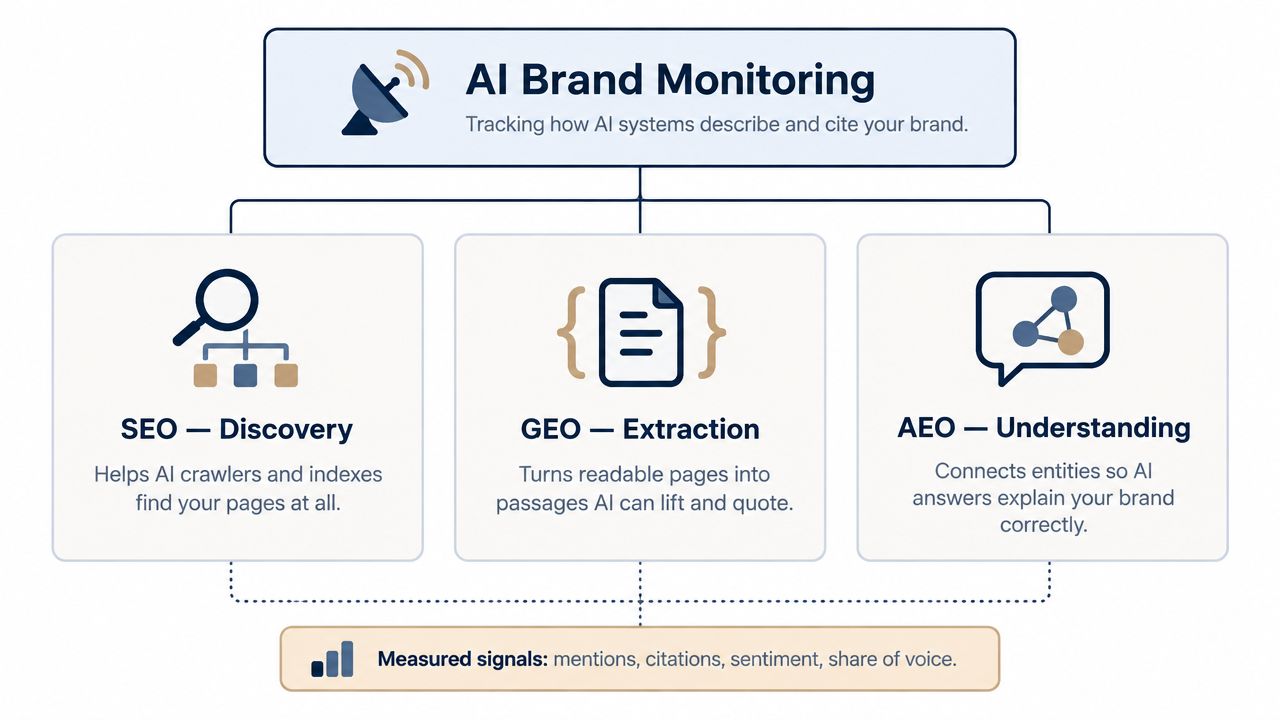
The practical implication is simple. SEO helps systems discover you. GEO and AEO help systems extract and understand you. AI recommendation intelligence measures whether systems trust and recommend you. The rest of this article uses that three-layer model because it separates visibility from selection, and selection is where the commercial outcome is decided.
Practical rule: if a tool can show mentions but can't show omission, it's only measuring half the problem.
Search demand confirms that AI answer engines are already large enough to warrant separate monitoring. A 2025/2026 visibility study reported ChatGPT at 49.37 million monthly U.S. searches and more than 326 million globally, while Perplexity exceeded 1 million monthly U.S. searches and 13 million globally (Global AI platforms search trends study). Those are not niche discovery volumes. They're material channels for shortlist formation.
What AI Brand Monitoring Tools Actually Measure Today
The cleanest way to evaluate the category is to separate three jobs. SEO helps systems discover your pages. GEO and AEO help systems extract and understand passages. AI recommendation intelligence measures whether the final answer chooses your entity. Those are related, but they're not interchangeable.
The publishing mechanics matter because AI systems don't rely on one shared evidence pool. A measurement study across ChatGPT, Google AI Overviews, Gemini, and Perplexity analyzed 602 controlled prompts and 21,143 valid search-layer citations. In that dataset, Perplexity triggered on 100% of prompts and cited a mean of 16.35 sources per prompt, while ChatGPT triggered on 98.64% of prompts and cited a mean of 6.88 sources per prompt (citation study). The same brand can therefore be present in one answer layer and diluted or absent in another.
The four layers serious workflows track
The best operating model tracks visibility, position, sentiment and framing, and citations and actions. Visibility answers whether the brand appears at all. Position shows whether it's first, buried, or absent from the shortlist. Sentiment and framing tell you whether the answer describes the brand as credible, weak, risky, or fit for the use case. Citations and actions tell you what source material the AI is relying on, and what pages need correction or reinforcement.
AI answers are more like evidence synthesis than keyword matching. If the source pool shifts, the recommendation can shift even when your site doesn't.
Visibility-only tools stop too early. They often show mention frequency or citation count, but they don't explain why the answer changed. A tool can tell you that a brand appeared less often this week. It can't necessarily tell you whether the problem is weak third-party corroboration, thin entity signals, or a source pool that favors a rival's framing. That diagnostic gap is the difference between monitoring and remediation.
The link below is a useful warning sign for buyers who only want surface metrics, because surface metrics are exactly where many tools stop: why surface-level AI tools understate the selection problem.
How to Evaluate AI Brand Monitoring Tools Without Surface Metrics
A useful evaluation starts with one question. Does the system measure citation presence, or only mention volume? Mention counts can rise while recommendation quality falls. That happens when an AI system cites a brand in a neutral or off-target context, or when it gives a competitor the stronger position in the buying scenario that matters.
The next check is whether the tool separates narrative depth from raw inclusion. A brand can appear in a one-line reference and still lose the recommendation. A stronger signal is when the system explains category fit, proof points, and decision context. If the tool cannot distinguish those cases, it is tracking noise, not authority.
Source patterns need the same scrutiny. Analysts found that only 11% of domains were cited by both ChatGPT and Perplexity, and another cited study showed a 46-times difference in brand citation rates between those platforms, with ChatGPT at 0.59% and Perplexity at 13.05% (cross-platform source overlap analysis). The conclusion is direct. Visibility is fragmented across systems, so one platform score can hide real exposure gaps. That is why why visibility-only scores create a false sense of coverage is a necessary check for buyers who rely on surface metrics.
What to demand in a demo
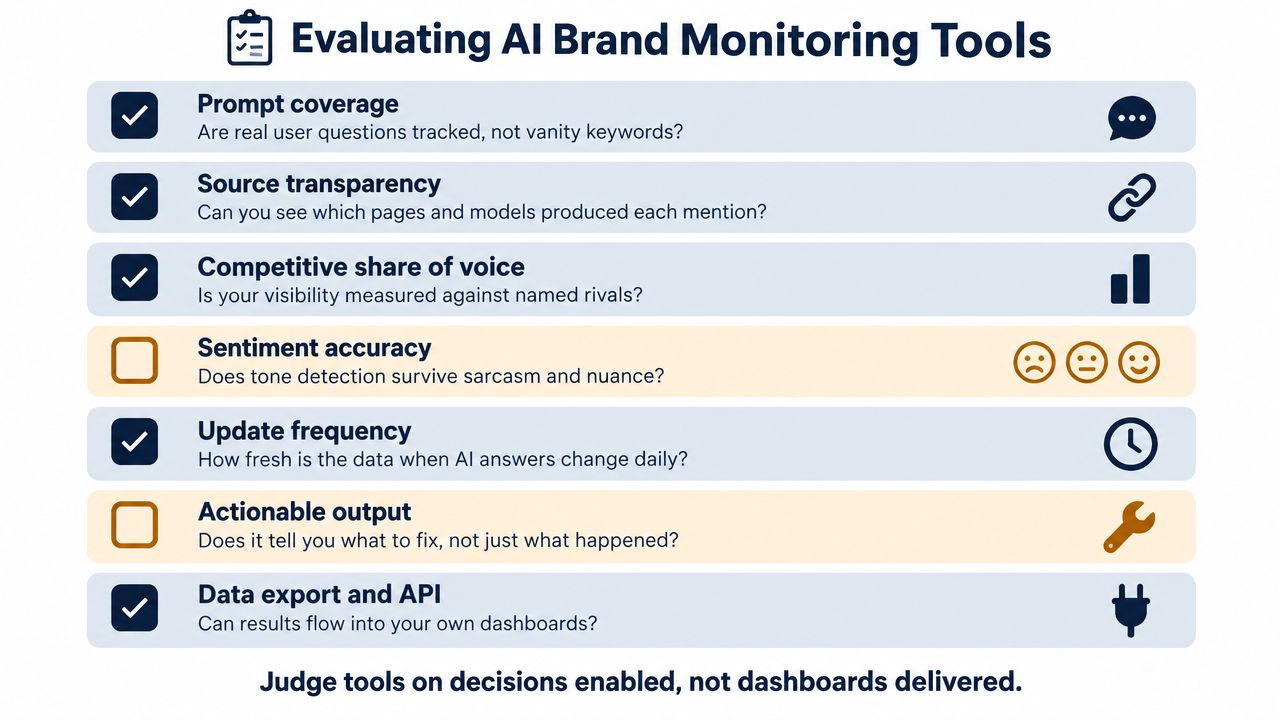
A serious evaluation should ask for prompt coverage, source transparency, competitive share of voice, sentiment accuracy, update frequency, actionable output, and data export and API. These checks show whether a system supports diagnosis or only observation. If it cannot show the prompt set, the source path, and the competitor frame side by side, it is not built for executive review.
Sentiment needs skepticism. Recent guidance notes that sentiment accuracy in AI monitoring trails traditional channels by 18 points. That does not make sentiment useless. It means tone labels should be treated as one input, not the decision layer. AI answers depend on context, and sarcasm, caution, and mixed framing can distort simple positive or negative tags.
Diagnostic rule: if the platform cannot explain why the metric moved, the metric is not actionable.
A useful internal benchmark is the AI Visibility Index (AVI) style of normalization. Different assistants cite different numbers of sources, weigh domains differently, and respond to different prompts. A normalized score helps leadership compare entities across systems without pretending those systems behave the same way.
Detailed Comparison of AI Brand Monitoring Tool Archetypes
| Archetype | Best For | AI Systems Covered | Diagnostic Depth | Limitation to Watch |
|---|---|---|---|---|
| Social listening led platforms | Teams that need always-on mention and sentiment tracking | Broad coverage of social and news ecosystems, with some AI visibility layers | Good for volume, sentiment, and trend monitoring | Often stops at observation and doesn't explain selection mechanics |
| AI answer monitoring specialists | Teams focused on how brands appear inside AI-generated answers | ChatGPT, Gemini, Perplexity, and similar answer engines | Strong on citations, position, and prompt-level inclusion | Can miss the wider source ecosystem that shapes answer quality |
| Intelligence and audit led approaches | High-trust firms that need diagnosis, benchmarking, and entity consistency assessment | Cross-system evaluation across leading AI assistants | Strong on cross-system comparison, authority gaps, and shortlist inclusion | Less suited to casual dashboard use when the goal is only routine tracking |
The most important distinction is not feature count, it's where the product stops. Social listening led platforms are useful when the job is continuous reputation tracking. They become insufficient when leadership wants to know whether the AI answer engine selected the brand in a high-intent query.
AI answer monitoring specialists sit closer to the decision layer. They are built around prompt testing, citations, and answer inclusion. Their strength is precision inside the AI layer. Their weakness is that they can underweight the upstream source environment that creates the answer in the first place.
Intelligence and audit led approaches are the right fit when the executive question is harder, and usually more expensive to answer incorrectly. They help isolate entity authority, competitive positioning, and consistency problems across systems. In the CitationOS model, that means a confidential audit, benchmarking, and structural diagnosis rather than passive tracking. I'm using it here as one option because the category needs a measurement-first design, not a marketing-first one.
A monitoring system is only useful if it changes a decision. If it doesn't alter content, sourcing, or positioning, it's reporting, not intelligence.
The 2026 comparison brief also found that the best all-in-one tool scored 71/100, while the best two-tool stack scored 93/100, and it argued that 78% of marketing teams still lack any AI monitoring capability. The takeaway isn't that every buyer needs two products. It's that a single product often leaves a measurable gap between observation and selection.
Use Cases That Determine Which Tool Fits Your Situation
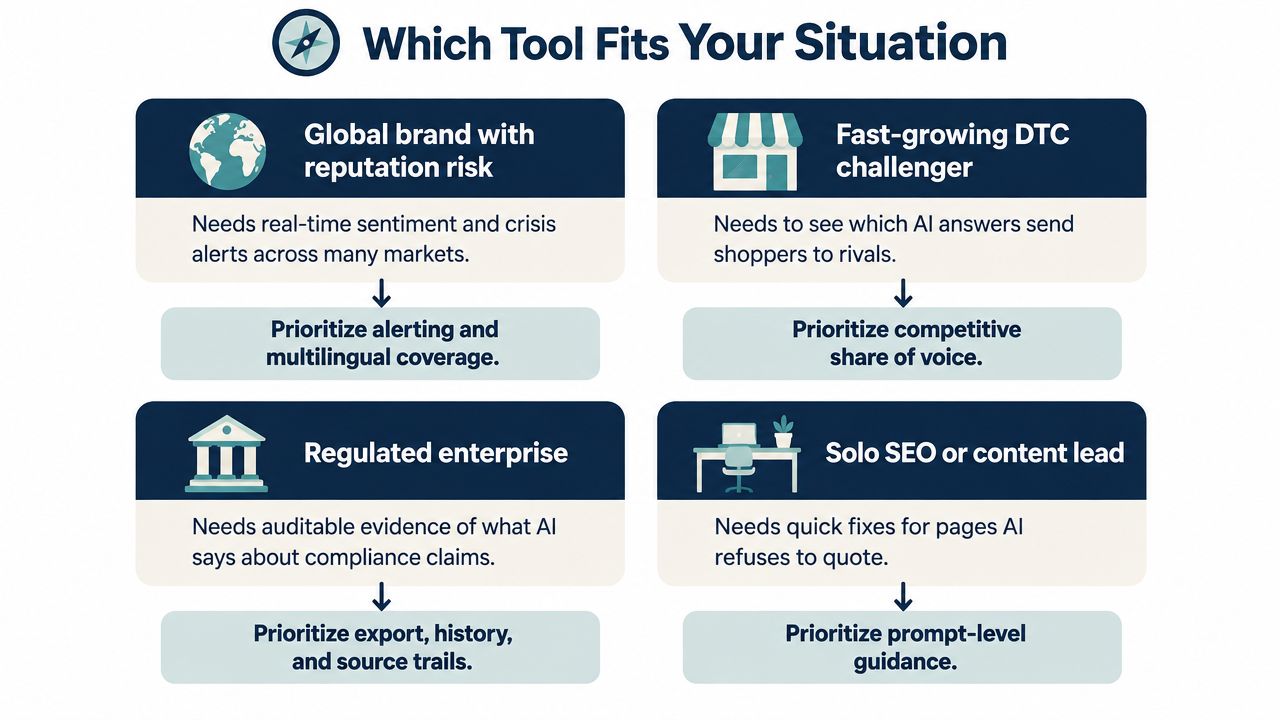
A global brand with reputation exposure needs the broadest coverage first. If the issue is consistency across markets, the priority is always-on ingestion, multilingual source coverage, and alerts that catch shifts before they harden into an answer pattern. Cloud-based monitoring fits this use case because the workflow depends on continuous scanning, not a one-time audit.
A regulated enterprise faces a different constraint. Its leadership needs auditable evidence of what AI says, where that wording came from, and whether the answer can be traced back to source material. In that setting, exportability, history, and source trails matter more than a colorful dashboard.
Four buyer contexts, four different priorities
A fast-growing consumer brand usually cares about competitive displacement. The question is which AI answers are sending buyers to rivals. A solo SEO or content lead has a narrower job, fixing pages that AI refuses to quote, which means prompt-level guidance matters more than enterprise-wide reporting.
A high-trust professional firm sits in the hardest category. It needs confidential benchmarking, entity consistency assessment, and a clean read on shortlist inclusion. The governing question is not whether the brand is visible. It's whether the AI system understands the firm well enough to recommend it in a category where trust is the product.
The right stack often means adding AI monitoring on top of social listening, not replacing it. That's the clean answer when a brand needs both reputation coverage and AI answer coverage. The tools serve different layers of the same problem, and the market data above shows why enterprises are already spending on platform-based monitoring rather than one-off services.
Implementing AI Brand Monitoring From Baseline to Ongoing Intelligence
Start with a cross-system baseline. Record how the brand appears in a fixed prompt set across the main assistants your buyers use, then preserve the results in a repeatable format. If you don't lock the prompt set, you can't tell whether a later shift came from the market or from your own testing changes.
Once the baseline exists, move to diagnosis. Separate the problem into source coverage, entity consistency, and citation quality. If the brand is absent, the issue may be discovery. If it appears but is framed weakly, the issue is usually extraction or interpretation. If it appears accurately but is still not recommended, the issue is selection.
A practical rollout sequence
- Baseline the current state. Capture where the brand appears today, alongside named rivals, so the team has a reference point.
- Stabilize the prompt set. Use real customer questions, not vanity keywords, because answer engines respond to intent patterns.
- Track on a recurring cadence. Continuous ingestion is the only way to see when answer behavior changes.
- Trace each drop. Link changes back to missing pages, weak entity signals, or the wrong sources.
- Fix the pages that matter. Update content structure, source references, and entity cues.
- Re-run the same prompts. A review cycle only works if it measures the same questions against the same competitors.
The recent market summary on social listening noted that 62% of marketers actively use these tools to guide strategy and measure ROI, while 55% expected to increase time and resources devoted to them (Talkwalker social listening market summary). That pattern matters here because the category scales fastest where monitoring feeds decision loops. The same logic applies to AI brand monitoring. If the data never reaches content, PR, or leadership action, the dashboard becomes decorative.
Operational standard: measure less, but make every metric point to a fix.
Recommendation Choosing the Right AI Brand Monitoring Approach
If your team only needs reputation coverage, a single platform can be enough. If you need both reputation coverage and AI answer coverage, stack the tools and keep the layers separate. The mistake is trying to force one product to do discovery, extraction, and selection at the same time.
For high-trust, high-competition firms, a diagnostic audit is often the right starting point. That's especially true when the question is why AI recommends a competitor while still naming your brand elsewhere. The selection problem needs cross-system citation intelligence, not just a broader dashboard.
The distinction is the one that matters most. SEO helps systems discover you. GEO helps systems extract and understand you. AI recommendation intelligence measures whether they trust and recommend you. The link below is useful because it frames that final step as a selection moment, which is exactly where executive judgment gets tested: the selection moment in AI visibility
If your leadership team can't see cross-system citation divergence, it's making resource decisions blind to the moment AI chooses one brand over another. That's the gap CitationOS is built to measure, through confidential audits, benchmarking, and the Citation Score framework. If you want to see how that applies to your own category, visit CitationOS and review how it diagnoses AI representation, shortlist inclusion, and authority gaps.