78% of the 116 law firms audited by CitationOS were invisible to AI recommendations. Entity authority is the degree to which AI systems can resolve, trust, and recommend a firm as a distinct entity.
That finding changes the question. The issue is not whether a firm appears online. The issue is whether an AI system can identify the firm cleanly enough to select it in a recommendation event.
The Blind Spot in Legal AI Visibility
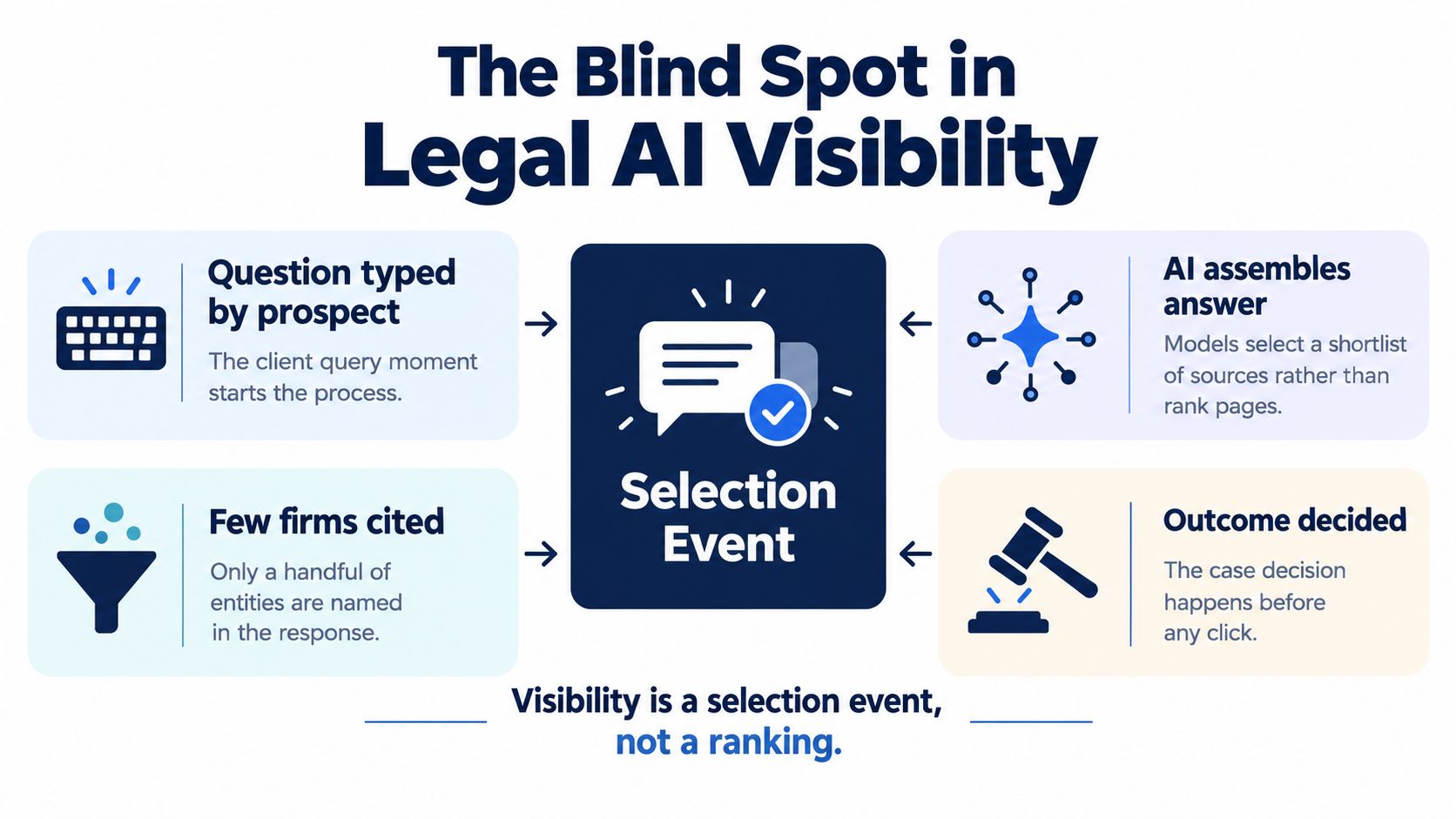
The selection point happens before a prospect clicks anything. A question gets typed, an AI system assembles an answer, and only a small number of firms are named. Everyone else is absent. That absence is not the same as poor search visibility, and it is not explained by traditional ranking alone.
CitationOS's audit of 116 firms found that 78% were invisible to AI recommendations despite having online visibility. That is a diagnostic clue, not a marketing slogan. It means the problem sits in the entity layer, where systems decide whether a firm is a coherent candidate for recommendation at all.
The visibility fallacy shows up when firms assume traffic, backlinks, or keyword rankings will transfer into AI inclusion. They often don't. AI systems do not need a page to be popular in the old sense. They need the firm to resolve as a stable, trusted entity with attributes that can be corroborated across sources.
Visibility and selection are different mechanisms
Traditional SEO helps systems discover you. GEO helps systems extract and understand you. AI recommendation intelligence measures whether the system trusts you enough to name you. That's a different outcome, and it depends on different signals.
Practical rule: If a firm is visible in search but absent in AI shortlists, treat it as an entity resolution failure first, not a content failure.
The operational implication is blunt. A firm can publish consistently, earn links, and still remain structurally unclear to retrieval systems. In legal markets, where names, offices, attorneys, and practice areas often fragment across pages and directories, that ambiguity suppresses recommendation eligibility.
How AI Systems Interpret Entity Signals
AI systems construct a firm's identity from distributed evidence. They compare structured data, external references, and naming patterns, then assess whether the resulting entity is coherent enough to cite or recommend. CitationOS treats this as a measurement problem: its diagnostic framework examines the gap between signals a firm publishes and the identity an AI system can resolve.
Schema.org markup provides a machine-readable layer for that analysis. In a 10 billion-page sample, 31.3% of pages contained Schema.org markup, compared with 22% one year earlier, and the study estimated that at least 12 million sites used it. Each marked-up page referenced an average of six entities and made 26 logical assertions among them. These relationships give systems structured material for interpreting identities and connections Schema.org usage statistics dataset.
The system looks for coherence, not volume
A firm name that changes across its website, directories, and publications creates identity friction. Systems need a consistent trail that connects Organization, Brand, and related attributes without ambiguity. A single authoritative page cannot establish that pattern. Repeated, compatible signals across sources do.
CitationOS's interpretation gap analysis shows how those distributed signals are reconciled before a firm can be cited. Its scoring methodology can quantify a condition legal marketers otherwise cannot observe directly: whether published evidence resolves into one recognizable entity.
Retrieval readiness also affects whether valid signals are usable at query time. Content should be discoverable, structured, and easy to parse. Clear headings, self-contained passages, and rendering that does not block extraction help systems identify and attribute relevant information retrieval readiness guidance.
The legal implication is structural
For law firms, the measurable question is whether one entity persists across office locations, attorney biographies, practice areas, and external references. Content volume alone cannot answer it. When those records diverge, AI systems have less basis for confident attribution, reducing the firm's eligibility for citation even when its material matches the query.
Primary Entity Signals and Data Sources
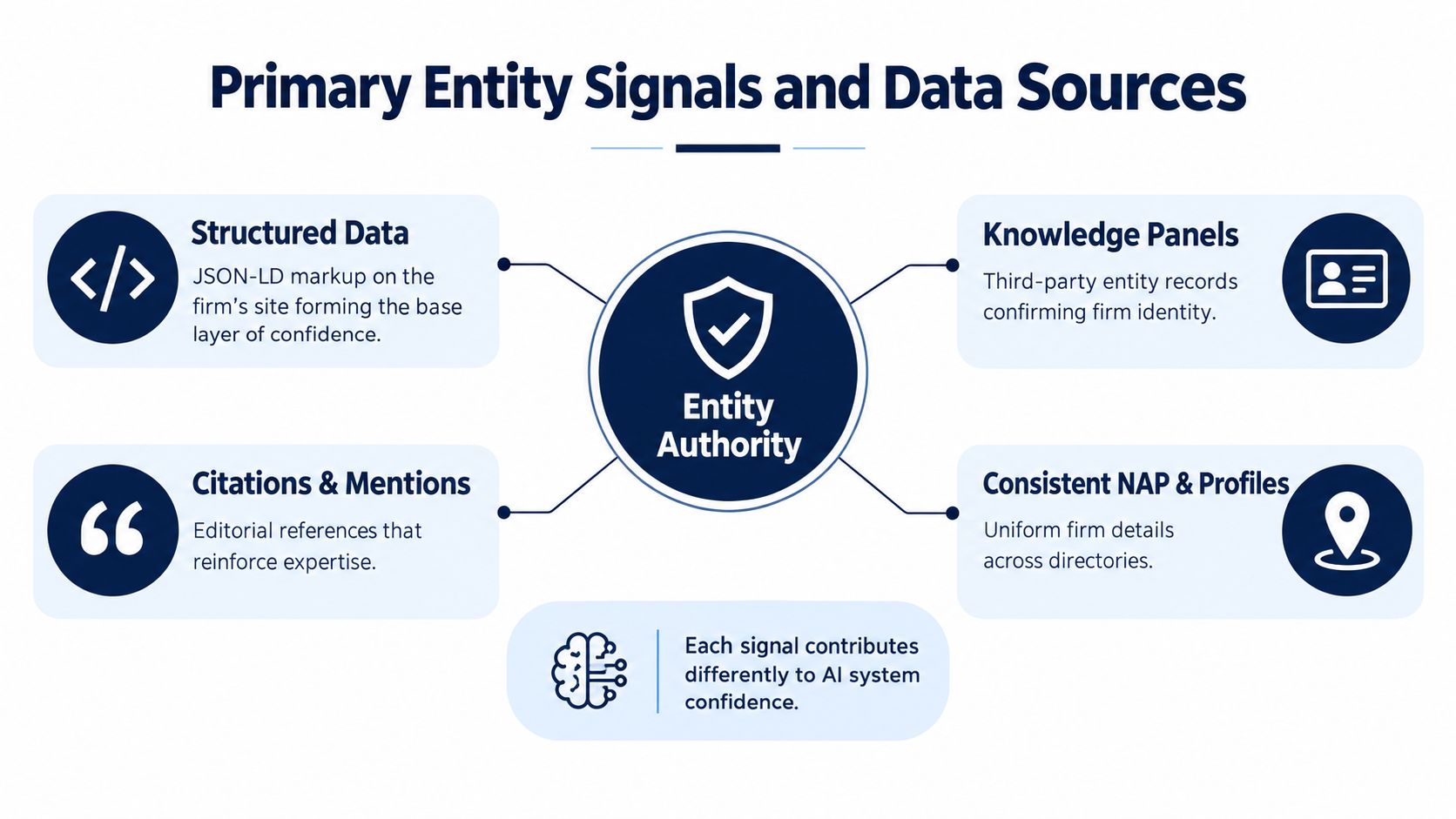
Entity authority is assembled from a small number of signal families, and each one contributes differently to system confidence. The mistake is to treat them as interchangeable. They are not. Some signals establish identity, others corroborate it, and others reduce ambiguity.
Structured identity is the base layer
On a firm's own site, JSON-LD markup identifies Organization, Person, and LegalService entities. That is the primary machine-readable declaration of who the firm is. If that layer is absent or inconsistent, every downstream signal has to work harder to compensate.
External profiles supply corroboration. Directory listings, bar repositories, and indexed publications help confirm that the same entity exists beyond the firm's own domain. Consistent naming, address formatting, and practice area taxonomy reduce interpretive friction across those sources.
Cross-source validation matters more than self-description
The strongest signals do not come from a single page. They come from agreement across sources. That includes knowledge graph recognition, consistent descriptors, and authoritative sameAs-style links that connect one identity to another without confusion entity authority in AI search.
Analyst note: The more a firm's public identity changes from channel to channel, the more work AI systems must do to reconcile it. Most of that work ends in caution, not recommendation.
This is why entity authority is better understood as a confirmation problem than a publishing problem. The system is asking whether the same firm, the same attorneys, and the same practice areas recur with enough stability to justify trust. Content helps, but only when it sits inside a coherent entity graph.
Measuring Entity Authority with Citation Scores
Without measurement, entity authority stays abstract. CitationOS uses a proprietary Citation Score framework to quantify AI inclusion, narrative strength, entity strength, and relative positioning across leading AI assistants. That matters because different firms can look strong in traditional SEO and still score near zero on AI recommendation readiness.
The four dimensions that matter
Citation presence asks whether the firm appears in AI-generated answers to high-intent legal queries. Narrative depth looks at how clearly the system describes the firm's capabilities and specializations. Entity strength evaluates how consistently the firm resolves across sources. Top-3 rate measures how often the firm lands in the shortlist rather than outside it.
Across 16 months of diagnostics, CitationOS found that traditional search performance did not guarantee AI inclusion. Firms with strong visibility in classic SEO could still present weak entity coherence, and when that happened, the AI system often had little confidence in naming them.
| Dimension | What it measures | Why it matters |
|---|---|---|
| Citation presence | Whether the firm is named in AI answers | Direct evidence of recommendation eligibility |
| Narrative depth | How fully the firm is described | Indicates whether the system understands the firm's role |
| Entity strength | How cleanly the identity resolves | Reduces ambiguity across sources |
| Top-3 rate | Shortlist inclusion frequency | Shows whether the firm is being selected, not just found |
A firm doesn't need more content first. It needs a measurable baseline that shows where recognition breaks. CitationOS methodology is one way to structure that baseline, because it treats AI interpretation as a scored system rather than a vague reputation effect.
What the score reveals in practice
The value of a score is not the number itself. It's the pattern behind it. Low citation presence with decent narrative depth suggests the system understands the firm but doesn't trust it enough to recommend it. Weak entity strength points to inconsistent identity signals. Low top-3 rate means the firm is being excluded at the decisive stage.
Entity Authority Audit Checklist for Law Firms
A useful audit starts with identity consistency. Check whether the firm name, address, phone number, and practice areas appear identically across the website, business profiles, directories, bar records, and any third-party citations. If those fields drift, entity resolution gets harder immediately.
Start with the identity layer
Look at the core facts first. The firm's name should not change by channel, and office locations should not be presented with conflicting formatting or partial variants. Attorney names also need consistent spelling and role attribution across bios, publications, and directory profiles.
Then inspect structured data. JSON-LD should be present on key pages, typed correctly, and free of obvious markup errors. The goal is not decoration, it's interpretability.
Check attribution and crawl access
Case results, verdicts, and publications should link unambiguously to the correct attorney or practice area. When attribution is fuzzy, the AI has to guess what belongs to whom, and guesswork weakens recommendation confidence.
If crawlers can't access or parse the entity-critical pages cleanly, the firm's authority signal won't survive the retrieval step.
A practical audit should also look for duplicate profiles, conflicting descriptions, and orphaned pages that mention the firm without reinforcing its core identity. Those are common places where entity coherence breaks down. The problem is rarely total absence. It is usually fragmentation.
Remediation Actions for Entity Authority Gaps
Fixing entity authority starts with coherence, not volume. More content can help only after the identity layer is stable. If the public record remains contradictory, additional publishing just multiplies the noise.

Resolve conflicts before adding new pages
The highest-priority action is to eliminate duplicate profiles, standardize naming and address formats, and remove contradictory descriptions across directories and publications. This is unglamorous work, but it directly improves the odds that AI systems will collapse multiple mentions into one trusted entity.
Next, strengthen structured data. Add detailed JSON-LD, type attorney and practice-area entities explicitly, and use sameAs links where there is a clear authoritative identifier. That gives the system a cleaner map of who the firm is and how its parts relate.
Then build corroboration outside the firm's site
Third-party references matter because they confirm that the identity survives beyond self-description. Indexed publications, legal directories, and verifiable case references all help reduce ambiguity. The point is not to create a larger footprint for its own sake. It's to make the footprint consistent enough to be trusted.
For firms using a measurement framework, each fix should be tied back to the scoring dimensions. If entity strength improves but citation presence doesn't, the issue may be visibility into the wrong query set. If narrative depth improves without shortlist inclusion, the system may understand the firm but still not trust it enough to recommend.
What Entity Authority Means for Law Firm Strategy
Entity authority is not a branding exercise. It is infrastructure, and it produces measurable outcomes. The firms that dominate AI recommendations are not necessarily the firms with the most content or the strongest historical SEO profile. They are the firms whose identity signals resolve cleanly enough for AI systems to recommend them with confidence.
That changes resource allocation. Before expanding content production, firms should prioritize entity consistency diagnostics, structured data implementation, and third-party reference building. Otherwise, they risk publishing more material into a broken signal layer.
The 78% invisibility rate from CitationOS audits should be read as diagnostic evidence, not as proof that the market is closed. It suggests that most firms have not yet built a machine-readable identity strong enough to survive AI selection.
One useful way to think about it is this. Traditional search rewarded discoverability. AI-mediated discovery rewards interpretability and trust at the point of recommendation. Firms that measure entity authority now will have an advantage as shortlist generation becomes a primary intake channel.
If you need to know whether your firm is recognizable to AI systems, CitationOS provides confidential audits, entity consistency assessment, and citation scoring that isolate where selection breaks down. Visit CitationOS to see how your firm's entity signals are being read, compared, and recommended across AI assistants.