
AI systems now influence whether a law firm enters a client's shortlist, yet 78% of firms remained invisible to AI recommendations in high-intent legal queries across 116 firms scored over 16 months of diagnostics. That finding changes what leadership should expect from a legal marketing consultant. A firm can publish consistently, rank for valuable terms, and still fail to appear when a prospective client asks an AI system which attorneys deserve consideration.
The hiring decision should therefore move beyond traffic acquisition. Executives need a partner who can measure AI recommendation authority, resolve inconsistent firm information, and identify whether generative systems describe the practice accurately enough to recommend it.
| Evaluation area | Conventional question | More useful executive question |
|---|---|---|
| Search visibility | Are our pages attracting organic traffic? | Are AI systems discovering, extracting, and using our information? |
| Content | Are we publishing enough practice-area material? | Does our content establish narrative depth for specific client decisions? |
| Authority | Do we have strong rankings and links? | Is our entity consistently represented across sources AI systems rely on? |
| Reporting | How many leads did marketing generate? | How often do we appear in relevant AI shortlists, and at what position? |
| Strategy | Which keywords should we target? | Which authority gaps prevent recommendation in high-intent queries? |
The Shift in Legal Client Acquisition
The 78% invisibility rate is not a minor reporting issue. It indicates that traditional search presence and AI recommendation presence can diverge materially. A firm may be visible when a user enters a keyword into a conventional search engine but absent when that same user asks an AI assistant to identify a suitable attorney for a defined case type and jurisdiction.
That distinction matters because high-value legal clients rarely make decisions from one isolated page. They compare expertise, location, case relevance, professional identity, credibility signals, and perceived fit. AI systems compress that evaluation into an answer, shortlist, or recommendation. A consultant who reports only rankings and sessions is measuring the discovery layer while leaving the selection layer unexamined.
The visibility fallacy in legal marketing is the assumption that being findable automatically means being chosen. It doesn't. Discovery creates an opportunity for evaluation. Recommendation requires the system to interpret the firm as relevant, credible, and sufficiently specific for the decision at hand.
Traffic is an incomplete proxy for shortlist inclusion
Organic traffic still has a role. Google's guidance confirms that generative search features depend on publicly accessible, crawlable content, with clear technical structure and unique, valuable information providing the foundation for later processing. But crawlability is a prerequisite, not evidence that an AI system will cite or recommend a firm. Google's AI search guidance supports that separation.
A legal marketing consultant should explain what happens after discovery. Can the system identify the firm's practice focus? Can it distinguish one attorney from another with a similar name? Can it associate the firm with the relevant city, courts, counties, and case categories? If the answer is unclear, more traffic may create more unmeasured exposure.
The consultant's mandate has moved upward
The modern mandate is not to abandon SEO. It is to place SEO in its proper position within a larger diagnostic model.
SEO helps systems discover you. GEO helps systems extract and understand you. AI recommendation intelligence measures whether systems trust and recommend you.
This is a structural change in the role of the legal marketing consultant. The consultant must connect technical discoverability with entity authority, narrative depth, citation presence, and recommendation outcomes. A report that celebrates page-one rankings without testing AI inclusion gives leadership only part of the market picture.
Practical rule: Treat organic visibility as evidence that a firm can be found, not proof that it will be selected.
Defining the Modern Consultant Scope
A modern consultant should separate three activities that agencies often blend together. Search engine optimization, or SEO, makes content accessible and understandable to conventional search systems. Generative engine optimization, or GEO, improves the likelihood that AI systems can extract, summarize, and associate information with the correct firm. AI recommendation intelligence tests the final outcome, whether those systems cite, mention, or recommend the practice.
Search Engine Land defines generative engine optimization as positioning a brand so AI platforms cite or recommend it. The definition rests on content strategy, brand presence, technical optimization, and reputation building. Those mechanics are useful, but they still describe preparation. Leadership also needs a measurement discipline for the recommendation event itself.
The three layers produce different evidence
SEO evidence includes crawlability, indexation, technical structure, and conventional rankings. GEO evidence includes extractable answers, clear relationships between entities, and content that addresses a defined decision context. AI recommendation intelligence examines citation presence, the wording used to describe the firm, the consistency of its attributes, and its inclusion relative to competitors.
Entity authority becomes operational. A firm's name, attorneys, office locations, practice areas, certifications, courts, and case types must align across the public sources that inform AI-generated answers. Contradictions create interpretive ambiguity. Generic descriptions create weak relevance. Thin biographies limit the system's ability to construct a precise recommendation.
Narrative depth is equally important. A firm that says it handles business disputes may be less intelligible than one whose public information clearly explains the dispute categories, industries served, jurisdictions covered, and attorney experience relevant to those matters. Narrative depth doesn't mean producing longer pages for their own sake. It means supplying enough connected evidence for a system to form a defensible description.
Recommendation authority is not another ranking report
A ranking report asks where a page appears for a query. An AI recommendation report asks whether the firm enters the answer, how prominently it appears, what attributes the system assigns to it, and whether the representation remains stable across systems and prompts.
The distinction also applies to answer engine optimization, or AEO. AEO can help structure responses for systems that answer direct questions. GEO broadens the work to discovery, extraction, brand presence, technical access, and reputation. AI recommendation intelligence evaluates whether those efforts produce inclusion in the client's actual decision context.
A consultant who understands this scope won't promise that content changes can control an AI response. The appropriate standard is measurement, diagnosis, and correction of the public signals that influence interpretation. That approach is more defensible for legal leadership because it distinguishes controllable inputs from probabilistic outcomes.
Core Diagnostic Services to Demand
A serious engagement should begin with a confidential baseline, not a content calendar. Leadership needs to know how the firm appears in high-intent prompts before approving a program designed to improve its representation.
The 2026 benchmark examined 1,000 legal consumer prompts across Perplexity, ChatGPT, Gemini, and Grok, using fixed prompt sets based on practice areas and jurisdiction to measure AI inclusion. The benchmark methodology illustrates the central requirement: test realistic client questions across multiple systems instead of relying on one generic brand query.
Begin with prompt-based citation auditing
A confidential AI citation audit should use prompts tied to the firm's actual case categories, geography, and competitive environment. The output should record whether the firm appears, whether it enters a top-three position, which sources support the answer, and how the system describes its qualifications.
The AI Visibility Index, or AVI, can serve as an executive measurement layer when it is defined clearly and applied consistently. It should not be treated as a decorative score. Leadership should understand which underlying dimensions influence it, including citation presence, narrative depth, entity strength, and relative recommendation position.
The top-3 rate adds decision context. A firm that appears occasionally but rarely in the leading recommendations has a different problem from a firm that is absent altogether. Both require action, but one may need stronger authority signals while the other may first need entity correction and clearer practice-area coverage.
Test representation, not only inclusion
An inclusion audit answers whether the firm appeared. An AI representation analysis answers what the system thinks the firm is. The consultant should record whether the answer correctly identifies the firm's attorneys, locations, case types, board certifications, and relevant courts.
An entity consistency assessment then traces those attributes across authoritative public sources. The purpose isn't to make every page identical. It is to remove contradictions that could cause an AI system to merge entities, omit relevant qualifications, or categorize the firm too broadly.
Benchmark the competitive field
Competitive positioning requires named competitors and matched prompts. The consultant should compare citation presence, narrative depth, top-3 rate, and the specific attributes that appear in recommendations. This shows whether the firm has a general visibility problem or a narrower authority gap in a particular practice, city, or case category.
The report should separate observations from recommendations. “The firm was not mentioned” is an observation. “The firm lacks publicly consistent evidence connecting its attorneys to a defined category of commercial disputes in a named jurisdiction” is a structural diagnosis.
A useful audit doesn't merely count mentions. It explains why the system had enough confidence to recommend one firm and not another.
Aligning Spend with AI Discovery Behavior
A legal marketing consultant should connect budget decisions to business economics, not just channel activity. A campaign that generates inquiries but fails to distinguish qualified matters, accepted engagements, realization, and collection can make weak acquisition look productive.
For small and midsize firms, a working marketing-spend range of 4% to 7% of revenue is cited in legal-firm benchmarks, alongside downstream operating measures such as realization and collection. The legal performance benchmark source gives leadership a useful principle: promotional investment should be evaluated against cash conversion, not lead volume alone.
That principle becomes more important when AI referrals enter the mix. Across 50 UK law firm websites, LLM referral traffic converted at 22.19%, compared with 2.63% for traditional organic search, according to AI discovery analysis for law firms. The figures shouldn't be copied into a forecast for every firm. They do show why AI-referred visits need their own source classification and conversion analysis.
Evaluate the budget by decision quality
A consultant's proposal should identify which work addresses discovery, which improves extraction, and which measures recommendation authority. Those categories shouldn't be bundled into one vague “AI visibility” line item.
A technically strong program may still be financially weak if it produces content without testing whether systems use it. Conversely, a diagnostic engagement may produce limited immediate traffic while revealing that the firm's public identity is inconsistent across important sources. Leadership should judge that work by the quality of the decision it enables.
| Evaluation category | Traditional agency focus | AI intelligence partner focus |
|---|---|---|
| Visibility | Rankings, impressions, and sessions | Citation presence and recommendation inclusion |
| Content | Publishing frequency and keyword coverage | Narrative depth and extractable entity relationships |
| Competition | Share of search and backlink comparisons | Relative top-3 rate and authority gaps |
| Conversion | Form fills and tracked calls | AI referral quality, matter fit, and downstream value |
| Reporting | Monthly channel summaries | Cross-system diagnostics tied to prompts and outcomes |
| Technology | Tool access and automated production | Measurement integrity, source comparison, and interpretation |
Technology adoption also belongs in the review. A 2025 ecosystem review found ranked firms used marketing technology more than unranked firms across almost every category, while AI use expanded across social media, content creation, and internal processes. The review documented particularly steep growth in accessibility software, content syndication, and public relations tools between 2024 and 2025. The legal marketing technology ecosystem review supports a practical conclusion: a consultant must assess the firm's measurement maturity and workflow integration, not merely recommend more software.
Don't approve a fee structure that rewards production while leaving recommendation outcomes unmeasured. For a deeper distinction between surface reporting and actual AI measurement, review what surface-level AI tools measure.
Interview Questions for Structural Competence
A consultant can sound current while applying an old reporting model. Executives should test the candidate with questions that require a mechanism, a measurement method, and an interpretation standard.
Ask: “How would you distinguish crawlability from recommendation authority?” A competent answer should identify crawlability as a prerequisite for processing, then explain how extraction, entity clarity, citation presence, and prompt-level inclusion are evaluated separately. Google's guidance on generative AI search confirms that publicly accessible, crawlable content comes first. It doesn't establish that crawlable content will be recommended.
Ask: “What does a high AI Visibility Index contain?” Reject an unexplained composite score. The candidate should identify the dimensions, state how they are sampled, and show how the score changes when a firm appears in a leading recommendation but is described inaccurately.
Ask: “How do you measure the top-3 rate?” The answer should refer to fixed, realistic prompts across practice areas and jurisdictions. It should also explain whether the consultant records system differences and distinguishes first-party mentions from citations supported by external sources.
Test the candidate's handling of ambiguity
Ask: “What happens when two public sources describe our attorneys differently?” The consultant should discuss entity consistency, source quality, dates, location, practice terminology, and the risk of merging or separating identities incorrectly.
Then ask: “How would you diagnose a firm that appears for broad legal queries but disappears for a specific case type?” A superficial provider will suggest more articles. A structurally competent partner will examine whether the firm has enough public evidence connecting its attorneys, experience, jurisdiction, and case category to that decision context.
Require a falsifiable reporting method
Ask the candidate to define success without promising control over an AI system. The answer should include a baseline, a fixed prompt set, repeatable sampling, cross-system comparison, and a record of how the firm is represented.
Ask for a sample report with sensitive information removed. Look for direct observations, source references, entity conflicts, narrative gaps, competitor comparisons, and recommended corrections. Be cautious if the report contains only screenshots, generic visibility scores, or a list of generated articles.
The right interview question is not “Can you optimize for AI?” It is “What evidence would prove that our recommendation authority changed?”
A final test is governance. Ask how the consultant handles confidential firm data, attorney advertising requirements, client information, and human review. Legal marketing requires judgment about accuracy and professional responsibility. Automation can assist research and drafting, but it can't replace the firm's review of claims, tone, and compliance.
The Final Evaluation Checklist
Before signing, leadership should require a written delivery model. The model should state what the consultant will test, which systems and prompts will be included, how often results will be reviewed, and which recommendations belong to technical teams, attorneys, or firm leadership.
A credible engagement usually has two distinct outputs. The first is a time-bound diagnostic that establishes the firm's current representation and competitive position. The second is an ongoing monitoring process that shows whether citation presence, narrative depth, entity consistency, and top-3 rate are changing.
Score the method before the promise
Use a simple internal matrix, but score evidence rather than presentation quality.
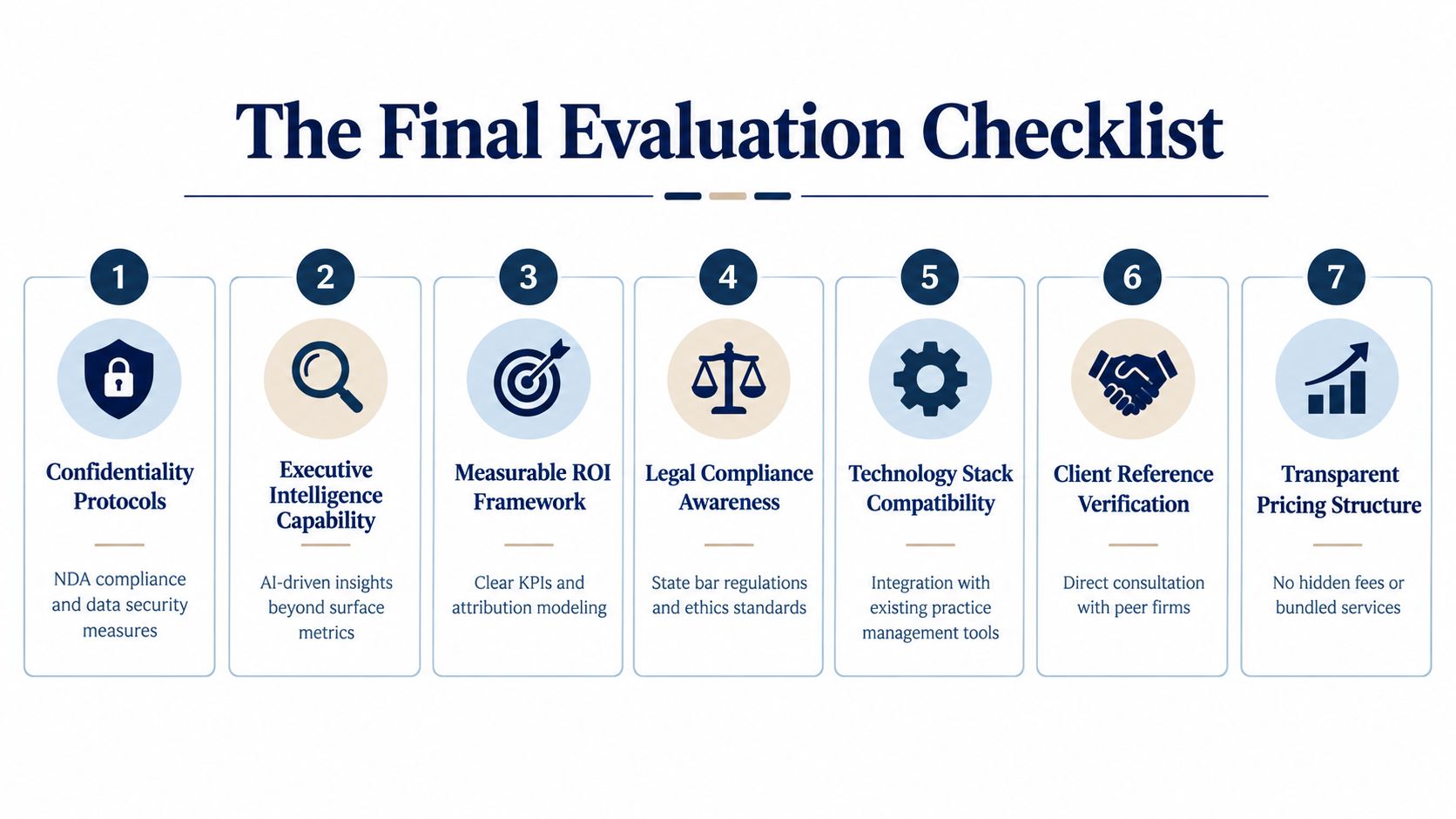
| Verification point | Evidence leadership should request |
|---|---|
| Confidentiality | Private reporting process, data handling rules, and clear limits on shared information |
| Executive intelligence | Analysis that explains selection outcomes beyond traffic and rankings |
| Measurable ROI | Defined AVI, citation presence, top-3 rate, referral quality, and matter-value measures |
| Legal compliance | Review procedures for attorney advertising and professional responsibility concerns |
| Technology compatibility | Clear integration with existing reporting, intake, and practice-management workflows |
| Reference verification | Direct, relevant references able to discuss methodology and delivery |
| Pricing transparency | Separate costs for audit, implementation, monitoring, and optional production work |
The consultant should also explain how cross-system differences will be handled. A firm may receive a strong representation in one assistant and a weak or incomplete representation in another. That variation isn't a reporting nuisance. It can reveal inconsistent source interpretation or different authority pathways.
Separate diagnosis from implementation
A firm shouldn't select a consultant solely because the consultant can produce content. First determine whether the provider can explain the absence, weakness, or inconsistency that content is meant to correct.
The evaluation should ask for a clear chain of reasoning: prompt outcome, observed representation, supporting sources, authority gap, corrective action, and follow-up measurement. Without that chain, leadership can't tell whether a recommendation addresses a causal weakness or only reflects a familiar marketing tactic.
The referral evidence reinforces the need for separate benchmarking. The analysis of 50 UK law firm websites found a materially different conversion pattern for LLM referrals and traditional organic search, so a consultant should report those channels independently rather than blending them into one acquisition figure. The specific result is documented in the law-firm AI discovery report.
Choose the provider that can tell leadership what it knows, what it infers, and what remains uncertain. That standard is more valuable than a polished dashboard with no diagnostic depth.
The Implication of Selection
Selecting a legal marketing consultant now determines more than the firm's search visibility. It determines whether leadership can see how external systems interpret the firm at the point when a prospective client asks for a recommendation.
AI systems don't inherit the firm's internal view of its expertise. They assemble representations from publicly available information, then use those representations to answer a specific prompt. If the firm's public identity is fragmented, broad, or poorly connected to a case category, the system may produce an incomplete answer even when the lawyers consider their positioning obvious.
That is why entity consistency is not a cosmetic brand exercise. It affects whether a system connects the right attorneys to the right practice, location, qualification, and decision context. Citation presence then shows whether external evidence supports that interpretation. Narrative depth determines whether the system has enough detail to explain why the firm belongs in the shortlist.
The binary moment is measurable
The selection moment in AI-mediated discovery is the point at which a user moves from asking for information to asking which provider should be considered. Traditional analytics often record what happened after the click. AI recommendation intelligence examines the decision before the click, including which firms were named, how they were described, and which evidence supported the answer.
That creates a sharper management question. Instead of asking whether the firm has produced enough marketing activity, leadership can ask whether the firm is structurally legible to the systems that shape client shortlists.
The right consultant won't claim to control an AI response. The consultant will establish a repeatable measurement framework, locate authority gaps, improve the clarity of the firm's public representation, and track recommendation outcomes across relevant systems. This is a discipline of diagnosis, not a promise of guaranteed placement.
The selection criteria are therefore clear. Hire a partner that understands SEO as discoverability, GEO as extractability, and AI recommendation intelligence as the measurement of trust and selection. Firms that make that distinction can allocate resources to the actual point of competitive separation. Firms that don't may continue optimizing visible activity while remaining absent from the answer that matters.
CitationOS provides confidential AI citation audits, competitive benchmarking, entity consistency assessments, and structural diagnosis of how law firms are represented and recommended in high-intent AI queries. Review the CitationOS platform to establish a measurable baseline for AI recommendation authority and determine where your firm's public signals are limiting shortlist inclusion.