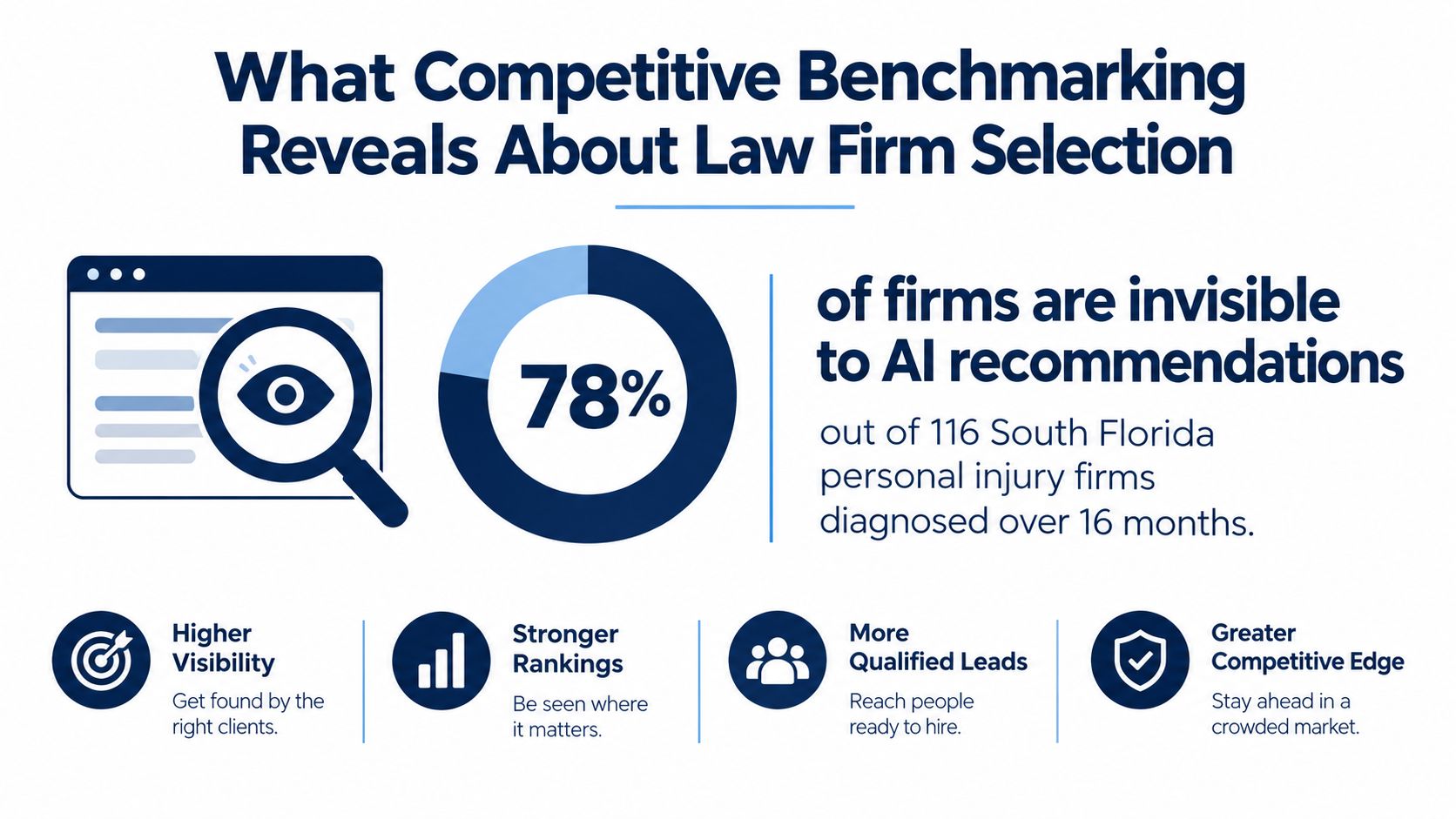
Across a 16-month diagnostic period, CitationOS scored 116 South Florida personal injury firms and found that 78% were invisible to AI recommendations despite strong traditional SEO signals. That is what competitive benchmarking now has to measure, not just whether a firm can be found, but whether it gets selected.
Competitive benchmarking started as a way to expose measurable gaps. In law, the gap has moved deeper, from search visibility to AI recommendation authority. Firms can still look strong in conventional reports and still miss the shortlist when a system is asked which lawyers it trusts enough to cite, describe, and recommend.
What Competitive Benchmarking Reveals About Law Firm Selection
78% of the 116 South Florida personal injury firms measured over 16 months were invisible to AI recommendations, despite showing traditional SEO signals associated with competitive performance. The finding changes the question benchmarking must answer. A firm can appear strong in search reports and still fail to enter the shortlist generated by an AI system.
Traffic, rankings, and backlink counts measure exposure to search engines. They do not establish whether ChatGPT, Gemini, or Perplexity can identify a firm, describe its capabilities accurately, cite it as an authority, or include it in a recommendation set. Those outcomes depend on the selection layer, where entity clarity, corroborated information, and trust signals influence which firms systems retrieve and present.
The metric that changes the question
Benchmarking developed from measurable operational failure. Xerox turned the practice into a management discipline after its copier market share fell from 86% in 1974 to 17% by 1984, while profits declined from about $1 billion to $290 million over the same period. The company also found that competitors' manufacturing costs were only 40% to 50% of its own, as documented in this history of competitive benchmarking. The lesson is precise comparison against a relevant reference group, followed by action on the measured gap.
Law firms require the same discipline at a different performance layer. The relevant benchmark asks whether comparable firms are consistently represented in AI-generated answers, whether their practice descriptions remain accurate, and whether recommendation systems associate them with the matters they want to win.
Practical rule: Benchmark search visibility and AI selection separately. Combining them hides the gap that determines whether a firm reaches the shortlist.
A firm may therefore have strong conventional visibility while remaining absent from AI-mediated decisions. Selection-layer representation makes that distinction operational: analysts can compare citation frequency, description accuracy, and shortlist inclusion across systems and peer firms. The result is a benchmark tied to selection outcomes rather than a monthly report's surface indicators.
The Methodology Behind Meaningful Competitive Benchmarking
Competitive benchmarking became useful when management replaced broad comparisons with a repeatable review of specific operations against named peers. Xerox's experience established the principle: a benchmark must identify the performance gap, isolate its cause, and connect the finding to a management decision.
Peer sets and normalization decide whether the answer is real
A serious framework begins with a defined peer set. Include direct rivals with similar practice areas, client profiles, and geographic reach, then add a small number of best-in-class analogs where they reveal a credible performance standard. The comparison becomes unreliable when one firm serves enterprise clients, another handles smaller matters, or demand varies sharply by market.
Normalization addresses those differences before analysts interpret the results. Adjust the comparison for segment, geography, currency, seasonality, service mix, and acquisition channel. Without those controls, a firm may appear stronger because it operates in a narrower category or a less demanding market.
The same discipline applies to AI selection benchmarking. A law firm should compare whether systems cite it for relevant matters, describe its capabilities accurately, and include it in recommendation shortlists. Traditional search visibility remains a separate measurement layer. Combining the two obscures the point at which a firm becomes eligible for recommendation.
The useful benchmark is a gap, not a label
Strong frameworks decompose performance into drivers. A KPI tree connects outcomes such as revenue, market share, conversion, retention, pricing, and digital engagement to the mechanisms producing them. These measures should remain distinct because each indicates a different competitive condition (driver-based benchmarking logic).
For legal services, low share may reflect weak awareness, poor conversion, inaccurate positioning, or unfavorable pricing. Each cause requires a different response. A single composite score conceals that distinction.
Analysts can then express relative position through quartiles or deciles and translate the gap into an improvement target. Benchmarking methodology notes support this structured approach. The output is a management system: it shows where the firm stands, why the gap exists, and which measurable condition should change.
Traditional Benchmarking Versus AI Citation Benchmarking
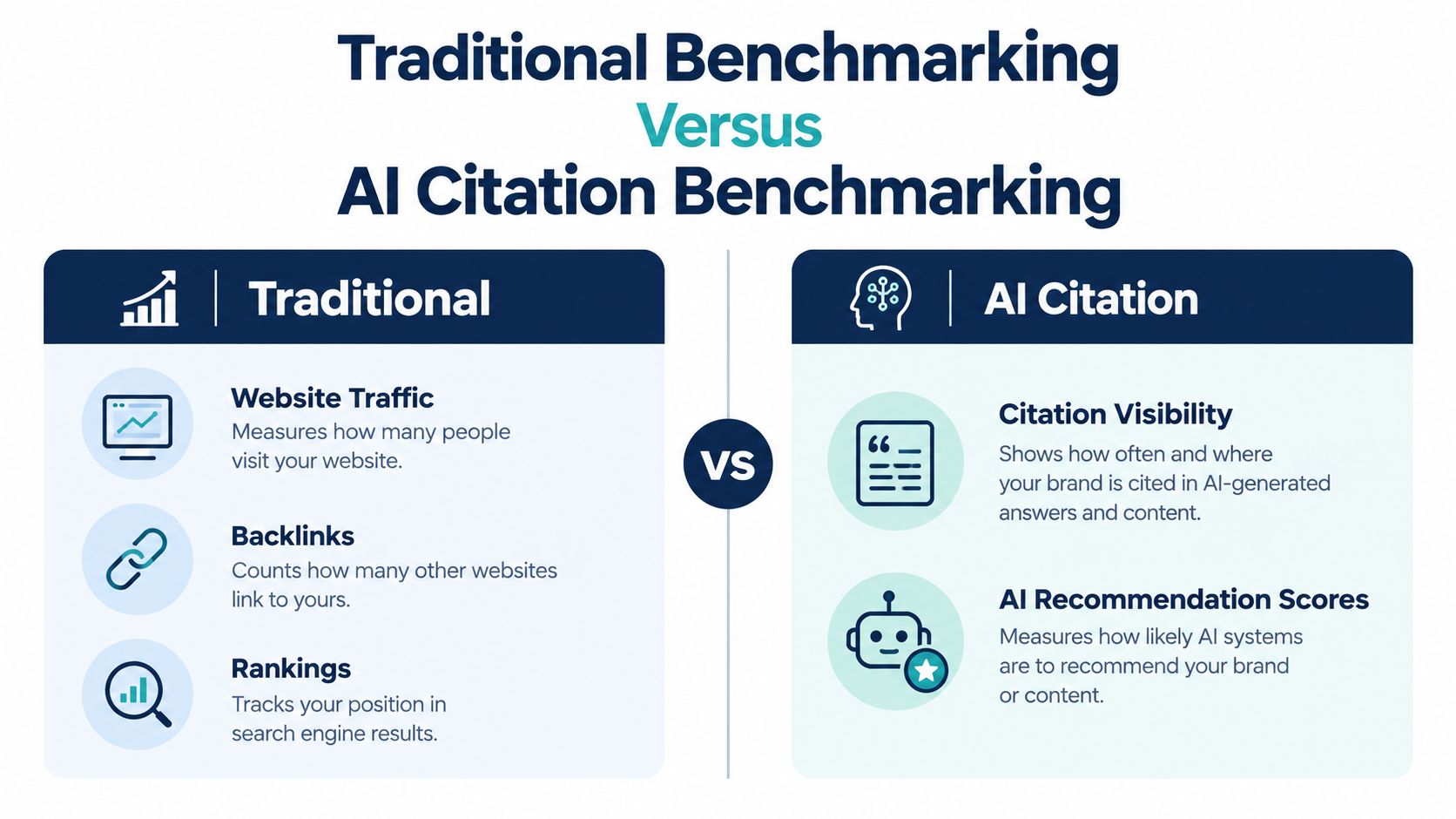
Traditional benchmarking still matters, but it answers a narrower question. It compares website traffic, backlinks, rankings, share of voice, and similar search-era signals. Those metrics show how discoverable a firm is inside the search layer, not whether it is trusted enough to be recommended.
AI citation benchmarking asks a different set of questions. Does the firm appear in the answer at all, does the system describe it with useful depth, and does it reach the leading recommendation positions across relevant prompts. CitationOS defines those operating signals as citation presence, narrative depth, and top-3 rate (AI visibility framework).
The same firm can win one layer and lose the next
That split is the point. A firm can perform well in traditional SEO benchmarking and still be absent from AI shortlists, which is exactly what the 78% invisibility finding demonstrates. Search visibility and selection visibility are related, but they are not interchangeable.
A firm that is easy to find is not automatically easy to recommend.
The modern benchmark changes from channel performance to interpretation quality here. AI systems do not just index pages. They assemble an answer, decide whether the firm is a relevant entity, and weigh whether the description is complete enough to include in a shortlist.
Why the selection layer changes executive priorities
For senior leaders, the practical consequence is direct. If benchmarking stops at search metrics, the firm may keep improving signals that no longer control recommendation outcomes. AI citation benchmarking forces attention onto the representation layer, where entity clarity, consistency, and narrative depth determine whether the firm is included, described accurately, and ranked near the top.
The old benchmark told firms whether they were visible. The new one tells them whether they are recommendable.
How to Build a Competitive Benchmarking Framework for Your Firm
A workable framework starts with discipline, not volume. The first step is to define the peer set, and the second is to decide which metrics are truly comparable. If those two choices are weak, the rest of the analysis becomes decoration.
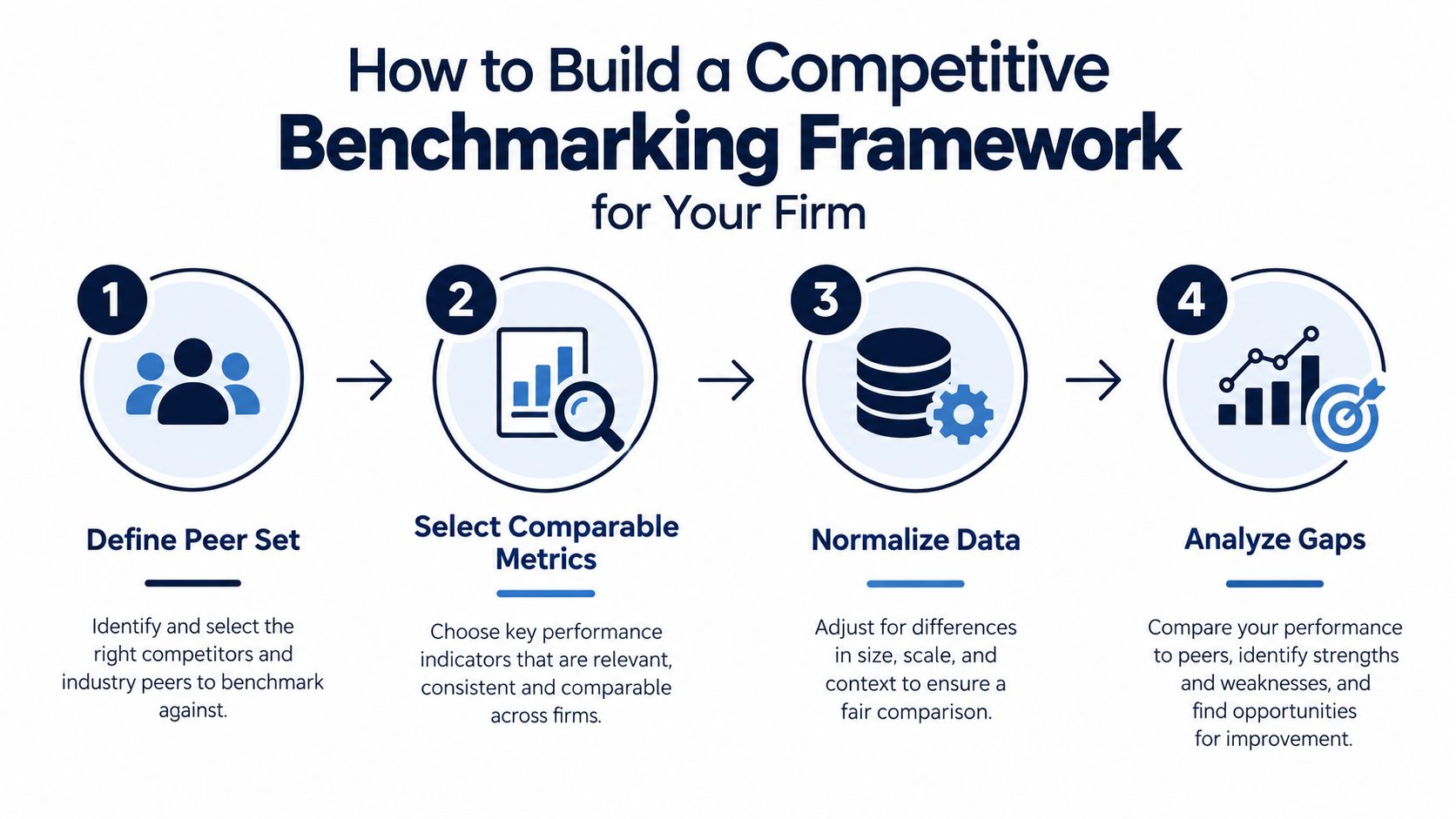
Build the framework in four passes
Define the peer set. Use direct rivals first, then add a small number of best-in-class analogs where the firm wants to close a known gap. A peer set that is too broad hides the signal.
Select comparable metrics. Keep the list tight and outcome-linked. If the benchmark is for AI selection, then citation presence, narrative depth, and shortlist inclusion matter more than vanity counts.
Normalize the data. Adjust for practice mix, geography, channel mix, and seasonality before comparing firms. This prevents false conclusions when firms do not operate under the same conditions.
Analyze gaps. Translate each gap into a driver-level explanation, then turn that into a target with a clear formula. If the gap is caused by weak entity consistency, the remedy is not more traffic. If it is caused by thin narrative depth, more pages alone won't fix it.
The framework works because it treats benchmarking as a causal loop. Measure shared KPIs over time, decompose the gap into drivers, then reset the target once the driver is isolated.
The mistake most firms make
They compare averages instead of mechanisms. That is how a firm ends up believing it is underperforming in one broad sense when the underlying problem sits in one channel, one entity signal, or one description pattern.
Operational standard: If a gap can't be tied to a driver, it isn't ready to act on.
A law firm can use this framework to compare itself against direct rivals, then refine the view by looking at how AI systems interpret the firm across decision contexts. In practice, that makes benchmarking a diagnostic instrument rather than a quarterly ritual.
A Law Firm That Benchmarked Well But Missed the Selection Layer
The pattern is common enough to be dangerous. A firm can post solid search metrics, build a respectable backlink profile, and maintain steady organic traffic, then vanish when a system is asked for a recommendation in a high-intent legal query.
The structural issue is usually not one thing. It often starts with inconsistent entity signals across directory listings, bio pages, and third-party references. When the same firm is described differently across sources, AI systems face interpretive ambiguity, and ambiguity weakens recommendation confidence.
What the diagnosis tends to show
The firm looks coherent from a marketing dashboard, but not from an entity perspective. Its practice names, attorney descriptions, or service attributes fail to line up cleanly across the sources that feed AI interpretation. That creates a gap between how the firm sees itself and how the system reconstructs it.
Once the firm aligns those signals, the benchmark changes. Citation presence improves because the system has a clearer entity to cite, and top-3 positioning becomes more plausible because the firm's description is now easier to trust and repeat. The change is not cosmetic. It is structural.
A useful way to read that pattern is simple.
- Strong search metrics can coexist with weak AI recommendation performance.
- Inconsistent entity data can suppress shortlist inclusion even when the firm is well known.
- Clearer narrative depth gives the system more to work with when it assembles an answer.

The lesson is not that SEO stopped mattering. It still helps systems discover you. The problem is that discovery is only the first filter, and firms can't assume the selection layer will reward them just because the search layer already did.
Why Benchmarking Is a Continuous Discipline, Not an Annual Audit
Benchmarking loses value when treated as a calendar event. Competitive position changes as search systems, source coverage, firm narratives, and peer activity change. The benchmark must therefore be repeated, with each cycle testing whether a known intervention altered the firm's position.
The driver tree keeps the diagnosis honest
A KPI tree keeps performance analysis tied to mechanisms rather than impressions. Revenue equals traffic multiplied by conversion and average order value. In legal services, the same logic applies across market share, pricing, retention, conversion, and digital engagement, each of which can reflect a different source of advantage (KPI driver logic).
A single gap rarely identifies the remedy. Lower share may reflect weak visibility, unclear differentiation, poor conversion, or an AI system that cannot describe the firm reliably. Those conditions require different actions, so the benchmark must connect each outcome to an underlying driver.
The same discipline applies to the AI selection layer. A firm may retain strong traditional SEO signals while remaining absent from recommendation shortlists. The 78% invisibility rate in the article's data illustrates the consequence: ranking evidence alone does not establish that systems will cite the firm, describe it accurately, or select it.
Continuous measurement is what makes the benchmark actionable
A one-time audit records the firm's position at collection. Continuous measurement shows whether the relevant driver improved, stalled, or regressed after an intervention. That turns benchmarking from a report into a management control.
CitationOS uses a proprietary Citation Score framework to quantify AI inclusion, narrative strength, entity strength, and relative positioning. Leadership can use those measures to compare the firm with its defined peer set and track whether selection-layer performance changes over time.
The test is repeated selection, supported by a consistent and accurately described entity.
If the benchmark cannot identify the driver behind a movement, it cannot determine the next action.
What Competitive Benchmarking Means for Law Firm Strategy Going Forward
Competitive benchmarking still begins with comparison, but the target has changed. For law firms, the useful comparison is no longer only about search exposure, it is about whether AI systems can cite, describe, and recommend the firm with confidence.
That shifts strategy away from surface metrics and toward selection-layer evidence. Citation presence shows whether the firm appears at all, narrative depth shows whether the system can describe it beyond the name, and top-3 rate shows whether the firm reaches the leading recommendation positions. Those are not cosmetic metrics. They are the operating signals that determine shortlist inclusion.
The firms that will win AI-mediated discovery are the ones that benchmark continuously, not annually. They will compare themselves against the right peer set, normalize for context, isolate the actual driver behind each gap, and treat entity consistency as a strategic asset rather than a housekeeping issue.
The implication is straightforward. Visibility without selection-layer presence is optimization for a battlefield that no longer determines outcomes. The margin between being recommended and being invisible is now measured in entity consistency, narrative depth, and benchmarked competitive position, not backlinks alone.
CitationOS provides confidential AI citation audits, competitive positioning benchmarking, and entity consistency assessment for firms that need to understand how they're represented in AI recommendations. If you want a measured view of how your firm compares in the selection layer, visit CitationOS and review how its benchmarking framework maps to your market.