In 2024, approximately $2.5 billion was spent on nearly 27 million legal-services advertisements in the United States, according to figures attributed to the American Tort Reform Association and reported by PracticePanther. Spending at that scale doesn't tell a managing partner whether a law firm marketing agency produced a retained matter, a consultation that never happened, or a prospect an AI system sent to a competitor.
Most agency comparisons stop at visibility. They compare rankings, articles, impressions, and social posts. They don't test what happens after a prospect acts, and they don't test whether ChatGPT, Gemini, or Perplexity names the firm when a client asks who to hire.
That's the gap this scorecard addresses. Judge each provider on intake performance and AI recommendation authority, then check whether the evidence supports the proposal.
Score Every Agency on Six Criteria Before You Sign
Clio's 2024 Legal Trends research found that firms investing more heavily in marketing spent 41% more than comparison firms and achieved a 21% increase in profitability, yet only 40% answered phone calls and 48% were effectively unreachable by phone. A scorecard has to test execution, not awareness alone.
Six Criteria for Comparing Law Firm Marketing Agencies
| Criterion | What to verify | Red flag | Evidence to request |
|---|---|---|---|
| Intake speed | Median time to first human contact on online leads | Reports only traffic or form fills | Timestamped response data by time band |
| Reporting depth | Cost per qualified lead, lead-to-consultation rate and source-level return | Impressions, sessions or rankings as headline results | Channel-level outcome dashboard |
| AI representation | Whether ChatGPT, Gemini and Perplexity name the firm and describe it accurately | No testing beyond conventional search rankings | Question-level results across several AI systems |
| Entity consistency | Firm name, practice areas and attorney profiles match across directories and sources | Inconsistent descriptions left unaddressed | Source-by-source consistency review |
| Practice-area fit | Documented experience in the firm's practice area and city | The same playbook used for every practice | Anonymized examples from comparable practices |
| Compliance controls | Attorney advertising review and handling of AI chat disclosures | Guaranteed results or no approval step | Written review workflow and named sign-off roles |
Score each criterion present (2 points), partial (1), or absent (0), for a total out of 12. Record each mark next to the evidence that supports it. A polished portfolio doesn't offset missing operating data.
An agency that can't produce timestamped response data fails intake speed, regardless of creative quality. An agency that reports rankings but not qualified consultations fails reporting depth. An agency that has never tested AI answers in your market can't claim strength on AI representation.
A Worked Score Shows Why the Total Isn't Enough
Agency A scores 2 on intake speed, 2 on reporting depth, 0 on AI representation, 2 on entity consistency, 2 on practice-area fit, and 2 on compliance controls. That's 10 of 12. It still shouldn't reach the proposal stage.
Agency B scores 1 on intake speed, 2 on reporting depth, 2 on AI representation, 1 on entity consistency, 2 on practice-area fit, and 2 on compliance controls. That's also 10 of 12, with no disqualifying absence. Only Agency B advances.
Shortlist rule: Any agency scoring absent on reporting depth or AI representation is out, because both claims can be checked against data you own or can test directly.
Apply the scorecard during the first call. Ask for the dashboard, the timestamp export, the question-level AI results, and the approval log. If the answer is a promise to build those later, mark the criterion absent and move on.
SEO, GEO and AI Recommendation Work at Different Layers
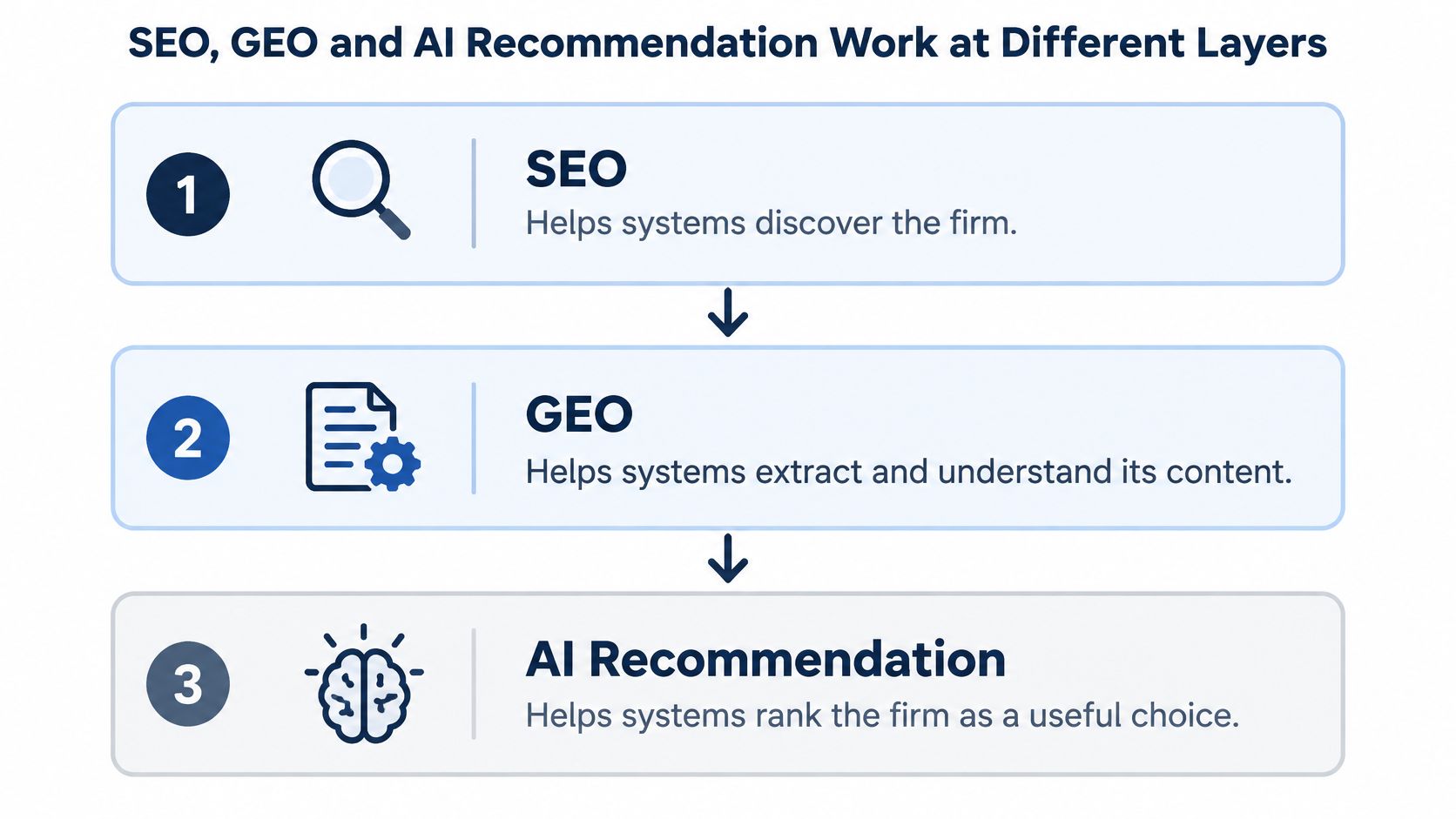
A law firm marketing agency can sell work at three layers, and buyers often pay for one while expecting another. SEO helps systems discover you. Generative engine optimization (GEO) helps systems extract and understand you. AI recommendation intelligence measures whether AI systems trust and name you when a client asks for a shortlist.
Ranking and recommendation don't move together, which is why the three layers blur in proposals. An Ahrefs analysis of 1.9 million citations from 1 million Google AI Overviews found that 76.10% of cited pages ranked in Google's top 10, 9.50% ranked between positions 11 and 100, and 14.40% did not rank within the top 100 organic results. Ranking helps. It doesn't determine inclusion.
Discovery and Understanding Don't Prove Selection
SEO work covers crawlability, relevance, and authority signals that put a page in front of a search system. GEO work covers clear structure, extractable facts, and consistent descriptions that help a system interpret what the firm does. A detailed overview of generative engine optimization sets out that extraction layer.
Neither layer answers the selection question. A firm can rank on page one for its core practice term and never appear when a prospect asks an AI assistant for firms to consider. That's a layer-three problem. More SEO spend won't fix it, because the firm was already discoverable.
SEO gets a firm found, GEO gets it understood, and recommendation intelligence shows whether it gets chosen.
At the third layer, ask for output by question and by system: the questions a buyer's clients type, whether the firm is named in the answer, which firms are named in its place, and how each system describes the firm when it does appear. A composite score only earns trust when the components behind it are visible, covering AI inclusion, narrative strength, entity strength, and position against named competitors. Answer engine optimization (AEO) belongs in this conversation too, but activity labels don't substitute for question-level results.
The pattern underneath the layer is consistent enough to plan around. CitationOS's founders built the audit around what their own question testing kept showing: well-regarded firms were routinely missing from AI answers, and the firms that were named were often described inaccurately. That is a representation failure rather than a ranking failure, and it appears most sharply in markets where a firm's traditional search position is strong.
Systems Don't Return the Same Answer
Legal audiences don't use one assistant. Law360 Pulse's 2024 AI Survey of 384 lawyers found reported tool usage distributed across several systems. A firm described accurately in one assistant can be absent, misclassified, or thinly described in another.
Two questions settle the proposal before signatures. Which layer does this agency sell? Which layer contains your firm's problem? If those answers don't match, the engagement is solving the wrong issue.
Judge Agencies by Intake Performance, Not Traffic
Only 9% of reported firm business came from online leads in the American Bar Association's 2023 Websites & Marketing TechReport, while respondents rated marketing effectiveness at 3 out of 5 and 31% of lawyers using social media professionally reported gaining a client directly or by referral from it. The gap between visits and signed matters is where agency selection succeeds or fails.
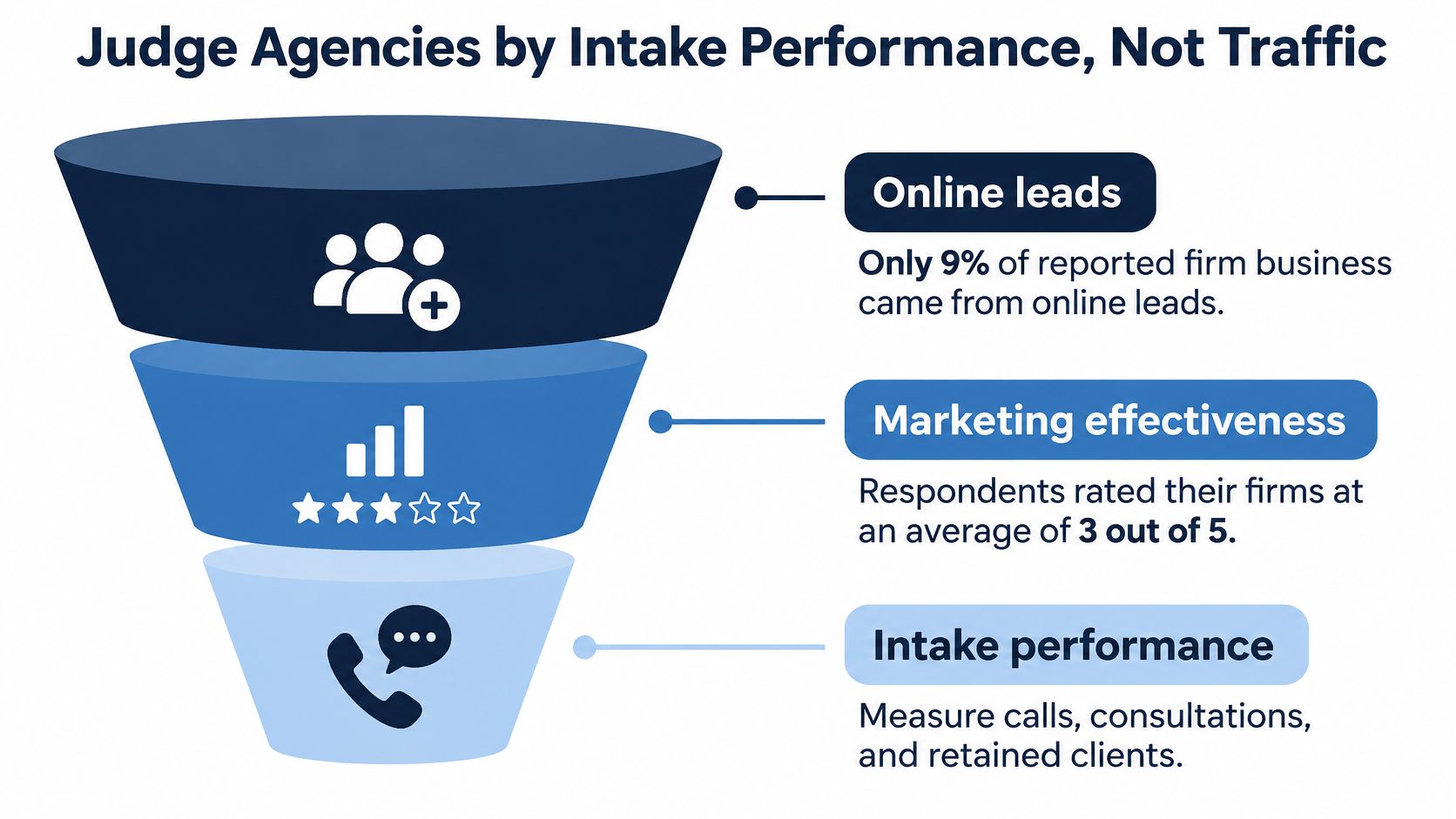
Separate channel metrics from outcomes. Organic search, paid media, social, referrals, and website forms are sources. Qualified consultations, retained matters, and revenue are results. An agency that mixes them in one success column hides where value stops.
Intake Metrics an Agency Should Report
| Metric | Definition | Reference value |
|---|---|---|
| Online lead share | Share of firm business that came from online leads | 9% of reported firm business, ABA 2023 |
| Median first response | Time from online lead to first human contact | 13 minutes in 2024, down from 21 minutes, independent 2024 study of law-firm online lead handling |
| Five-minute response share | Share of leads contacted by a human within five minutes | 28% of firms, 2024 study |
| Lead-to-consultation rate | Share of qualified leads that book a consultation | Report monthly by source against your own baseline |
| Consultation-to-engagement rate | Share of booked consultations that become engaged matters | Report monthly by practice area against your own baseline |
| Cost per qualified lead | Channel spend divided by qualified leads from that channel | Report by channel, with qualification rules stated |
Speed data shows how much pipeline is lost before qualification starts. That same 2024 lead handling study found 73% of firms responded at all, 35% responded within 10 minutes, and 56% responded within two hours. The implication for agency review is direct. A vendor can increase form fills while the firm forfeits the return through slow or absent follow up.
Report Response in Bands, Not Averages Alone
Require four bands for every source and practice area:
- Under five minutes: first substantive human contact, not an automated acknowledgment
- Five to ten minutes: still workable, but below the standard to set
- Ten to 120 minutes: delayed contact that needs a staffing or routing explanation
- Over two hours: lost urgency, after-hours failure, or a broken handoff
Set the working standard at human follow-up within five minutes during staffed hours. Audit unanswered, duplicated, and after-hours leads weekly. That audit should name an owner for each failure type, because a routing error, a staffing gap, and a bad form need different fixes. Qualification rules need the same discipline. A form fill is not a qualified lead until someone checks jurisdiction, practice fit, urgency, and conflicts process. For a practical breakdown of how firms define that step, see lead qualification for law firms.
Score social activity on referral and trust effects, not last-click conversions alone. Read every rate against intake data, practice area, jurisdiction, and matter value. A channel with expensive leads can still be sound if its consultation-to-engagement rate is strong.
A cheap channel that produces unqualified inquiries is expensive in staff time.
Match the Engagement Model to the Evidence You Hold
Recent legal-sector survey reporting found that 32.39% of respondents maintained ongoing PR retainers while 29.58% used agencies only as needed. Consumer use of AI for legal questions is still measured thinly, but the direction changes how a firm should buy marketing. Two layers decide whether the spend works: post-click intake performance and whether AI systems name the firm when a client asks. Three purchase models sit behind most proposals, and the evidence a firm already holds determines which one fits.
Compare them on four questions. What does the provider own? What evidence does it produce? How is it paid? Where does it fail?
Three Models, Three Different Purchases
A full-service retainer agency owns ongoing production across SEO, PR, paid media, and content. It is paid for recurring execution, and it usually reports activity, rankings, and channel output. That model fits established channels with known economics. It fails when it reports page-one rankings while the firm is absent from AI shortlists, because production continues without testing selection.
A specialist firm owns one channel or function, such as paid search, intake technology, or review management. It is paid for depth in a narrow area, and it should produce channel-specific evidence. That model fits a diagnosed problem with a clear owner. It fails when it optimizes one intake form while response time runs past two hours, because the constraint sits outside its remit.
A diagnostic provider owns a fixed-scope analysis. It examines how the firm is represented, which competitors are named instead, and why. It is paid for a decision; production is out of scope. It fails when the report names competitors but assigns no owner, priority, or sequence to the fix.
Pricing stays qualitative here because reliable comparative rates aren't established. The distinction still matters. A retainer funds production. A diagnostic funds a decision about where production should go.
CitationOS is an AI citation intelligence firm that works in the diagnostic category. Its full audit is a private analysis of how the firm appears in high-intent queries for its practice and city, and the firm does not publish client results or share them with competitors.
Engagement Model by Evidence Situation
| Situation | Evidence that points to it | Engagement to buy |
|---|---|---|
| Established channels with steady intake | Consistent qualified leads and known source attribution | Ongoing retainer for execution |
| Intake gaps or slow response | Median response above 10 minutes or many unanswered leads | Intake and response measurement before any media spend |
| Unexplained competitor selection | Competitors named in place of the firm in high-intent AI queries | One-time diagnostic audit across AI systems |
| New practice area or market | No attribution history for the practice | Narrow pilot with defined measurement, then a decision |
| Low matter value and no measurement | Spend cannot yet be tied to consultations | No spend until tracking is in place |
Use thresholds before you authorize recurring spend. You need enough qualified matters to judge a channel, practice-area economics that support acquisition cost, consultation-to-engagement quality, and attribution you trust. You also need competitor inclusion in high-intent AI answers and entity consistency across authoritative sources.
Suppose a firm has strong referral intake but finds competitors named in its place in AI answers. A long retainer is premature. The firm should buy a scoped audit first, because the audit decides which channel deserves funding.
That audit should run the queries clients ask in the firm's market across major AI systems. It should trace each answer to the sources the system relied on, identify why competitors were selected, and show whether the problem is citation presence, narrative depth, entity confusion, or weak third-party authority.
Spend should follow a measured gap, not a general wish to do more marketing.
If you can't name the gap, you can't judge the proposal. Buy evidence first. If you can name the gap and the economics work, fund execution and hold the provider to downstream outcomes.
Build an Approval Workflow Before Scaling AI Content
The American Bar Association's guidance on attorney advertising ethics makes the ownership point plainly: lawyers remain responsible for third-party and AI-generated marketing under supervisory duties. Model Rule 7.1 requires advertising to be truthful and non-misleading. Firms must understand how chatbots work and review their scripts. Florida guidance requires AI chatbots that communicate with clients or third parties to disclose that they are AI and not lawyers or firm employees. Delegation does not transfer responsibility.

The strongest AI content operation is the one with the clearest approval system. Output volume is a poor proxy for control. Volume without review creates advertising, confidentiality, and supervision exposure at scale.
Controls to Require in Writing
- Named reviewer: a specific person checks every generated claim before publication
- Reviewed chatbot script: approved language, clear automated identification, and no improvisation on legal questions
- Advice boundary: rules that stop unauthorized legal advice and route legal questions to a person
- Information protection: controls for data submitted through forms and chatbots
- Audit trail: a log showing source, draft, reviewer, changes, approval, and publication date
- Vendor-risk checks: documented review of each AI tool, its data handling, and its permitted use
Firms can plan editorial reviews with TheContentMap when mapping reviewers, handoffs, and sign-off stages. The workflow itself still needs legal ownership inside the firm. An agency can operate the process, but it cannot own the professional duty.
Multi-jurisdiction campaigns raise the bar. If content reaches prospects in several states, apply the strictest applicable advertising and disclosure rule to the shared asset. A national campaign template should not override a state requirement.
Consider a Florida intake chatbot that opens with a friendly greeting but does not state that it is automated. A prospect describes a legal problem, expecting a firm employee. That is a disclosure failure before qualification begins. The agency built the bot, but the firm carries the supervisory exposure.
The law firm content marketing guide should be read with that control point in mind. The workflow needs to show where claims originate, who reviews them, and who signs off before publication.
Put one request to every finalist. Show the workflow, the approval roles, and the log from a past campaign. If the agency cannot produce all three, it is not ready to scale AI content for your firm.
Choose the Agency That Can Show Its Evidence
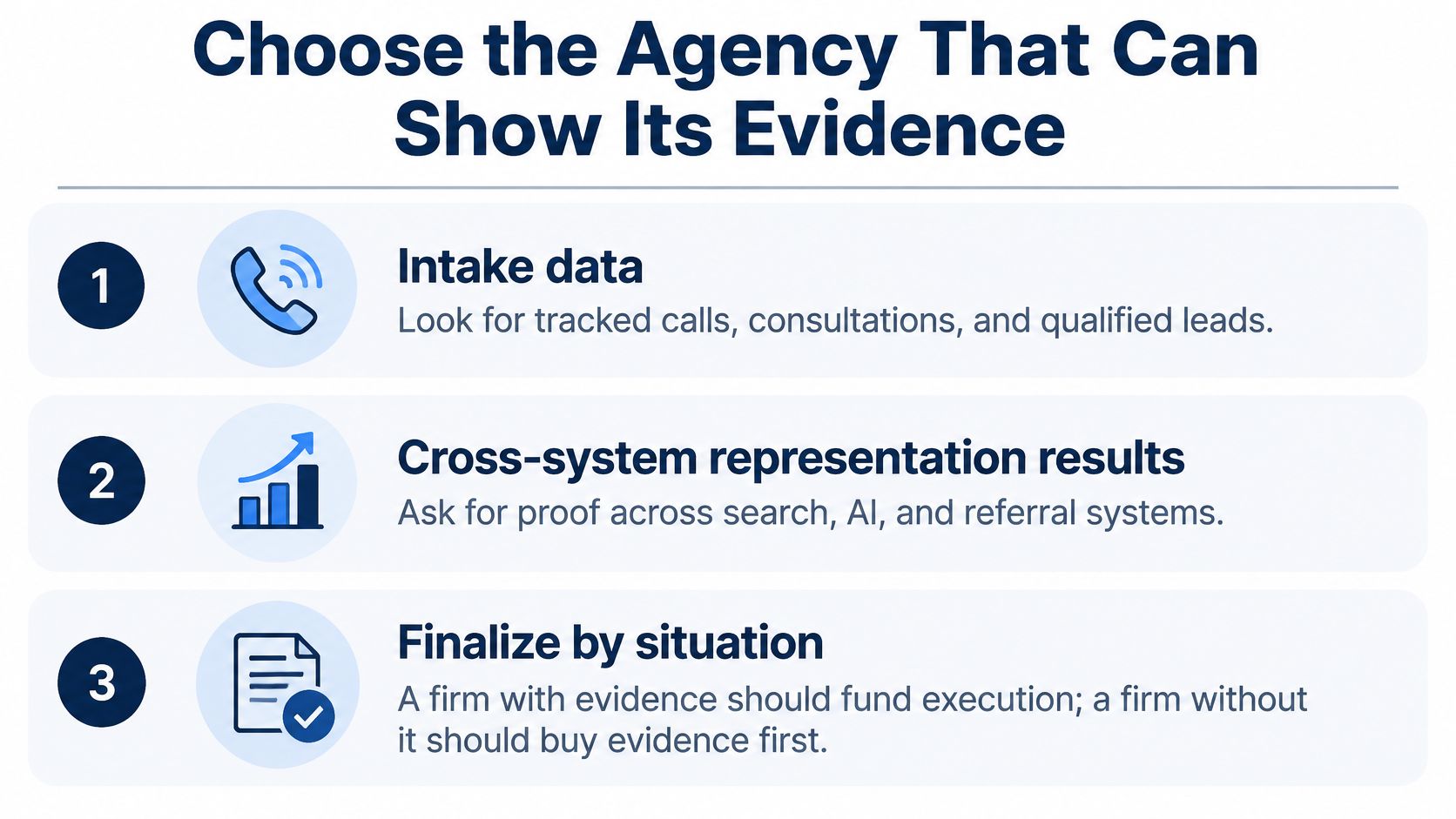
The verdict depends on your situation. A firm with reliable intake data and cross-system representation results should fund execution. A firm without them should buy evidence first. Signing a production retainer before you can measure either layer turns the first contract period into paid guesswork.
Run finalists on identical inputs. Don't let one agency present a case study from another market while another answers questions about your practice. Give each finalist the same practice area, city, intake export, and competitor set.
Three Questions for Every Finalist
First, what can the agency show from your own intake data? It should identify source quality, response bands, qualification losses, and consultation outcomes. A generic promise to increase leads doesn't answer the question.
Second, what does it report for your market across ChatGPT, Gemini, and Perplexity? One assistant isn't a market view. Ask for question-level inclusion, description accuracy, citation presence, narrative depth, and top-3 rate by system. A related law firm SEO audit can test discoverability, but it doesn't replace recommendation measurement.
Third, what did its approval workflow produce on a past campaign? Request the reviewer roles, advertising checks, chatbot disclosures where relevant, and the publication log. Process claims without records are still claims.
A claim without a source-level record counts as absent, whatever the proposal says.
A free AI visibility snapshot is one way to set a baseline before proposals arrive. It asks an AI assistant four client-style questions for the firm's market and shows whether the firm is named and which firms are named instead. It also includes a check of the website's GEO and SEO readiness.
A full audit is a separate, scoped purchase. To request it, a firm provides its firm name, website, primary practice area, market, and a work email. A firm should be able to decline that audit and still complete the comparison using the scorecard, its intake records, and direct AI testing.
The implication is narrow but consequential. If you can't see how your firm is represented across systems, you're buying marketing on assumptions. Hire the provider that shows its evidence before it asks for a contract.
CitationOS measures whether AI systems name, describe, and recommend your firm in the high-intent questions clients ask, across ChatGPT, Gemini, Claude, and Perplexity. Start with a private baseline before you fund another law firm marketing agency retainer, and visit CitationOS to request your firm's AI visibility snapshot.