Organic search still drives about 52.6% to 53% of total law firm website traffic, and SEO leads in this market convert at roughly 6.4% to 7.4% in industry benchmarks (SEO audit for lawyers). That makes a law firm SEO audit more than a maintenance exercise. It is a revenue diagnostic, and, now, a recommendation diagnostic.
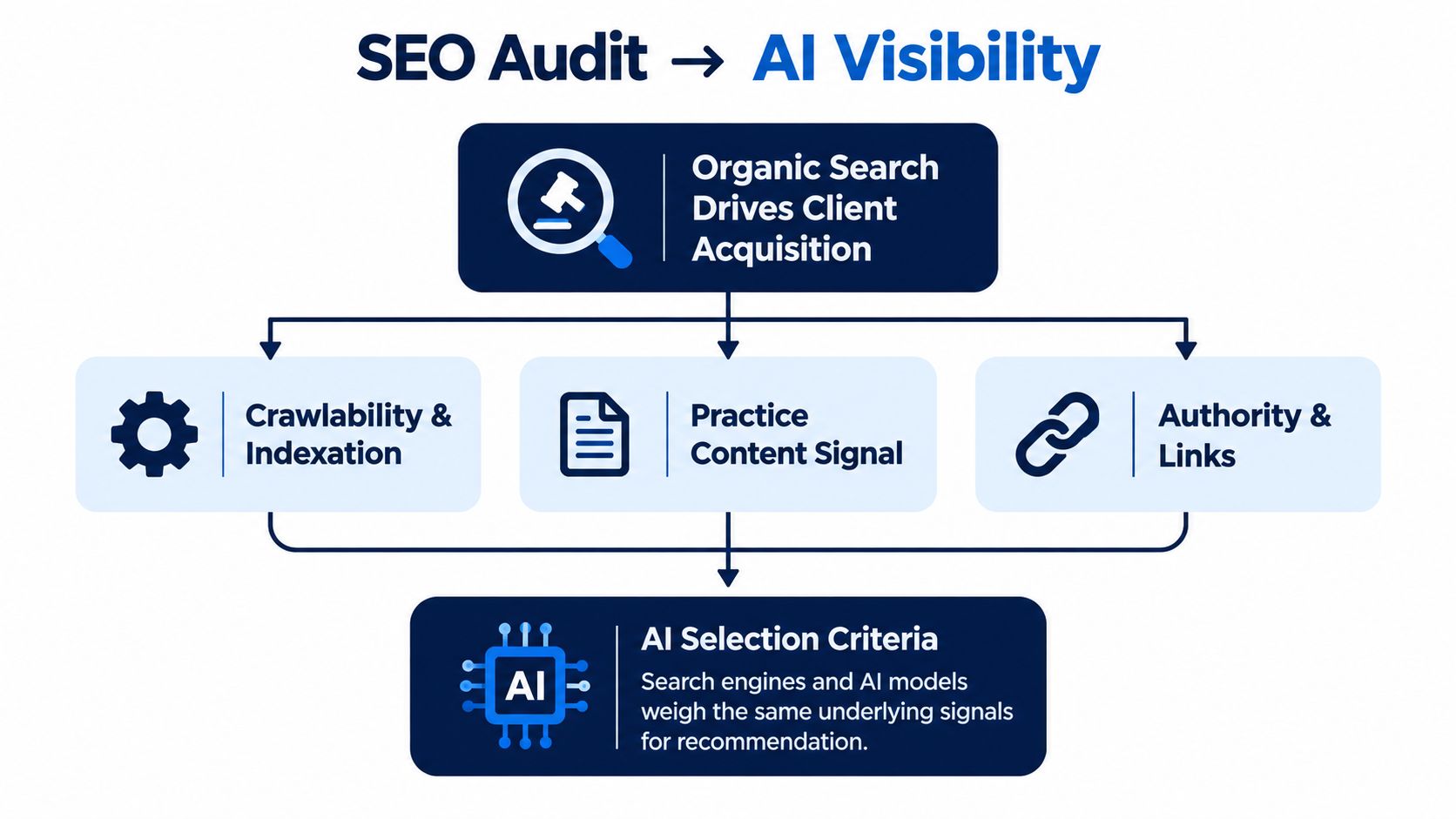
The old framing is too narrow. SEO helps systems discover you. GEO helps systems extract and understand you. AI recommendation intelligence measures whether those systems trust and recommend you. If you only test crawlability and titles, you'll miss the layer where AI systems build shortlist logic.
Table of Contents
- Why a Law Firm SEO Audit Now Determines AI Recommendations
- Technical Foundation and Crawlability Checks
- On Page Content and Practice Authority Review
- Local Presence and Entity Consistency Across Sources
- How SEO Findings Connect to AI Visibility and Shortlist Inclusion
- Prioritizing Fixes and Measuring What Matters Next
Why a Law Firm SEO Audit Now Determines AI Recommendations
97% of people who searched online for attorney information used search engines, and nearly nine in ten adults visited at least two websites before contacting a lawyer (online marketing for law firms). The figures describe a selection process, not a single click. A firm must first become discoverable, then understandable, then credible enough for inclusion in a shortlist.
Discovery is the first diagnostic layer
58% of law firm website traffic comes from non-branded searches, so many prospective clients begin without a specific firm in mind (online marketing for law firms). Search access therefore remains a basic audit question. A firm that cannot be found cannot enter consideration.
Discovery does not establish recommendation eligibility. A site can attract organic visits while leaving its practice focus, attorney attributes, and supporting evidence ambiguous. That ambiguity limits what automated systems can extract and how confidently they can associate the firm with a legal need.
Extraction determines what systems can represent
AI-mediated search requires more than indexed pages. It requires identifiable services, attorneys, locations, outcomes, and explanatory content that systems can connect without guessing. Technical and local corrections can improve access, yet they do not resolve unclear positioning or unsupported claims.
The audit should therefore separate technical access from content extraction. The first asks whether systems can reach and process the firm's pages. The second asks whether those pages provide coherent evidence about who the firm serves and why it fits a query.
Recommendation is a separate test
Recent legal-marketing coverage identifies AI citations, brand visibility, and zero-click discovery as growing priorities, while conventional audits often end with technical, local, and backlink checks (SEO trends in 2025 for law firms). The missing question is whether a firm's evidence is strong and consistent enough to support selection.
Practical rule: an audit that reports rankings but not shortlist inclusion is incomplete for AI-mediated search.
A useful three-layer model keeps the diagnosis precise. Technical access measures reachability. Content extraction measures interpretability. Recommendation intelligence examines whether the available evidence supports trust and inclusion. The selection moment in AI recommendations provides a framework for distinguishing these stages rather than treating visibility as one metric.
Technical Foundation and Crawlability Checks
A technical audit is the first layer of a law firm SEO audit: discovery. It establishes whether search systems and AI services can reach, render, and interpret the firm's pages. If that layer fails, later content and authority work has limited effect. Headline revisions cannot compensate for pages blocked from access or excluded from indexing.
Start with indexation and canonical control
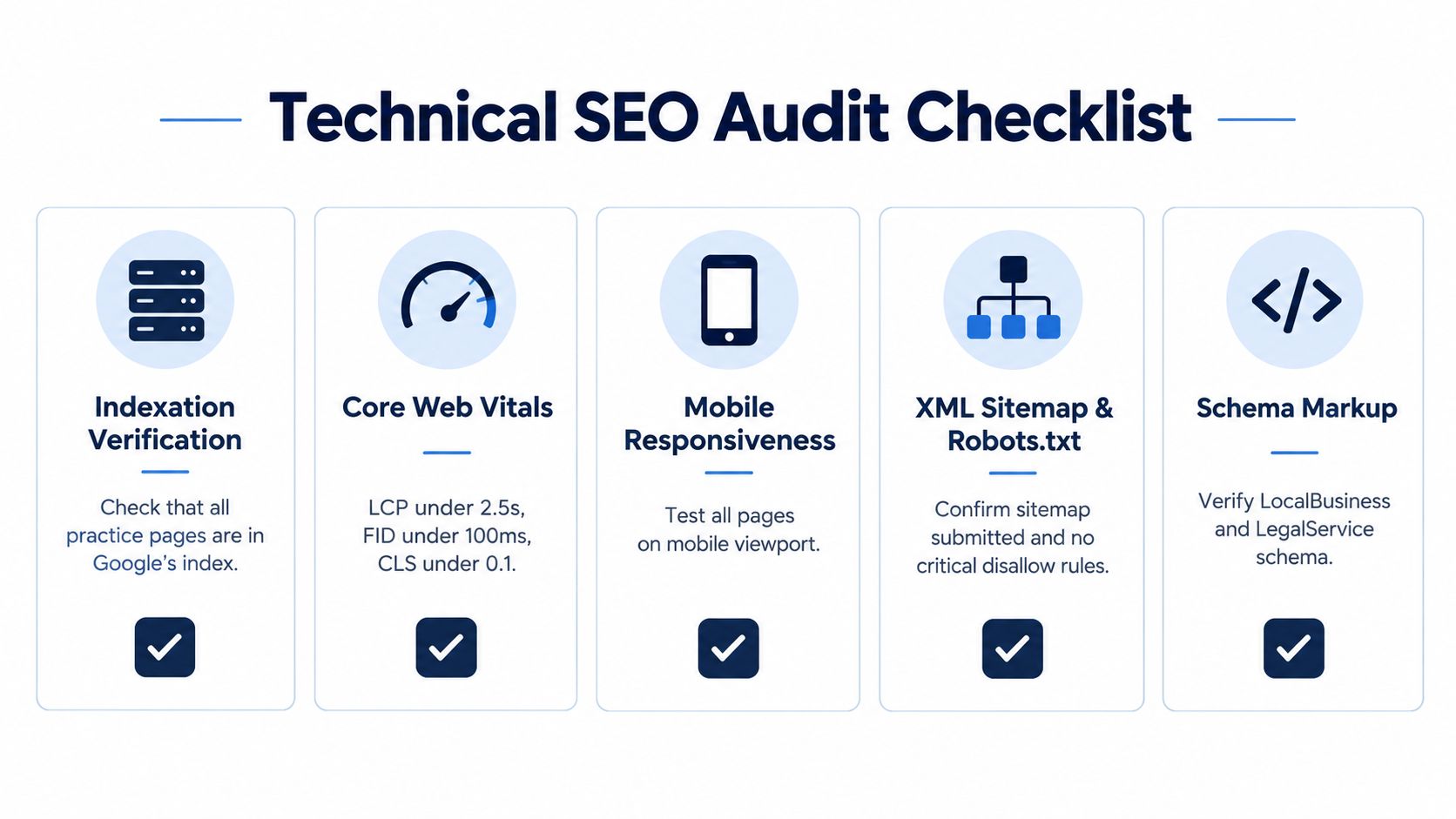
Check whether core practice pages are indexed and whether the indexed versions are the intended pages. Review blocked sections, accidental noindex tags, duplicate URLs, redirect chains, and orphaned pages. A practice page that exists only on the site but cannot enter the index contributes little to search discovery or AI retrieval.
Sitemaps and robots directives should reflect the actual site structure. Canonical signals should identify the preferred URL instead of distributing confidence across duplicates. Legal websites require particular care because firms often create parallel pages for offices, locations, and closely related practice areas.
Test rendering on mobile and desktop
Legal searches frequently occur under time pressure. A phone number hidden after a long load or a menu that fails on a small screen can interrupt intake before a visitor reviews the practice page. That is an access failure, not a content failure.
Structured data belongs in the same diagnostic. LocalBusiness and LegalService schema can clarify the entity represented by each page. Accessibility also affects extraction. Unlabeled controls, unreadable text, and poorly structured elements create obstacles for users and machines.
Document failures by ownership, not symptom
Operational rule: give developers breakpoints, not frustrations. “This page loads slowly” describes a symptom. “This script delays mobile rendering on practice pages” identifies an instruction someone can implement.
Classify findings as hard blockers or soft issues. Hard blockers include index exclusion, broken canonical paths, and render failures. Soft issues include slow loading, partial mobile usability, and inconsistent schema. Assign each item to an owner and record its affected templates or URLs. The objective is reliable access, not a vanity score.
A 2025 survey of 1,700 professionals found that 26% of firms and in-house teams were using generative AI, up from 14% a year earlier, with respondents mainly in the US, Canada, the UK, and Australia (Global Legal Post summary). That adoption makes technical readability relevant beyond conventional search. Systems must first discover and process the firm's information before they can extract its practice focus, assess its evidence, or place it on an AI shortlist. Technical access is therefore the first diagnostic layer, not the recommendation itself.
On Page Content and Practice Authority Review
A crawlable page still has to communicate a distinct legal entity. The audit therefore examines what systems can extract from each page: the firm's practice focus, the matters it handles, the attorneys responsible, and the jurisdictions they serve. Keyword placement is only one signal. Ambiguous or interchangeable content can leave a technically accessible site difficult to classify.
Practice pages need specific legal meaning, not broad service language
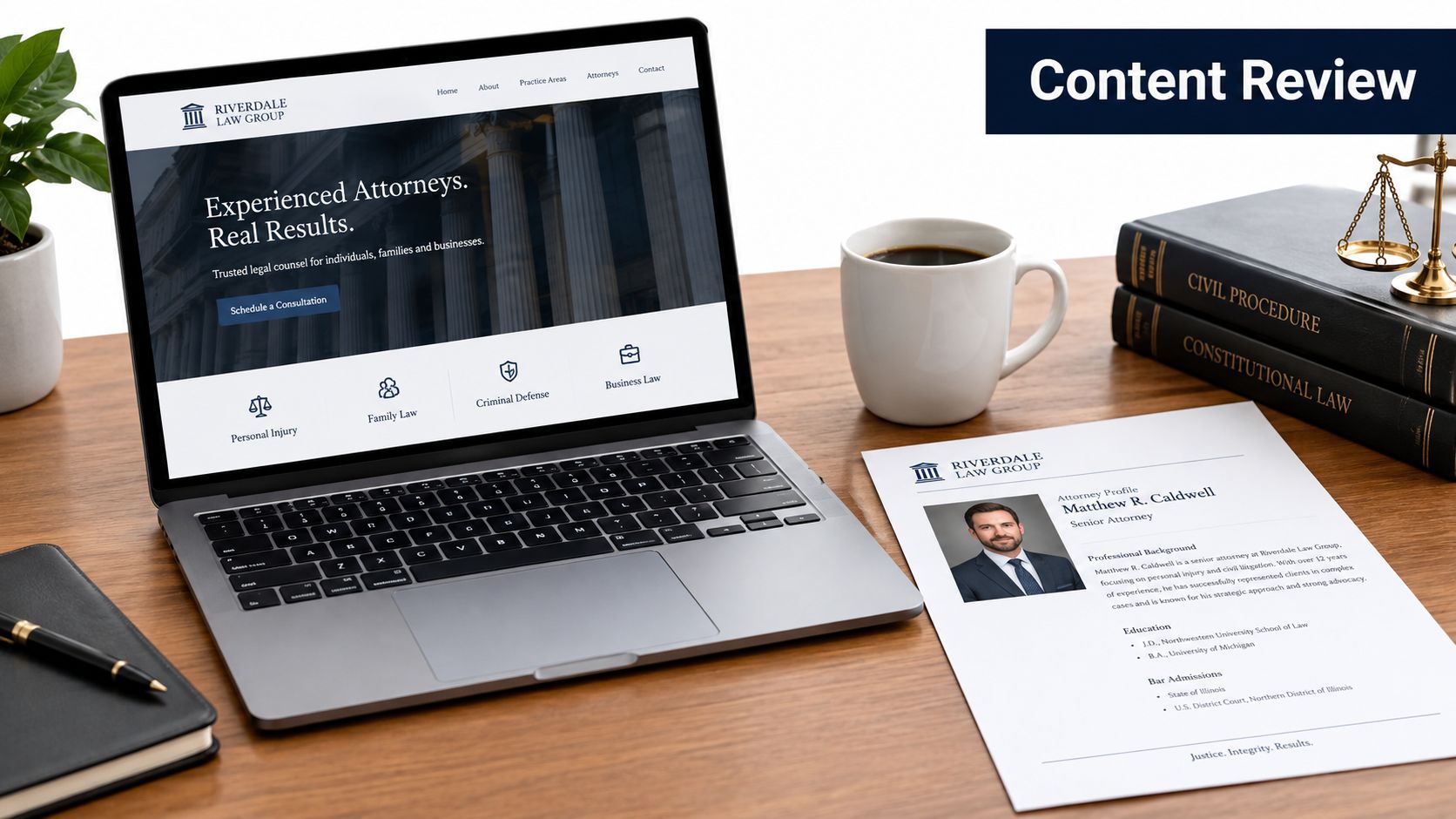
Review whether each practice page names the actual matter types the firm handles. Subheads should correspond to questions that affect a prospective client's decision, while terminology should remain consistent across related pages. Broad service descriptions weaken topical interpretation. Repeated boilerplate across multiple pages can make distinct practices appear identical.
Attorney biographies require the same examination. Each bio should identify the lawyer by name, jurisdiction, credentials, and relevant practice focus. If every profile uses the same wording, systems receive too little information to distinguish one attorney from another. Named-entity clarity supports extraction and gives the practice structure a human reader can verify.
Internal linking should mirror how buyers evaluate risk
Legal buyers commonly research before making contact. The audit should therefore test whether the site answers connected questions in a logical sequence, rather than placing isolated keywords on separate pages.
Practice pages should link to relevant attorney biographies, biographies to jurisdiction-specific material, and informational pages to the core service page. These connections show which lawyer handles which matter and where the firm operates. Misaligned headings, duplicated biography language, and weak cross-linking create ambiguity even when individual pages contain accurate information.
The site should read like a mapped practice, not a pile of legal pages.
The internal reference for this diagnostic is attorney SEO guidance. Its relevance here is structural: page organization, specificity, and entity clarity determine whether content can be extracted as a coherent practice profile.
Audit for narrative consistency across the page set
Compare the homepage, practice pages, attorney profiles, and informational content for conflicting signals. A homepage that emphasizes one practice while attorney and service pages emphasize another creates interpretive friction. In a regulated profession, inconsistent claims also raise accuracy concerns.
The three-layer diagnostic separates discovery from extraction and recommendation. Technical checks establish access. On-page review tests whether systems can extract a stable practice narrative. Recommendation requires that narrative to be specific enough for a system to associate the firm with a relevant matter and attorney.
Thin pages need targeted information, not added volume. Strengthen headings, state matter descriptions explicitly, identify attorney responsibility, and clarify the hierarchy of services. These changes give both readers and AI systems a more consistent basis for evaluating the firm.
Local Presence and Entity Consistency Across Sources
Local authority depends on whether external sources identify one firm consistently. Directory coverage alone is insufficient. Conflicting names, practice descriptions, office details, or attorney rosters create ambiguity that can weaken discovery, extraction, and later recommendation.
Recent guidance on AI visibility identifies structured data, named attorney bios, independent recognition, and governance as signals systems use to understand firms (AI legal marketing visibility). The audit should therefore compare how the firm is represented across sources, rather than count listings. Discovery establishes that the entity exists. Extraction depends on whether those sources support one stable profile. Recommendation depends on whether the profile clearly connects a matter, practice, jurisdiction, and responsible attorney.
Entity consistency priority matrix
| Source Type | Entity Signal Checked | Priority |
|---|---|---|
| Google Business Profile | Name, practice focus, office details | High |
| Primary legal directories | Firm name, attorney names, services | High |
| Attorney bios on authoritative profiles | Credentials, practice areas, jurisdiction | High |
| Independent recognition pages | Practice focus, mentions, entity framing | Medium |
| General directory listings | Address, phone, category alignment | Medium |
| Low-authority citation pages | Basic identity consistency | Low |
Begin with the sources carrying the strongest authority. Correct the firm name, office details, practice focus, and attorney attributes there before expanding to lower-value listings. This order addresses ambiguity more efficiently than pursuing a larger citation count.
Compare local signals as a single entity graph
The firm's business profile, directory listings, review profiles, and independent references should describe the same organization. A different practice emphasis in one source, or an outdated attorney roster in another, can prevent systems from resolving which facts belong to the firm. The likely outcome is interpretive drift, not necessarily a direct ranking penalty.
Local search remains a meaningful discovery channel for legal services. The Google Map Pack appears before regular results 93% of the time when local intent is detected, and firms in the local pack receive about 44% of user clicks (online marketing for law firms). Those figures make source consistency part of local visibility. They do not establish that local placement alone produces AI shortlist inclusion.
Prioritize authority over volume
A single authoritative reference that aligns the firm name, practice area, and attorney identity can provide a clearer entity signal than numerous low-value listings containing partial or outdated data. The audit should record each inconsistency, identify the source owner, and separate factual correction from reputation-building work.
Correct authoritative sources first, then secondary listings, then the long tail. This sequence gives the clearest evidence priority in the three-layer diagnostic. Technical and local fixes can improve discovery, but recommendation still requires a profile that systems can extract and associate with the right legal matter.
How SEO Findings Connect to AI Visibility and Shortlist Inclusion
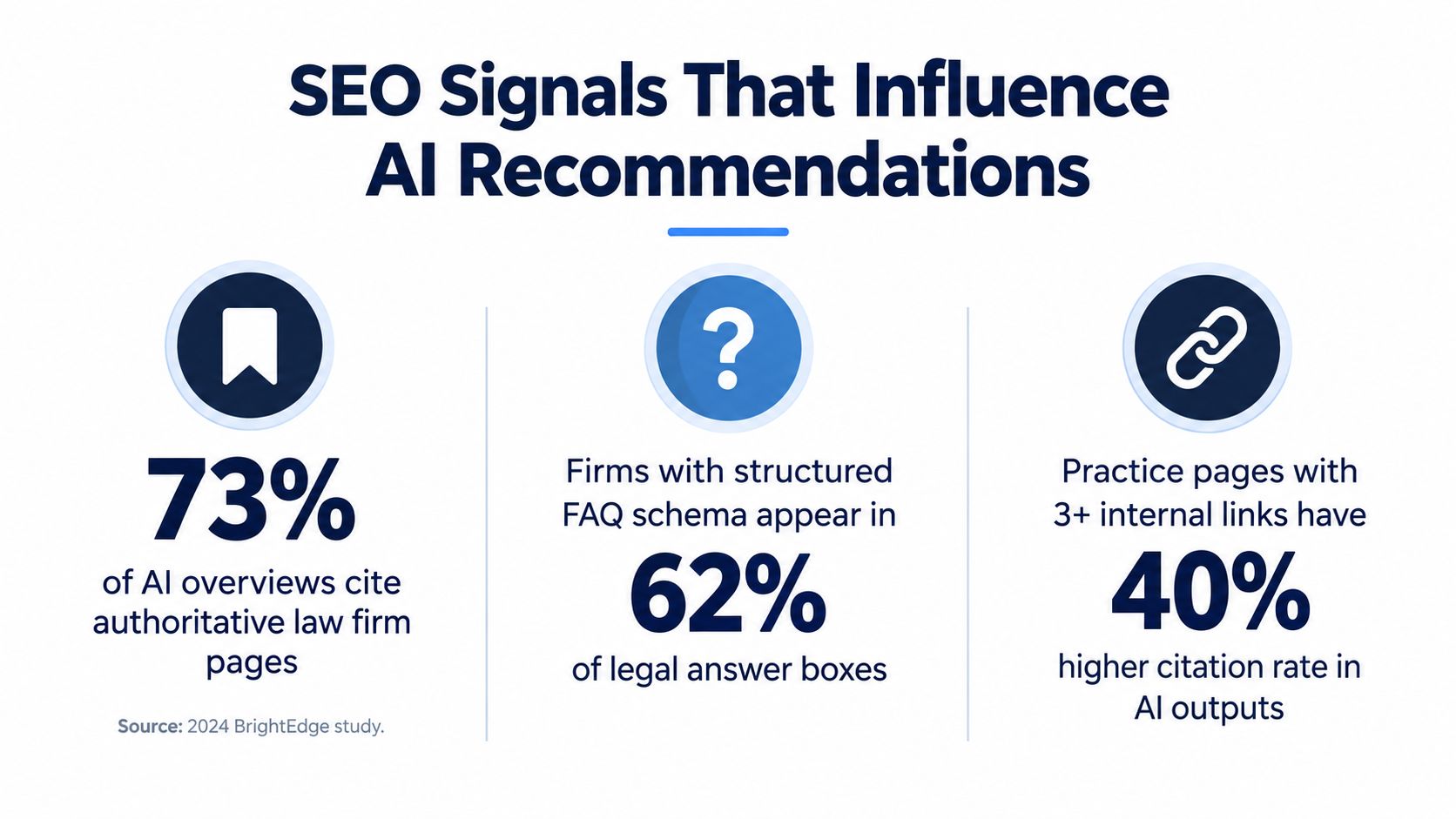
An SEO audit should treat AI visibility as a three-layer diagnostic: discovery, extraction, and recommendation. Organic search can locate a firm, an AI system can summarize its pages, and neither outcome ensures inclusion in a shortlist. Technical health and local consistency support discovery, but recommendation depends on whether systems can extract a clear, credible entity and match it to the user's legal need.
Discovery varies across answer systems
A 2026 study summary reported 38,000 AI searches covering 25 practice areas in 15 US cities. It found about 6% overlap between two systems for identical queries, while firm-naming rates differed sharply across systems, ranging from about 12% in one system to roughly 96% to 99% in others.
The audit implication is operational. Treat AI visibility as a set of system-specific observations, not one ranking position. Record which systems name the firm, which omit it, and which attach the wrong practice narrative to the firm.
Extraction is separate from citation presence
Citation presence shows that a firm appeared in an answer or source set. Narrative depth shows how accurately the system describes its practice, attorneys, geography, and matter types. Top-3 rate shows whether the firm enters a competitive shortlist. Each measure answers a different diagnostic question.
A firm may pass the discovery layer and still fail extraction. Pages can be crawlable while their practice distinctions remain too vague, fragmented, or weakly supported for an answer system to use. Audits should therefore test not only whether content is found, but also which facts survive summarization.
The surface-level AI measurement framework helps distinguish visible output from the underlying signals that produced it. That distinction prevents a citation count from being treated as proof of recommendation strength.
Structured references support recommendation
A 2026 legal discovery baseline reported testing across eight engines with sixty buyer-intent prompts. It found that Wikipedia coverage at the firm, named-partner, and practice-area concept levels was a stronger predictor of AI citation share than AmLaw revenue rank or Chambers placement (5W Public Relations baseline).
The finding does not make rankings or awards irrelevant. It shows that prestige markers cannot substitute for consistent, structured entity references. The audit should verify whether independent sources connect the firm, attorneys, practice areas, and legal matters in language an answer system can extract.
Recommendation requires a complete entity signal
CitationOS operates as an AI recommendation intelligence platform. Its AI Visibility Index measures citation presence, narrative depth, and top-3 rate. Those measures let a firm compare discovery, extraction, and recommendation outcomes, then locate the layer where visibility breaks down.
Prioritizing Fixes and Measuring What Matters Next
Prioritize remediation by failure layer. Resolve technical blockers first, then contradictory entity signals, then weak narrative depth. A persuasive message cannot compensate for inaccessible content, and a technically clean site cannot resolve conflicting firm identities across external sources.
Search visibility alone is an incomplete outcome. The scorecard should track AI citations, brand visibility, and zero-click discovery, alongside conventional rankings. These measures show whether systems can find the firm, extract accurate information, and include it in recommendations.
Measure three outcomes, not one
The audit should report three separate results:
- Discovery: Can systems access and interpret the firm's pages?
- Extraction: Do they recover the correct attorneys, practices, matters, and locations?
- Recommendation: Does the firm appear in relevant AI shortlists?
A single visibility score conceals the failure point. Assign ownership by layer. Operations and development handle access problems. Marketing and intake leadership reconcile entity records. Content teams and attorneys review narrative depth and factual precision.
Treat branded discovery as a leading indicator
More frequent firm mentions can indicate that entity signals are becoming clearer. Stable traffic paired with thin recommendation share indicates a different problem. The site may be discoverable, while its facts remain difficult for systems to extract or trust.
Review these results on a fixed cadence and compare changes with completed remediation. A technical repair should improve discovery. Consistent references should improve extraction. Stronger, supported practice narratives should improve recommendation readiness.
For high-trust firms in crowded markets, recommendation readiness is the decisive measurement layer. An audit that stops at rankings cannot show whether a firm is eligible for an AI-generated shortlist.
CitationOS measures citation presence, narrative depth, and shortlist inclusion across major AI systems. It extends the law firm SEO audit from site indexing to recommendation analysis.