The popular advice on generative engine optimization is too small for the problem. It treats GEO as if it were a standalone tactic, when the underlying system is layered, selective, and far more unforgiving than classic search ever was. SEO helps systems discover you. GEO helps them extract and understand you. A third layer determines whether they trust you enough to recommend you.
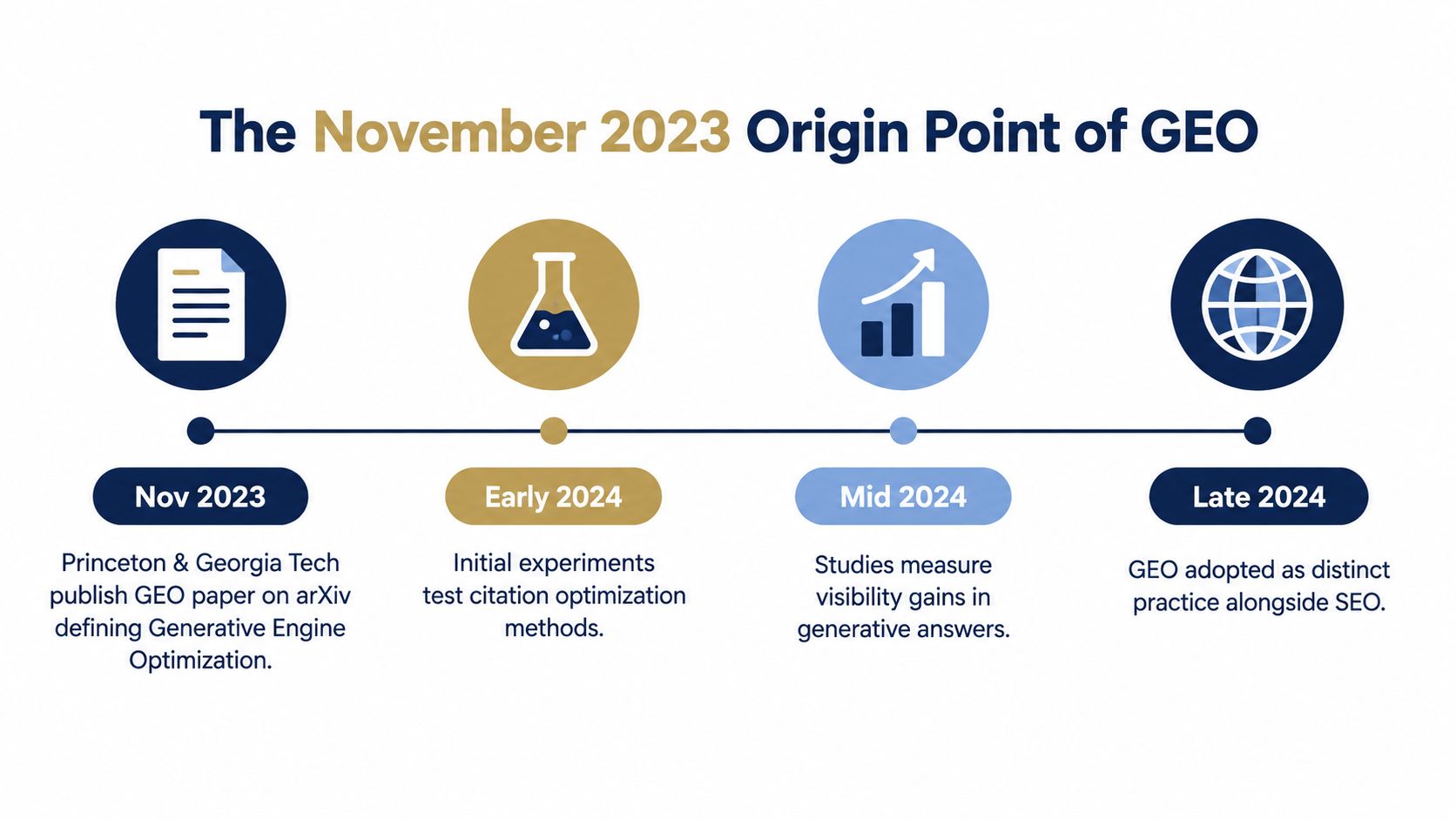
That distinction matters because generative search didn't emerge in a vacuum. The category was formally introduced in a Princeton-led paper posted on arXiv on November 16, 2023, which defined a measurement framework and the GEO-bench benchmark for optimizing content in generative responses. The same research tested strategies across roughly 10,000 queries and found that adding statistics, citations, and quotations could improve visibility in generative answers by up to 40% (history of generative engine optimization). That was the origin point, not the finish line.
Table of Contents
- Why Generative Engine Optimization Is the Middle Layer
- The November 2023 Origin Point of GEO
- SEO Versus GEO and the Extraction Gap
- Why GEO Alone Leaves Firms Invisible
- The AI Visibility Index Above GEO
- Citation Behavior in High Intent Legal Queries
- What High Trust Brands Must Add Beyond GEO
- The Category Implication for AI Visibility
Why Generative Engine Optimization Is the Middle Layer
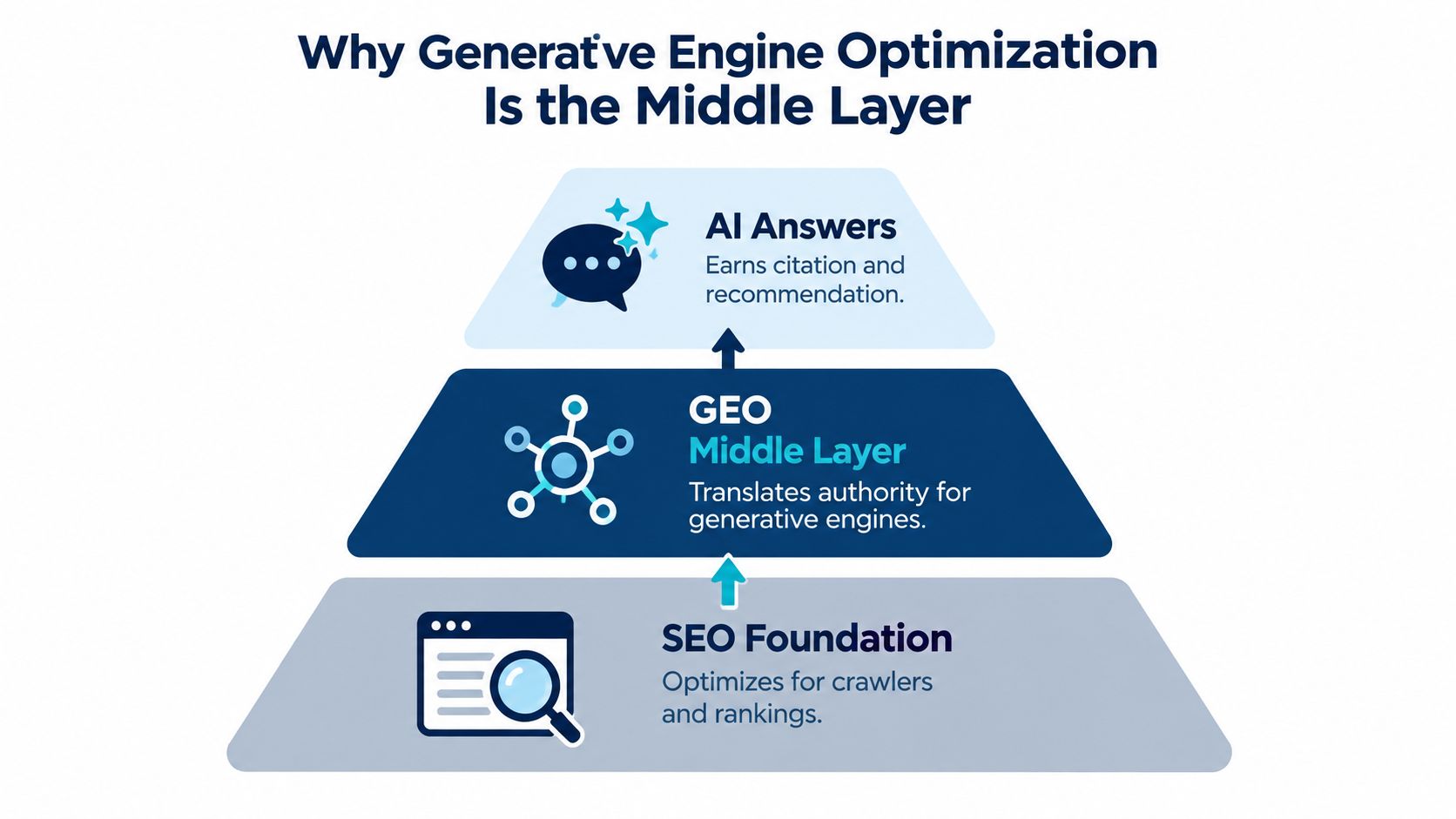
Generative engine optimization gets described as if it replaces SEO. The structure is narrower than that. SEO controls whether a brand is discoverable in the web graph. GEO controls whether a generative system can extract a page's evidence and use it in an answer.
Three layers, not one tactic
The stack has three distinct layers. Layer one is SEO, which helps AI systems discover the brand through the open web. Layer two is GEO, which helps systems extract, attribute, and cite the brand once they have decided to answer. Layer three is recommendation intelligence, which measures whether the answer layer selects the brand as a preferred option.
Practical rule: if a page can be found but not reused, it may rank in search and still fail inside the answer layer.
GEO belongs in the middle because it depends on discoverability below it and feeds recommendation behavior above it. A page that is visible to crawlers but thin on evidence can still miss the answer layer entirely.
That changes the executive question. The test is not whether a page is “optimized for AI.” The test is whether it can be discovered, extracted, and repeatedly recommended. In a three-layer stack, those are separate outcomes.
Why the market misread the category
The category was misread because the timing was abrupt. The academic definition arrived just before AI answers moved into mainstream search surfaces. Google announced the general rollout of AI Overviews to U.S. users on May 14, 2024, which pushed AI-generated summaries into prominent search positions (historical timeline). Once summaries became part of search behavior, citation started to look like authority and extraction started to look like endorsement.
That confusion is expensive. A brand can do enough to be cited and still remain absent from recommendation behavior. CitationOS found that 78% of 116 firms were invisible to AI recommendations, which is why GEO cannot be treated as the finish line. It is necessary. It is not the whole system.
The November 2023 Origin Point of GEO
The original Princeton-led paper did more than name the category. It gave GEO a benchmark, a measurement frame, and a testable method for changing how generative systems select evidence. That matters because it turns visibility into something observable, not a vague content judgment.
What the paper actually changed
The paper's real contribution was methodological. It showed that generative systems respond to source-like writing, not just to standard SEO signals. In the original benchmark, adding quotations, statistics, and citations improved visibility by up to about 40%, while keyword stuffing performed worse than doing nothing (paper summary). That result cut against older search habits.
It also defined a new object of optimization. Traditional SEO aims to raise a page in ranked results. GEO aims to raise the chance that a model extracts from a page and reuses its language as evidence. Those are different mechanisms, and the benchmark made that difference measurable.
Why the timing made GEO commercial
The research landed before the market fully understood the shift. By the time Google rolled out AI Overviews in the U.S. in May 2024, generative answers had moved from a research topic into the search interface people already used (historical timeline).
That timing compressed adoption. Teams did not get a long experimental window. The answer layer became visible first, then strategy had to catch up.
The old model treated ranking as the finish line. The newer model uses ranking as an input, then decides which evidence gets reused.
That is the origin point. GEO emerged because search stopped being only a list and became a selection problem inside a generated answer.
SEO Versus GEO and the Extraction Gap
SEO and GEO are built on the same asset, a brand's indexed web presence. They don't do the same job. SEO helps the page appear in a ranked list. GEO helps the page get extracted into a synthesized answer. Those are not interchangeable outcomes.
Discovery and extraction are different mechanics
A page can be highly discoverable and still be unusable to a generative system. That happens when the page lacks explicit facts, clear entity cues, or source-like structure. A generative engine is not merely looking for relevance. It is looking for language it can safely absorb.
| Dimension | SEO | GEO |
|---|---|---|
| Primary goal | Discoverability in search results | Extraction and citation in generated answers |
| Core surface | Blue-link ranking | Synthesized natural-language response |
| Main signal | Relevance and authority against a query | Entity clarity, source structure, and extractable evidence |
| Success state | Visible in a list | Reused inside an answer |
The difference is structural. Search ranking rewards page-level competitiveness. Generative extraction rewards whether the system can parse the page as a stable source of evidence.
The extraction gap is where visibility disappears
This gap is why a strong ranking position doesn't guarantee inclusion in an AI answer. It also explains why a weaker-ranking page can sometimes be cited if it is cleaner, more explicit, or easier to attribute. That's the extraction gap, and it's where many firms lose presence.
A useful internal distinction is laid out in the interpretation gap. The point is not that search is obsolete. The point is that search visibility no longer predicts answer visibility with enough confidence for high-stakes categories.
Operational rule: if the page can't be extracted cleanly, it can't be reused reliably.
That's why GEO is a middle layer. It starts after discovery and ends before recommendation. Teams that stop here usually overestimate their AI visibility because they're measuring reach, not reuse.
Why GEO Alone Leaves Firms Invisible
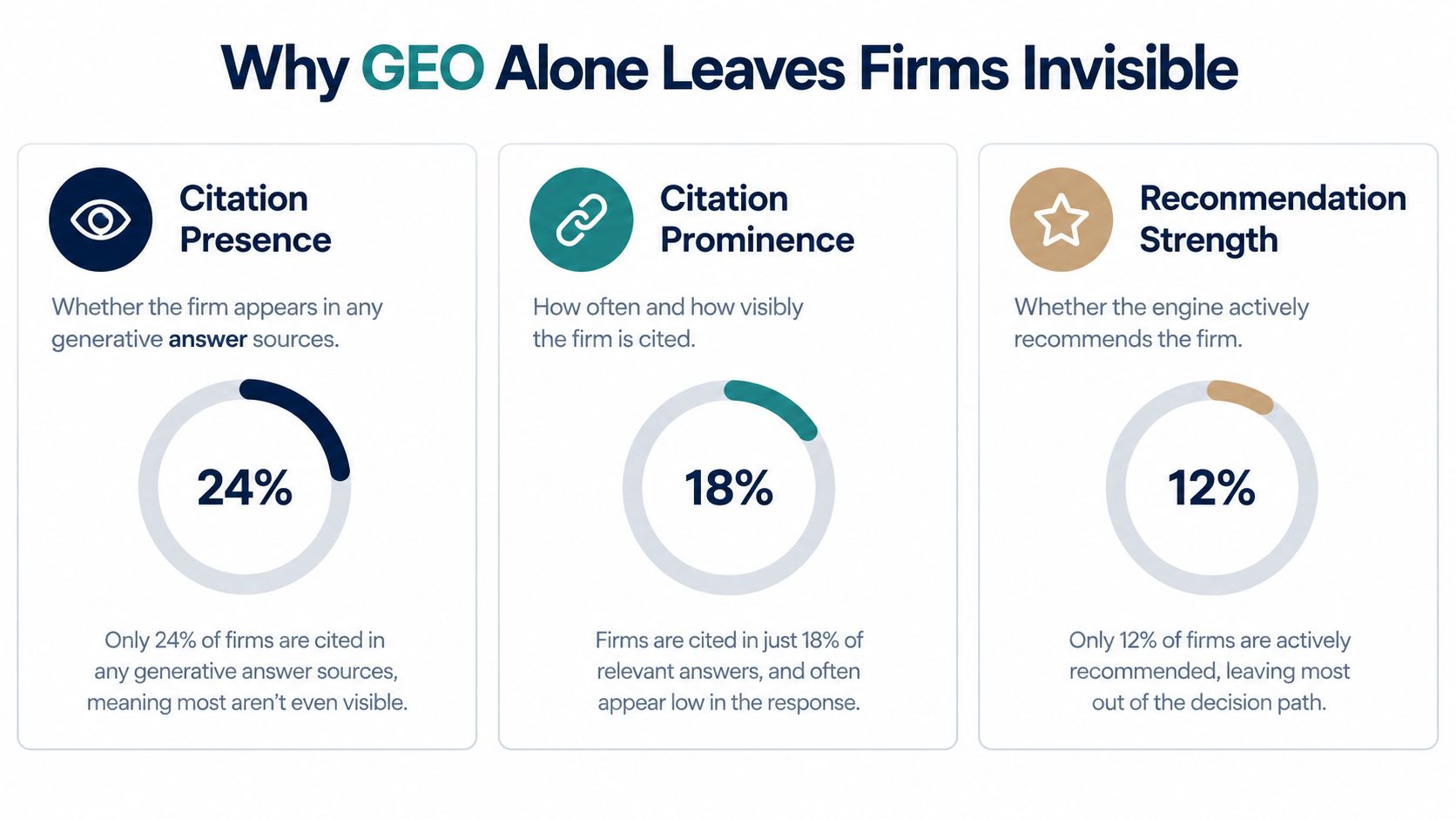
Being cited is not the same as being recommended. In high-intent categories, that difference decides whether the answer layer reduces uncertainty or merely repeats source material. CitationOS found that 78% of 116 South Florida PI firms were invisible to AI recommendations despite having functional SEO and basic GEO signals. That is the gap in practice, not theory.
Three measures expose the gap
The problem breaks into three parts.
Citation presence asks whether the firm appears in any generative answer at all. Narrative depth asks whether the surrounding language frames the firm as authoritative, peripheral, or merely mentioned. Top-3 rate asks whether the firm appears among the first three options the system produces.
These are different outcomes. A firm can have citation presence with almost no narrative depth. It can also appear in a long answer without making the shortlist. Counting mentions alone misses the commercial point.
The broader conclusion is simple. GEO can improve extraction, but extraction does not create trust. In high-stakes services, trust determines whether the brand is treated as an option or an afterthought.
Thin citations don't create shortlist power
Generative systems often surface a narrow slice of available evidence. Independent research on LLM-based search systems analyzed 55,936 queries across six LLM search engines and two traditional search engines, and found that 37% of cited domains were unique to LLM-based systems (LLM search study). A separate analysis found that Perplexity's Sonar visits about 10 relevant pages per query but cites only three to four. The funnel is tight.
That narrow funnel is why firms cannot confuse exposure with recommendation. A page may be good enough to enter the citation set and still fail to shape the answer narrative in a way that benefits the firm.
the visibility fallacy is that mistake. It treats a mention as proof of recommendation when the model may only be acknowledging a source, not endorsing it.
The AI Visibility Index Above GEO
GEO tells you whether a system can extract you. The AI Visibility Index tells you whether the system is favoring you. That is a different measurement problem, and high-trust brands need it before they spend more on content or structured data.
What the index measures
A useful index should combine four things. Citation frequency across major generative engines. Narrative positioning that shows how the brand is described. Top-3 inclusion rate in high-intent queries. And competitive share of voice across peer firms.
Those are not vanity metrics. They are signals of recommendation strength. A brand that is cited often but described weakly has a different problem from one that appears rarely but with strong narrative depth. The index has to distinguish between those conditions.
| Measurement Layer | What It Captures | Limitation |
|---|---|---|
| Citation counting | Whether a URL appears in an answer | Misses how the brand is framed |
| GEO-only review | Extractability and citation readiness | Doesn't show recommendation strength |
| AI Visibility Index | Citation presence, narrative depth, and top-3 inclusion | Requires structured analysis across engines |
The distinction matters because a flat citation count hides context. It tells you nothing about whether the model describes the firm as primary, peripheral, or merely useful for background.
Why weighted measurement comes first
The original measurement framing for GEO already treated the system as two-stage, selection first, then absorption (two-stage framework). The AI Visibility Index adds the layer that many teams skip, which is whether selection turns into recommendation.
That's why surface-level AI tools are insufficient for executive decisions. what surface level AI tools measure is usually the easiest thing to count, not the thing that moves shortlist behavior. Counting mentions is operationally cheap. Understanding narrative depth is strategically harder.
Practical rule: if the index doesn't segment by query intent, it will blur informational visibility with buyer-intent visibility.
For trust-sensitive brands, that blur is dangerous. The answer layer can misclassify a firm with one weak signal, and the business impact shows up in shortlist inclusion, not traffic.
Citation Behavior in High Intent Legal Queries
Legal search is where the recommendation layer becomes easiest to see. Buyers aren't asking casual questions. They're asking who can be trusted with a consequential decision. That changes the citation pathway.
Why intermediaries dominate the path
In legal queries, structured intermediary sources often carry more weight than firm-owned pages because they package expertise in a way generative systems can parse quickly. The legal-specific visibility study covering 1,620 answers to 540 lawyer-hiring queries found that a legal directory was the first source cited 77.8% of the time, and directories accounted for at least 51.8% of all 18,900 citations.
That matters for one reason. The citation pathway runs through sources the firm often doesn't control. A practice page can be well written and still lose to a structured intermediary because the intermediary gives the system cleaner provenance.
The retrieval problem is not just on-page
High-intent legal answers tend to rely on structured evidence, not generic brand prose. The system is looking for provenance, recency, and authority cues it can verify quickly. That makes attorney bios and practice pages necessary but insufficient.
The practical implication is direct. Law firms that only tune their own site are optimizing one node in a wider citation graph. The actual recommendation path often depends on the sources the engine trusts upstream.
That's why GEO alone falls short in legal services. It can help a firm become more extractable, but the answer layer may still prefer intermediary proof over owned content. Firms that ignore that structure end up visible in principle and omitted in practice.
What High Trust Brands Must Add Beyond GEO
GEO is necessary for high-trust brands, but it's not enough. The third layer requires a brand to be legible across the places generative systems already trust, not just on the brand's own pages.
The real work is structural
High-trust brands need defensible entity graphs. They need consistent naming, consistent attributes, and consistent positioning across owned, earned, and structured sources. They also need citations in authoritative intermediaries that AI engines retrieve from. None of that happens automatically when a content team writes more pages.
Narrative depth matters more than raw mention volume. A weak citation can make a brand appear present without making it appear credible. A strong narrative can turn a mention into a recommendation cue, but only if the source structure supports it.
Some firms need a diagnostic layer that can show the difference. CitationOS is one example of an AI recommendation intelligence platform that measures representation, narrative strength, and shortlist inclusion across AI systems. In this category, the point is not to manipulate outputs. It is to measure whether the system has enough evidence to trust the brand.
The firms that win in AI answers won't just be discoverable. They'll be structurally legible in the sources the model already believes.
What leadership should stop expecting
Executives shouldn't expect GEO to solve recommendation blindness on its own. If the brand is weak in intermediary sources, inconsistent in entity signals, or thin in narrative depth, more GEO content only improves extraction around the edges.
That's the core category mistake. GEO is a bridge, not the destination. The destination is recommendation readiness, which has to be measured separately.
The Category Implication for AI Visibility
AI visibility is not one project. It's a layered measurement problem. Firms that optimize for extraction without measuring recommendation trust will keep producing pages that can be cited but not chosen.
The sequence that actually works
The order should be strict. Measure first. Then optimize the pages and entities that feed the answer layer. Then measure again to see whether the brand has moved from citation presence to recommendation strength.
For law firms and other high-intent businesses, the right starting point is an AI Visibility Index audit that checks citation presence, narrative depth, and top-3 recommendation rate. That audit tells you whether the firm is even retrievable in the forms that matter. If it is not, further GEO work is guesswork.
The deeper implication is strategic. A firm can have functional SEO and passable GEO and still lose the recommendation layer entirely. That doesn't mean the content is bad. It means the system doesn't trust the brand enough to place it in the shortlist.
So the priority is not more content by default. It's better diagnosis. Once the entity graph, source mix, and narrative structure are visible, the next move becomes obvious.
CitationOS gives executive teams a way to see where AI systems are citing, framing, and selecting a brand across high-intent queries. If you're evaluating GEO, the first question is whether your firm is being extracted at all, and the second is whether it's being recommended. Visit CitationOS to assess that gap before you spend more on content or schema work.