78% of 116 law firms scored by CitationOS were invisible to AI recommendations across 16 months of diagnostics. That finding changes the central question for law firm content marketing. The issue is not just whether a firm ranks, attracts sessions, or earns backlinks. It's whether an AI system can identify the firm as a credible answer, extract a defensible statement about its capability, and recommend it when a prospective client asks for counsel.
Traditional search metrics still matter at the discovery layer. They don't explain the selection decision that follows. Content can be indexed and highly visible in conventional search while remaining absent from shortlists generated by AI systems.
The practical distinction is simple. SEO helps systems discover you. GEO helps systems extract and understand you. CitationOS measures whether AI trusts and recommends you. That third layer is where law firms need a more exact operating model, built around citation presence, narrative depth, and top-3 rate.
Table of Contents
- The Reframe Most Law Firm Content Marketing Still Misses
- The Three Layers of AI Visibility for Law Firms
- Formats That No Longer Earn AI Recommendations
- Building a Topical Architecture AI Can Extract From
- What Citation Intelligence Measures That GEO Tools Cannot
- How a Content Program Changes When Recommendation Is the Goal
- The Strategic Implication for Law Firm Leadership
The Reframe Most Law Firm Content Marketing Still Misses
The CitationOS diagnostic provides a useful baseline: 116 firms scored, 78% invisible to AI recommendations, and 16 months of diagnostics. The result doesn't show that these firms lacked websites or published nothing. It shows that conventional online visibility doesn't guarantee inclusion when an AI system constructs an answer or shortlist.
That distinction matters because legal buyers rarely evaluate content as an isolated publishing output. They use it to assess whether a firm understands a matter, serves a relevant jurisdiction, has handled comparable work, and can be trusted with a consequential decision. An AI system performs a compressed version of that evaluation by selecting sources it can interpret and connect to a credible entity.
A ranking report may tell a managing partner that a page appears for a keyword. It doesn't tell the partner whether an AI response mentions the firm, which page supports the mention, or whether the firm appears among the leading recommendations. The visibility fallacy in legal search is treating discovery as proof of selection.
Content must function as evidence
The strongest legal content resembles a well-built record. It states a clear proposition, identifies the author, specifies the jurisdiction and matter type, and provides enough supporting context for another system to verify what the firm is claiming.
That requires more than polished prose. A generic article about commercial disputes may be readable, but it gives an extraction engine little basis for deciding what is distinctive about the firm. A matter-specific analysis with attributable authorship, jurisdictional detail, and verifiable outcomes gives the system more usable evidence.
Practical rule: If a sentence can't stand as a sourced answer to a client question, it probably won't carry much recommendation weight.
This is why citation presence should come before traffic interpretation. A firm that never appears in an AI response has a different problem from a firm that appears but is never cited, and both differ from a firm that is cited but consistently excluded from the top three sources.
Three metrics replace one vague visibility score
Narrative depth measures how fully AI systems can describe the firm beyond its name. Citation presence measures whether the firm or its content appears in the response. Top-3 rate measures whether the firm reaches the leading cited or recommended positions across relevant prompts.
Together, these metrics describe recommendation authority more precisely than sessions or rankings alone. They also give marketing leaders a sequence for action: establish discoverability, improve extractability, then strengthen the evidence that supports recommendation.
The Three Layers of AI Visibility for Law Firms
AI visibility has three distinct layers, and each one fails for a different reason.
Discovery determines whether the system can find the evidence
Discovery is the technical and structural layer. Crawlers and retrieval systems need to locate practice pages, attorney profiles, case materials, jurisdiction pages, and supporting references. Search architecture, internal links, indexability, clear URLs, and consistent entity information all influence whether the content enters the system's available evidence set.
A firm can fail here even when its writing is strong. Important material may sit behind poor navigation, appear only in image formats, or lack connections to the firm and attorneys it describes. Industry guidance for legal SEO recommends mapping practice areas, locations, and long-tail questions to distinct intents, then reinforcing the architecture with internal links and ongoing updates. The surface-level measurement problem begins when teams mistake this layer for the whole system.
Extraction determines whether the claim is usable
Extraction asks whether an AI system can lift a clean, accurate statement from a page. Legal content needs explicit answers, identifiable sources, jurisdictional boundaries, named authors, and structured context. A page that discusses many issues without a clear proposition may be discoverable but difficult to quote or summarize reliably.
Generative engine optimization, or GEO, and answer engine optimization, or AEO, become practical disciplines. They aren't replacements for sound legal editorial standards. They make those standards legible to systems that need to identify what a page says, who stands behind it, and when the statement applies.
Recommendation determines whether the firm is selected
Recommendation is the decision layer. The system has found and understood the material, but it still must decide whether the firm belongs in the answer. That choice depends on the strength and consistency of the firm's entity signals, the depth of its narrative, the relevance of its evidence, and the authority of sources connecting the firm to specific legal work.
The working vocabulary should remain precise:
- AI Visibility Index, or AVI: an overall view of how consistently a firm appears across relevant AI discovery and recommendation contexts.
- Citation presence: whether the firm or its published material appears in an AI-generated answer.
- Narrative depth: how much specific, attributable information an AI system can use to characterize the firm.
- Top-3 rate: how often the firm appears among the leading cited or recommended sources.
- Entity authority: the coherence and credibility of signals connecting the firm, its lawyers, practice areas, jurisdictions, and matters.
A useful diagnostic starts by identifying the failed layer. If the page isn't found, improve discovery. If it's found but not quoted, improve extraction. If it's quoted but the firm isn't recommended, investigate entity authority, comparative evidence, and top-3 performance.
Formats That No Longer Earn AI Recommendations
Partner bios, generic FAQ pages, and unsigned thought leadership aren't useless. They're weak when firms ask them to do work they weren't designed to perform.
Recent legal-marketing coverage says Google AI Overviews answer over 60% of legal informational queries directly, which reduces the value of a strategy built entirely around earning a click from a basic explainer. The source for that figure, coverage of the 2025 legal marketing landscape, also points to a market in which firms need to prepare for both conventional search and AI-driven discovery.
The structural weakness is clear. A conventional bio may establish experience but contain no extractable matter detail. A generic FAQ may answer a common question without identifying jurisdiction, source, or firm-specific competence. An unsigned opinion may express a position without giving an AI system enough authorship and verification context.
| Legacy Format | Why AI Skips It | Replacement Format |
|---|---|---|
| Partner biography | Lists credentials without connecting them to specific matters, jurisdictions, or outcomes | Credentialed jurisdiction page with attributable experience and case evidence |
| Generic FAQ article | Answers broad questions without intent boundaries or primary support | Intent-clustered question hub with sourced, jurisdiction-specific answers |
| Unsigned thought leadership | Offers opinion without a verifiable expert or matter connection | Named-expert analysis tied to a documented legal issue or representative matter |
Editorial structure matters more than word count
The replacement isn't longer content for its own sake. It's content with a stronger evidentiary shape. A page should make clear who wrote it, what legal question it addresses, where the answer applies, and which facts support the conclusion.
The same principle applies to case studies. Ethical and confidentiality constraints may limit what a firm can disclose, but that doesn't require every matter page to become vague. Firms can describe matter type, procedural posture, jurisdiction, legal challenge, strategic approach, and outcome where permitted.
A recommendation engine needs reasons to select a firm, not merely reasons to index a page.
The shift is therefore editorial discipline, not cosmetic optimization. The selection moment for AI recommendations occurs after discovery and extraction. Firms that publish undifferentiated content may remain present in the corpus while contributing little to the final choice.
Building a Topical Architecture AI Can Extract From
A 2026 law-firm benchmark found that 96% of law firm websites include partner profiles, while 54% include in-house legal articles (law-firm marketing benchmarks for 2026). That gap suggests a common information architecture: substantial identity content, thinner evidence about how the firm applies legal knowledge to defined matters.
A stronger architecture treats the website as an evidence graph, not a sitemap. Each page should connect a legal issue to a jurisdiction, an attorney, a practice capability, and supporting proof.
The first tier establishes substantive capability
Practice-area pillars should define the firm's actual work in terms a client and an AI system can distinguish. A litigation page, for example, should separate commercial disputes, shareholder conflicts, regulatory investigations, and appellate work where those distinctions reflect real capability.
Each pillar needs jurisdictional boundaries and links to deeper evidence. Broad labels alone create weak entity associations because they don't show how the firm applies the practice in a specific context.
The second tier resolves jurisdiction
Jurisdiction pages should identify bar admissions, court coverage, relevant local statutes, and the lawyers responsible for the work. A client asking about a legal issue in a particular state or court isn't asking for a generic practice overview.
This tier gives the extraction engine the context needed to avoid overgeneralization. It also helps the firm connect its named attorneys and matter experience to a place where the legal question arises.
The third tier answers grouped client intents
Question pages should be organized around distinct intent clusters, including comparative, procedural, and cost-related questions. The point isn't to publish every conceivable FAQ. It's to create a set of pages where each question receives a clear answer with defined scope and supporting references.
A question hub can link from a broad issue to procedural steps, decision criteria, and the evidence that supports the firm's approach. Structured data, clear headings, and expert author bios help systems resolve the page's meaning.
The fourth tier supplies matter-specific proof
Case studies, representative verdicts, settlements, and transaction pages provide the evidence layer. Where disclosure permits, structured facts should identify the matter type, jurisdiction, legal problem, firm role, and result. Where confidentiality limits detail, the page should state those limits rather than substitute unsupported generalities.
Every tier needs entity markers, verifiable author credentials, and structured data. The objective is to let an extraction system connect the firm to a matter without inference doing all the work.
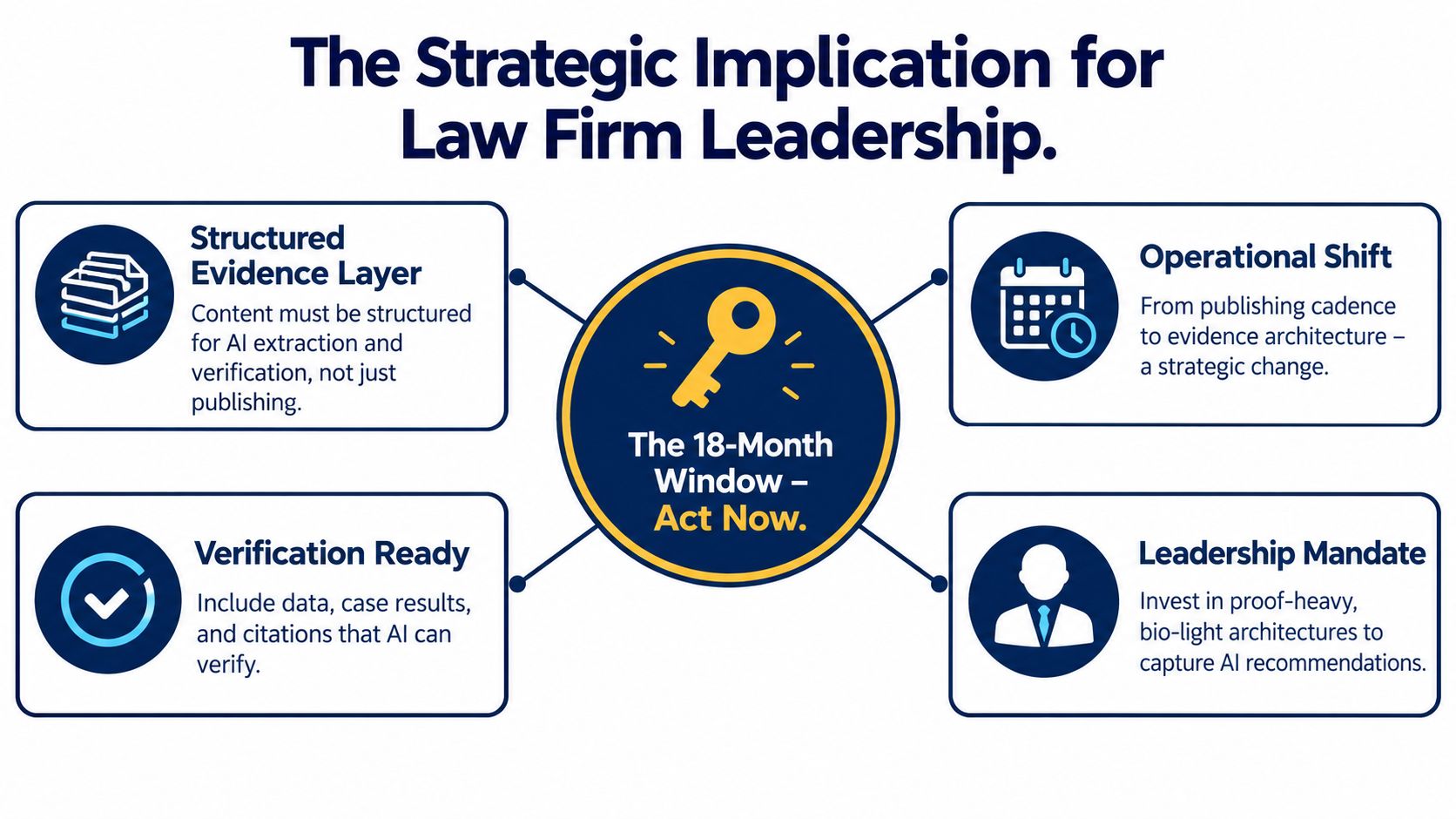
The architecture changes the production question from “What should we publish this month?” to “Which missing connection prevents the system from understanding and recommending us?”
What Citation Intelligence Measures That GEO Tools Cannot
Surface-level GEO reporting often collapses different outcomes into a single visibility label. That creates an executive problem: a firm may appear somewhere in an answer, yet never receive a citation, never support the extracted claim, and never reach a leading recommendation position.
Citation intelligence separates the outcomes.
| Measurement Layer | Surface GEO Tools | Citation Intelligence |
|---|---|---|
| Presence | Reports whether a firm appears in a sampled response | Tracks appearance by query, system, practice area, and context |
| Extraction | May show broad visibility without identifying the supporting page | Maps extracted claims to the page and passage that support them |
| Recommendation | Often treats any mention as success | Measures inclusion, relative position, and top-3 rate |
| Narrative | Uses a general score for visibility | Scores the specificity and depth of the firm's representation |
| Entity authority | Reviews isolated signals | Connects firm, attorneys, practices, jurisdictions, and matters across sources |
| Change over time | Provides snapshots | Tracks movement across multiple AI systems and query sets |
Presence isn't recommendation
A firm can be named in a response because an AI system found a relevant page. That doesn't mean the system considers the firm a leading choice. The distinction becomes material for high-intent queries, where a shortlist position has more strategic value than a passing mention.
A useful framework therefore includes a Citation Score that aggregates inclusion, narrative strength, entity strength, and relative positioning across relevant systems. It should also show the underlying query-level evidence, rather than asking leadership to accept one opaque number.
Diagnostic detail changes the decision
A recommendation audit can reveal that one practice area has strong citation presence but shallow narrative depth. Another may have detailed pages but weak entity consistency because attorney credentials, directories, and firm pages describe the practice differently.
Cross-system tracking across ChatGPT, Gemini, and Perplexity adds another necessary dimension. Different systems may retrieve different sources and represent the same firm differently. A single dashboard that reports only traffic cannot expose those divergences.
CitationOS is an AI recommendation intelligence platform that evaluates citation presence, narrative depth, and top-3 recommendation rate across those systems. Its role is measurement and structural diagnosis, not content production or search-engine optimization.
A ranking report asks where a page appears. A recommendation audit asks why a firm was selected, what evidence supported the selection, and what prevented a stronger position.
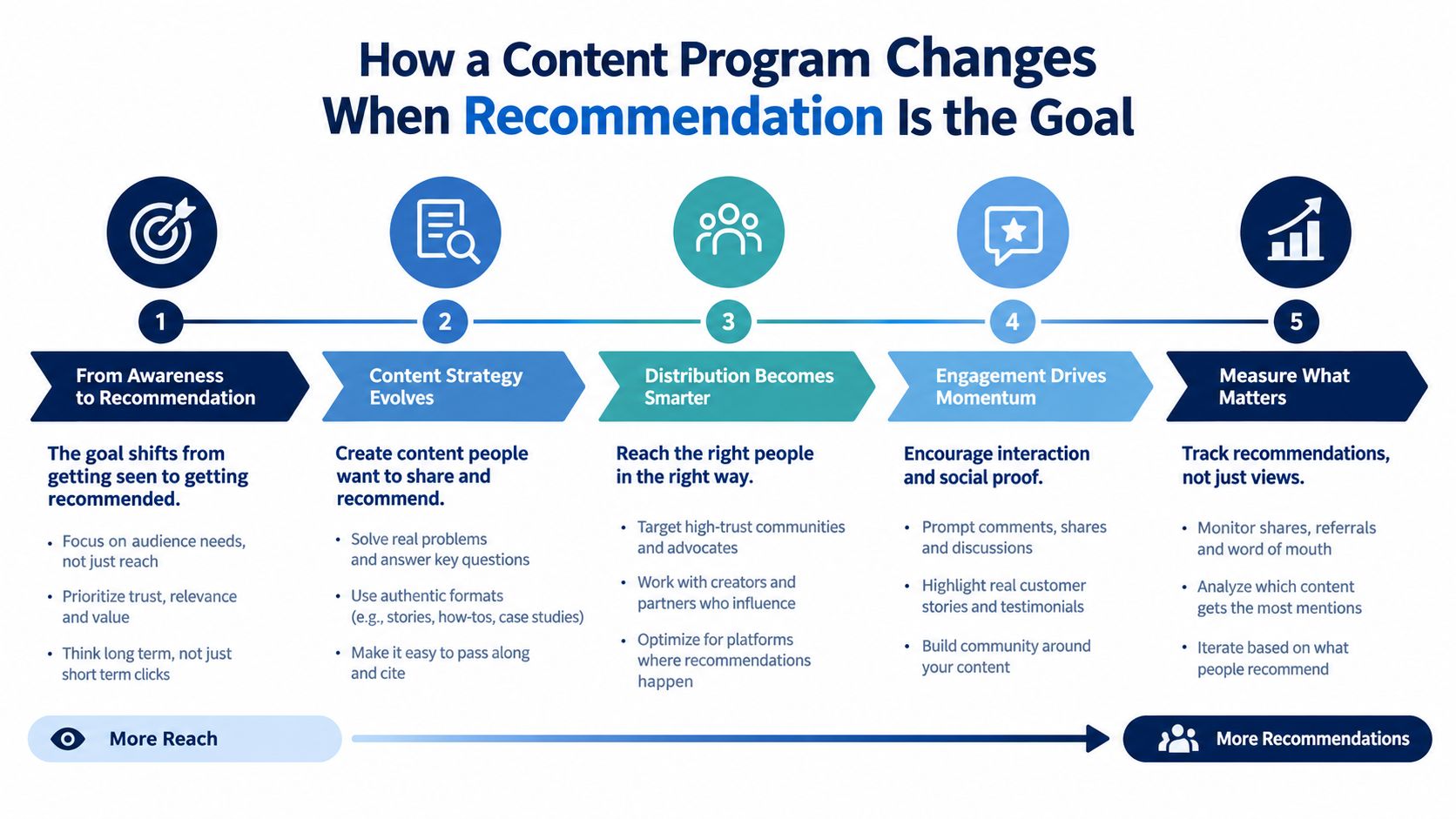
How a Content Program Changes When Recommendation Is the Goal
Consider a representative mid-market litigation firm with an established publishing calendar, several strong attorneys, and conventional search visibility. Its leadership doesn't begin by commissioning more articles. It begins by testing whether AI systems recommend the firm for the matters it wants.
The first month creates a recommendation baseline
The firm runs a citation audit across 50 commercial-litigation queries. The audit identifies which competitors occupy recommendation positions, which questions produce no firm citation, and which existing pages appear in responses without placing the firm among the leading sources.
The output is not a list of keywords. It's a map of recommendation gaps. One cluster may lack jurisdiction pages. Another may have relevant attorney bios but no matter-specific evidence. A third may contain useful content that AI systems can find but cannot attribute clearly to the firm.
Months two through four replace calendar logic
The firm retires its generic thought-leadership calendar and redirects production toward the four evidence tiers: practice pillars, jurisdiction pages, intent-clustered questions, and case-specific proof.
Before publication, each asset receives an editorial assessment:
- Citation presence: Does the content address a query the firm wants to own?
- Narrative depth: Can an AI system describe the firm's capability with specific facts?
- Entity authority: Are the author, firm, jurisdiction, and matter connections verifiable?
- Extraction clarity: Can the answer be lifted without reconstructing the argument?
This process changes who participates. Practice-group leaders supply matter context and source material. Marketing teams manage structure, governance, and measurement. Attorneys remain accountable for legal accuracy and permitted disclosure.
Months five through eight optimize for selection
Traffic no longer determines which pages receive attention. Extraction diagnostics identify pages that are present but not recommended, then editors revise the missing evidence, attribution, or jurisdictional detail.
A page may need a named author, a clearer answer near the top, a link to a representative matter, or a more precise description of the firm's role. In other cases, the page should be consolidated because several similar URLs divide the firm's authority and make the intended source unclear.
The operating principle is structural fit, not publishing volume. A smaller set of pages with clear claims and defensible evidence can serve recommendation systems better than a larger stream of interchangeable commentary.
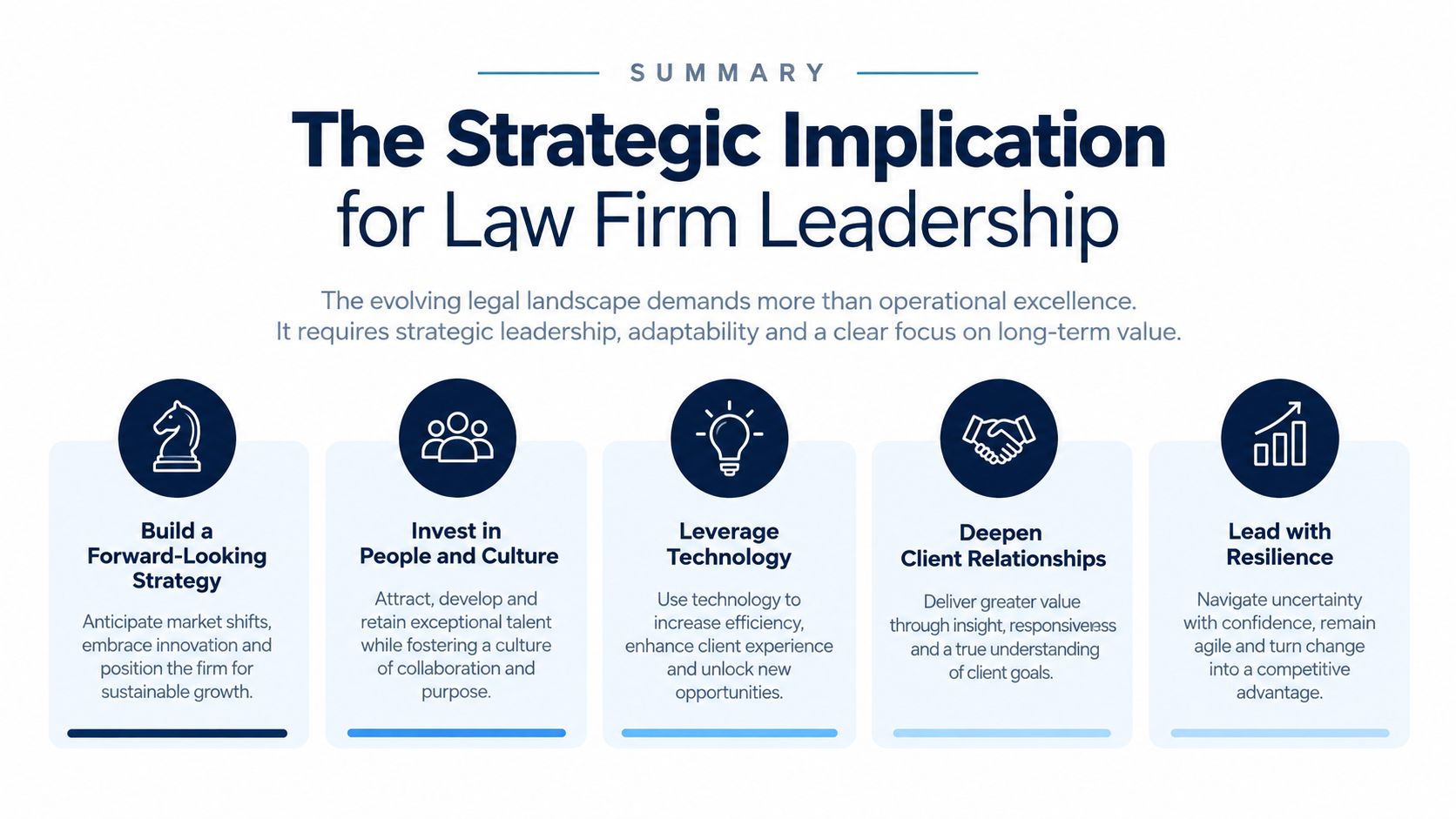
The Strategic Implication for Law Firm Leadership
Law firm content marketing is moving from a publishing function to a structured evidence function. The shift doesn't eliminate articles, bios, or search optimization. It changes the standard each asset must meet before leadership treats it as a strategic contribution.
For managing partners, the budget implication is direct. Production volume should no longer absorb the entire content allocation. Firms need resources for citation diagnostics, entity consistency, authorship governance, matter documentation, structured data, and recurring audits across the AI systems that shape client shortlists.
Editorial governance also needs to move closer to practice leadership. Marketing teams can identify query gaps and manage the architecture, but attorneys and practice-group leaders hold the source material that creates narrative depth. Without their involvement, content tends to describe services in abstract terms instead of demonstrating capability through matters, jurisdictions, and outcomes.
The measurement model must change
The executive dashboard should separate the three layers:
- Discovery: whether relevant pages and entity references can be found.
- Extraction: whether systems can identify and use accurate claims.
- Recommendation: whether the firm earns citation presence and a meaningful top-3 rate.
AVI can summarize the overall position, but leadership should inspect its components. Citation presence shows reach within answers. Narrative depth shows whether the system can explain the firm. Top-3 rate shows whether that explanation translates into competitive recommendation authority.
The competitive baseline remains severe. CitationOS found 78% of 116 scored firms invisible to AI recommendations, based on 16 months of diagnostics. That gap creates an unusual leadership decision. Firms don't need to assume every competitor is prepared. They do need to recognize that conventional visibility may conceal the same weakness across the market.
The next 18 months are an authority-building window
The practical window is 18 months. That doesn't mean every firm will transform at the same pace, or that AI recommendations will remain static. It means leadership has a defined period in which to build a structured evidence layer before recommendation authority becomes harder to displace.
Firms should treat the next 18 months as a recommendation-authority build. The winners won't be the firms that publish the most. They'll be the firms whose content AI systems can discover, extract, verify, and confidently connect to a real legal capability.
CitationOS provides confidential AI citation audits, competitive benchmarking, entity consistency assessment, and ongoing monitoring across ChatGPT, Gemini, and Perplexity. Visit CitationOS to establish a baseline for citation presence, narrative depth, and top-3 recommendation rate before reallocating your law firm content marketing program.