By March 2025, the number of keywords triggering Google AI Overviews had reached nearly 19 million, a 91% increase in six months, following the expansion set out in Google's AI Overviews update. That's not a marginal change in search layout. It's a change in where decisions start.
When an assistant answers first, a firm doesn't compete only for a click. It competes to be selected, described correctly, and placed on a shortlist the user may never expand. AI content optimization therefore isn't a rewrite exercise. It's the work of making claims extractable, evidence traceable, and entity signals consistent enough that a system can cite a firm without distorting what it does.
The common error is treating every absence as a content problem. Some absences are discovery failures. Some are extraction failures. Others occur at the recommendation layer, where the firm is known but not trusted enough to name. Each requires a different fix, and applying the wrong one wastes the test.
Why AI Content Optimization Is Now a Separate Discipline
Three layers determine AI visibility, and they fail independently. SEO helps systems discover you through indexing, crawlability, and rankings. Generative engine optimization (GEO) helps systems extract and understand your claims. AI recommendation intelligence measures whether an assistant names and cites you when a user asks whom to consider.
Ranking settles only the first question. Google introduced AI Overviews in the United States in May 2024, and Authoritas later analyzed 6,599 U.S. keywords and found overviews for 17% of queries, with six out of ten cited pages coming from outside Google's conventional top ten organic listings, as reported in The Verge's account of Google AI search and publishing. Position alone didn't determine source selection.
The Layer Distinction in Practice
A page can rank, yet state its services too vaguely for extraction. A page can be extractable, yet lack the independent evidence that supports recommendation. That's why assessments of content optimization software for 2025 are useful only if you first know whether you need discovery, extraction, or recommendation measurement. Tool selection follows diagnosis, not the reverse.
CitationOS has scored 116 firms over 16 months of diagnostics, and 78% were invisible to AI recommendations. Many ranked respectably in conventional search. Their problem wasn't absence from the index. It was absence from the answer.
Name the failing layer before you choose an intervention. A discovery fix won't repair an extraction gap, and neither will repair weak recommendation authority.
Diagnosing the Gap Precedes the Five-Step Optimization Cycle
Hold every edit until the baseline is complete. Editing first destroys the comparison you need later, because you won't know whether a change in output came from your page, a third-party source, or normal variation between runs.
Run a fixed prompt set across ChatGPT, Gemini, and Perplexity before touching copy. Classify each absence as discovery, extraction, or recommendation. Then locate the source of the failure. If assistants cite a directory that misstates your practice area, rewriting your own service page won't correct the answer. If they cite your page but compress two services into one, that's an extraction problem on a page you control.
Step One Defines the Query Set
Build one fixed set per practice area, client type, or service line. Split prompts across three stages. Discovery prompts ask how a problem is handled. Comparison prompts ask how options differ. Shortlist prompts ask for named firms in a place, specialty, or matter type.
List the entities each prompt should reasonably name, including your firm and direct competitors. Don't rewrite prompts mid-test to chase a better result. A moving prompt set produces movement you can't interpret. A structured AI search audit gives this classification a repeatable form before any content work begins.
Step Two Establishes the Baseline
Run the set under fixed settings and repeat each run. Single outputs are anecdotes. Assistants vary phrasing, source order, and sometimes the firms named, so repetition separates a stable absence from a one-off omission.
Score each output with a metric that weights both citation and prominence. Citation presence records whether you're cited at all. Prominence records where you appear and how much of the answer you occupy. A citation buried after five competitors isn't equivalent to a named recommendation in the opening lines.
Record the prompt, date, platform, sources cited, firms named, and score for every run. Keep the raw outputs. You'll need them when a later result looks better but describes you less accurately.
Steps Three and Four Isolate Each Change
Create controlled variants that change one element at a time. Test citation, quotation, statistics, terminology, readability, and keyword changes separately. If you add a statistic, rewrite the heading, and change the service description in one release, you can't attribute the result.
The evidence for isolation is clear. In the GEO-bench study of approximately 10,000 queries across 25 domains, adding relevant quotations, statistics, and source citations produced roughly 30 to 40% relative gains in Position-Adjusted Word Count, while keyword stuffing fell from 19.3% to 17.8%, as set out in the Princeton GEO study methodology and critique.
Treat those gains as directional. The benchmark environment doesn't fully represent every current assistant or every legal, medical, or financial query. What transfers is the method, not the percentage. A sourced, specific claim is easier for a system to reuse than a page padded with repeated terms.
- Citation variant: Add one authoritative source to one material claim, then rerun.
- Statistic variant: Add one dated, attributed figure where the page previously made a general claim.
- Terminology variant: Replace internal jargon with the plain matter or service term clients use.
- Readability variant: Shorten sentences and put one claim in each paragraph without changing the facts.
Step Five Validates on Live Systems
Validate on production assistants after the change window, using the same prompts and settings as the baseline. Fix the single most-cited source first when descriptions conflict, because that source is doing the most work in the answer. Don't declare success from one improved output.
Compare citation presence, position, and description accuracy against the baseline log. Keep changes that improve inclusion without introducing error. Revert or revise changes that increase mentions while degrading how you're described. That trade is not progress.
Structuring Pages So Models Extract Claims Accurately
Put the answer first. Place each verifiable claim in the opening lines of its section, with one claim per paragraph, so extraction doesn't depend on a system reading the full page and inferring your point from context.
A practice or service page should state scope, jurisdiction or service area, matter or case type, named expertise, and evidence in the first substantive paragraph. Don't leave jurisdiction only in the footer. Don't describe expertise only through adjectives. Name the people, credentials, and work types that support the claim.

Rules for Extractable Claims
Attach an authoritative source to each material assertion. Date and attribute every statistic on the page, not in a separate document the reader has to hunt for. If a claim can't be sourced, narrow it until it can, or remove it.
Name matter types in headings in plain terms. A heading that says contested probate, spinal surgery, or cross-border tax gives a system a clean category. A heading built around a slogan gives it nothing to classify. Answer engine optimization (AEO) starts here, with information a system can lift without guessing.
Keep related facts together. If a credential appears on a biography, a different title appears on the service page, and the office address differs in the footer, extraction can combine fragments into a statement none of your pages made.
Fan-Out and Structured Data
Anticipate adjacent questions. Google's guidance on AI features in Search describes a query fan-out process in which AI Overviews and AI Mode issue multiple related searches across subtopics and data sources, then identify additional supporting pages while generating the response. Your page therefore competes not only on the user's exact wording, but on the subquestions the system generates from it.
Answer those adjacent questions on the page where they're relevant. For a service page, that usually means eligibility, process, timing, geography, who handles the work, and what evidence supports the firm's experience. Don't scatter those answers across unrelated posts and expect the system to assemble them.
Google also states that no special AI markup or machine-readable file is required for eligibility, and that structured data should match the visible page text. Check markup for credentials, addresses, and practice or service names against the biographies and pages it describes. A mismatch gives the model two versions of one fact.
Finish with a direct check. Read each page one claim at a time and mark every claim that lacks a source or a named entity. Those marks are your edit list.
Aligning Entity Names, Credentials and Practice Areas
Say a boutique firm handles probate litigation. Its own site says probate litigation. One directory lists it under wills and trusts. An assistant, weighing both, places it in estate planning. The firm then appears for work it doesn't seek and disappears from contested matters it does handle.
No single source caused that outcome alone. AI systems form conclusions from distributed signals across directories, regulator or bar listings, biographies, publications, verdict or outcome reports, and third-party references. A conflict in any one source can surface in the answer, especially if that source is cited often. Building entity authority depends on removing those conflicts at their origin, a process set out in the entity authority framework.

The Six-Attribute Audit
Audit six attributes across every source you control or can correct.
- Legal name and abbreviations: One full name, one approved short form.
- Practice or service areas: The same category labels in every listing.
- Jurisdictions and locations: Current offices only, with closed locations removed.
- Titles and credentials: Titles that match regulator, licensing, or institutional records.
- Founding and office history: Dates that don't shift between biography and directory.
- Client types described: A consistent account of whom the firm serves.
For each attribute, choose one canonical phrasing, correct the outlier at its source, and record the date of the change. Don't just fix your website and leave the directory entry that assistants cite. Prioritize by citation evidence from your prompt tests, not by which listing is easiest to update.
Check each attribute against the licensing body or regulator register that governs the firm. Those records are what a careful reviewer checks first, and they're the reference point when internal pages disagree with each other.
The risk isn't specific to law firms. A clinic with a closed location still listed in a directory can be recommended in a city it left. A wealth manager assigned the wrong specialty can be excluded from the prompts that matter. A luxury house described through an outdated product line carries the same exposure. In each case the error persists because nobody owns the source record.
Assign one named owner for entity corrections. Without ownership, the audit becomes a document rather than a set of completed changes.
Citation Practices That Differ Across ChatGPT, Gemini and Perplexity
Platform averages differ enough to change your coverage strategy. In an analysis of 40,000 AI responses containing 250,000 citations, Perplexity averaged 6.61 citations per response, Gemini 6.10, and ChatGPT 2.62, as reported in Thomson Reuters' 2025 generative AI in professional services report.
| Platform | Citations per response | What the count means for coverage |
|---|---|---|
| Perplexity | 6.61 | Many sources per answer, so coverage across several pages can win |
| Gemini | 6.10 | Many sources per answer, so pages answering adjacent subtopics matter |
| ChatGPT | 2.62 | Few sources per answer, so the single cited page must carry the claim |
Where many sources are cited, breadth helps. Several accurate pages across your site and third-party sources give the system more eligible material. Where few sources are cited, the margin for a weak page disappears. The one page selected has to support the exact statement made about you.
Source Type Shifts by Stage
The same analysis found third-party editorial sources more prominent during problem exploration, forums and review sites growing during comparison, and brand or competitor websites more common during final evaluation. That sequence has a direct implication. Publishing more first-party articles may not improve shortlist inclusion if the decision stage draws on reviews, directories, and editorial coverage you haven't addressed.
Map sources by stage instead of treating all citations as interchangeable. For exploration prompts, check whether credible editorial sources describe your category and include you accurately. For comparison prompts, check reviews and directories for wrong specialties, stale locations, and missing credentials. For final evaluation, make your own service pages specific enough to confirm scope, people, and evidence without forcing the user to search elsewhere.
Review stage results separately. A firm can look strong in educational answers and weak in shortlist queries, and an aggregate score will hide that split. The commercial risk sits in the shortlist stage, so that's where absence deserves the most scrutiny.
When assistants describe the firm differently, correct the most-cited source first. Correcting the least-cited source first feels orderly and changes little.
Place verified firm data in directories and editorial coverage that match the actual practice or service. Don't pursue coverage in categories you don't serve. Miscategorized visibility creates the next round of correction work.
Measuring Citation Presence, Narrative Depth and Top-3 Rate
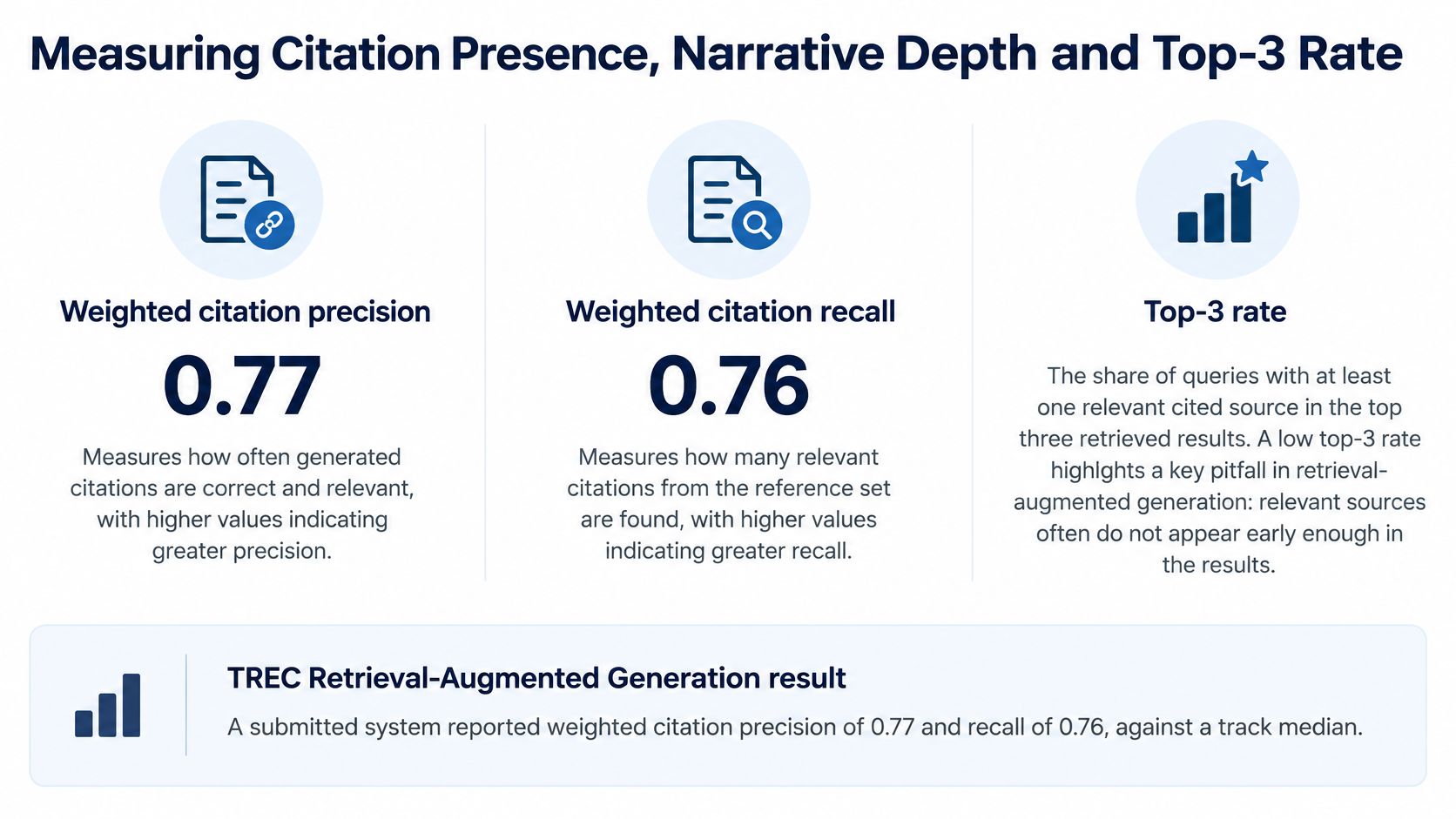
Citation counts alone will mislead you. In the TREC Retrieval-Augmented Generation track, a submitted system reported weighted citation precision of 0.77 and weighted recall of 0.76, compared with an approximate track median of 0.40, according to the TREC 34 RAG track paper. A system can cite a source and still fail to support the proposition it generated.
Score visibility and support as separate questions. Inclusion tells you whether you appear. Entailment tells you whether the cited page backs the claim attached to your name. Reporting those as one number rewards exposure even when the underlying statement is wrong.
| Metric | What it measures | How to capture it | Warning sign |
|---|---|---|---|
| Citation presence | Share of test prompts where the firm is cited | Repeated runs under fixed settings | Cited on one prompt family only |
| Top-3 rate | Share of answers that name the firm among the first three recommendations | Position-tagged output logs | Cited often but never named first |
| Narrative depth | Accuracy and completeness of how the firm is described | Score descriptions against verified facts | Correct name, wrong practice focus |
| Citation accuracy | Whether the cited page supports the exact claim | Map each assertion to its source | Citation present but claim unsupported |
| Source coverage | Share of query variants that cite the firm's own evidence | Variant-level tally | Strong on one phrasing, absent on others |
Top-3 rate matters because citation and recommendation aren't the same outcome. Pew Research Center's analysis of Google AI summaries found that 88% of AI summaries cited at least three sources. Being one source among many doesn't establish that you're a leading recommendation.
Reading the Composite Without Losing the Detail
The AI Visibility Index (AVI) combines these dimensions into one trend line. That's useful for executive reporting across prompts, platforms, and competitors, provided the claim-level checks remain visible underneath it. A rising AVI with a rising misdescription rate is not improvement. It's wider distribution of an error.
Across the 116 firms scored in CitationOS diagnostics over 16 months, 78% were invisible to AI recommendations. Measurement is where that gap becomes undeniable, because firms that assumed search visibility implied recommendation visibility could see the two results side by side.
Report misdescription as its own line beside the AVI trend. Review every narrative description against verified facts before reporting any citation gain. A wrong jurisdiction, specialty, or client profile isn't a rounding error in legal, medical, or financial services. It's reputational and, in some contexts, compliance exposure.
Cost discipline belongs in the same review. Guidance on how to earn AI citations with leaner spending is relevant when repeated testing expands across platforms, but cheaper testing that drops repetition or claim mapping removes the evidence you need. Ongoing tracking options are compared in the AI brand monitoring tools review, and the test for any of them is whether they preserve prompt-level outputs, not whether they produce a cleaner dashboard.
Judge progress in this order. First, accuracy. Second, top-3 inclusion. Third, citation presence. Exposure that fails the first test shouldn't be scaled.
CitationOS measures whether AI systems cite, describe, and recommend your firm across decision-critical prompts, using citation presence, narrative depth, and top-3 rate rather than rankings alone. If you don't yet know which layer is failing, start with that diagnosis before editing another page. Visit CitationOS to request a confidential assessment of your firm's AI recommendation authority.