Organizational use of generative AI among legal professionals rose from 12% in 2024 to 22% in 2025, according to the Thomson Reuters generative AI report executive summary. Personal use was higher: 41% of respondents used publicly available tools such as ChatGPT, while 17% used industry-specific generative-AI tools, according to the same report.
Those figures make the distinction between discovery and selection more consequential. Search rankings show whether prospects can find a firm; campaign and form metrics show whether marketing activity generates responses. Neither establishes whether an AI assistant interprets the firm's expertise clearly enough to name it when a prospect asks for a shortlist.
For high-trust firms, that interpretation is a separate measure of visibility. A digital marketing audit should distinguish evidence that a firm is discoverable from evidence that systems recommend it.
What a Digital Marketing Audit Examines First
A digital marketing audit is a decision instrument, not a channel inventory. It tells a managing partner or CMO which acquisition claims are supported by evidence, which are estimated, and which are activity reported as progress.
Start with a scan, not a fix list. Each layer answers one question and supports one decision. If a layer can't change a decision, it doesn't belong in the first pass.
| Layer | Question it answers | Evidence inspected | Decision it changes |
|---|---|---|---|
| SEO | Can systems discover eligible pages? | Crawl, internal links, index coverage, Core Web Vitals by template | Which templates enter the technical work queue |
| Paid media | Is spend producing qualified demand? | Platform spend reconciled to tagged sessions and qualified inquiries | Which campaigns continue, pause, or change offer |
| Content | Can a system extract what the firm does? | Practice, geography, and proof in visible text matching structured data | Which pages are rewritten for clarity versus retired |
| Social | Do outside sources corroborate the firm? | Mentions, profiles, and third-party references, not follower counts | Where entity signals conflict or go silent |
| Analytics | Do reported outcomes match the business? | Events from visit through consultation, intake, qualified matter, and retained client | Which dashboards are fit for executive use |
| AI recommendation | Does an assistant name the firm with confidence? | Citation presence, narrative depth, top-3 rate, entity consistency across systems | Whether the gap is discovery, extraction, or selection |
Most templates stop at row five. Row six is where the audit stops describing traffic and starts describing market representation.
Field Data, Not a Sitewide Average
Weight the SEO layer toward field-measured page experience. Google's Core Web Vitals documentation defines three thresholds using real-user data. Largest Contentful Paint should be no more than 2.5 seconds, Interaction to Next Paint should be below 200 milliseconds, and Cumulative Layout Shift should be below 0.1.
Each metric diagnoses a different failure. Slow LCP means primary content renders late. High INP points to heavy JavaScript or main-thread contention after input. Increased CLS means layout shifts, accidental clicks, and reduced trust at the point where a visitor decides whether to stay.
A sitewide average hides all three. Segment by template, device, geography, and traffic source instead. A practice landing page that starts consultations and fails INP on mobile matters more than a passing news page that never produces a matter.
Remediation follows the diagnosis. Improve server response and critical rendering resources for LCP. Reduce JavaScript execution and third-party scripts for INP. Reserve dimensions for images, embeds, and dynamic components for CLS. That turns a generic speed complaint into a work queue tied to consultation starts and abandonment.
The pass rate gives leadership context. In 2025, 48% of mobile websites achieved a good overall Core Web Vitals assessment, according to the SEO Improve summary of HTTP Archive data. Passing isn't distinction. It's the point where page experience stops taxing every other acquisition claim.
Firms reviewing current programs before setting new priorities often start with channel reflection, and LegalRev's guide to improving digital marketing provides a useful general frame for that review. The audit scan goes further by forcing each channel to name its evidence standard.
Score every layer as proven, estimated, or unknown before anyone writes a fix list.
A finding labeled proven can support spend. A finding labeled estimated can support a test. A finding labeled unknown supports repair work on measurement, not a larger media budget.
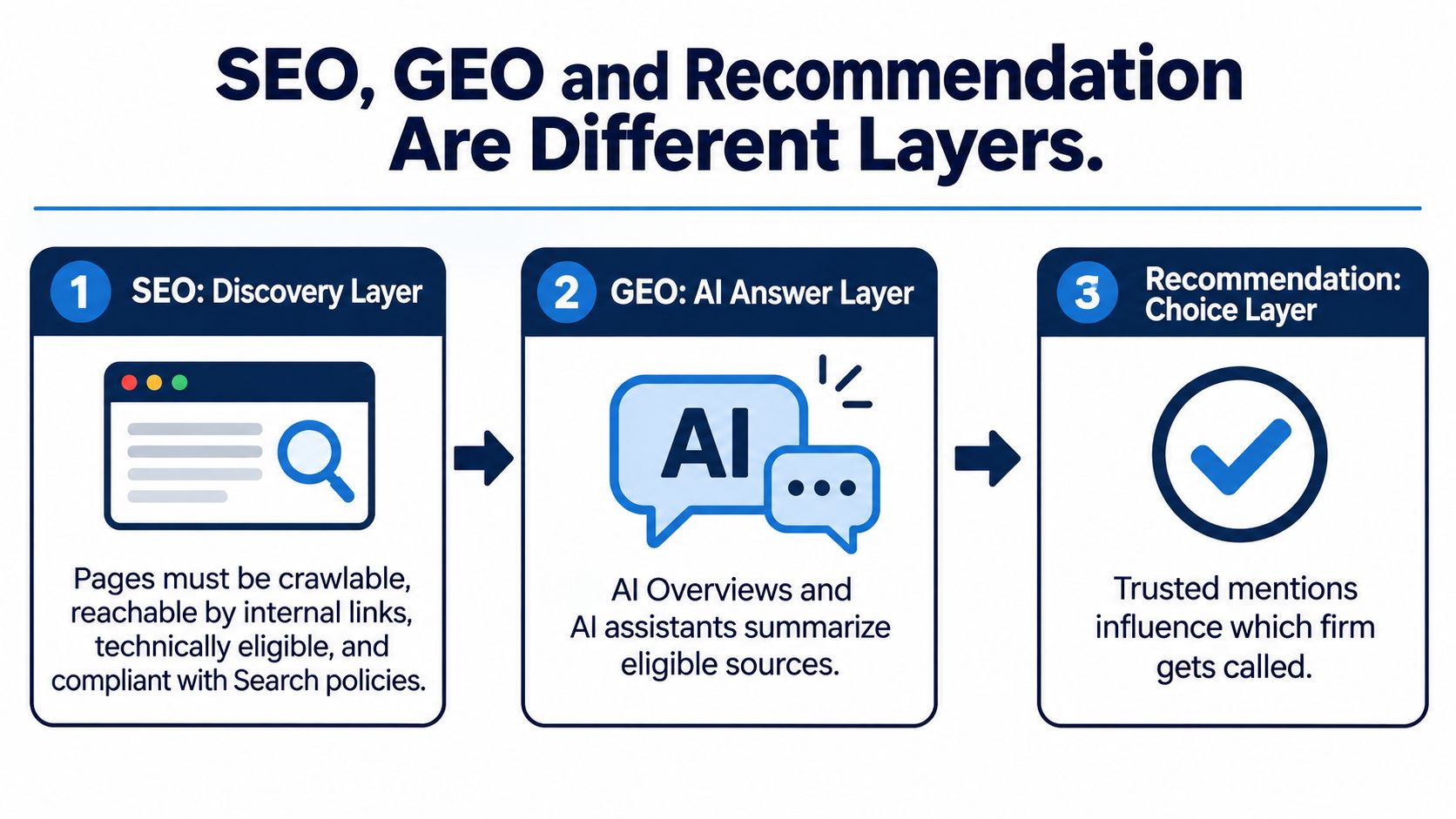
SEO, GEO and Recommendation Are Different Layers
Confusing three layers produces one common error. Leadership sees rankings hold, assumes visibility is intact, and misses that assistants have stopped naming the firm, or never named it.
Discovery Comes First, and It Ends There
SEO is the discovery layer. Google's guidance on AI features in Search states that the foundational requirements for AI Overviews and AI Mode are the same as for ordinary Google Search. Pages must be crawlable, discoverable through internal links, technically eligible, and compliant with Search policies.
Google also states there are no additional requirements for inclusion. There's no special AI markup, no new machine-readable file, and no special Schema.org vocabulary required. Important content must be available in text, and structured data must match visible page content.
That boundary is precise. Technical eligibility lets a system find a page. It doesn't establish that an assistant will describe the firm accurately, cite it, or recommend it against named competitors.
Extraction Is a Separate Problem
Generative engine optimization (GEO) and answer engine optimization (AEO) sit above discovery. They concern how information is organized after a system finds it, so the system can extract practice focus, geography, credentials, and proof without ambiguity.
A firm can be eligible and still be hard to interpret. Practice pages that list every service with equal weight, bios that omit location, and case descriptions written for peers rather than buyers all create extraction risk. The system reads the pages and still can't assign the firm to a specific matter type in a specific city.
For firms comparing terminology across vendors, the Excellorix guide to AEO and GEO lays out how those labels differ from conventional SEO in practice. A deeper treatment of the extraction layer is available in the guide to generative engine optimization.
Recommendation Is the Downstream Outcome
AI recommendation intelligence measures what happens after discovery and extraction. It tests whether the system trusts its interpretation enough to name the firm. The measures are citation presence, narrative depth, top-3 rate, entity authority, and position on an AI Visibility Index (AVI).
SEO helps systems discover you. GEO helps systems extract and understand you. Recommendation measurement tests whether AI actually names you.
Use a plain analogy. SEO is whether the file is in the cabinet. GEO is whether a clerk can read the label. Recommendation is whether the clerk will hand that file to a client who asked for one name.
An audit that stops at rankings has verified the cabinet. It hasn't reached the selection outcome, and it shouldn't be presented to leadership as if it has.
Trusted Numbers Versus Estimated Influence
Attribution figures can look precise while leaving executives uncertain about what drove a matter. A Supermetrics 2025 marketing data report summary says businesses were handling 230% more data than in 2020, while 66% of marketers worried about cross-channel tracking and 57% expected third-party-cookie loss to reduce targeting and attribution effectiveness. In the same report, 42% planned to invest in marketing-mix modeling in 2025, signaling that user-level attribution alone may not answer executive questions.
More data creates more opportunities for precise-looking numbers that do not support a confident decision.
Sampling Can Manufacture a Channel Winner
Google Analytics 4 illustrates the risk. Google's GA4 data limits documentation notes that standard properties can use tables containing up to 10 million events, while Analytics 360 properties can use tables containing up to 100 million events. Reports and explorations may still apply sampling, thresholding, or other data-quality constraints.
GA4 identifies heavily sampled explorations and can show the proportion of available data used. An exploration based on 8.88% of available data is less accurate than an unsampled report. If a firm compares organic search, paid media, referrals, and direct traffic using that sample, the apparent gap may reflect measurement error rather than user behavior.
That error can affect budget decisions. A partner sees paid outperform organic in a sampled view and shifts spending to the apparent winner. The audit should establish whether the data supports the comparison before treating it as evidence.
Hygiene defaults also affect whether reported outcomes are meaningful. Google recommends one web data stream per property in most cases. Exclude internal traffic, control unwanted referrals, and configure cross-domain measurement correctly. Reconcile ad-platform spend with GA4 campaign parameters, and confirm conversion events represent qualified business outcomes rather than form loads or button clicks.
For professional services, the relevant path runs from first visit to consultation request, intake completion, qualified matter, and retained client. Structured law firm benchmarking can help establish comparable definitions across that path before periods are compared.
| Constraint | What it distorts | Audit check |
|---|---|---|
| Sampled or thresholded GA4 data | Channel and landing-page comparisons | Check the sampling share; prefer unsampled totals for decisions |
| Broken campaign parameters | Paid spend versus on-site outcomes | Reconcile platform spend with GA4 source and medium |
| Internal and unwanted referrals | Direct, referral, and conversion rates | Exclude internal traffic and correct referral exclusions |
| Cross-domain breaks | Path from visit to intake | Test continuity into consultation and form completion |
| Cookie and consent loss | User-level ROI and retargeting | Mark what is observed, assisted, or modeled |
| Offline and phone intake | Last-click credit for high-value matters | Record intake source and compare it with CRM retained clients |
Observable Activity Is Not Decision Influence
Legal demand exposes the limits of click-based attribution. Consideration cycles can be long, and a prospect may not leave an identifiable click before calling. A prospect might read an attorney profile on a phone, ask an assistant for names a week later, receive a referral, then call using a directory listing. Last-click attribution credits the directory, though it may not explain what prompted the decision.
Separate observed activity from reported influence. Pair first-party CRM outcomes with assisted-conversion evidence. At intake, ask where the client first heard the firm's name and what prompted the call now. Record the answers separately because they describe different points in the decision.
Apply the same distinction to AI claims. A 2025 survey of nearly 100 legal marketing decision-makers found that just over one-third of firms used AI regularly or widely. AI performance claims should be labeled according to what the firm measured, what it estimated, and what remains unknown.
Leadership needs three clear categories: what is proven, what is estimated, and which measurement investment could reduce uncertainty enough to change a spending decision. A dashboard is not proof unless its underlying measures support the conclusion.
Running the Audit in a Fixed Order
Order matters because later steps depend on earlier ones. Interpret channels before testing analytics hygiene and you'll assign budget based on data you haven't validated.
Run these steps in sequence. Don't reorder them to fit vendor availability.
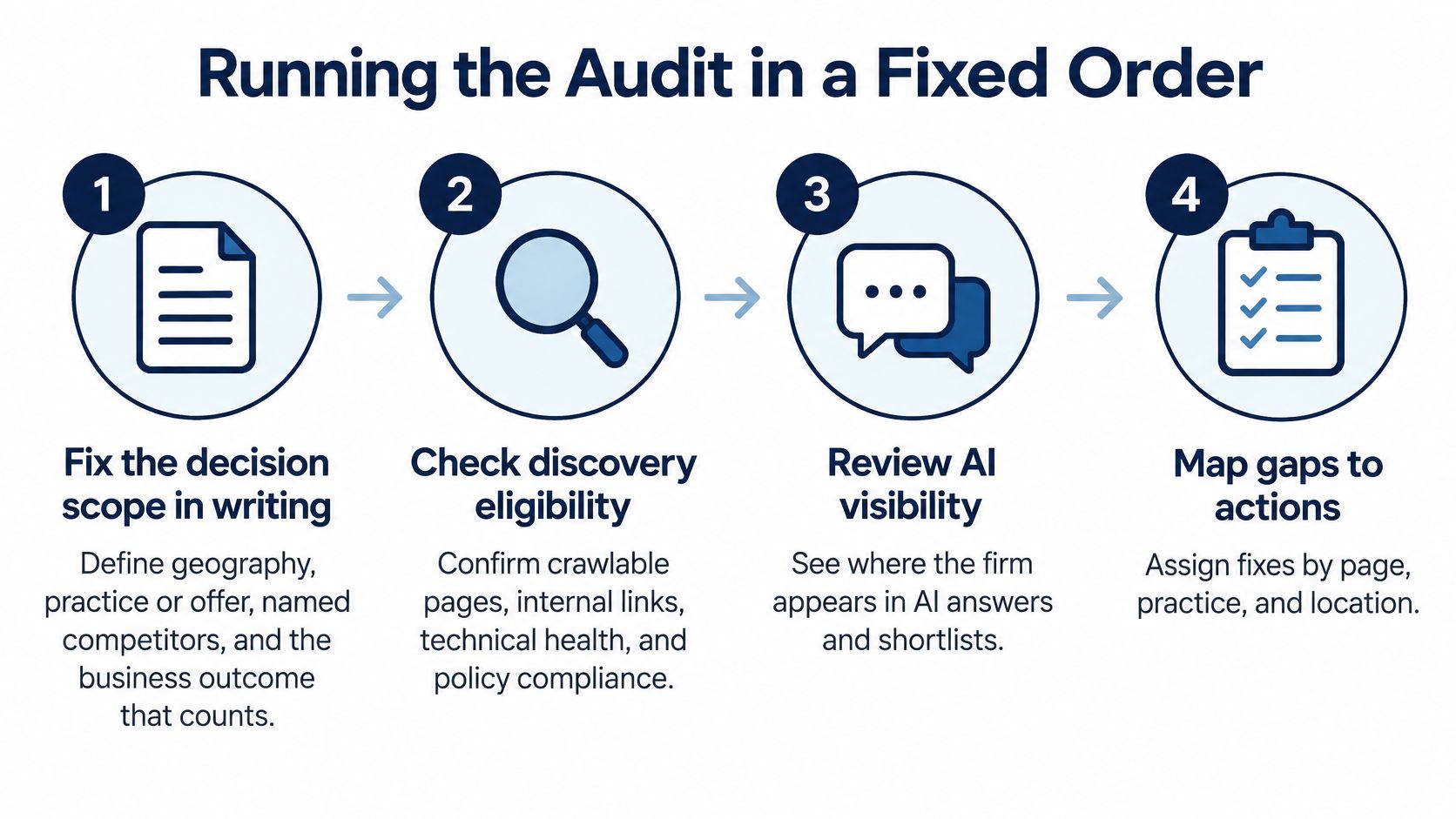
- Fix the decision scope in writing. Name the geography, practice or offer, competitor set, and business outcome that counts. Use qualified consultation, not session. This step fails if two partners describe the target matter differently.
- Freeze a measurement baseline. Record definitions for source, medium, and conversion before changing tags, pages, or bids. Without a frozen baseline, every later improvement is an opinion about a moving measurement system.
- Inventory collection points. List pixels, cookies, SDKs, CRM uploads, consent signals, retention periods, and vendor access. Reconcile the list against the privacy notice. Performance that depends on data the firm can't legitimately use isn't performance.
- Test analytics hygiene. Confirm the data stream setup, internal-traffic exclusion, unwanted-referral settings, and cross-domain continuity from first visit to intake. If this step fails, stop. Channel comparisons after a failed hygiene test aren't decisions yet.
- Review eligibility, then reconciliation. Check SEO eligibility and page experience by template. Reconcile paid spend to tagged outcomes. Confirm visible content matches the claims structured data makes, because a mismatch tells systems the page asserts something it doesn't show.
- Check entity consistency outside the site. Review social profiles, directories, and third-party references for one purpose only. The same name, practice focus, and location should appear everywhere an assistant might read. Follower growth is a separate question and doesn't belong here.
- Run the AI diagnostic separately. Test the same competitor set across more than one assistant. Score citation presence, narrative accuracy, and shortlist inclusion on prompts that reflect real buyer language for the named practice and city. Keep this apart from the channel scan because it measures a different layer.
- Label and rank. Mark every finding proven, estimated, or unknown. Rank work by expected effect on qualified matters, not by task difficulty. An easy fix with no path to a qualified matter ranks below a harder fix on the template that starts consultations.
Record Findings So Quarters Compare
Use a findings register with five fields for every step. Record the decision the step serves, the evidence source and its sampling status, the owner, the proven, estimated, or unknown label, and the failure condition that would reverse the finding.
The failure condition is the field most audits omit. It converts a finding from a claim into a testable statement. If a landing page is labeled proven because it produces qualified consultations, the failure condition states the qualification rate below which that label is withdrawn.
Reuse the same register each cycle. Baselines stay comparable, definitions don't drift between quarters, and leadership can see whether the unknown column is shrinking. An audit that changes its own definitions each quarter can't prove progress even when progress occurs.
Audit discipline: A step that fails blocks interpretation of every step after it. Repair in order.
Visible Law Firms Still Miss the Shortlist
An AI assistant asked which firm to call for a matter in a particular city may return three names, each with a short explanation. Firms left off that list have no visible position on it. A search ranking report cannot show whether the assistant named them.

A Worked Example of Fragmented Interpretation
Consider a firm with strong organic visibility, active paid campaigns, and a complete website. Traffic is stable, practice pages rank, and intake forms work.
Then compare the firm's information across sources. Attorney bios emphasize litigation. Directory listings emphasize transactional work. Third-party profiles describe a practice mix the firm left years ago. Location names vary, and two profiles list a city where the firm no longer takes matters.
The website remains discoverable, but the combined signals make it harder to form a confident account of what the firm does, where it works, and whom it serves. Competitors with more consistent descriptions may be easier to characterize and recommend.
The gap is interpretation, not basic visibility. A conventional digital marketing audit can establish discovery and activity; it may not show whether AI systems can form a clear enough picture to name the firm at the selection moment.
The Legal Marketing Association survey of legal marketing decision-makers found that more than one-third of surveyed firms reported regular or widespread AI use, while 70% of legal marketing decision-makers said their teams are taking greater responsibility for technology adoption. Separate 2025 figures cited for small firms and solo practitioners report 53% integrating generative AI into workflows and 43% identifying digital marketing as important to client acquisition.
CitationOS describes its work as AI citation intelligence for professional service organizations, including confidential audits and benchmarking across systems such as ChatGPT, Gemini, and Perplexity. Its reported diagnostic sample covered 116 firms over 16 months; using its own scoring process, CitationOS found that 78% were absent from AI recommendations in the queries assessed. That sample describes the firms examined, not the wider legal market.
A recommendation audit should test the named competitor set across several assistants with decision-oriented prompts. Score citation presence, narrative depth and accuracy, competitor inclusion, and entity consistency. Record whether the firm appears, how it is described, and which sources support that description.
Ranking gains alone do not establish stronger recommendation presence. A firm can improve search rankings while conflicting directory information continues to obscure its practice, locations, or client fit.
The same distinction applies in other high-trust markets. When systems synthesize information across sources, an audit of visibility alone cannot establish whether the organization is represented clearly enough to be selected.
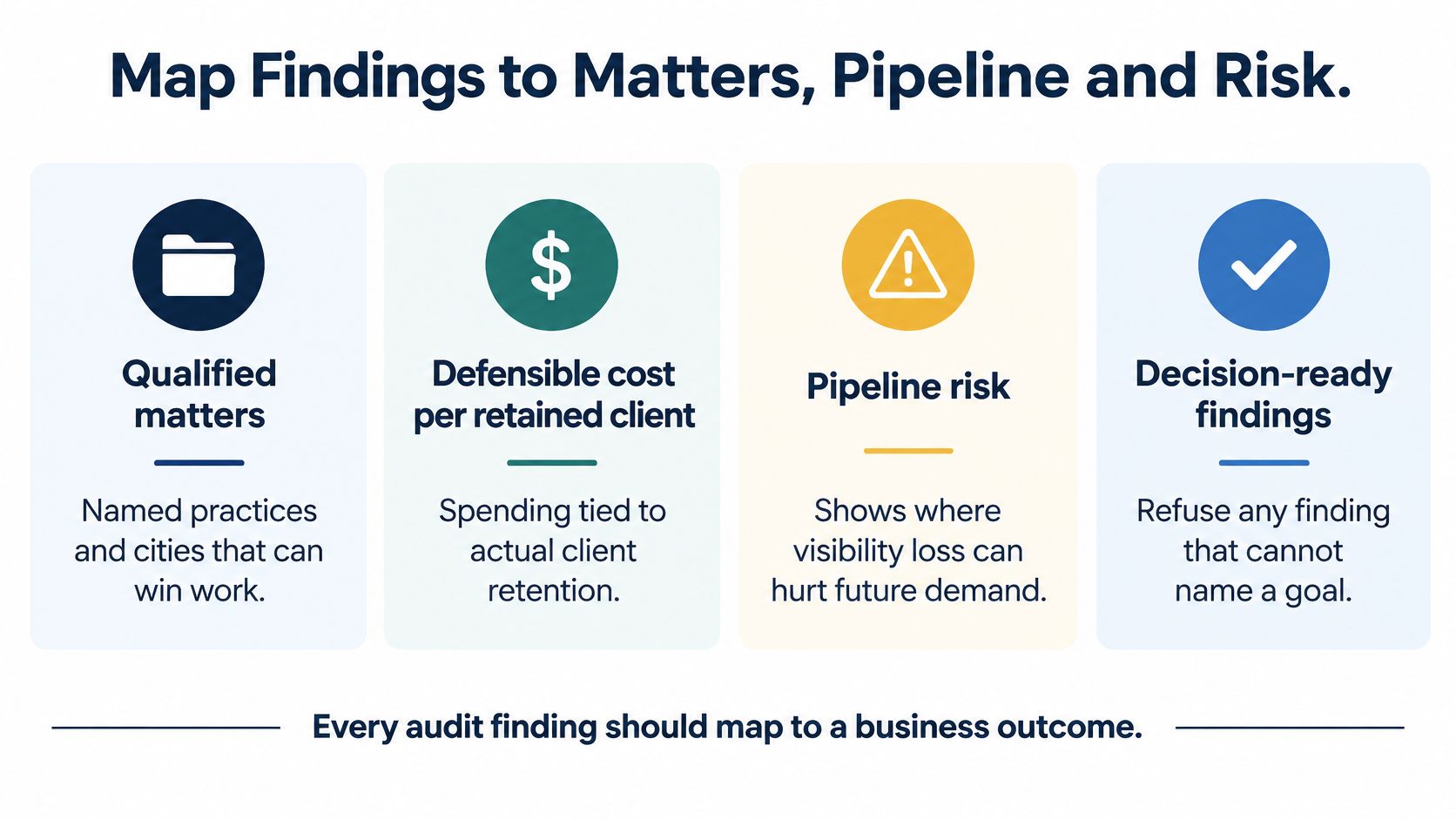
Map Findings to Matters, Pipeline and Risk
Leadership should refuse any finding that can't name a goal. Four goals cover most high-trust firms, and each carries a different proof standard.
| Business goal | Acceptable proof | Weak proxy | Owner |
|---|---|---|---|
| Qualified matters in a practice and city | Consultation, intake, qualified matter, and retained client in CRM | Sessions, rankings, or raw form fills | Marketing with intake operations |
| Cost per retained client | Spend and production cost over the full consideration cycle | Platform ROAS on sampled data | Finance with marketing |
| Coherent market narrative | Consistent entity, practice, and geography across sources and AI descriptions | Follower counts or page views | Marketing leadership |
| Lawful data use | Consent, retention, vendor access, and working suppression | High match rates from undeclared audience uploads | Privacy counsel with marketing ops |
Qualified Matters and Defensible Cost
For qualified matters, acceptable proof sits in the CRM. Consultation source, intake completion, matter qualification, and retention, read beside assisted paths, show whether marketing produced work the firm wanted. A ranking gain or a raw form-fill spike doesn't. Form fills include vendors, job seekers, and matters outside the firm's practice, and counting them as pipeline inflates every downstream ratio.
For cost, reconcile paid spend and content production cost against retained clients across the full consideration cycle. Platform-reported returns calculated on sampled, short-window data describe platform performance. They don't describe client acquisition economics. Finance should co-own this figure, because a cost per retained client that marketing calculates alone won't survive a partner meeting. Content investment belongs in the same calculation, and firms structuring that spend can use a disciplined approach to law firm content marketing to tie production cost to practice priorities.
Narrative Coherence and Lawful Data Use
For narrative, the proof standard is consistency. The same entity, practice focus, and geography should appear on the firm's site, in directories, and in how assistants describe the firm. Follower counts and page views measure attention. They say nothing about whether the market, human or machine, can state accurately what the firm does.
For risk, inventory pixels, cookies, SDKs, CRM uploads, audience-sharing destinations, consent signals, retention periods, and vendor access. Then test whether suppression and deletion requests propagate to every connected system, not only the CRM. A suppression that works in email and fails in an audience upload is a compliance gap with a marketing interface.
The enforcement context isn't abstract. The FTC 2023 privacy and data security update reported that through 2023 the agency had brought 97 privacy cases, 89 data-security cases, and 169 cases involving the Telemarketing Sales Rule and CAN-SPAM since 1999. Global firms also operate under GDPR, ePrivacy, state privacy laws, and platform policies. Regulatory exposure follows the same data flows the audit inventories.
A finding enters the plan only when the table can name the goal, the proof standard, and the owner.
Activity without that link stays in the unknown column. It may be worth doing later. It isn't worth funding now.
Decide What the Next Audit Must Prove
End with a decision rule. Read the unknown column from the first scan and act on the first layer that failed.
Repair in the Order the Layers Failed
If definitions, sampling, or cross-domain continuity failed, the next spend is measurement repair. One clean data stream. Agreed conversion events tied to qualified outcomes. CRM fields that record how the client arrived and what prompted contact. Channel optimization before that repair manufactures confidence, because every reported gain rests on data the firm already knows is unreliable.
If measurement holds and discovery is weak, the next work is eligibility and page experience on the templates that start consultations. Hold those templates to the thresholds the audit already set. Don't spread the work across the whole site to make the average look better.
If pages are eligible, measurement is sound, and assistants still describe the firm vaguely or omit it entirely, more rankings won't answer the question. The firm has a selection problem, and selection problems aren't visible in traffic reports.
The Missing Proof Is Recommendation
At that point the next audit must prove recommendation directly. Measure citation presence, narrative depth, top-3 rate, and entity authority against named competitors across ChatGPT, Gemini, and Perplexity. Use decision-oriented prompts in buyer language, not branded queries the firm is guaranteed to win. Position the result on an AI Visibility Index (AVI) so leadership can compare cycles without redefining terms.
A confidential AI Citation Audit, delivered as a private report, measures representation and shortlist inclusion at that layer. It doesn't manipulate model outputs. It isn't a substitute for an SEO or media program, and it shouldn't be sold to partners as one. It answers the narrower question the channel audit can't reach.
Governance belongs in the same decision. Analytics transitions have repeatedly broken comparability, from the launch described in the InfoTrust history of Google Analytics, which notes the service launched on November 14, 2005 and attracted more than 100,000 accounts during its first week, through Universal Analytics in October 2012 and GA4 in October 2020. Every transition created broken tags and inconsistent definitions. The next audit should document measurement objectives in writing so the next transition doesn't erase the baseline again.
A digital marketing audit that can't separate discovery, extraction, and selection will keep funding activity. The rankings will look defensible. The dashboards will look complete. And the selection moment will keep passing with a competitor's name in the answer.
If your audit shows eligible pages and sound measurement but assistants still don't name the firm, the unresolved question is representation, not traffic. CitationOS provides a confidential AI Citation Audit that measures citation presence, narrative depth, top-3 rate, and shortlist inclusion against named competitors across major AI assistants, delivered as a private report for partner and CMO review.