Accenture found that, among active generative-AI users, 18% preferred AI for purchase recommendations, compared with 11% who preferred search engines. That finding comes from a January 2025 survey of 18,214 consumers across 14 markets. Half of respondents had already used generative AI to inform a purchase decision, and 9% considered it their single most trusted source for deciding what to buy, according to Accenture's consumer survey.
For high-trust firms, visibility now includes what happens before a prospective client reaches a search-results page or visits a firm's website. AI brand visibility is whether a system names a firm, describes it accurately, connects it to the right capabilities, and presents it as a credible option when asked for a recommendation. A search listing is a name in a directory that a buyer must open. An AI recommendation is the name a trusted adviser says aloud when asked whom to consider.
That distinction calls for a different executive measure. A firm can be easy to find but absent from a shortlist, or present but misclassified. This 2026 guide for dental practices offers a useful vertical-specific perspective on how AI visibility is discussed beyond legal services.

The practical analysis is sequential: distinguish discovery, extraction, and recommendation; understand how systems select firms; assess why search rankings don't predict selection; measure the result; and establish a baseline before making changes.
An AI Shortlist Now Comes Before the Search Results Page
The Accenture figures show that AI is part of purchase research for a substantial share of respondents, including people seeking recommendations. They do not show that AI has replaced search or professional advice. The survey covered markets including the United States, the United Kingdom, Canada, France, Germany, India, Japan, Brazil, China, and Australia, with fieldwork from January 6 to 17, 2025.
In professional services, a prospective client may ask an AI system which firms handle a particular dispute in a specific jurisdiction and have relevant experience. The answer can shape an initial shortlist before the user checks a ranking, reads a profile, or contacts a firm. This selection step applies across sectors, including the perspective in a 2026 guide for dental practices.
A firm can be named but assigned to the wrong practice area, accurately described yet left out of recommendations, or recommended without enough detail for a client to judge its fit. These are distinct outcomes: absence, misclassification, thin narrative depth, and conflicting signals about the firm can each affect whether it is selected.
A directory listing supplies a name to investigate; a recommendation adds a reason to consider it. Leadership should track these outcomes separately rather than compress them into one generic visibility score.
The executive question is whether AI systems identify a firm, represent it accurately, and select it in a relevant decision context. Those measures distinguish a selection problem from simple exposure, while leaving discovery and understanding as separate parts of the analysis.
Three Layers That Separate Discovery, Extraction and Recommendation
The three layers are sequential but distinct: SEO supports discovery, generative engine optimization (GEO) and answer engine optimization (AEO) support extraction and understanding, and AI recommendation intelligence measures selection. A firm can perform well at one layer and still fail at the next.
Think of a library. Its catalogue makes a book findable; the text makes the book's contents usable; and the librarian's choice when a reader asks for a recommendation is a separate decision. Search rankings resemble the catalogue. Structured, clear content helps a system interpret the book. Neither guarantees that a system will recommend it.
In May 2025, Google said AI Overviews reached more than 1.5 billion users per month across over 200 countries and territories. It also reported that, in major markets including the United States and India, AI Overviews drove more than 10% growth in the types of queries that generated AI answers, according to Google's account of AI-powered search. The company's figures describe its own product and selected markets; they don't establish how often any particular firm is recommended.
Thomson Reuters' 2025 survey adds a legal-sector signal: 26% of legal respondents reported using generative AI, up from 14% in 2024, with use at 28% among law-firm respondents, according to its survey of legal professionals. Adoption makes it more important to distinguish routine discovery from being selected in an AI-generated answer.
| Layer | Question it answers | What it governs | How it is measured |
|---|---|---|---|
| SEO | Can systems discover the firm? | Crawling, indexing, and ranking position | Rankings and organic traffic |
| GEO and AEO | Can systems extract and understand the firm? | Structured content, entity clarity, and query-to-page alignment | Accuracy and completeness of extracted claims |
| AI recommendation intelligence | Do AI systems trust and recommend the firm? | Citation presence, narrative depth, and shortlist inclusion | AI Visibility Index (AVI), citation presence, narrative depth, and top-3 rate |
A firm can rank well and be extracted correctly yet remain absent from a shortlist. For a deeper treatment of the extraction layer, see this guide to answer engine optimization.
The failure modes follow the sequence: not found, found but poorly understood, and found but not chosen. Each calls for a different diagnosis. More website content may help with understanding, but it won't necessarily repair an external profile that describes the firm incorrectly or prove that systems recommend the firm.
How AI Systems Decide Which Firms Get Named
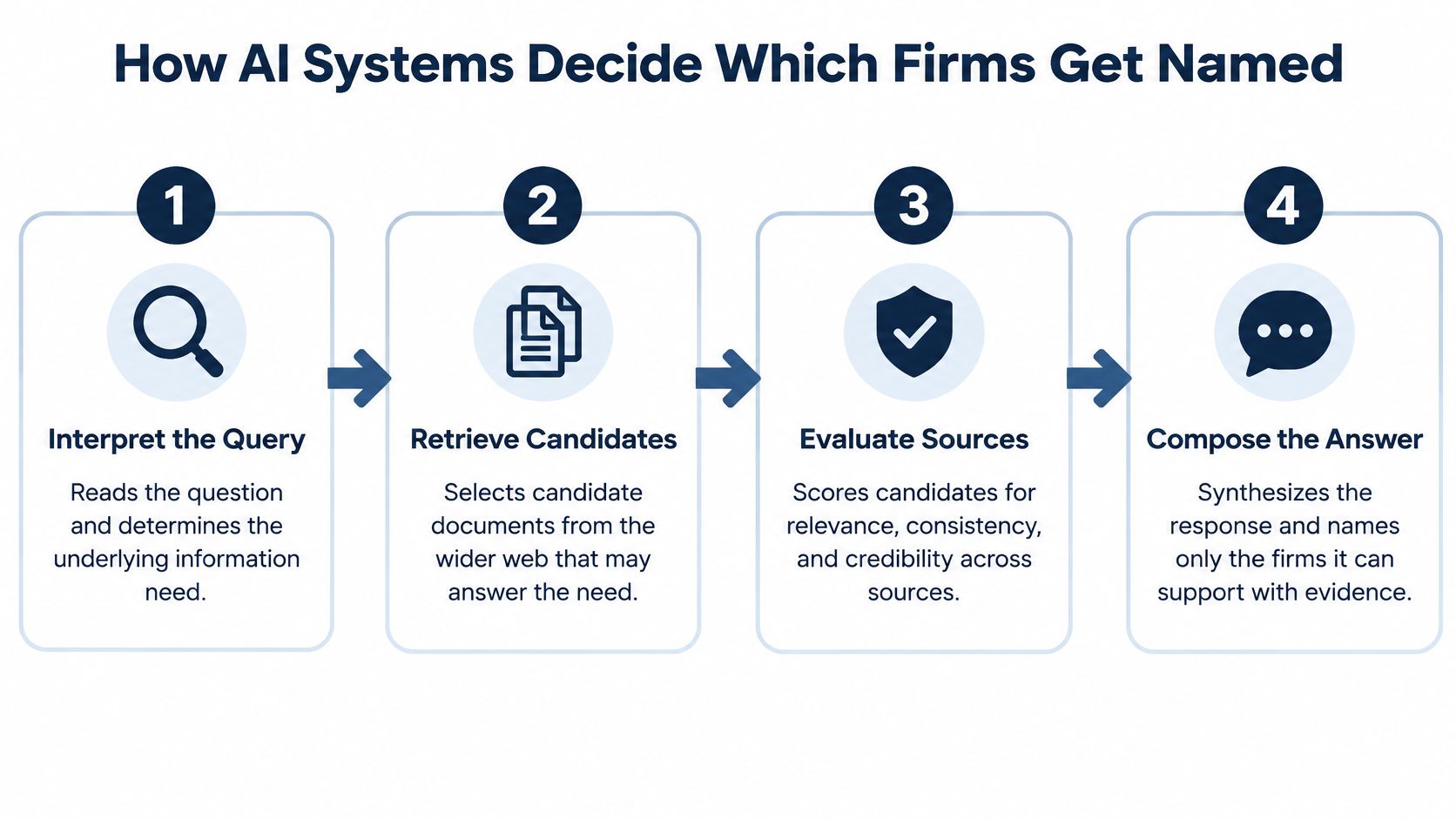
A recommendation answer is the end of a selection pipeline, not a direct reflection of a firm's conventional search position. The system first interprets the question, then retrieves candidate material, ranks or orders that material in context, and finally generates an answer from the evidence that survives.
- Interpret the query. The system identifies what the user is asking for, including matter type, location, and any stated constraints.
- Retrieve candidates. It selects documents and sources that could answer the underlying need.
- Evaluate source position. Ranking or placement within the retrieved context influences which candidates remain available to the answer.
- Compose the answer. The system turns surviving evidence into statements, citations, and recommendations.
A controlled retrieval-augmented-generation experiment spanning six large language models and 252,000 paired trials found that topical relevance and source position were the strongest citation drivers. Price and recency acted as major gatekeepers; completeness and trust signals offered secondary gains, while formatting had negligible impact, according to the experiment on citation probability. The result points to retrieval quality and fit as central factors. It doesn't show that a particular tactic guarantees a firm will be recommended.
Consider a probate litigation firm that ranks well for its own name but doesn't appear in answers to a contested-will question in Miami. If its pages don't match the question's language or present current, practice-specific evidence, a retrieved source about another firm may fit the request better. Price and recency deserve particular attention when the question explicitly asks about cost or timing.
Diagnostic rule: Find the stage where the firm drops out. Is the query being interpreted incorrectly, is relevant evidence missing from retrieval, is the evidence poorly positioned, or does the final answer fail to use it?
This is also why directory listings can support AI visibility: they may provide external descriptions that help systems identify a firm and its attributes. The broader principle of entity authority is that systems need coherent evidence about what the firm does and where it operates. That principle informs diagnosis; it doesn't establish that any one directory or listing determines the outcome.
Why Search Rankings Do Not Predict AI Recommendations
A firm's own website accounted for a minority of the citations in a multi-market study. Among 167,551 URL-grounded citations for 128 brands across 12 countries and 13 languages, 85.7% pointed to third-party websites and 14.3% to brand-owned properties, according to the study of AI citations. Strong website content may still leave a firm poorly represented if outside sources omit relevant attributes or describe them inconsistently.
The citations were concentrated: 80% came from approximately 18% of domains, according to the same study. That pattern suggests that a relatively small group of external sources supplied much of the evidence in its results. A search position for a firm's own page therefore cannot show whether the sources used to describe it are broad, consistent, or representative.
This is a selection problem, not merely a ranking problem. Search optimization asks whether a firm's page matches a query and earns a visible position. AI recommendations also depend on which sources are retrieved, what those sources say, and whether the system selects the firm for the answer. A firm can be absent, misclassified, described with little narrative depth, or surrounded by contradictory entity signals. Those outcomes require different diagnoses.
An audit should distinguish four questions:
- Retrieval: Does the system identify the firm at all?
- Evidence: Which domains support the answer?
- Agreement: Do those sources align on practice areas and market position?
- Selection: Does the system recommend the firm, or merely mention it?
Consider a firm whose website emphasizes commercial litigation, while a bar profile and legal directory identify another primary specialty. The system may return an incomplete or conflicting description even when the website is accurate. Publishing more pages would not resolve that mismatch by itself. First identify which sources disagree and which attributes need correction.
The study covers brands across industries, not law firms specifically. Applying its citation patterns to legal services is an informed inference, not a legal-sector finding. For a firm, the practical value is a set of questions to test: which sources appear, how concentrated the citations are, and whether external descriptions agree with the firm's own account.
Measuring Representation With AVI, Citation Presence and Top-3 Rate
A useful measurement system distinguishes whether a firm is named, cited, described accurately, or recommended. One answer cannot establish whether representation is consistent or competitive. Comparable observations across repeated prompts are more informative.
| Metric | What it measures | How to read it |
|---|---|---|
| AI Visibility Index (AVI) | Composite read of representation across AI systems | Track direction over repeated monitoring, not a single reading |
| Citation presence | Whether the firm is cited as a source in an answer | Present or absent per prompt. A citation alone isn't a recommendation |
| Narrative depth | How fully practice areas, positioning, and credentials are described | Distinguishes a passing mention from a decision-ready profile |
| Top-3 rate | Share of tested prompts where the firm is among the top three recommendations | The most direct proxy here for shortlist inclusion |
| Entity consistency | Whether names, locations, practices, and attorneys match across sources | Conflicts can weaken interpretation of the other measures |
Use repeated, standardized prompts across ChatGPT, Gemini, and Perplexity. Vary wording, geography, practice area, recency, and named competitors to test whether a result holds across query conditions. For each observation, record whether the firm appears, whether it is cited, its citation position, claim accuracy, and whether it enters the shortlist. This separates absence from citation without recommendation, inaccurate description, or weak narrative depth.
CitationOS reports that 78% of 116 firms scored over 16 months of diagnostics were invisible to AI recommendations. This is a finding from the company's diagnostic work, not a general estimate for all firms or industries. The distinction matters: an absence rate alone does not show whether a firm was overlooked, misclassified, described too thinly, or excluded despite being cited.
Before comparing AVI scores from different providers, ask how each composite is calculated, which systems and prompts it covers, and how often measurements are repeated. Without those details, a score may combine unlike observations and obscure the specific selection problem it is meant to track.
Confirm Your Baseline Before Changing Anything
Nearly half of consumers, 48%, reportedly cross-check AI answers across platforms, according to the Yext study on AI archetypes. When systems or profiles give conflicting descriptions of a firm's name, location, practice areas, or credentials, that inconsistency can become a decision problem, not just a cosmetic defect.
Before changing content, capture a dated baseline. Run the same prompts for core matters across ChatGPT, Gemini, and Perplexity, then record how each system names, classifies, and recommends the firm. Separate absence from inaccurate classification, a thin description, or contradictory signals across platforms.
| Symptom | What it indicates | Where to check first |
|---|---|---|
| Absent from answers to core matters | The firm wasn't retrieved, or its evidence didn't match the query | Query-to-page alignment and third-party coverage for that practice area |
| Named but placed in the wrong practice area | Conflicting entity signals may have led to misclassification | Directory, bar, and professional profiles for practice labels |
| Cited but never recommended | Narrative depth or authority may be too weak for selection | Independent descriptions and credentials |
| Correct on one platform, wrong on another | Source information is inconsistent across systems | Run the same prompt across each system |
| Recommended in one city, absent in another | Geographic scope may not be established | Location signals across sources |
The table's distinctions matter because each symptom points to a different source of trouble. A firm absent from a matter-specific answer may need better query-to-page alignment or external coverage. A firm placed in the wrong practice area needs its source descriptions checked before its leadership invests in new copy.
Without a dated baseline, later changes in shortlist position can't be attributed confidently. If a firm revises pages, adds listings, or publishes new material first, it won't know whether the resulting answer reflects that work or a change in the systems. A structured AI search audit can help establish a consistent record of inclusion, citation patterns, accuracy, and shortlist presence.
Strategies That Improve Representation Without Manipulating Outputs
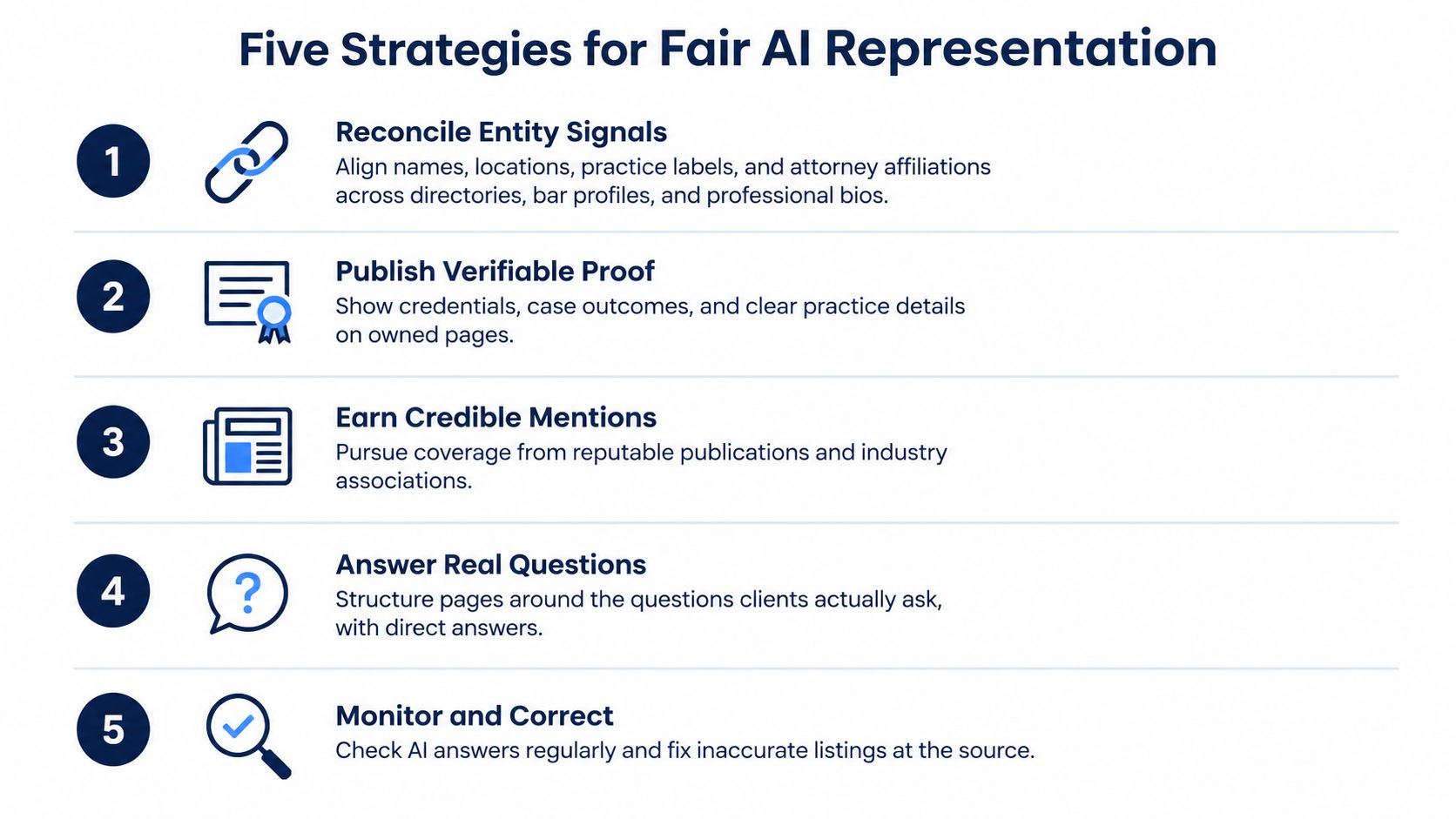
The goal is better evidence about the firm, and the test is how systems use it. Five actions provide a practical sequence, from correcting source information to measuring the resulting representation.
Reconcile entity signals. Align the firm's name, locations, practice labels, and attorney affiliations across directories, bar profiles, and professional bios. Conflicting details can make a firm harder to classify accurately, even when individual sources contain useful information.
Map high-intent queries to authoritative sources. Identify the matter types, practice areas, and jurisdictions prospective clients ask about. Then check which credible external sources describe the firm in those contexts. This helps distinguish a shortage of relevant evidence from a gap in the firm's own pages.
Align owned pages with the query. Use the language clients use for their matter and jurisdiction, and keep practice-specific evidence current. Clear pages help systems extract the firm's claims. They do not, by themselves, establish the independent support needed for a recommendation.
Earn independent corroboration. Seek accurate coverage in sources relevant to the practice, such as bar profiles, court opinions where relevant, legal directories, trade publications, client reviews, and rankings. The useful sources will vary by practice area and jurisdiction. Firm-controlled pages and independent references play different roles, so assess both. The GEO strategies for small law firms resource offers further context on clarifying firm information without attempting to influence model outputs.
Measure repeatedly across systems. Reuse the same core prompts over time, then vary wording and context to see whether the firm's representation holds across different ways of asking. Record inclusion, accuracy, citations, and shortlist placement. Comparing those measures helps separate continued absence from misclassification or a weak account of the firm's experience.
These steps improve the accuracy and coherence of the firm's evidence, then test how systems use it. Publishing more material before reconciling conflicting sources can add ambiguity rather than clarify the firm's record.
Start with the source record and query map. Invest in content after leadership understands what systems retrieve, what they get wrong, and which evidence is missing.
CitationOS provides confidential AI recommendation intelligence audits examining firm representation, citation patterns, and shortlist inclusion across AI systems. Its baseline assessment distinguishes absence from misclassification and weak narrative depth. Learn more about CitationOS.