
Traditional law firm benchmarking still treats the firm as a backward-looking machine. It measures billing rates, utilization, realization, staffing depth, and expenses, then assumes those numbers explain market position. They don't, not anymore. A firm can run clean internal economics and still disappear in the selection layer where AI systems decide whether to name it, describe it, or omit it entirely.
That gap matters because the market is no longer judging firms only on output. It is also judging whether the firm is legible, coherent, and recommendable to systems that mediate discovery before a buyer ever speaks to a partner. Law firm benchmarking now has to answer a harder question than profitability: can the firm be selected by machine-mediated shortlists, or is it merely visible in the wrong place?
The Shift From Financial Metrics to AI Selection
For years, leadership used financial and operational measures to decide whether the firm was healthy. That logic still has value, but it stops at the firm's own ledger. It doesn't tell you whether a high-intent buyer, or the AI layer helping that buyer, will surface your name.
The selection moment is the real benchmark
The critical event is not exposure, it's selection. An AI system either names the firm or it doesn't. That binary outcome is closer to market power than traffic, impressions, or even general brand familiarity. The selection moment is where entity authority becomes visible, because a firm can't rely on passive recognition once the system is asked a pointed question.
Practical rule: if the firm is not consistently named in answer layers, the problem isn't awareness alone. It's recommendation readiness.
This is why the old habit of reading benchmarks as a rear-view mirror is inadequate. Financial metrics can show that the firm is efficient. They can't show whether the firm is structurally understandable to recommendation systems.
The selection moment framework makes that distinction explicit. It separates being found from being chosen, and in legal services that difference is now decisive.
Visibility is not the same as recommendation
The older approach assumed that a firm with strong marketing and strong operations would naturally be shortlisted. AI search breaks that assumption. Recommendation systems don't reward effort, they reward coherence. If the firm's identity is fragmented across practice pages, bios, directories, and third-party references, the model may not assemble a stable representation.
That's the analytical shift. SEO helps systems discover you. GEO helps systems extract and understand you. AI recommendation intelligence measures whether they trust and recommend you. Law firm benchmarking has to span all three layers now, because performance inside the firm and performance inside the answer engine are no longer the same problem.
Traditional Benchmarks Versus Modern Market Intelligence
Traditional law firm benchmarking still matters, but its original purpose was internal control. The Canadian Bar Association benchmarking guide describes benchmarking as a statistical method for identifying best management practices, and it connects law firm profitability to billing rates, utilization, realization, staffing ratios, and expenses, with realization often split into billed-to-billable and collected-to-billed ratios. That framework remains useful for operational discipline. It does not explain how a firm reads outside its own financial records.
What the old model measures, and what it misses
Billing and utilization show how efficiently work is produced. Realization shows how much of that work becomes collected revenue. Staffing ratios show how the labor stack is arranged. Expenses show how much the structure costs to run. These are internal signals, and they matter.
What they do not show is external interpretation. AI systems do not inspect utilization reports. They infer credibility from distributed signals, then decide whether the firm belongs in a shortlist response. A firm can look strong on internal economics and still be weak in recommendation contexts.
Modern intelligence looks at market interpretation
Contemporary benchmarking is more dimensional. A major legal-industry framework evaluates firms across Business Model, Value Proposition, Service Delivery, Client Impact, and Brand Eminence. That structure is more useful for explaining why a firm underperforms in the market. If delivery is sound but the market still reads the firm poorly, the problem is interpretation.
| Benchmarking Dimensions Compared | ||
|---|---|---|
| Dimension | Traditional Focus | AI Recommendation Focus |
| Business model | Rates, staffing ratios, utilization | Whether the firm's structure fits the query intent |
| Value proposition | Revenue and pricing | Whether the firm's expertise is legible and specific |
| Service delivery | Operational efficiency | Whether model outputs reflect clear capabilities |
| Client impact | Matter outcomes, retention | Whether the firm is described with credible authority |
| Brand eminence | Rankings, reputation, visibility | Whether the firm is named, trusted, and shortlisted |
The market intelligence layer matters because it shows a firm's standing across peer groups and reputational signals, not just internal throughput. Market observers use benchmarking frameworks to compare performance, profitability, staffing trends, and market dynamics across major segments. Law.com Compass benchmarking IFLR1000 global rankings The comparative field has widened, and the question is no longer whether a firm performs. It is whether its performance can be read consistently across sources.
A firm can have strong matter outcomes and still benchmark poorly if its signals are scattered, incomplete, or inconsistent across sources.
Traditional benchmarking explains performance inside the business. Modern market intelligence explains whether the market can interpret that performance at all.
Core Metrics for AI Recommendation Intelligence
AI recommendation intelligence needs its own scorecard, because answer systems do not disclose their reasoning in the same way a dashboard does. For law firm benchmarking, the question is whether the market can read the firm as a credible option when a buyer asks for a specific legal need. The right measure set should track citation presence, narrative depth, top-3 rate, and entity authority. Together, those signals show whether a firm is merely named or framed as a defensible choice.
The four measures that matter
Citation presence is the base layer. It asks whether the firm appears in answer output at all. If the answer layer never names the firm, the rest of the diagnosis starts from absence.
Narrative depth measures how fully the firm is described. A flat mention is weak evidence. A detailed, relevant description shows whether the system understands the firm's practice focus, market position, and differentiators. Without that context, the mention has little diagnostic value.
Top-3 rate captures shortlist exposure. A firm that appears early in an answer has a different market position from one buried in a long response. The first set of options shapes user attention, so placement matters as much as inclusion. For a close look at why surface-level reads miss that distinction, see why surface-level AI tools fall short.
Entity authority is the hardest signal to produce, and the most important to interpret. It reflects whether the system has enough coherent evidence to treat the firm as a stable, trustworthy entity. Consistent naming, aligned practice descriptions, and a defensible connection between the firm and the topics it claims all feed that signal.
GEO helps extraction, AI recommendation intelligence measures trust
Generative engine optimization, or GEO, helps systems extract and understand information. That is necessary, but it does not prove recommendation strength. A page can be technically legible and still fail to earn authority in the answer layer.
Interpretive rule: extraction is a prerequisite, trust is the outcome.
That distinction separates a surface-level read from a real diagnostic framework. A surface-level read tells you whether the system found content. An AI recommendation intelligence framework tells you whether the system preferred the firm.
CitationOS is one option built around that distinction. It provides confidential AI citation audits, competitive benchmarking, entity consistency assessment, and an AI recommendation intelligence framework that scores inclusion, narrative strength, entity strength, and relative positioning.
Why the audit has to be structured
A useful competitive positioning audit should standardize prompts, compare response patterns across models, and score how the firm is represented against named peers. AI systems can reflect fragmented evidence in ways that sound confident while remaining weakly grounded.
The point is not whether a firm has content. The point is whether that content assembles into a coherent recommendation.
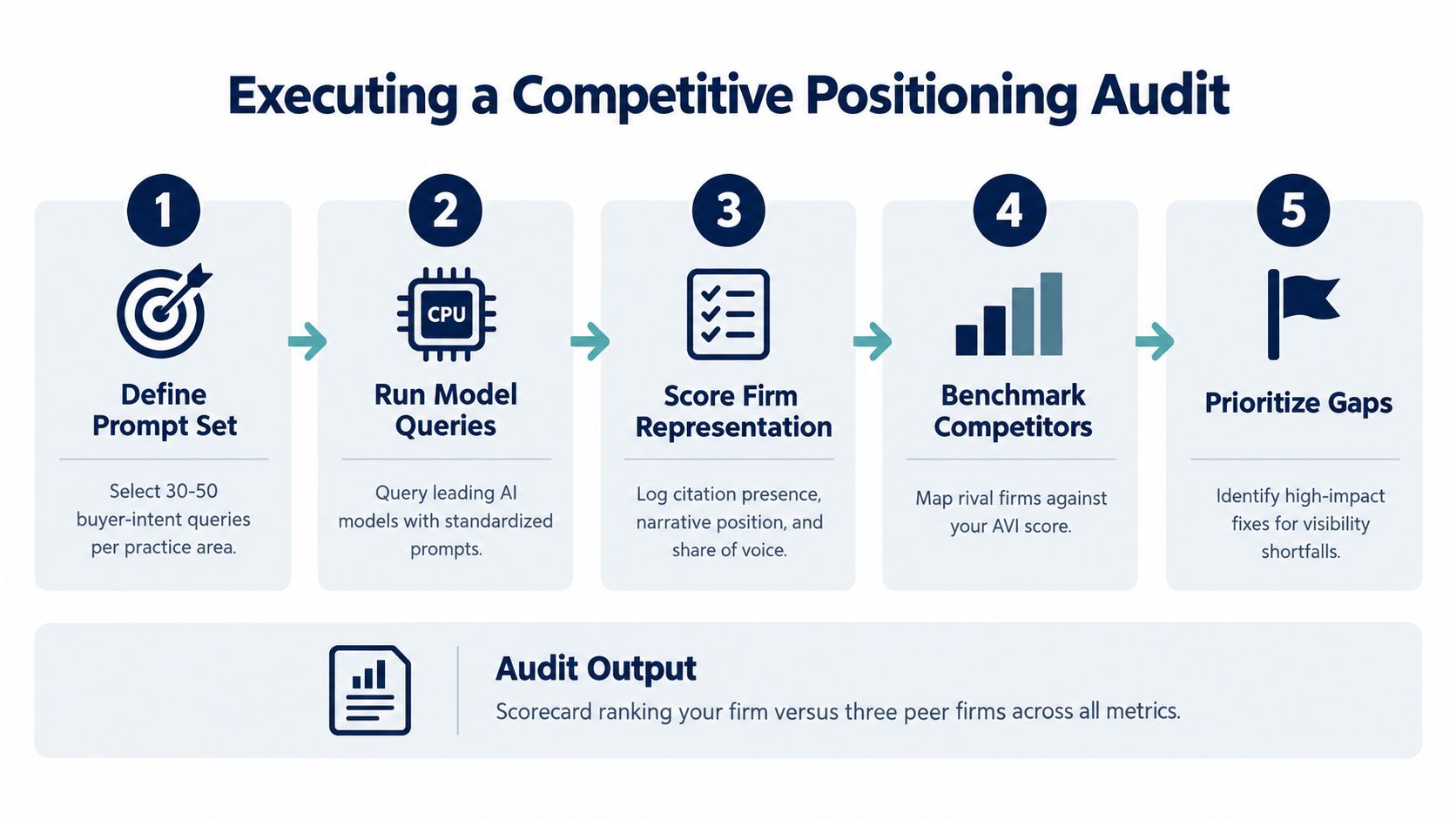
Executing a Competitive Positioning Audit
A credible audit starts with high-intent queries, not generic brand searches. Managing partners need to see how the firm appears when a buyer asks for help with a specific matter type, in a specific geography, under a specific legal need. That is where recommendation quality becomes visible.
Standardize the query set
Use a fixed set of buyer-intent prompts for each practice area. Keep the wording consistent across runs so the results can be compared without noise. A query for a specialty matter should be tested the same way across models, then scored for presence, placement, and explanation quality.
The objective is not to chase every possible prompt. It is to isolate the queries where shortlist formation is likely to happen. Those are the prompts that reveal whether the firm enters the model's consideration set.
Read the responses as entity diagnostics
When the model names the firm, look at more than the mention. Check whether the description matches the firm's actual focus, whether the practice area is stated cleanly, and whether the tone reflects authority or uncertainty. A naming event without coherent description is a weak signal.
If the firm is omitted, the omission itself is data. It can reflect weak source consistency, poor topical alignment, or insufficient market evidence for the model to trust the entity. The audit therefore needs to be confidential and comparative. The value is in seeing the gap, not in public posturing.
Compare against a small peer set
The comparison should be against direct market peers, not a broad universe. Peer comparison shows whether the problem is general market invisibility or relative weakness within a tightly defined competitive set. That distinction prevents leadership from overcorrecting with broad content production when the issue is structural consistency.
Surface-level AI measurement is not enough. A serious audit tracks representation, description quality, shortlist position, and cross-query consistency, then organizes those findings into a scorecard.
Practical rule: if the same firm is named for one practice and omitted for another adjacent one, the issue is often entity coherence, not raw visibility.
The point of the audit is simple. It turns a vague concern about AI visibility into a structured review of competitive position.
Interpreting Relative Positioning and Authority Gaps
A weak AI recommendation is not automatically a marketing failure. It may indicate unclear service framing, an indistinct value proposition, or a reputation gap that additional content cannot correct. Benchmarking becomes useful only when it identifies which signal is failing.
Diagnose the failure mode
A firm that appears in an answer but is rarely shortlisted faces a different problem from one that never appears. The first pattern suggests limited differentiation or insufficient authority at the selection stage. The second suggests entity invisibility, inconsistent source signals, or weak alignment between the firm's stated practices and the questions being asked.
Separate delivery, perceived value, and market reputation before selecting a remedy. Strong client delivery with generic external descriptions points to a weak signal stack. A clear value proposition with little representation suggests inadequate third-party reinforcement. A visible firm that is repeatedly passed over may have a relevance or credibility problem.
These distinctions matter because the same investment can improve one failure mode while leaving another unchanged. More publishing will not necessarily resolve a fragmented entity, and stronger brand recognition will not automatically establish practice-specific authority.
Interpret benchmarks by firm type
A boutique specialty firm, a midsize regional practice, and a global platform operate under different authority conditions. Their credible shortlist routes, evidence requirements, and expected query coverage vary. A single benchmark can therefore misclassify focused strength as limited scale or mistake broad presence for meaningful expertise.
Practice mix provides the sharper test. Ask whether the firm is associated with a defined decision context, not whether it appears broadly famous. Narrow authority may matter more in a specialized category, while scale and consistent representation may carry greater weight across a wide service portfolio.
The interpretation gap between perceived visibility and system recognition often reveals the central issue: the firm sees a visibility deficit, while the system encounters an incoherent entity. That distinction redirects the audit from promotion toward evidence structure.
If the firm's name, practice labels, and proof points do not align, AI systems may treat the entity as less reliable than the firm believes it is.
The conclusion is operational. Establish whether the gap concerns recognition, representation, or recommendation before allocating resources. These are separate failure modes, and each requires a different diagnostic response.
Translating Diagnostics into AI Visibility Strategy
The audit has value only if it changes resource allocation. Firms that keep treating AI visibility as a content issue will keep paying for the wrong layer. The right response is structural, because recommendation systems are reading the firm as an entity, not as a campaign.
Prioritize coherence before volume
The first task is to align the firm's external footprint. Practice descriptions, attorney bios, matter signals, and third-party references need to reinforce the same identity. When those signals diverge, the model has to work harder to infer who the firm is and why it belongs in a response.
That doesn't mean producing more content indiscriminately. It means tightening the informational structure that supports inference. If the entity is incoherent, added volume just creates more places for inconsistency to spread.
Build for the selection layer
The selection layer should be treated as a core strategic asset. Firms need a repeatable way to measure whether AI systems trust and recommend them in the moments that matter. That includes monitoring how often the firm appears, how it is described, and whether it earns placement in the first set of answers.
The market context makes that urgency clear. A June 2026 trade research report found that 78% of legal queries now trigger a Google AI Overview, AI referral traffic to legal sites grew 527% between January and May 2025, and AI-referred prospects convert at 4.4x the rate of standard organic visitors. AI search reshaping legal discovery Those figures show why selection-layer measurement can't sit outside firm strategy.
The deeper warning comes from visibility itself. Independent research on legal AI visibility found that law firms or attorneys are named in only 5 to 7.5% of legal answers across measured models, with an average of 0.2 to 0.3 providers named per answer. Legal AI Search Visibility Benchmark 2026 That is not a branding nuance. It's a structural shortage of recommendation density.
Make benchmarking continuous
The selection layer changes as models, sources, and buyer behavior change. The firm therefore needs a standing measurement process, not a one-time report. The point is to know when the entity is becoming easier to recommend, and when it is slipping back into ambiguity.
A serious program should track the firm's AVI, peer position, and narrative consistency over time. It should also tie those findings to operational decisions, so leadership can see whether the firm is gaining recommendation authority or merely producing more noise.
The conclusion is straightforward. Law firm benchmarking is no longer just a backward-looking financial discipline. It is a forward-looking diagnostic of AI recommendation readiness and entity coherence. Managing partners who treat the selection layer as optional will keep optimizing the wrong surface while the actual competition happens elsewhere.
CitationOS measures whether your firm is being named, described, and shortlisted by AI systems in high-intent legal queries. If you want a confidential read on citation presence, narrative depth, top-3 rate, and entity authority, visit CitationOS and review how your firm appears across the selection layer before your competitors do.