
Most firms are not losing AI visibility because their websites rank poorly. They're losing it because AI systems don't hold a coherent, confident account of who they are, what they do, and why they should be recommended over named competitors. That distinction changes how you should judge the best AEO tools. A useful platform doesn't only report appearance. It explains citation presence, omission, and mischaracterization with evidence leadership can verify.
Why AI Answers Changed How Visibility Is Measured
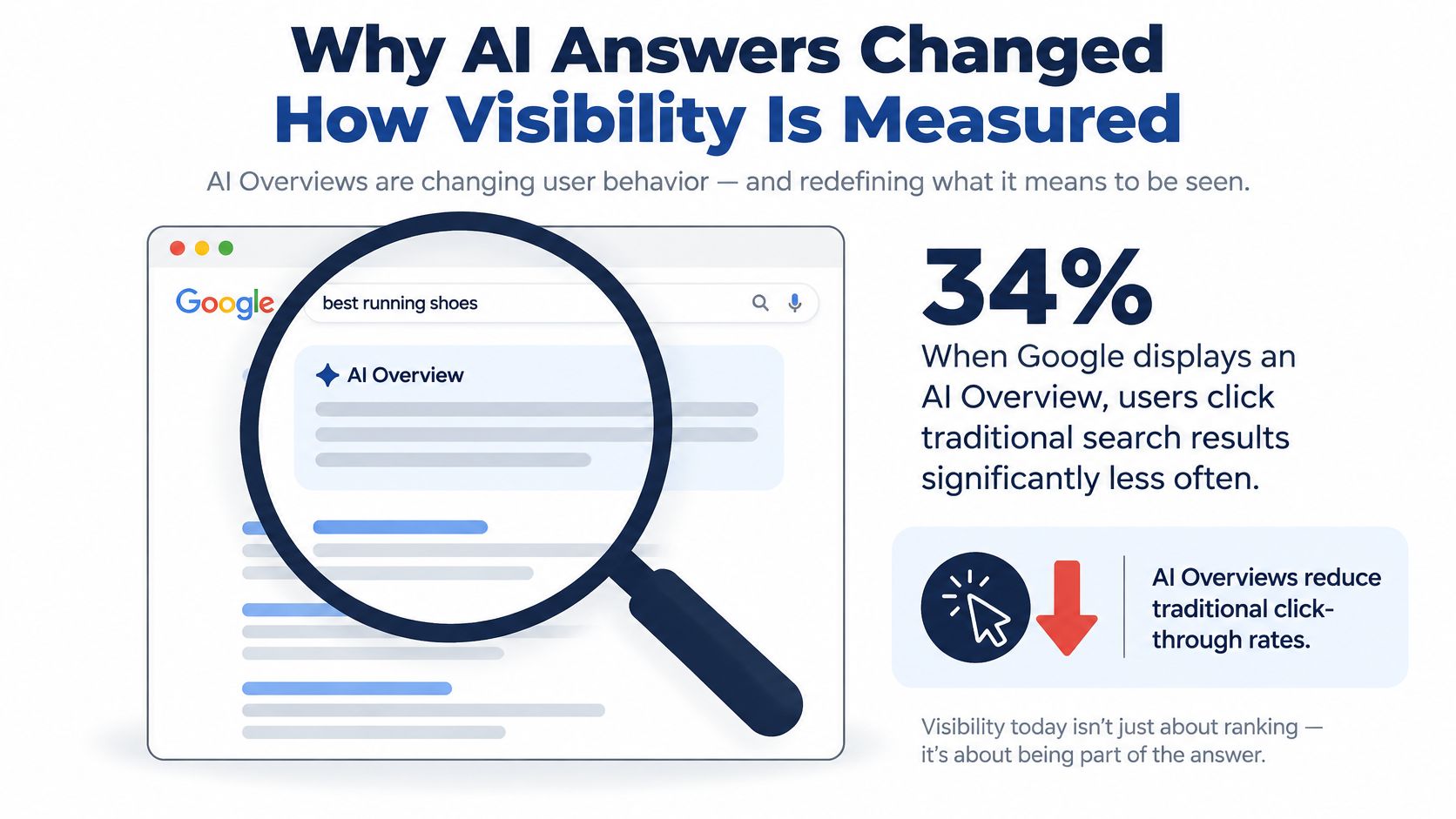
When Google displayed an AI Overview, users clicked a traditional search result in only 8% of visits, compared with 15% when no summary appeared, according to Pew Research Center browsing analysis reported by The Indian Express. The study tracked more than 900 U.S. adults and nearly 69,000 Google searches in March 2025. The commercial consequence is clear: an answer can shape a user's shortlist before a website visit.
Users clicked a source cited inside an AI summary in just 1% of visits, while 26% of visits with an Overview ended on Google, compared with 16% without one, according to the same analysis. For a law firm, competing for a position below an answer that names other firms is a shortlist problem as well as a traffic problem. A prospective client may form an initial judgment about credibility, specialization, and suitability without visiting the firm's site.
Rank Position No Longer Explains Lost Demand
Publisher click rates fell 47.5% on desktop and 37.7% on mobile when an AI Overview appeared, according to Authoritas research on UK news-related queries reported by Press Gazette. A page can retain a strong organic position while attracting fewer clicks. Standard SEO reporting may show the decline, but it cannot explain whether the firm appeared in the answer, what sources supported it, or whether its services were described accurately.
Measurement implication: Inclusion in an answer is a commercial outcome when that answer shapes the shortlist.
A useful AEO assessment must distinguish a passive mention from a recommendation, then establish what evidence supports the recommendation. For law firms, that means testing whether answers reflect the right practice areas, jurisdictions, and credentials, rather than counting appearances alone. Place-specific results also matter; why AEO matters for local businesses explains why local answers require their own measurement logic. Traffic remains relevant, but it cannot establish whether a firm is represented accurately at the answer layer.
SEO, GEO, and AI Recommendation Intelligence
Three functions are often collapsed into one budget line. They should not be. SEO helps systems discover you. GEO helps systems extract and understand you. AI recommendation intelligence measures whether AI trusts and recommends you. Each layer answers a different management question, and failure at one layer can't be diagnosed by tools built only for another.
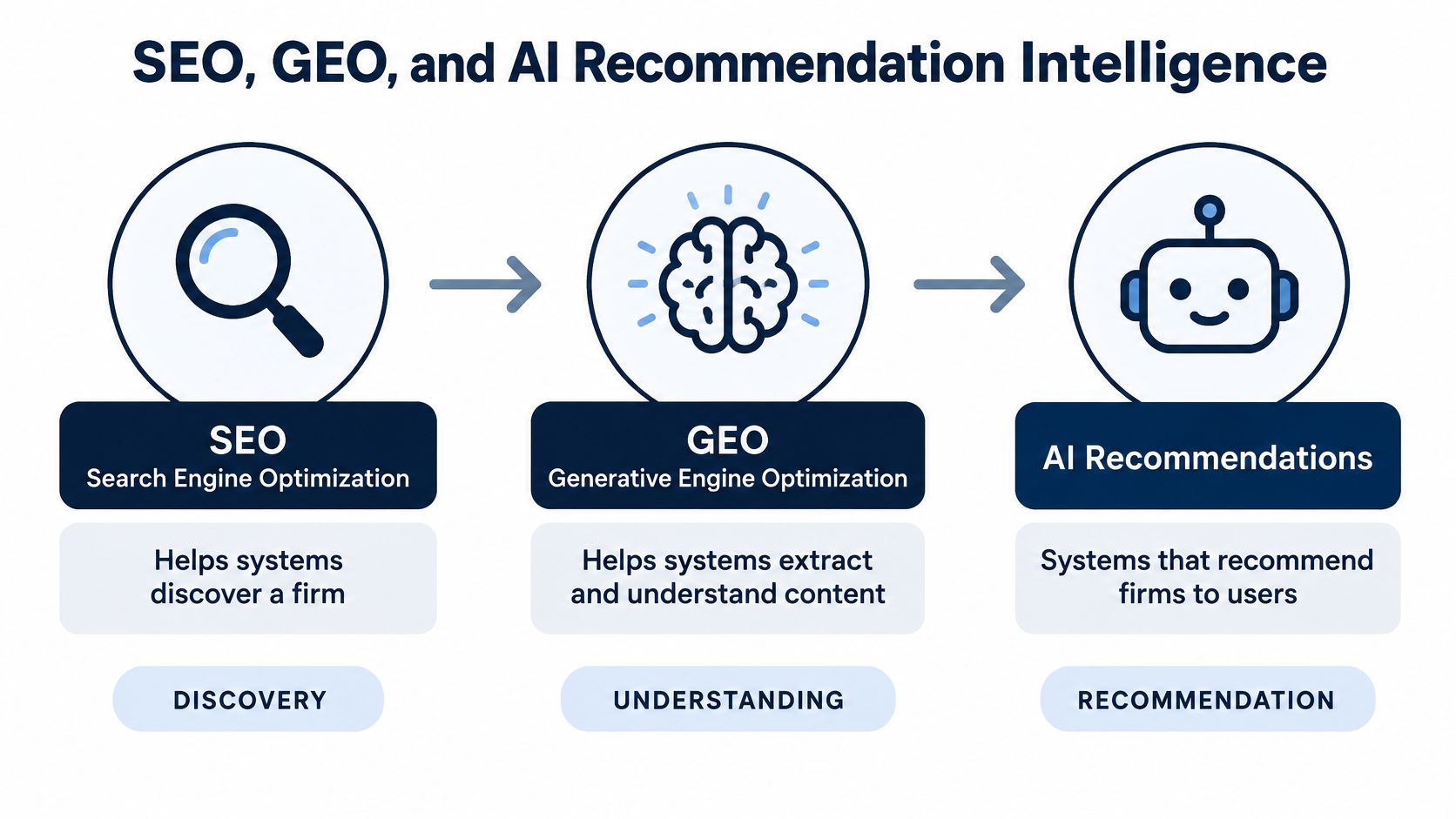
SEO establishes crawl access, relevance, and discoverability. Generative engine optimization (GEO) concerns whether systems can extract clear statements about services, people, locations, credentials, and outcomes. Answer engine optimization (AEO) is broader in common use, but buyers should ask which layer a tool measures. A content score is not evidence of recommendation.
Technical Eligibility Is Not Selection
Google states that websites don't need new AI text files or special schema.org structured data to appear in AI features, according to Google Search Central guidance on AI features and websites. The same guidance recommends ordinary SEO fundamentals and structured data that matches visible page text. That clarification matters. Markup may support interpretation, but it doesn't establish entity authority, guarantee selection over competitors, or show how a generated answer characterizes the firm.
- Discovery: Can systems find and index the relevant pages and profiles?
- Understanding: Can systems extract consistent facts about the firm, its attorneys, offices, and practice areas?
- Recommendation: Do systems cite the firm, describe it accurately, and place it in the final shortlist?
The third question requires output measurement. Leadership needs to inspect answer text, cited sources, competitor order, top-3 rate, and narrative depth. A firm may be technically eligible and well understood yet still absent when a prospective client asks which firm to hire for a specific dispute. That's not an SEO failure in the narrow sense. It's a failure of AI recommendation authority, and it requires a different diagnostic method.
How the Leading AEO Tools Compare
Feature counts are a weak basis for procurement. A more defensible standard is whether a platform can preserve evidence, reproduce findings, and explain change. An independent methodology assesses AEO platforms across a 23-point capability matrix covering measurement, diagnosis, action, and platform functions, according to the AEO Landscape methodology. Its measurement layer includes prompt-level tracking, citation and source analysis, competitor benchmarking, share of voice, sentiment, false-claim detection, AI-crawler analytics, and AI-referral traffic.
AEO Tool Capability Comparison
| Tool | Measurement Depth | Cross-Engine Coverage | Source-Level Evidence | Actionability |
|---|---|---|---|---|
| Monitor-only tracker | Appearance and share of voice | Often limited to selected assistants | Usually domain-level | Reports gaps for manual follow-up |
| SEO suite add-on | AI visibility beside rank and traffic data | Variable, sometimes tier-dependent | May connect prompts to known keywords | Useful for consolidated reporting |
| Content optimization platform | Citation gaps linked to pages | Depends on monitoring module | Page and topic evidence | Produces briefs or recommended fixes |
| AI recommendation intelligence platform | Inclusion, citation, positioning, and description accuracy | Designed for normalized comparison | Query, model, answer, and citation records | Links corrective work to changed representation |
The categories overlap, so the table should be used as an interrogation framework, not a ranking. Ask vendors to show the exact prompt, model context, answer snapshot, cited sources, and competitor set behind any score. Aggregate visibility without that record can't explain why a firm was shortlisted, omitted, or misdescribed. It also can't support a board-level decision when results move after a model update.
A score leadership cannot audit is an opinion presented as a metric.
Cross-engine breadth also needs qualification. Coverage may span ChatGPT, Gemini, Perplexity, Google AI products, Copilot, Claude, Grok, and Meta AI, while broader access may require higher tiers or add-ons, according to comparison coverage of AEO tool features. Regional interpretation adds another variable, and AEO strategies for Irish businesses illustrates why market context shouldn't be inferred from a global dashboard. The best AEO tools preserve historical snapshots, normalize results across assistants, and expose source-level evidence. Without those controls, trend lines may reflect sampling changes rather than changed recommendation behavior.
What the Data Shows About Law Firm Visibility
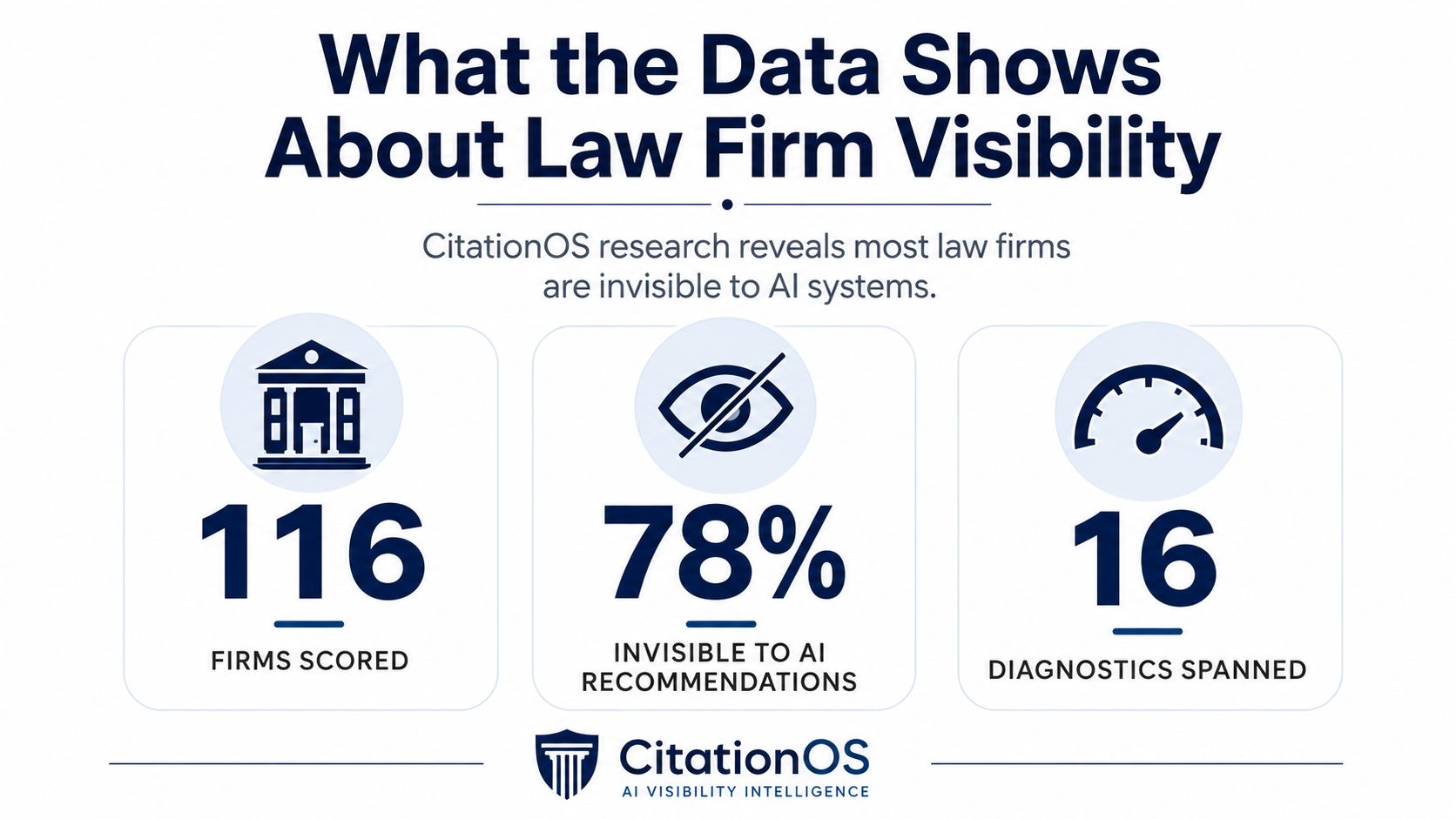
CitationOS research scored 116 firms over 16 months of diagnostics and found that 78% were invisible to AI recommendations. Read carefully, that finding doesn't claim those firms lacked websites, rankings, directories, or marketing activity. It indicates that AI systems did not surface them when recommendation intent was present. The gap between discoverability and selection is therefore measurable, not theoretical.
Invisibility Usually Reflects Weak Recommendation Signals
A firm can be absent because its entity signals conflict across sources. Names, office locations, practice labels, attorney profiles, awards, and case experience may not resolve into one confident interpretation. Another firm may appear but with thin narrative depth, giving the system little basis to explain why it fits a particular legal problem. A third may be cited for general information while competitors receive the actual recommendation.
Those are different failures requiring different corrections. A detailed law firm benchmarking analysis should therefore compare inclusion and positioning against named competitors, not report visibility in isolation. The relevant commercial unit is the high-intent prompt: a jurisdiction, a legal problem, a level of urgency, and a request for suitable representation.
Market adoption remains uneven. In a September 2025 survey, 37.2% of 250 U.S. marketing professionals were actively optimizing for AI-search visibility and another 30.8% were exploring such strategies, according to survey findings on emerging AEO adoption. The same survey found ChatGPT was monitored by 76.4% of respondents, compared with 35.6% for Google AI Overviews, per those reported results. That imbalance creates risk. Performance in one assistant doesn't establish performance elsewhere, because citation sources, descriptions, and competitor inclusion vary by model.
A Protocol for Testing Any AEO Tool
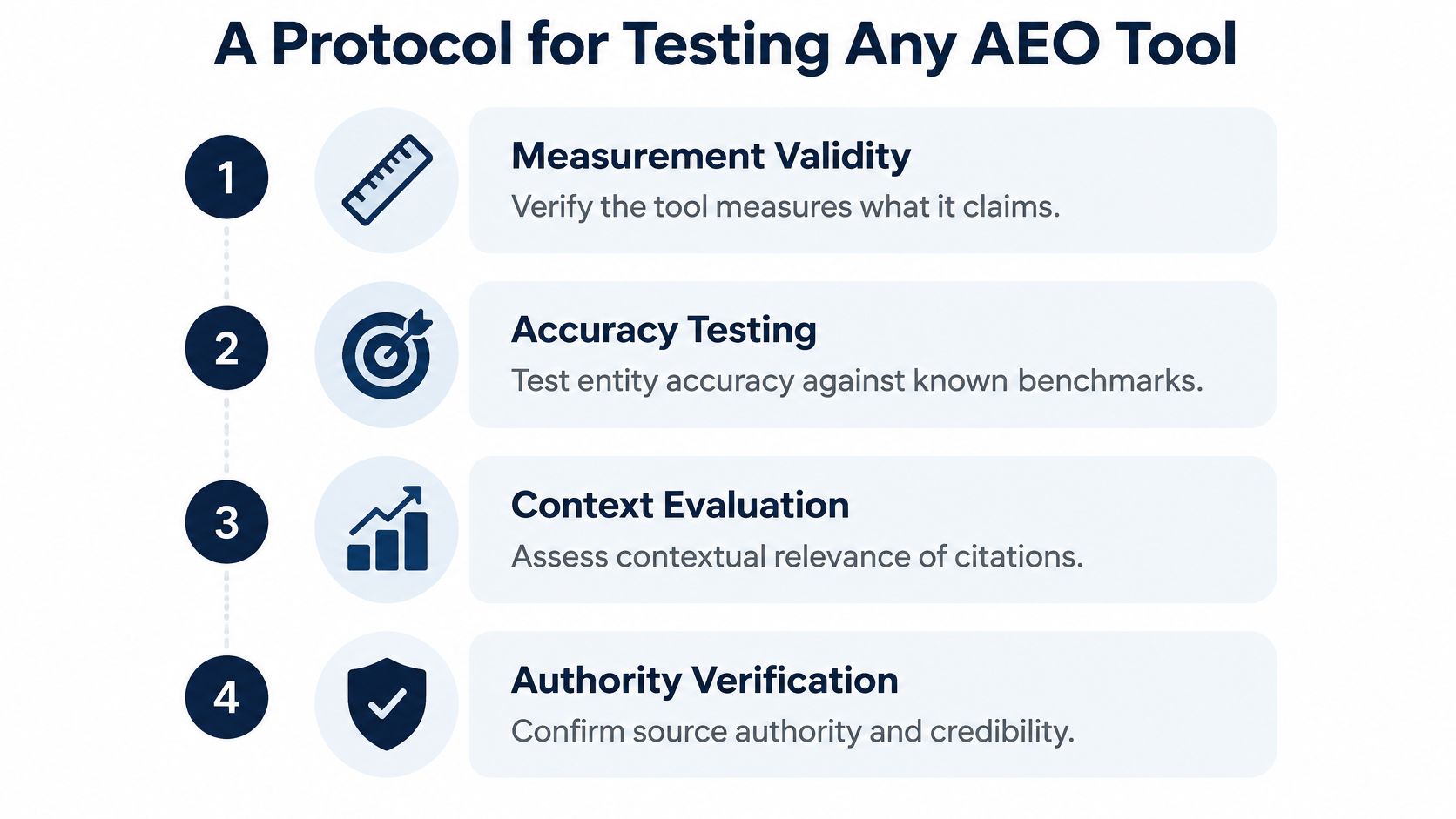
Do not buy a dashboard before testing how it behaves under uncertainty. AI answers are nondeterministic, may vary by region or personalization, and can change when prompts are worded differently or models are updated. Published tool comparisons note that monitoring is often limited to a defined prompt set and citation data can fluctuate after model updates, according to hands-on testing of leading AEO tools. A vendor should explain those limitations before contract signature, not after leadership challenges a trend.
A Reproducible Test Before Procurement
- Fix the prompt cohort: Select commercially important queries by practice area, jurisdiction, client type, and intent, then keep the wording stable during the test.
- Run repeatedly: Require multiple runs so one answer doesn't become a false baseline, and ask how variation is reported.
- Verify citations at source level: Open cited pages and confirm that they support the claim attributed to them.
- Separate outcomes: Record representation, inclusion, recommendation, and conversion as distinct measures rather than one blended score.
The test should also include competitor controls. If every firm moves in the same direction after a model change, the tool shouldn't present that movement as firm-specific progress. Ask for change logs, model-version records, confidence intervals or stability indicators, and raw answer retention. False positives deserve particular attention. A brand mention inside a list of firms to avoid, or a citation used for a generic legal fact, is not recommendation authority.
Broad engine coverage is less valuable than reproducible measurement inside the queries that produce qualified instructions.
An AI search audit framework gives leadership a structured way to apply the same questions across vendors. During evaluation, require the tool to explain one omission and one inaccurate description using inspectable evidence. If it can only restate that visibility fell, it is a monitor. If it can identify the prompt, answer, competing firms, supporting sources, and likely entity weakness, it approaches diagnostic value.
Why Entity Accuracy Matters More Than Mention Volume
Mention volume is easy to sell and easy to misread. An AI system may mention a firm frequently in low-intent contexts while excluding it when a user asks for representation. It may also cite the firm's content for a legal definition but recommend competitors for the work. Citation presence, narrative depth, and top-3 rate provide a sharper account of commercial position than raw mentions.

Accuracy Determines Whether a Mention Helps
Entity authority depends on coherence. The firm's name, offices, practice areas, attorneys, awards, case experience, and third-party descriptions need to support the same interpretation across directories, publications, verdict reports, professional profiles, and its own pages. Conflicting attributes create ambiguity. An AI system resolving that ambiguity may choose a competitor with a cleaner entity record, even when the omitted firm has stronger conventional rankings.
- Factual citation: A source supports a statement about law, process, or the firm.
- Entity representation: The answer describes the firm's identity, focus, people, and location correctly.
- Recommendation: The system advances the firm as a suitable choice for a stated problem.
These outcomes should never be merged into one count. A firm with fewer but authoritative, contextually relevant citations may be better positioned than a firm with many weak mentions. Inaccurate praise is also a liability. If an answer assigns the wrong practice area, jurisdiction, attorney, or credential, visibility can damage trust before the first conversation.
An entity authority assessment should show where descriptions diverge and which sources appear to carry weight in generated answers. That evidence lets leadership correct the record methodically. It also prevents a common error: producing more content when the underlying problem is inconsistent identity. AI systems don't need more claims about the firm. They need claims that agree.
Choosing the Right Tool for Your Firm
Start with the decision the measurement must support. A managing partner asking whether the firm appears at all needs a different instrument from a CMO deciding where to correct entity records or build authority. Geography, practice concentration, competitor intensity, and client research behavior determine the prompt set. Tool selection follows from that scope, not from the longest engine list.
Match the Instrument to the Management Question
For a rapid baseline, choose a time-bound audit with a standardized score, preserved answers, named competitors, and clear definitions for AI Visibility Index (AVI), citation presence, and top-3 rate. The output should identify where the firm is absent and whether descriptions are accurate. A baseline that can't be repeated has limited value, so the prompt cohort and model context must be documented.
For a high-competition practice, prioritize cross-engine comparison and source-level evidence. Leadership needs to see which firms are selected for the same problem, which sources support their inclusion, and whether the firm's narrative is deep enough to justify recommendation. Historical snapshots are essential because a single run can't distinguish a stable disadvantage from normal answer variation.
Decision rule: Buy the tool that can explain your most expensive omission, not the tool with the largest aggregate visibility chart.
For a firm with visible rankings but inconsistent recommendations, authority-gap analysis matters more than content generation. The priority is to find conflicting entity attributes, weak third-party corroboration, and practice-area misalignment. Correct those structural issues first, then remeasure with the same prompts. The best AEO tools for professional services are therefore not a single category. They're the platforms whose evidence model matches the firm's actual failure mode.
The Strategic Implication for Professional Services
AI-mediated selection changes what marketing leadership must prove. It is no longer sufficient to show rankings, impressions, or a rising traffic line when prospective clients receive a synthesized shortlist before visiting any firm. The governing questions are narrower and more consequential. Are we included? Are we cited for the right reasons? Are we described accurately? Are competitors receiving stronger recommendations for the matters we want?
Visibility Is Not Recommendation Authority
Firms that treat AEO as another content tactic will misdiagnose absence. They may publish more pages while conflicting directories, thin attorney narratives, and weak third-party signals continue to limit selection. The firms better positioned for AI-mediated demand will maintain coherent entity records and measure the output layer repeatedly. They'll know which prompts matter, which competitors win them, and which sources support the result.
That is the distinction between being ranked and being chosen. The tools that matter will not merely count appearances. They will explain, with reproducible answer-level evidence, why a firm is trusted, omitted, or misrepresented when a client asks for counsel.
If your firm needs a defensible baseline for AI inclusion, citation presence, narrative depth, and top-3 rate across leading assistants, a confidential audit can establish where you stand against named competitors and why. Visit CitationOS to examine the AI recommendation intelligence framework and determine whether an assessment fits your firm's decision needs.