Pew Research Center measured what happens when Google places a generated summary above the results. In visits containing an AI summary, a click on a traditional search result occurred in 8% of cases, against 15% when no summary appeared, a click on a link inside the summary itself happened in just 1% of visits, and 88% of those summaries cited at least three sources (Pew Research Center).
A firm can sit inside the answer and shape a buyer's shortlist without a single click landing in its analytics. A traffic dashboard records a quiet month. The selection happened anyway.
An AI visibility audit is a repeatable test of whether an assistant names the firm for the questions that carry revenue, which sources it uses to describe the firm, and whether those descriptions hold up when a client checks them.
Citation presence is a weak risk metric on its own. The Pew pattern already shows why: most summaries cite several sources, and almost no one clicks them. Citation validity is the figure that matters, because a named source can still misdescribe the firm. Raw mention counts create a second distortion. They mark a smaller or specialist firm as weak whenever a larger name appears more often, even when the failure is an evidence-supply gap: the sources an assistant already trusts do not carry that firm's facts. An authority gap is a different failure. Sources exist, but nothing in them gives the assistant a reason to select the firm. Conventional search rank can look orderly while either gap stays open. The audit has to separate those two failures before a mention tally is treated as a verdict.
Eight Metrics That Separate Presence From Selection
SEO helps systems discover a firm. GEO and AEO help an assistant extract and understand what that firm publishes. Neither reaches the layer where a model decides whom to recommend, and that layer is where the commercial outcome is settled. The discipline that measures it is AI recommendation intelligence, and the audit is its instrument.
The market condition is no longer speculative. In the Reuters Institute's 2025 survey across six countries, 54% of respondents reported seeing an AI-generated answer in response to a search query during the previous week, and another 19% were unsure whether they had encountered one (Reuters Institute). Information-seeking use more than doubled over the year, with 24% using generative AI to obtain information in the previous week, up from 11% in 2024. Shortlists now form inside answers, not only beneath them.
| Metric | What It Measures | Unit of Measurement | What a Weak Result Signals |
|---|---|---|---|
| Inclusion rate | Share of prompts where the firm is named | Per prompt, per assistant | Absent from shortlists even when search visibility is strong |
| Citation rate | Share of answers containing a verifiable firm or third-party citation | Per answer | The firm is named without any supporting source |
| Citation validity | Whether the cited page supports the specific claim attached to it | Per cited URL | High mention rate resting on low credibility |
| Narrative accuracy | Whether practice areas, location, representative matters and client fit are described correctly | Per answer | Miscategorization by the assistant |
| Narrative depth | How specific the description is about practice, jurisdiction and distinguishing experience | Per answer | Generic or thin representation |
| Top-3 rate | Share of prompts where the firm appears among the first three firms named | Per prompt set | Named, but outside the short list users act on |
| AI Visibility Index (AVI) | Composite of inclusion, citation, accuracy and depth across the full query universe | Per firm, per query universe | Trend signal only; diagnose with the underlying metrics |
| Citation Score | CitationOS framework quantifying inclusion, narrative strength, entity strength and relative positioning | Per firm, per query universe | The specific gaps behind a low total |
Read the eight in a deliberate order. Inclusion and citation rate establish whether the firm is being selected at all. Citation validity and narrative accuracy establish whether that selection is safe to leave uncorrected. Narrative depth and top-3 rate establish how close the firm sits to the shortlist a client acts on, which is a different question from appearing anywhere in the answer.
The composites come last, not first. An AVI that drifts two points across a quarter is a trend, not a diagnosis, and a Citation Score without its components is a number a managing partner cannot act on. Break either one into prompt-level rows before it reaches a board meeting.
The rule that governs everything after it: a high inclusion rate paired with low citation validity is a reputational risk, not a success. The firm is being recommended on evidence that won't survive the client's check.
Firms that still need to fix the extraction layer before measuring selection can start with this GEO advice for UK small businesses, which covers how content has to be structured for generative engines to read it cleanly. Once measurement is running, benchmarking a firm against its named competitors is what converts a score into a decision about where to spend.
How to Build the Query Universe and Run the Protocol
One afternoon of prompting produces anecdotes. A query universe produces evidence, because every cell was defined before the first run and a second analyst could repeat it without asking what you meant.
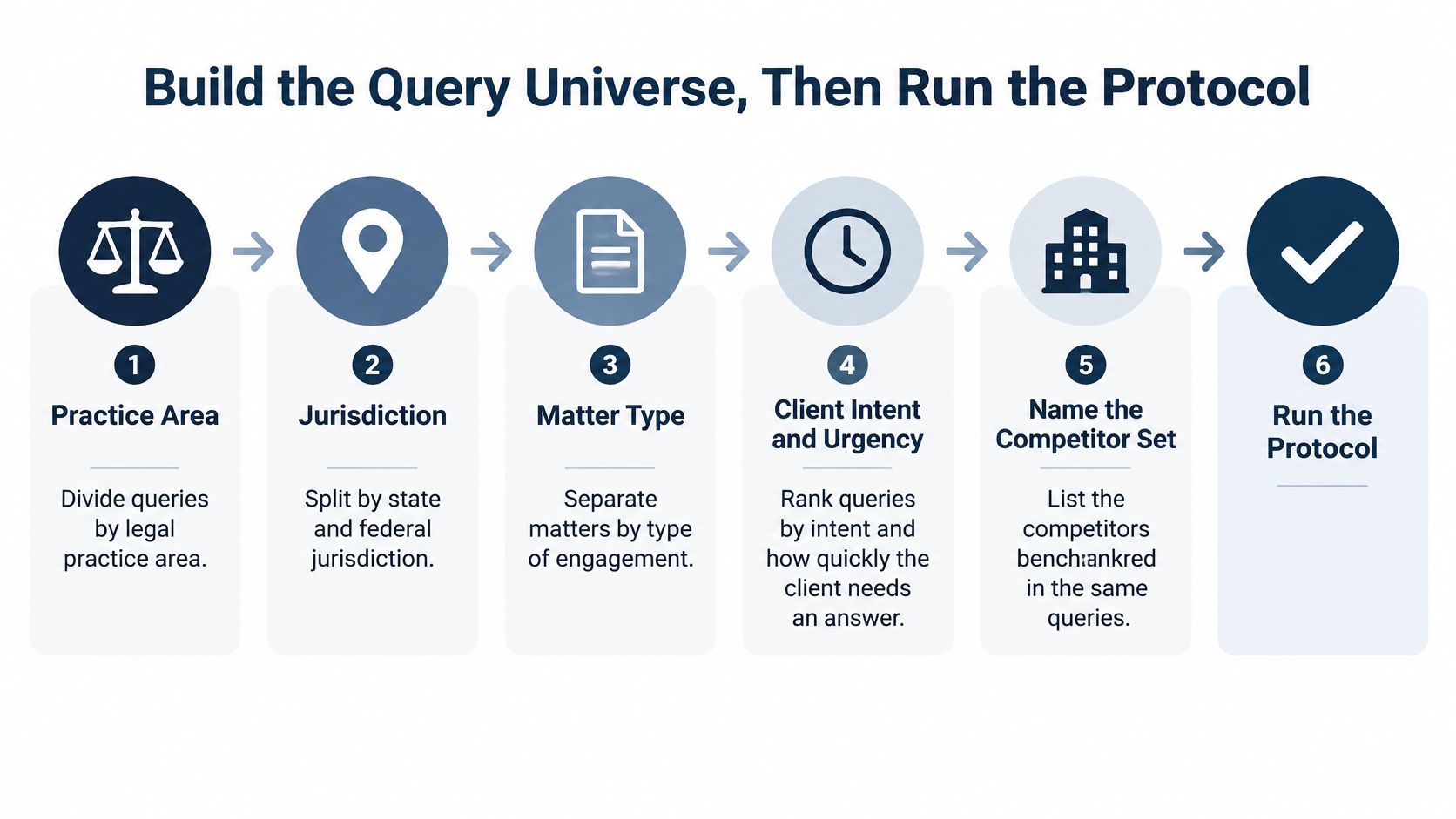
Build in six moves.
- Map the universe before writing a single prompt. Divide by practice area, then jurisdiction, then matter type, then client intent and urgency. A cell such as "employment disputes, two states, urgent injunction" is a universe; "employment law" isn't. The usual slip is inheriting a keyword list from the SEO team and calling it a query set.
- Write branded and unbranded prompts for every cell, including one that states a problem rather than a service. "We've been served with a non-compete suit and need counsel this week" tests a different retrieval path than "non-compete lawyer". Composition is the slip that matters here: prompts written by the firm's own marketing team use the firm's vocabulary, and clients don't. Ground the phrasing in how buyers frame intent, as this guide to intent-driven content for SMB websites sets out, then rewrite every prompt in the buyer's words.
- Run identical prompts across at least three assistants, for example ChatGPT, Gemini and Perplexity. Identical wording is the control, so that when two systems diverge the difference is the system and not your phrasing. Testing everything from one logged-in session in one afternoon is the slip that invalidates the most audits.
- Log the model or version, date, geography, personalization state, full answer text and every cited source. If you can't reconstruct the run, you can't defend the finding six weeks later when someone disputes it. Screenshots without that metadata are the most common failure in reports that get challenged.
- Repeat the full matrix on separate dates. Movement between dates is a finding about volatility, not noise to be averaged away. A firm that appears on Tuesday and vanishes on Thursday has a different problem from one that never appears at all.
- Store results at the prompt level. One average hides the pattern that matters, because a firm can score well on general practice questions and disappear on the jurisdiction-specific ones that carry fee value. Collapsing to a composite in week one is what turns remediation into guesswork.
Capacity to run this properly is unevenly distributed, and the distribution shapes what the numbers mean. In the American Bar Association's 2025 legal industry data, 39% of professionals at firms with 51 or more lawyers reported generative-AI adoption, against roughly 20% at firms with 50 or fewer (American Bar Association). The same dataset found 43% of small firms named digital marketing as a key client-acquisition channel while 85% still depended on referrals. A firm built on referral reputation can be absent from retrieval entirely, and that absence says more about its public record than its practice.
Minimum defensible matrix: one practice area, two jurisdictions, six prompts, three assistants, two dates. That's 36 runs per cycle.
Budget about two weeks for a first baseline on that matrix, with the log complete before anyone scores a single response.
Verifying Citations Before They Shape Client Trust
Citation validity is the risk metric. A mention rate can rise while the account of the firm gets worse.
NIST's generative AI profile warns that AI systems can produce confabulated reasoning and citations that misleadingly increase user trust, and it recommends comparing outputs against known ground truth with human review alongside automated evaluation, including ongoing verification of sources and citations (NIST AI 600-1). A citation is a claim about provenance. Support is a separate test: the cited page has to state the claim the sentence makes. A URL under a sentence shows that a model retrieved something. It does not show that the page says what the sentence says.
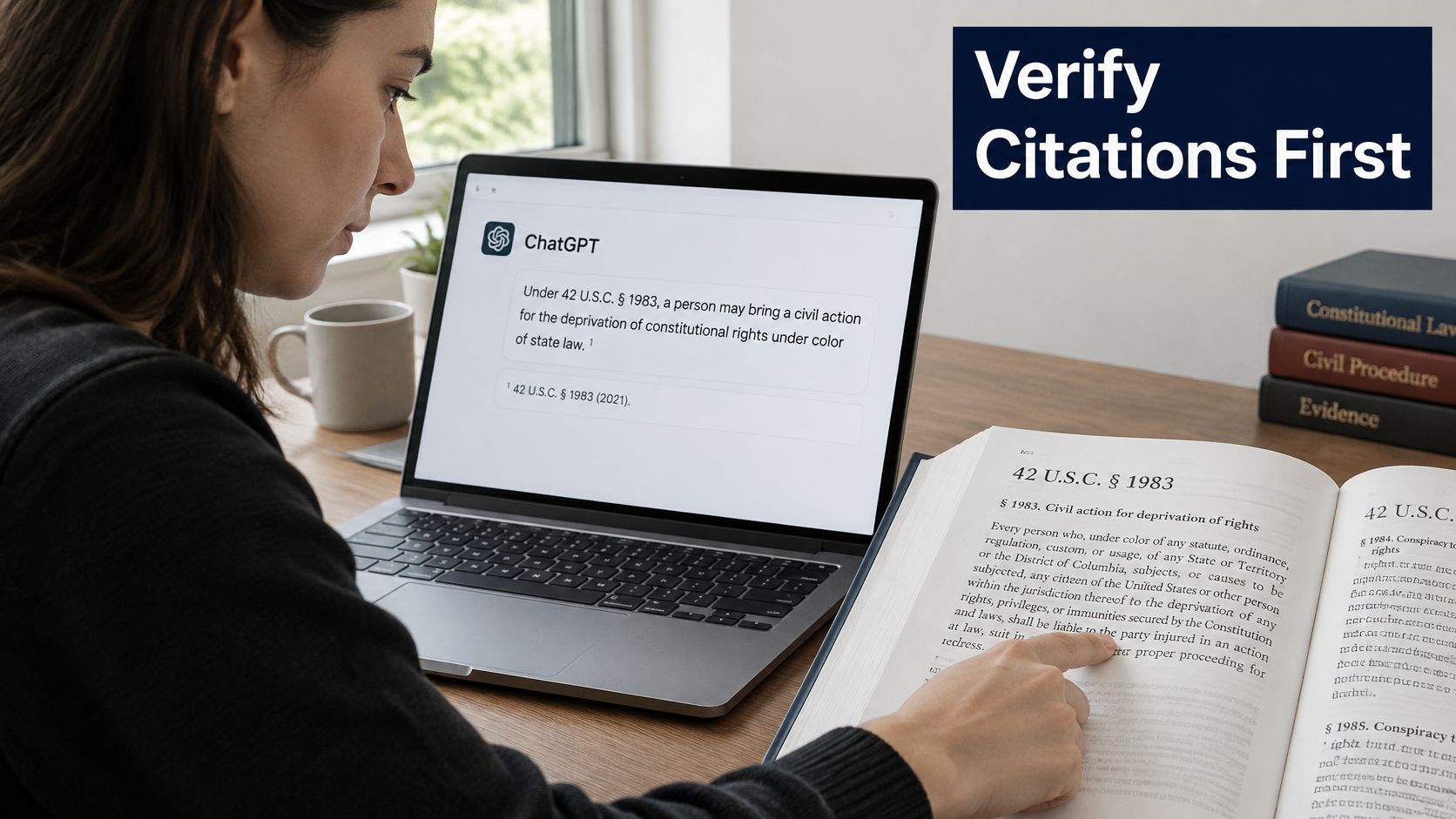
The check stays manual for any description that will change how a firm is presented. A smaller or specialist firm is easy to misjudge if the only score is how often it is named. The material exposure is an invalid citation that a prospective client can open.
The verification order an analyst runs
On the first pass, open every cited URL. Do not sample. A dead link, a redirect to a homepage, or a page rewritten since the crawl is a finding on its own.
Then confirm that the page supports the specific claim attached to it, not the general topic. A genuine page about commercial litigation that never mentions the client's sector does not support a sentence about sector expertise.
Classify each claim as supported, partly supported, unsupported, or fabricated. Use four states. Partly supported is where most misrepresentation sits, and where a correction is usually still available.
Attach a consequence to each classification. A label without severity produces a list nobody prioritizes.
Weighting severity by consequence
Build the scale before scoring anything. A wrong jurisdiction or a wrong practice area outranks a missing practice-area mention, because it sends the client to the wrong place rather than merely underselling the firm. An invented representative matter outranks both, because it invents a credential. Unsupported superlatives rank below factual errors and above a thin but accurate description.
When a comparison rests on a small prompt set, publish the interval next to the number. A three-point gap across twelve prompts is indistinguishable from run-to-run variation, and presenting it as a finding invites a decision the evidence cannot carry. Twelve prompts is a pilot, not a benchmark.
Keep visibility and correctness in separate columns. A dashboard that merges them lets a firm celebrate a mention rate that misdescribes it.
The gap between claimed readiness and verified practice
Clients already reward AI readiness they cannot inspect. Thomson Reuters research found that 59% of corporate legal clients want their firms to use generative AI, while 71% do not know whether their firms do, and that research puts legal-sector generative AI usage at 26% in 2025, up from 14% in 2024, with 45% of law-firm respondents either using it or expecting to make it central within a year (Thomson Reuters).
Clients assume capability, cannot verify it, and read the assistant's answer as the account of record. That is the condition under which a bad citation becomes expensive. Testing practice strengths, jurisdictions, industries, representative matters, and client-service capability, then flagging descriptions that create a misleading impression of technology use or outcomes, is governance work.
The trust test: if a prospective client read the answer and then opened every citation, would the account of the firm survive?
Record every finding with the prompt, model, date, geography, answer variation, source support, and material inaccuracy. Route corrections through verifiable firm pages, corrected directory records, and published matters. Do not try to steer the output directly. Those attempts fail and leave a trail.
The audit answers one question: whether a stranger receives a defensible account of the firm.
Telling an Authority Gap From an Evidence Gap
Two firms can post the same composite score for opposite reasons, and the response each needs is opposite too.
An authority gap means the substance isn't there for that matter type: no track record, no partner who has done the work recently, no basis for a recommendation. An evidence-supply gap means the substance exists and the public record doesn't show it: thin matter descriptions, inconsistent biographies, few independent mentions that name the firm alongside its practice.
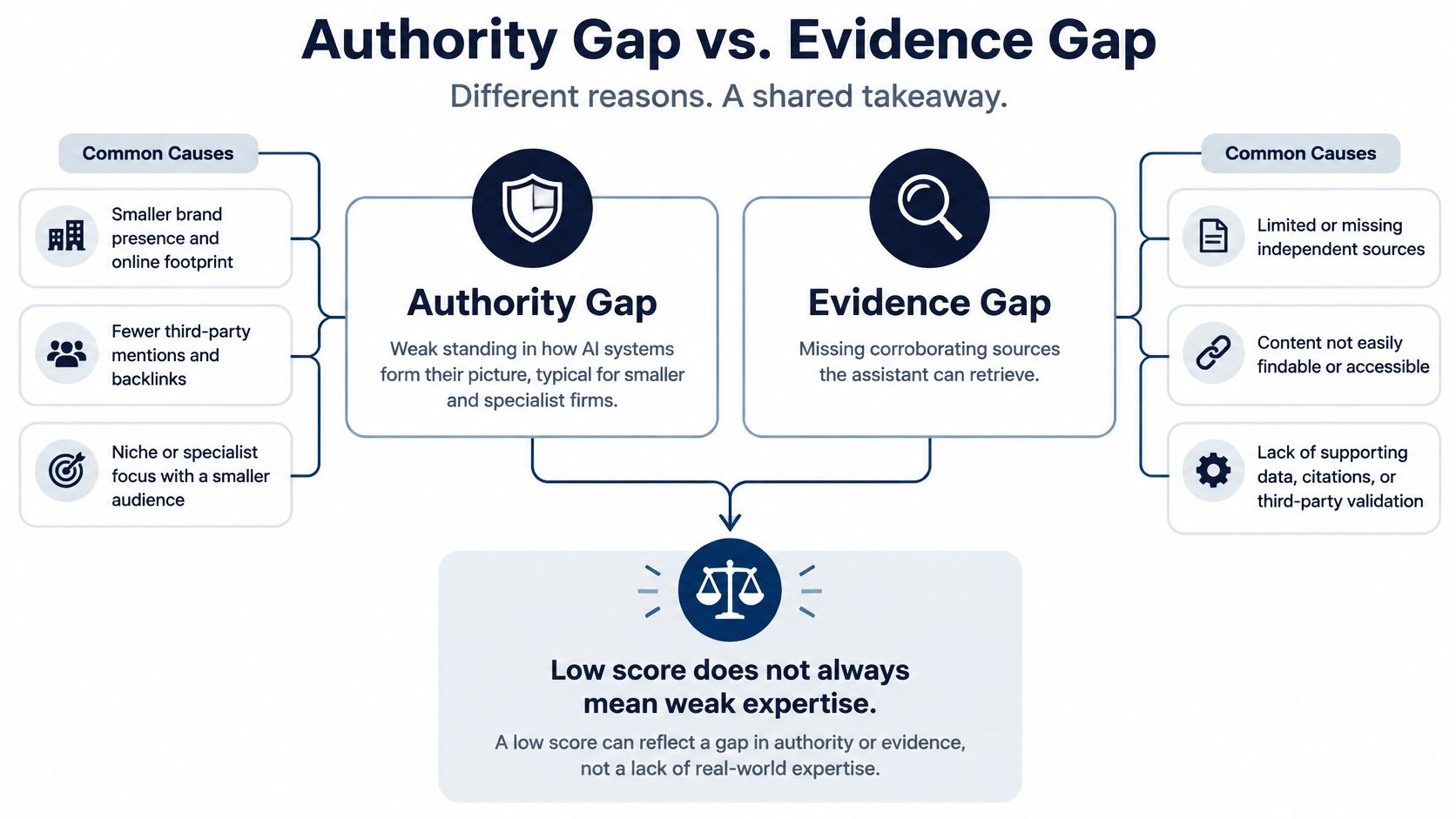
The first calls for a practice decision. The second calls for publishing and correction, and it is fixable within a couple of quarters. Treating the second as the first is how good boutiques get written off by data that only measured their publishing habits.
| Observed Pattern | Likely Cause | Diagnostic Check |
|---|---|---|
| Named for a broad query, absent for a specific matter | Narrow expertise is not evidenced in public sources | Compare the matter type against the firm's published matter descriptions |
| Present in one assistant, absent in another | Retrieval or prompt variance | Repeat the runs on separate dates before drawing a conclusion |
| Named under the wrong practice area | Inconsistent entity signals across directories and bios | Compare how the name, practice areas and people are described across each source |
| Absent despite a strong referral reputation | Little independent corroboration online | Count third-party references that name the firm together with its practice area |
| Named with claims the sources do not support | Unverified or overstated statements on public pages | Open each cited URL and check the claim against the page |
Segment before comparing. Raw mention counts reward whoever publishes most, which is a proxy for size rather than quality. Compare by query intent on entity consistency, independent corroboration, jurisdictional specificity, recency and practice-to-matter fit. Report absence as absence, because "not recommended" is not proof of irrelevance, and one model's omission can come from retrieval, from phrasing, or from an index that hasn't caught up.
There's a reason the gap stays invisible to leadership. A 2026 consumer study found 46% of adults would consult AI before contacting a lawyer, yet only 20% would use an AI recommendation to find a lawyer, against 54% who would ask for referrals (2026 Clio Legal Trends Report). Research happens in AI; selection still happens through people, for now. That lag is what lets an evidence gap persist unnoticed until a competitor closes it.
Boutiques benefit most from the distinction. For them, how entity authority is built across directories and bios is a publishing problem they can solve, not a verdict on their expertise. Firms that want the content side mapped matter by matter will find a workable structure in X8 Web Design's legal marketing playbook.
Sequencing Remediation and Re-Testing Over Time
Order fixes by how fast you can prove they worked, not by how much they matter.
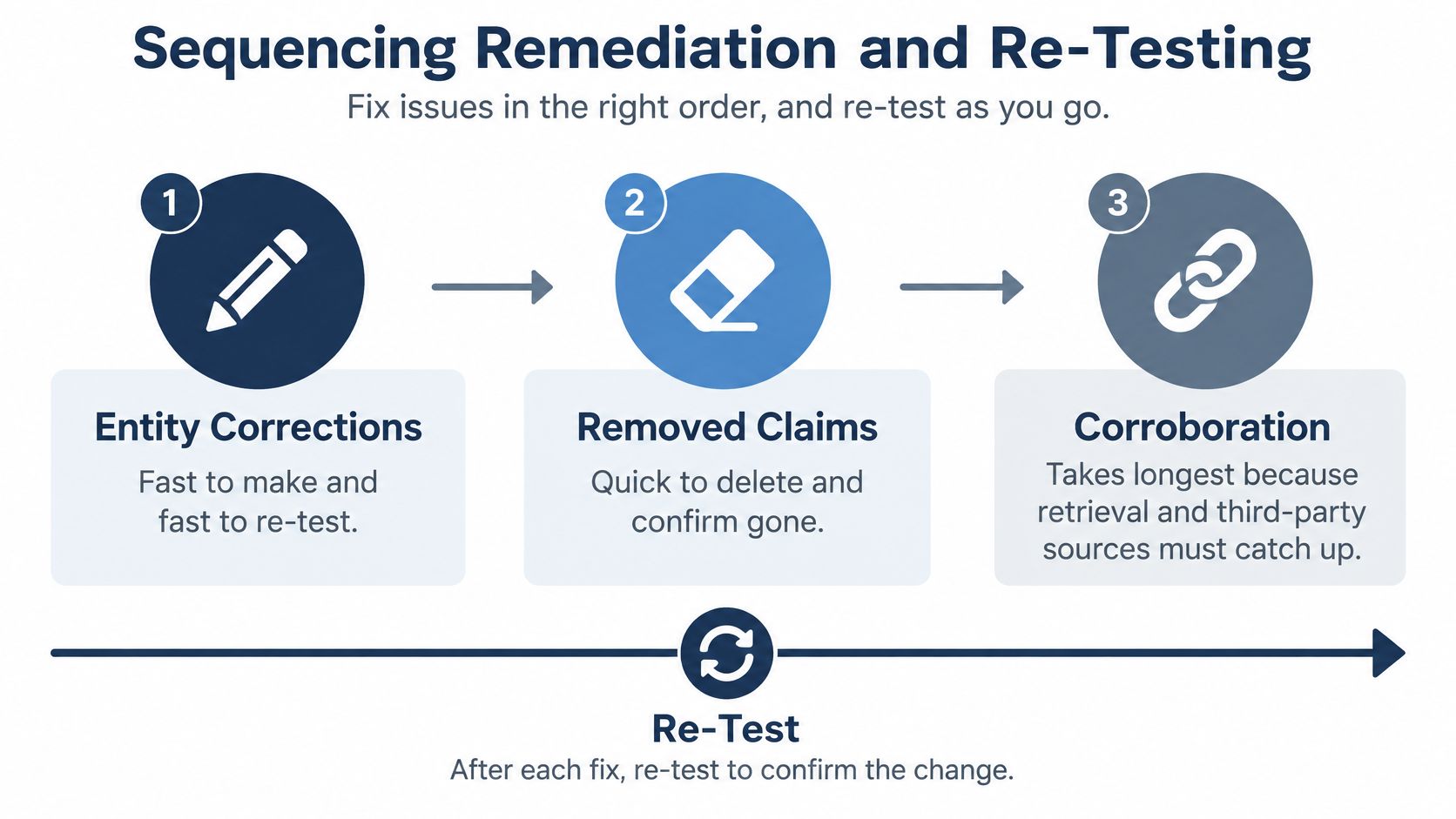
Entity corrections and removed claims are fast to make and fast to re-test. Corroboration is slowest, because retrieval and third-party references accumulate over months and no single edit moves them.
| Remediation Action | Gap Addressed | Re-Test Window | Evidence to Confirm |
|---|---|---|---|
| Correct inconsistent entity records in directories and bios | Entity consistency | 30 days after source updates | Name, practice areas and people match across sources |
| Remove or qualify unsupported claims on firm pages | Citation validity and risk | Next scheduled run, about 30 days | Each cited URL supports the claim attached to it |
| Publish matter-level evidence on practice pages | Narrative depth and practice-to-matter fit | 60 to 90 days | Practice pages describe matter types and jurisdictions the firm can document |
| Strengthen jurisdictional detail in market-facing content | Narrative accuracy by jurisdiction | 60 to 90 days | Answers name the correct jurisdiction for matter-type prompts |
| Earn independent corroboration from publications and third-party references | Citation presence | One to two quarters | Third-party sources name the firm with its practice area |
Those windows are planning judgments for scheduling, not promised response times. Treat them as the date on which you check, not the date on which you expect the model to have changed.
The sequence follows from that ordering. Correct entity records and unsupported claims first, because they're cheap, they reduce risk immediately, and they clear the noise that makes later movement hard to attribute. Publish matter-level evidence and jurisdictional detail next. Run corroboration as a multi-quarter programme with its own owner, since it depends on people outside the firm.
Two-cycle rule: don't judge a remediation until the same fixed prompt set has run twice after the change.
Re-score each cycle against that fixed set of prompts, so movement reflects the firm's changes rather than a different test. Report the Citation Score as its four components on separate lines every cycle, so any move in the total traces back to one specific gap instead of a vague improvement. Log every change with its date, so the next audit can attribute movement to an action rather than to a model update.
Firms running this continuously, rather than annually, get more from it; monitoring AI brand mentions over time covers what to watch between cycles.
Deciding Whether to Commission a Baseline Audit
The choice depends on whether the firm can run a clean, repeatable test. An in-house analyst can follow the protocol above, but a single login or prompts written by the firm's own team can bias the results. Commissioning an independent analysis can help separate those testing effects from the firm's actual representation in AI answers.
Set the test scope before choosing a route: identify the practice area and market that matter most, then define the client-style questions the firm expects to appear for. Those choices determine which answers the audit can meaningfully assess. A broad prompt set may produce more mentions, but it can obscure whether the firm appears for the work and market it is targeting.
For a useful baseline, assess each relevant answer at the prompt level. The key question is whether the firm is absent because its authority is unclear or because the sources AI systems rely on do not provide enough evidence. A raw mention count cannot distinguish those causes, particularly for smaller or specialist firms. Citation validity matters more than citation presence: an answer that names the firm but relies on weak or mismatched sources may create more client-trust risk than an omission.
The free AI visibility snapshot checks the firm's website for GEO and SEO readiness and asks an AI assistant four client-style questions, while the confidential full audit examines high-intent queries across the firm's practice and city, including competitors named instead, the reasons behind those selections, and the firm's Citation Score and specific gaps. The full audit arrives within 7 business days, with no automated outreach or obligation.
A first baseline earns its cost when it gives the firm an actionable account of what is missing and why. Use that diagnosis to choose a response: strengthen the evidence available for a relevant claim, address an authority gap, or correct inconsistent entity information. The composite score can summarize the result, but the prompt-level findings should guide the decision.
An audit that produces only a score has not answered the operational question. CitationOS's free snapshot shows whether an AI assistant names the firm and which firms it names instead. Request the full private audit for the Citation Score, competitor reasoning, and specific gaps to address at CitationOS.