Roughly 75% of the content people watch on Netflix and 35% of the pages they visit on Amazon arrive through a recommendation rather than a direct request, according to a 2024 review of the economics of recommender systems citing research by MacKenzie and colleagues.
Read that as an executive and the implication lands hard. In two of the most heavily instrumented marketplaces on earth, most consumption is allocated by a ranked list the user never inspects. The same allocation now happens in language. Ask an assistant for a commercial litigation firm in a specific city and it returns three or four names with a sentence on each, no directory attached.
The decisive moment in that exchange isn't placement. It's inclusion. A firm that isn't named has no position to defend, and better page copy doesn't rescue a name the engine never considered.
An AI Recommendation Engine Decides Who Enters the Shortlist
A recommendation engine turns evidence about entities, preferences and interactions into a set of ranked choices. In a legal search, that set may be only a few firms, each paired with a brief explanation. The first question is whether a firm enters the set at all.
A concierge asked for a family lawyer does not hand over a directory of 400 firms. She gives a few names in a deliberate order, with a reason for each: one firm may handle relocation disputes, another mediation, and another cases involving a foreign jurisdiction. The firms she omits may never have entered her consideration set.

The shortlist is the product; the catalog is its raw material. For an organization assessed this way, inclusion comes before position. A firm that is absent has no ranking to improve.
The Discipline Behind the Shortlist
Netflix launched the Netflix Prize in October 2006, offering a $1 million award for a 10% improvement in its Cinematch rating predictor and releasing roughly 100 million anonymized ratings from about 500,000 users across some 17,000 films, according to an AI Wiki history of recommender systems. The competition helped focus the field on ensembles, offline measurement and feedback loops. The ACM Conference on Recommender Systems followed in 2007. Research on recommendation systems has since expanded substantially.
Generative assistants present the shortlist in prose. They give names and explanations, while the process that shaped the answer remains out of view. A polished explanation does not establish that the candidate set was complete, or that an omitted firm was assessed and rejected.
What changes with generative answers: the shortlist is compact, and the system states its reasoning. That makes omissions visible, but it does not make them neutral.
For a firm, the central risk is exclusion before comparison. Its position matters only after it has been named.
Four Stages Turn a Large Pool Into a Short List
Production systems don't score every candidate at once. They cascade through candidate retrieval, lightweight pre-ranking, full ranking and optional re-ranking, the architecture set out in ACM RecSys research on industrial recommendation pipelines. The constraint is arithmetic. Running an expensive model over an entire catalog takes longer than an interactive session allows, so a cheap stage shrinks the pool before the costly stage touches it.
Here's how that cascade behaves for a single query, say a family lawyer in a named city.
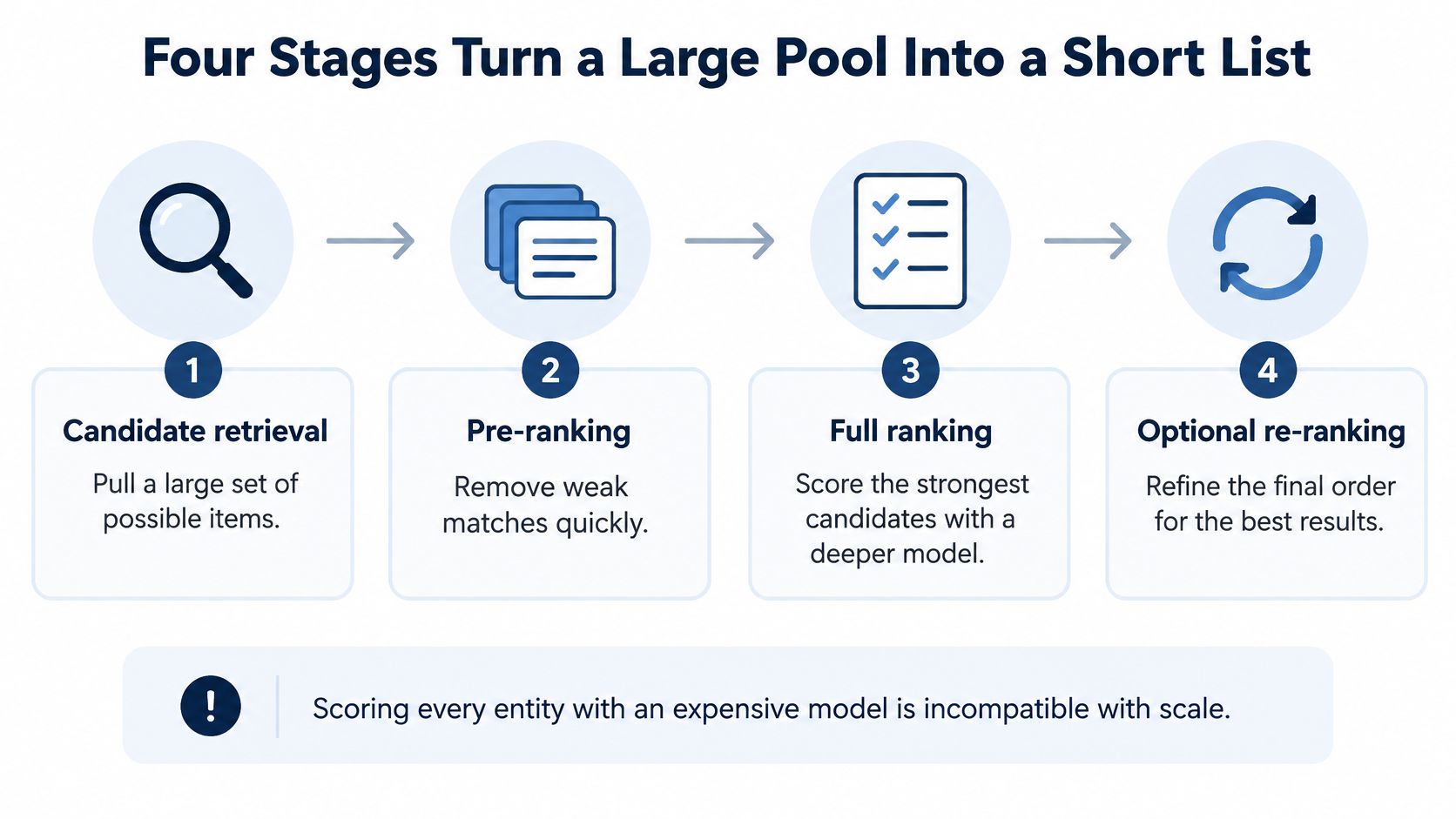
| Stage | Job in the pipeline | Example for a law firm query |
|---|---|---|
| Candidate retrieval | Recalls every entity that plausibly matches the query | All firms with a family-law practice in the named city |
| Pre-ranking | Cuts the recalled set to a manageable number with a lightweight score | Firms with consistent, specific entity records |
| Full ranking | Scores each remaining candidate with a high-capacity model | Firms whose practice claims are corroborated across sources |
| Re-ranking | Applies diversity, freshness and business rules | Avoids naming three firms from the same network |
Each stage carries its own latency budget and its own failure mode. Retrieval fails by exclusion. Pre-ranking fails by discarding a relevant firm whose record is thin. Full ranking fails by trusting a confident claim that no source corroborates. Re-ranking fails by producing a list that looks varied and says nothing.
Where the Shortlist Is Actually Lost
Retrieval is the consequential stage, and it fails without warning. A firm outside the candidate set cannot be rescued by a better ranker downstream, which makes source coverage and entity representation engineering problems rather than copywriting problems.
Candidate quality gets measured with Recall@K, HitRate@K and NDCG@K. Click-through rate measures only what happened after the funnel closed, so a strong final CTR can sit on top of a systematic retrieval failure, because users click what they're shown.
A firm missing from retrieval isn't ranked low. It isn't in the room.
Assistants don't publish their internal pipelines, so treat the cascade as a reference architecture to test against rather than a description of any one system. For each query that matters to your practice, work through three questions in order. Is the firm retrieved at all? Does it survive the filter that removes weak matches? Is it ranked high enough to be named in the answer a client reads?
When buyers run this filtering by hand, they scan directories that place practice areas and jurisdictions side by side, the way a compare law firms Singapore listing lets a reader narrow before shortlisting. An engine performs the same scan faster, and with far less transparency about what it discarded.
Signals That Decide Which Firms Get Named
Approximately 78% of citations in one analysis of AI search output pointed to corporate websites, including companies' own pages and third-party pages published by organizations in the same market, per research on how AI search engines represent, cite and recommend brands. An AI answer is an aggregate. The system reads those pages alongside directories, profiles and other references, then writes a description that no single source owns. That share sitting on corporate sites cuts against treating a firm's website as a brochure. The pages the firm controls supply most of the raw material for how it gets described, and they also decide whether it is named at all. Position only matters after the name clears that first filter.
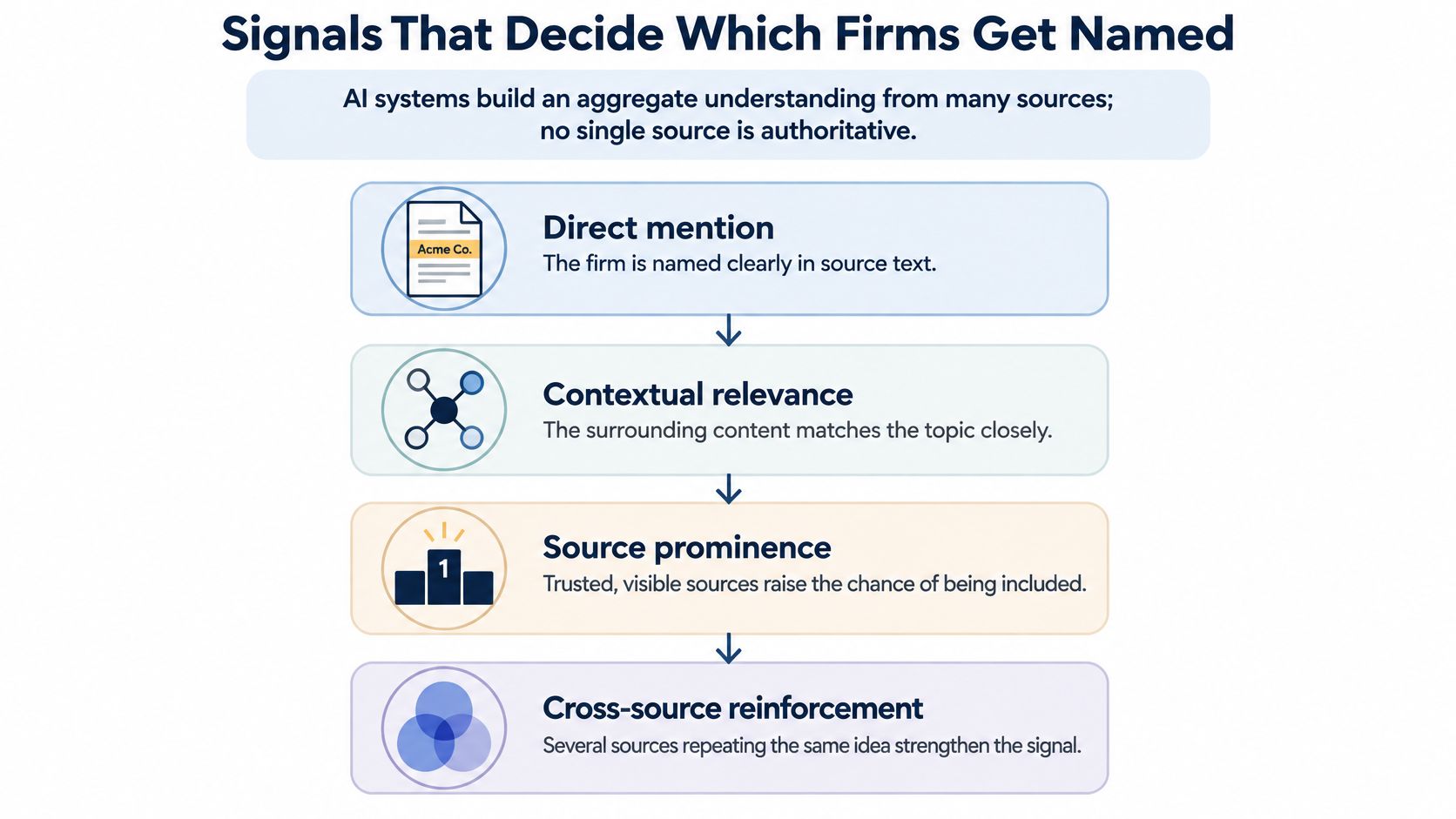
| Signal | What AI systems read | Effect on selection |
|---|---|---|
| Entity consistency | Name, practice areas, offices and admissions across sources | Conflicting details create ambiguity and lower confidence |
| Firm-controlled pages | Practice pages, attorney profiles and insight articles | Corporate sites dominate AI citations, so thin or missing pages leave the firm out of the set of names |
| Third-party corroboration | Directories, verdict databases and editorial mentions | Independent sources confirm claims the firm makes about itself |
| Structured data | schema.org markup and knowledge graph records | Makes the firm and its people identifiable as entities |
| Narrative specificity | Matter types, jurisdictions and outcomes described precisely | Vague descriptions yield vague recommendations or none |
| Client review evidence | Ratings and review volume | Directional for services; strongest boost in consumer research pairs high ratings with high volume |
Consistency Precedes Strength
Start with entity consistency, because the other signals rest on it. A firm's name, practice descriptions, office locations and admissions need to match across its own site, directory profiles, attorney bios and structured records. A practice that appears as Smith & Associates on one page and Smith and Associates LLP on another, with three different descriptions of its work, hands the system a problem it resolves by hedging or by naming a competitor with cleaner records. The failure mode is omission, not a slightly worse slot. A firm that never appears in the answer cannot be judged on how well it was described.
Firm-controlled pages come next, and thin ones are expensive. Vague practice copy forces the system to compose a description from somebody else's words, which is how firms end up characterized by an outdated deal, a directory category they never chose, or a competitor's comparison page. Confirm the firm is named before arguing about its place in the list.
Local practices feel this first, since being retrieved at all depends on being findable and consistently described; practical AI search guidance for local businesses addresses the discovery side before the description side.
Specificity, Reviews and Corroboration
Structured data does a different job from corroboration. Directories, editorial mentions and verdict records confirm what the firm says about itself, while schema.org markup and knowledge graph records make the firm and its people machine-identifiable in the first place. Narrative specificity then sets the quality of the result. A page claiming "complex commercial disputes" gives an engine nothing to match, while one naming matter types, jurisdictions and outcomes gives it something to recommend.
Review evidence deserves a caveat rather than a claim. Consumer research on products shows the strongest preference boost from AI agents for items with both high ratings and high review volume, which is directional for professional services and not proven for them. Most firms generate too little volume in this channel for the pattern to carry them.
The test that matters is one question applied to every signal above. Does the firm's record say the same thing everywhere it appears? Firms that publish their own reference material and keep it current have less repair work to do, and the mechanics behind that are set out in this breakdown of entity authority.
Visibility, Position and Narrative Are Separate Outcomes
Researchers behind the 2024 Princeton GEO study tested 10,000 queries and found that adding quotations, statistics and citations raised a source's visibility in generative answers by as much as approximately 40%. The strongest effects varied by subject area. Citations performed particularly well on factual and legal questions. Statistics performed well on law, government and opinion questions.
That lift is a visibility result, not a shortlist result. The study separated visibility from ordinary ranking with position-adjusted word count, the amount of answer text attributed to a source and weighted toward earlier sentences, plus a subjective impression score covering relevance, influence, uniqueness, position, amount and likelihood of clicks. A source can supply more of the answer and still leave the firm off the names a client sees.

Three layers answer different questions. SEO asks whether systems can discover a source, which shows up as indexing and crawl coverage. Generative engine optimization (GEO) and answer engine optimization (AEO) ask whether systems can extract and use what the source says, which the Princeton measures capture as position-adjusted word count and subjective impression. Whether an AI system names the firm, places it among the first names, and describes it with any substance is a separate measurement. Discovery and extraction can both look sound while the firm is still missing from the recommendation.
| Layer | Question it answers | Measured by |
|---|---|---|
| SEO | Can systems discover the source? | Indexing and crawl coverage |
| GEO and AEO | Can systems extract and use what the source says? | Position-adjusted word count and subjective impression |
| Measurement | Is the firm named, placed and described? | Citation presence, top-3 rate, narrative depth |
The first filter is the shortlist. Omission comes before position. Confirm the firm is named at all before reading anything into where it sits.
Being named in the closing sentence of an answer is a different outcome from being named in the opening line of a recommendation. A citation shows the engine used the page. Naming, place among the first names, and the substance of the description are further results, and a firm can be cited without being selected.
Three measures keep those outcomes apart. Citation presence is how often AI names the firm across the question set. Top-3 rate is how often it is named among the first three. Narrative depth is how substantively AI describes the firm. Read together, they are a Citation Score for how AI systems see the firm when a client is choosing, set against the firms named instead. The AI search visibility methodology sets out how those layers get separated in practice.
When Recommendations Replace Client Judgment
The evidence points in two directions. A 2025 quasi-natural experiment found that generative AI increased purchases of products with lower brand awareness, rather than concentrating purchases among established brands. A separate 2025 experimental study reported lower satisfaction under AI recommendation than under user autonomy, with scores of 1.25 against 1.75. It argued that optimization can draw attention away from familiar brands, as summarized in research on recommendation agency and shortlist formation.
Adoption is running ahead of trust. Capgemini's 2025 consumer trends research reported that 58% of surveyed consumers had replaced traditional search engines with generative AI for product or service recommendations, while 68% wanted AI to aggregate information across search, social and retailer sources. Adobe reported that 44% of surveyed users trusted AI advice but still sought expert verification. People use the shortlist, then check it.
Privacy can also affect recommendation quality. Evaluations of privacy-preserving recommender systems find that stronger protection generally reduces utility, with effects that vary by model and dataset. Some systems affect users with niche preferences more sharply, while differential privacy reduces popularity bias in others. For a firm serving a narrow practice in a narrow jurisdiction, representation may be less reliable than for one whose work resembles the cases a system encounters often.
Three Moments, One Decision
Executives often collapse three distinct outcomes into one. Inclusion asks whether the firm enters the set considered. Framing asks whether its description is accurate, specific and supported. Choice asks whether the client selects it. The client controls only the last; the first two shape what the client can choose.
The practical consequence: a well-known name and a well-retrieved name are two different assets.
For high-consideration services, familiarity alone may not secure inclusion. A prominent firm with contradictory records and generic practice pages can be omitted, while a smaller firm whose evidence matches the query may be named. The reverse is also possible. If a firm's market presence is poorly represented in information an AI system can use, its reputation may not enter the recommendation at all.
Testing Selection and Auditing Before Changing Content
An offline score can suggest how a recommender might perform, but it cannot establish whether clients find a firm. Research on evaluating marketplace recommenders argues for validating quality through controlled online experiments; measures such as NDCG and Recall@K are lower-cost proxies that require later confirmation.
Offline Scores Are Proxies, Not Results
Accuracy is only one objective. A system can rank more precisely while offering less novelty, diversity, transparency or satisfaction. If it favors familiar names, measure shortlist relevance alongside outcomes tied to the query's intent, and separate results by practice area, geography and user type.
Set guardrails before testing. Track over-concentration on a small group of firms, unsupported claims in generated descriptions and loss of variety in the names offered. Isolate ranking changes from changes to entity data or source coverage; otherwise, a result cannot show which change affected selection.
How to Run the Measures
| Measure | How to run it |
|---|---|
| Citation presence | Repeat each client-style question across sessions and record how often the firm is named. |
| Top-3 rate | Record how often the firm appears among the first three names when it is named. |
| Narrative depth | Review descriptions for substantive detail and accuracy against the firm's public record. |
| Recall@K and NDCG@K | Use as offline retrieval and ranking proxies, then confirm findings with live outcomes. |
| Qualified inquiry rate | Track enquiries that match the intended practice and location, and compare them with AI-referred contacts. |
Run each question repeatedly. The same prompt can produce different answers across sessions, so one response cannot establish a pattern. Keep the query, answer and supporting source with each observation. That makes the result inspectable and helps distinguish a change in selection from a change in description.
The Audit Sequence
- List the questions. Write the questions a prospective client might ask for each practice area and city, using the client's language.
- Record named firms. Across assistants and repeated runs, capture which firms appear and in what order.
- Trace answers to sources. Identify the pages each answer relied on; those sources show what information was available to the system.
- Check entity consistency. Compare the firm's name, offices, admissions and practice descriptions across directories, bios and structured data.
- Assess changes within existing rules. Correct pages for accuracy and specificity while following the firm's professional obligations.
Guardrail metrics depend on reliable tracking. Validate tracking before A/B testing, so a measured change reflects the test rather than a tracking error.
What the Diagnostics Show
The first question is whether a firm appears at all. A free AI visibility snapshot asks an AI assistant four client-style questions for the firm's market and reports whether the firm is named and which firms appear instead. That establishes whether the firm enters the shortlist before the firm evaluates its position or considers content changes.
A firm omitted from the answers has a different problem from one that appears but is described inaccurately. A structured AI search audit can examine high-intent questions across AI systems, compare the firms named instead and trace answers to their sources. CitationOS provides this kind of analysis for law firms, including a Citation Score and the specific gaps behind it.
CitationOS runs real client questions across major AI systems and reports how the firm is represented, cited and recommended. To see whether your firm enters the shortlist in its market, visit CitationOS.