Only 1% of visits to search pages with an AI summary produced a click on a link inside that summary, according to Pew Research Center's analysis of browsing by 900 U.S. adults during March 2025. For a high-trust business, website visibility and inclusion in the answer a prospective client consumes are different competitive outcomes.
A useful competitive analysis must distinguish them. It should establish which firms AI systems name, what evidence accompanies those recommendations, and whether your absence reflects weaker authority or an identity that systems can't consistently interpret. The result isn't a collection of rival tactics. It's a reproducible basis for deciding what to fix.
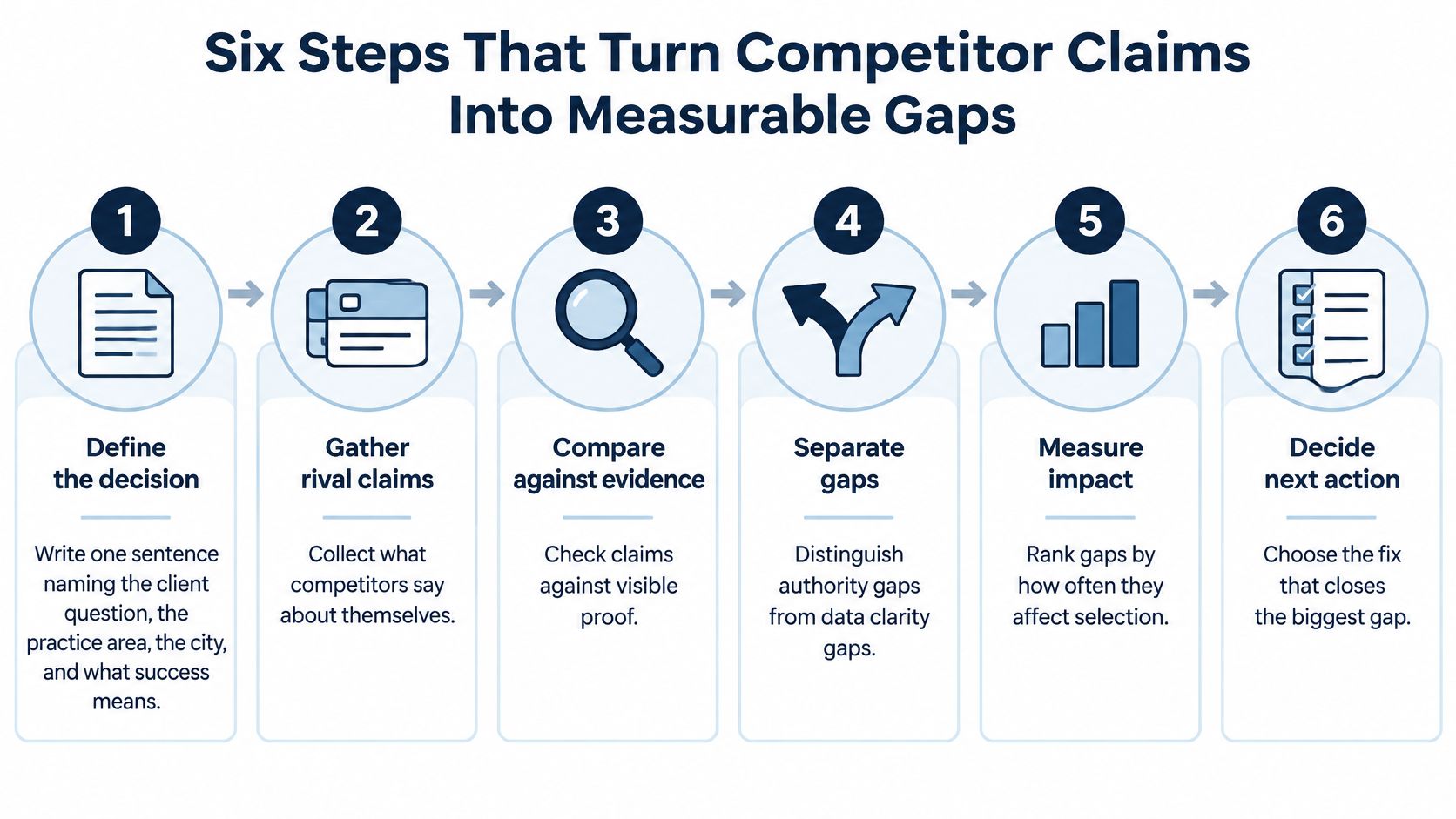
Six Steps That Turn Competitor Claims Into Measurable Gaps
- Define the decision. Write a sentence naming the client question, practice area, city, and success condition. For example, a Chicago employment boutique might test whether it's shortlisted for a contentious executive dismissal matter.
- Build the comparison set. Include direct rivals, alternatives clients could choose instead, and firms AI systems name. Keep discovery separate from formal scoring.
- Collect evidence. Run equivalent client questions across the major AI assistants in repeated sessions. Save complete answers and their cited sources, not just a screenshot of the most favorable result.
- Score representation. Measure citation presence, top-3 rate, and narrative depth using definitions fixed before collection.
- Diagnose gaps. Determine whether each recurring shortfall reflects insufficient authority or unclear entity information. Don't infer the cause from absence alone.
- Assign and review. Give each validated gap an owner, an intervention, a leading indicator, and a review date. An unassigned finding isn't an operational decision.
The sequence matters because later judgments depend on earlier definitions. Change the client question after collecting answers and you're testing a different decision. Add competitors halfway through scoring without rerunning the baseline and the comparison is incomplete.
Measure the answer rather than assuming the click
In Pew's browsing analysis, users encountering an AI summary clicked a traditional result in 8% of visits, compared with 15% without a summary. Those findings concern observed search behavior, not legal-client conversion, but they justify measuring answer inclusion separately from website acquisition.
SEO helps systems discover you. Generative engine optimization (GEO) and answer engine optimization (AEO) help systems extract and understand you. AI recommendation intelligence measures whether they represent, cite, and recommend you. Recommendation is observable behavior, not proof of an internal state of trust.
Conventional channel evidence still belongs in the investigation. Silver Spoon Agency's resource on competitor insights across search and ads offers a complementary view of search and advertising competition, but those observations shouldn't substitute for testing generated recommendations.
Decision rule: A strong search position is evidence of discoverability, not evidence of shortlist inclusion.
For executives seeking competitive analysis how-to guidance, the first deliverable should be concrete: a dated decision statement, an agreed comparison set, and an evidence sheet containing the initial observations. Don't commission corrective work before those records exist.
Build a Comparison Set That Survives Scrutiny
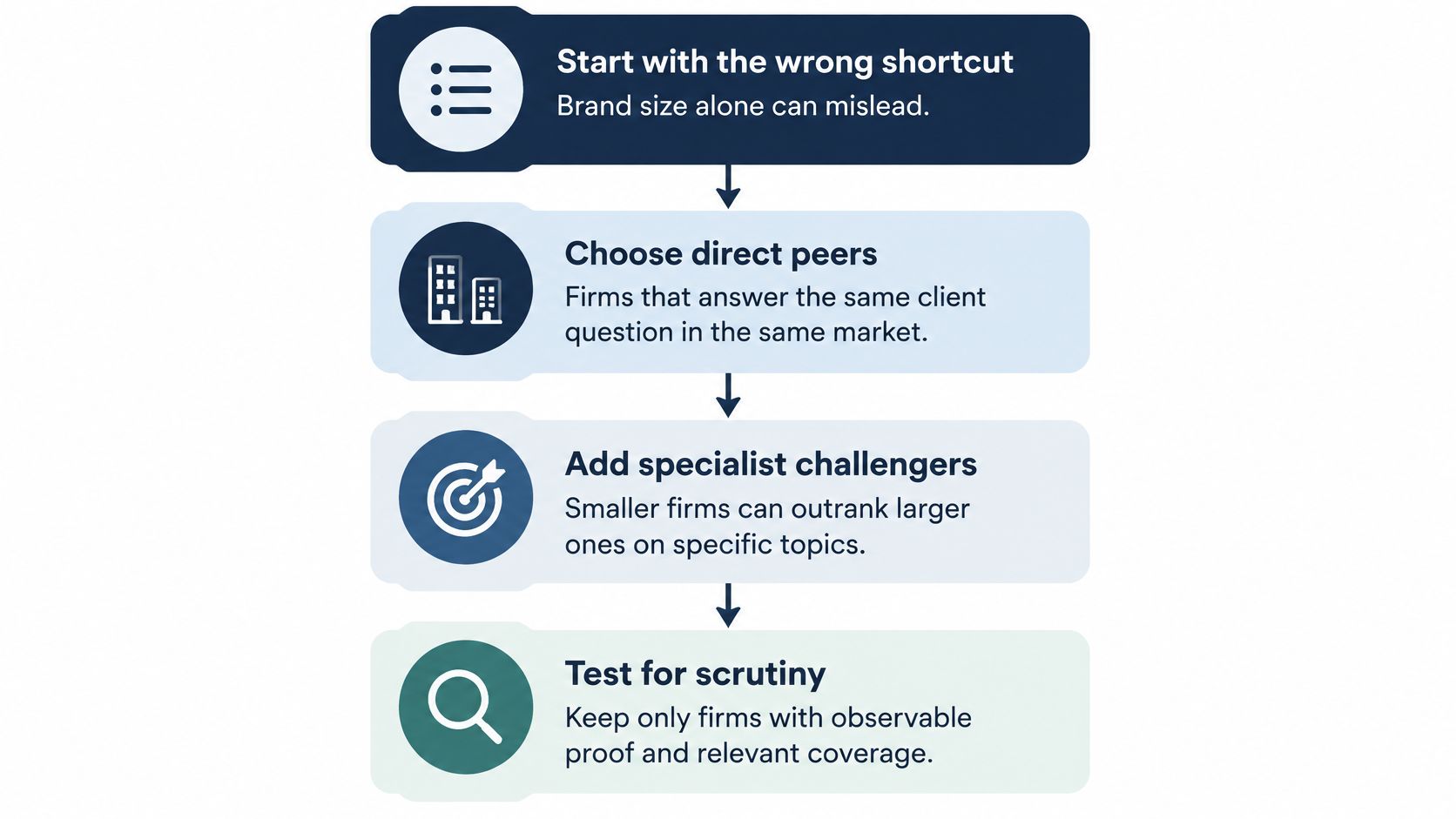
Choosing a handful of recognizable firms by brand size is an easy shortcut. In professional services, it's also a weak basis for comparison: the relevant unit is the client decision, not the organization's total footprint.
Harvard Business School's discussion of benchmarking cautions that comparisons become misleading when organizations produce differentiated services. A national full-service firm and a specialist boutique may overlap on a particular matter while remaining incomparable on aggregate revenue, staffing, or visibility.
Include rivals according to their role in the decision
Build the set in tiers, preserving the reason each organization belongs.
| Tier | Inclusion test | Analytical role |
|---|---|---|
| Direct rivals | Can the firm serve the same matter, client segment, city, and jurisdiction? | Primary performance benchmark |
| Substitutes | Could the client resolve the need without hiring this type of firm? | Alternative decision path |
| AI-selected alternatives | Does the system name this firm for the tested question? | Observed recommendation competitor |
| Declining or exited firms | Does a relevant historical comparison help test a claimed success factor? | Check against survivor bias |
Substitutes might include an internal legal department or a specialist service platform. A referral network belongs only when it offers a genuine alternative route to resolving the client's need, rather than merely supplying introductions.
The Harvard Business School Institute for Strategy and Competitiveness's five-forces framework broadens competition beyond existing rivals to substitutes, entrants, buyers, and suppliers. Apply that logic narrowly: can this alternative win the same client decision, and under what conditions?
Normalize the matter before comparing the firm
Say a Chicago employment boutique initially selects national firms as its benchmarks. During discovery, regional specialists repeatedly appear for executive-dismissal questions. Those specialists warrant inclusion because the observed decision context supports it, not because their overall brands resemble the subject firm.
Record practice category, matter type, client segment, jurisdiction, and query intent for every entry. A firm advising employers shouldn't automatically be scored against an employee-side practice just because both use employment-law terminology.
Historical entries need separate treatment. Don't combine an exited firm's past representation with current recommendation rates; use it to test whether an apparently successful tactic also appeared among organizations that declined.
A comparison set is defensible when an analyst can explain every inclusion without referring to brand recognition.
Keep the active set manageable rather than filling a predetermined quota. Each entry needs a tier, a sentence explaining its inclusion, and a comparability note. If discovery reveals a missing rival, amend the set formally and rerun the relevant baseline rather than adding it to the scorecard without documentation.
Collect Evidence From Four Sources, Not One
The evidence base should combine repeated outputs, cited material, owned pages, and independent profiles, with rankings recorded separately where relevant.
Evidence sources for AI competitive analysis
| Source | What it shows | How to collect | Limit |
|---|---|---|---|
| Repeated AI prompts | Whether each firm is named, its position, and how it's described | Run client questions for the firm's city and practice across the selected major assistants over repeated sessions | Answers vary between runs; record volatility |
| Cited sources in AI answers | Which pages, directories, and profiles the system attributes information to | Record each cited URL against its answer | Citations may not reveal every input used |
| Firm and rival public pages | Practice descriptions, attorney biographies, and location signals | Capture dated pages and retain an archive | Shows only publicly visible information |
| Directories and third-party profiles | Consistency of names, practice areas, and people | Compare equivalent attributes line by line | Coverage differs by market and directory |
| Published rankings and awards | Third-party credibility signals | Record issuer, year, and category | Category-specific recognition isn't automatically comparable across markets |
Preserve the conditions behind every answer
Use questions a prospective client could realistically ask. Specify the matter and location, but don't insert the subject firm's name into an unbranded recommendation test. Branded questions assess recognition and accuracy, which is a separate task.
Record the exact prompt, collection date, assistant, available model or mode identifier, session identifier, browsing setting, and complete output. Start fresh sessions for independent tests and retain any contextual instructions. Otherwise, conversation history can become an uncontrolled input.
A Search Engine Land account of an AI-search adoption study reported that adoption was advancing faster than trust. That distinction supports a cautious measurement posture: neither user adoption nor a fluent answer validates the recommendation.
Code each answer for firm inclusion, ordered position, descriptive attributes, and cited URLs. Preserve a separate field for whether a statement was directly observed or inferred. A cited directory is observed attribution; a claim that the directory caused selection remains an inference.
Archive sources and test coding consistency
Capture the subject firm's pages and competing pages with dates. Compare names, office addresses, practice labels, attorney affiliations, and award descriptions against external profiles. A changed biography or office page can alter the available evidence between collection windows.
Maintain the difference between source presence and source agreement. Several profiles repeating the same outdated description don't establish independent confirmation. Record apparent duplication and identify the originating material where possible.
Collection safeguard: An answer that appears once is an observation. A recurring pattern under controlled conditions is a candidate finding.
Have another analyst independently code a sample of saved answers, then resolve disagreements against the written rubric. Separately rerun a sample of prompts to examine output variation. These checks test different problems: coder inconsistency and system volatility.
When evaluating AI brand monitoring tools, prioritize exportable answers, source records, session metadata, and reproducible comparisons over a dashboard's headline score. Finish collection with a fully coded question set across all selected systems, including refusals, empty answers, and collection failures labeled distinctly.
Score AI Representation With Three Metrics and an Index
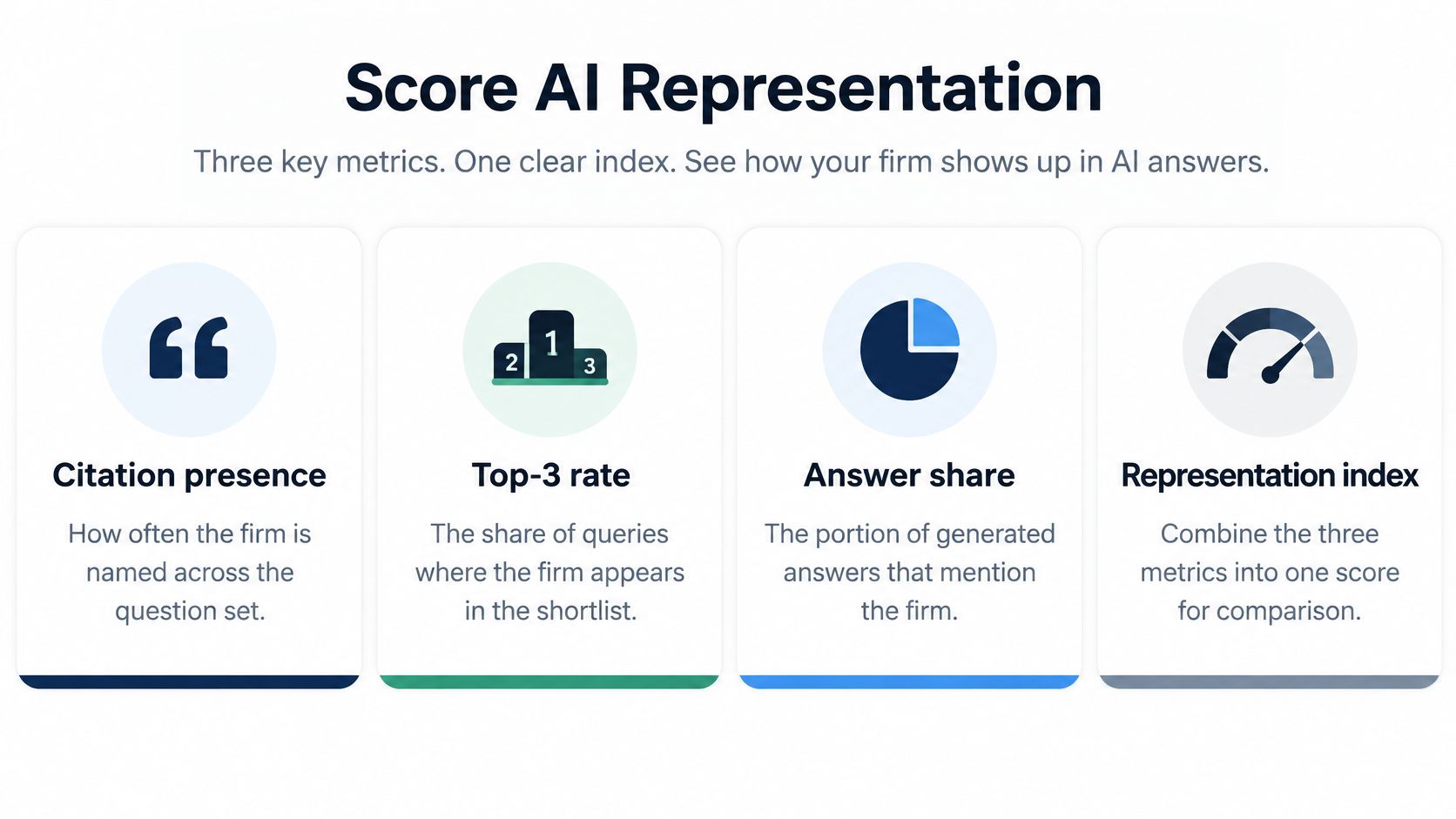
Citation presence measures how often the firm is named, not how often its website receives a citation. Keep source-link attribution in a separate field so the terminology doesn't conceal different outcomes.
Top-3 rate measures appearances among the first three named recommendations. It's a declared shortlist proxy, not a claim that every prospective client stops reading at that position. Narrative depth measures the specificity and accuracy of the description.
The AI Visibility Index (AVI) combines those dimensions into a reproducible comparison figure. Treat it as an analytical index whose construction must be disclosed, not as a universal standard or an estimate of market share.
Representation metrics and how to calculate them
| Metric | Definition | How to calculate | Read as |
|---|---|---|---|
| Citation Presence | How often the firm is named across the question set | Answers naming the firm divided by total eligible answers, per AI system | Baseline inclusion against the same rivals |
| Top-3 Rate | How often the firm appears among the first three | Answers placing it in positions 1–3 divided by total eligible answers | Prominent shortlist placement rather than a late mention |
| Narrative Depth | How substantively and accurately the firm is described | Apply a fixed rubric for practice, geography, credibility, and accuracy | Quality of representation when named |
| AI Visibility Index (AVI) | Composite of the three measures | Normalize components, apply identical published weights, and combine | Comparable only under a reproducible method |
Define eligibility and the rubric before scoring
Fix the question set, collection window, session schedule, and denominator. Retain valid answers that omit the firm; excluding them would inflate inclusion. Log technical failures separately and replace them using the same collection protocol.
For narrative depth, assess whether the answer correctly identifies practice focus, jurisdiction, and attributable credibility. Mark each dimension as accurate and specific, incomplete, absent, or wrong. Publish the conversion rule before turning those judgments into an index component.
Separate conditional depth from overall representation. A firm might receive excellent descriptions when mentioned but rarely appear. Don't let that conditional strength conceal low inclusion in the AVI.
A competitive-intelligence measurement paper supports establishing competitor baselines, using fixed rubrics, independently checking coding, and repeating measurement after interventions. Apply the same discipline to AI recommendation authority rather than treating a single output as a stable ranking.
Read component gaps before the composite
As a hypothetical calculation, a firm named in three of ten eligible answers has 30% citation presence. If it appears among the first three in one answer, its top-3 rate is 10%. A rival named in seven answers, including four prominent placements, is ahead on both inclusion and position.
Those are illustrative arithmetic, not observed performance benchmarks. An AVI improvement alone wouldn't reveal which component changed, and it wouldn't establish that an intervention caused the change.
PurpleCow Digital Marketing's guide to measuring your business's AI visibility offers a complementary practical perspective. For executive decisions, retain the underlying evidence rather than relying on a summary assessment.
Record every firm and system against the same metric rows with a baseline date. The graphic's answer-share terminology describes mention frequency here; it isn't an additional independent component. Don't double-count inclusion or present this illustrative AVI as a disclosed formula for a proprietary score.
Separate Authority Gaps From Data Clarity Gaps
In CitationOS's own question testing, well-regarded firms were routinely missing from AI answers, while firms that were named were often described inaccurately. Those outcomes point to different diagnostic questions: is relevant evidence too weak to support a recommendation, or is existing evidence unclear or inconsistent?
An authority gap is a structural weakness that limits how relevance and credibility carry through to a recommendation. A data-clarity gap arises when a firm's identity or attributes are ambiguous or inconsistent. The distinction matters because improving source clarity will not create missing authority, and adding more evidence will not resolve conflicting firm details.
Bank of America's competitive-analysis guide provides a conventional basis for comparing rival offers and positioning. For AI representation, extend that comparison to entity consistency, source agreement, practice specificity, and jurisdictional accuracy before choosing a response.

Treat symptoms as hypotheses
Symptoms in AI answers and the gap behind each
| Symptom in AI answers | Likely gap | First action |
|---|---|---|
| Firm absent while rivals appear for the same query | Possible authority gap, including limited third-party practice evidence | Verify identity clarity, then examine attributable practice-and-city references |
| Firm named with the wrong practice area | Data-clarity gap from inconsistent descriptions | Align practice wording across the website, directories, and biographies |
| Variant names or the wrong office | Entity consistency issue, classified under data clarity | Standardize entity and office details across controlled sources |
| Firm named but described thinly | Narrative-depth symptom that needs authority-versus-clarity testing | Check whether accurate, specific practice and jurisdiction information is available across sources |
| Firm named by only one system | Possible source-coverage gap | Compare cited sources and identify where coverage differs |
| Firm present in one session and absent in another | Output variation, not yet a diagnosed gap | Repeat controlled prompts before classifying the cause |
An empty recommendation slot does not establish weak authority. Accurate, relevant evidence may exist but be attached to conflicting names, obsolete locations, or imprecise practice descriptions.
Compare the firm with the rival selected in its place. Check whether independent sources agree, then test whether the symptom recurs across systems and sessions. Repeated wrong-office attribution points toward a different intervention than an accurate description supported by little independent practice evidence.
Assign a primary cause without concealing uncertainty
Use entity authority as a diagnostic lens, not as a synonym for prominence. Recognition, coherent identity, and credible practice evidence are related but distinct.
Classify each validated register entry as either authority or data clarity. Preserve secondary symptoms and confidence notes, but split clearly separate causes into separate entries. If the evidence does not yet support either classification, keep the observation pending rather than manufacturing certainty.
Rank Gaps by Selection Impact Before Spending
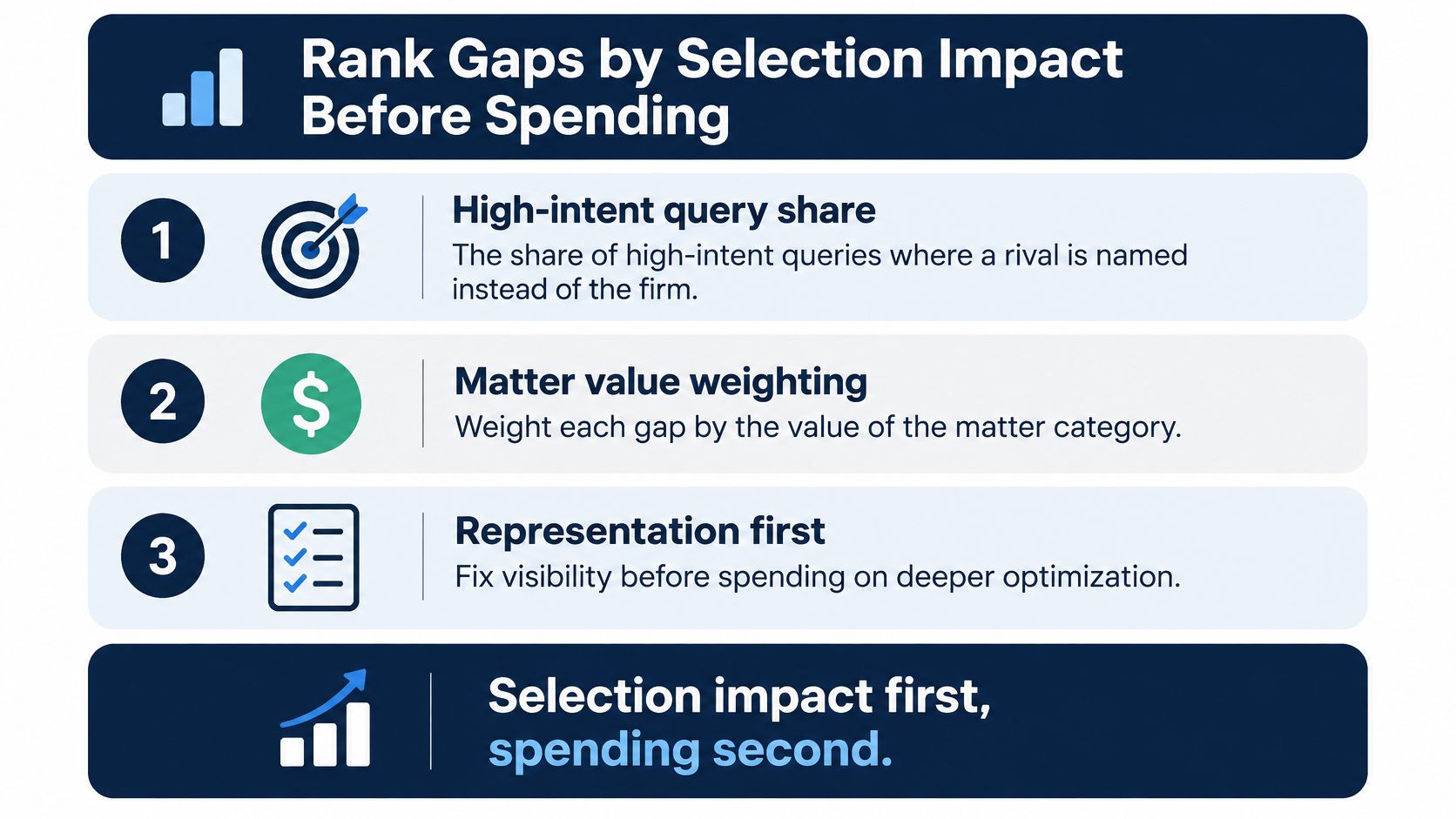
Rank validated gaps by the share of relevant high-intent questions where a rival appears and the firm doesn't, weighted by the business importance of the matter category. Use the evidence sheet for the first input and documented commercial judgment for the second.
The Business Standard account of Pew's findings reports that 26% of users encountering an AI summary ended their browsing session immediately, compared with 16% without AI content. That's a reason to examine representation before assuming a prospective client will reach the firm's website.
Prioritize exposure and dependencies
Start authority work early in commercially important matter categories when the evidence supports it. Independent recognition and attributable references require external participation, so they shouldn't wait behind cosmetic publishing changes.
Run confirmed data-clarity corrections in parallel. Schedule narrative and source-coverage work according to their diagnosed cause and dependencies, not as automatic lower priorities. A misleading practice description could deserve immediate attention if it repeatedly affects a valuable decision.
For selection-impact calculations, declare whether the unit is a unique question or an answer instance. If you use unique questions, first define how repeated runs establish a recurring omission. Don't let additional sessions increase the weight of an easy-to-test query.
Gap register template
| Field | Entry |
|---|---|
| Gap name | Employment practice attributed to an obsolete office |
| Gap type | Data-clarity gap, exactly one primary type |
| Evidence | Saved systems, prompts, and sessions showing the repeated attribution |
| Share of high-intent queries lost to a rival | Qualifying questions naming a rival but omitting the firm divided by all eligible high-intent questions |
| Owner | Named marketing operations lead |
| Intervention | Correct office and practice attributes across controlled pages and request profile corrections |
| Leading indicator | Agreement of current office information across the audited source set |
| Review date | Calendar date fixed at approval, after corrections are publicly accessible |
Set judgment thresholds before the review
Distinguish an intervention's completion from its effect. Corrected profiles establish that implementation occurred; a sustained change in controlled outputs is a separate observation. Neither automatically proves that the firm won additional matters.
Set the review threshold in advance: the required pattern of recurrence, acceptable coding agreement, and minimum commercially meaningful change. There isn't a universal passing AVI or recommendation rate in this method. Thresholds should reflect the decision, observed baseline volatility, and consequences of acting incorrectly.
CitationOS is an AI Recommendation Intelligence platform, not an SEO agency, GEO agency, or digital marketing company. Its focus is the selection moment, when the system names potential providers.
Approve spending against a diagnosed selection problem, not a rival's visible activity. The decisive question is whether the selected rival has stronger attributable evidence or whether your firm's identity is harder to interpret. Those findings lead to different budgets.
CitationOS offers a confidential full audit of how your firm appears in high-intent queries for its practice and city, which competitors are named instead and why, and its Citation Score with the specific gaps behind it. Visit CitationOS to request the analysis, delivered within 7 business days. Audits go privately to the requesting firm; we don't publish client results or share them with competitors.