Across 116 law firms scored over 16 months of diagnostics, CitationOS found that 78% were effectively invisible to AI-generated recommendations from systems such as ChatGPT, Gemini, and Perplexity. That finding changes the question executives should ask. The issue isn't whether a firm ranks, publishes, or earns citations. It's whether an AI system can identify the firm accurately, distinguish it from competitors, and recommend it for a high-intent legal query.
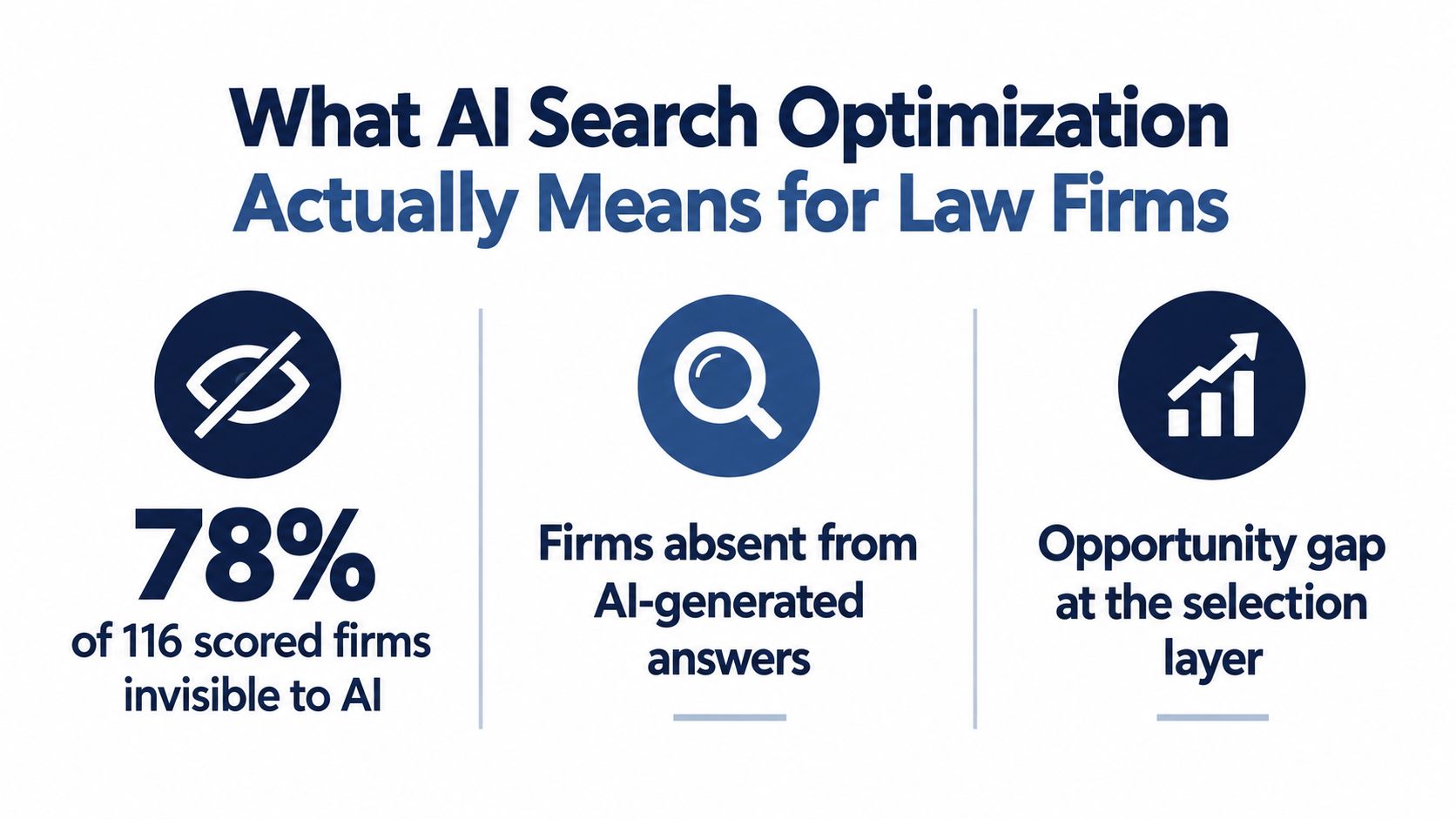
What AI Search Optimization Actually Means for Law Firms
AI search optimization is a selection problem before it's a content problem. A prospective client may ask an AI assistant to identify firms for a specific dispute, jurisdiction, industry, or legal need. The answer system then constructs a shortlist from sources it can retrieve, interpret, and trust. A firm can have strong conventional visibility and still fail to appear in that shortlist.
Google's introduction of AI Overviews in May 2024 marked a measurable shift from conventional blue-link rankings toward machine-generated summaries. In a study based on one month of browsing data from a representative panel of 900 U.S. adults, approximately 18% of Google searches produced an AI Overview. Users clicked cited sources on only about 1% of AI Overview visits, while browsing sessions ended on 26% of pages containing an Overview, compared with 16% of pages without one. These figures are U.S.-specific, but they show why a ranking report no longer describes the complete visibility picture. (Research on AI Overviews and browsing behavior)
The three-layer distinction matters:
- SEO helps systems discover you. It supports crawlability, indexing, conventional relevance, and access to the firm's pages.
- Generative engine optimization, or GEO, helps systems extract and understand you. It improves the likelihood that useful passages will be retrieved and included in a generated response.
- AI recommendation intelligence measures whether AI trusts and recommends you. It evaluates representation, citation presence, narrative depth, shortlist position, and competitive inclusion.
Practical rule: A citation is an intermediate event, not the business outcome.
For a law firm, the target isn't citation volume in isolation. The target is accurate entity representation and AI recommendation authority. The system needs to understand what the firm does, where it operates, whom it serves, and why it fits the query. That requires a measurement framework capable of separating discovery from retrieval, retrieval from citation, and citation from recommendation.
Why SEO and GEO Are Not the Same Problem
A firm can rank well in conventional search and remain absent from an AI-generated shortlist. That isn't a contradiction. It reflects two different selection mechanisms.
SEO governs discoverability. It helps a search system find and evaluate a page within a conventional results environment. GEO governs extraction and inclusion. It makes individual passages easier for a generative system to retrieve, interpret, and use in an answer. AI recommendation intelligence governs selection quality, including whether the system names the firm when the user asks for a provider or comparison.

The difference becomes clear in practice. A firm might have a well-ranked page about employment disputes. An answer system may retrieve and cite that page for a general explanation of wrongful termination. Yet when the user asks which firms handle complex executive investigations in a particular jurisdiction, the firm may not appear. The page was discoverable and potentially citable, but the firm wasn't sufficiently characterized for recommendation.
The academic GEO benchmark by researchers from Princeton, Georgia Tech, the Allen Institute for AI, and IIT Delhi found that adding citations, quotations, and statistics increased source visibility in generated responses by more than 40%, while keyword stuffing could perform worse than making no optimization changes. (GEO benchmark research) The finding supports better passage design, but it doesn't eliminate the selection problem. Stronger passages can improve extraction only when the underlying entity signals are coherent enough for the system to connect those passages to the right firm.
That is why advice such as “publish more content” is incomplete. More pages may increase the number of possible retrieval points, but they can also multiply inconsistent descriptions, overlapping practice labels, and unsupported claims. The correct sequence is to establish entity authority, structure evidence for extraction, and then measure whether generated answers reflect the firm as intended.
The useful executive test is simple: SEO answers whether the system can find the firm. GEO answers whether it can use the firm's information. AI recommendation intelligence answers whether it can confidently choose the firm.
Building Entity Authority That AI Systems Can Interpret
AI systems don't form their understanding of a law firm from the website alone. They assemble an entity interpretation from firm pages, attorney biographies, directories, structured data, legal publications, case references, and other sources. If those sources disagree about the firm's name, location, practices, or leadership, the system receives a fragmented identity.
Entity authority is the coherence of the attributes that make a firm identifiable and relevant. It isn't the number of mentions a firm has earned. A smaller specialist firm can be highly relevant for a narrow query, but the system must be able to verify that specialization across multiple sources.
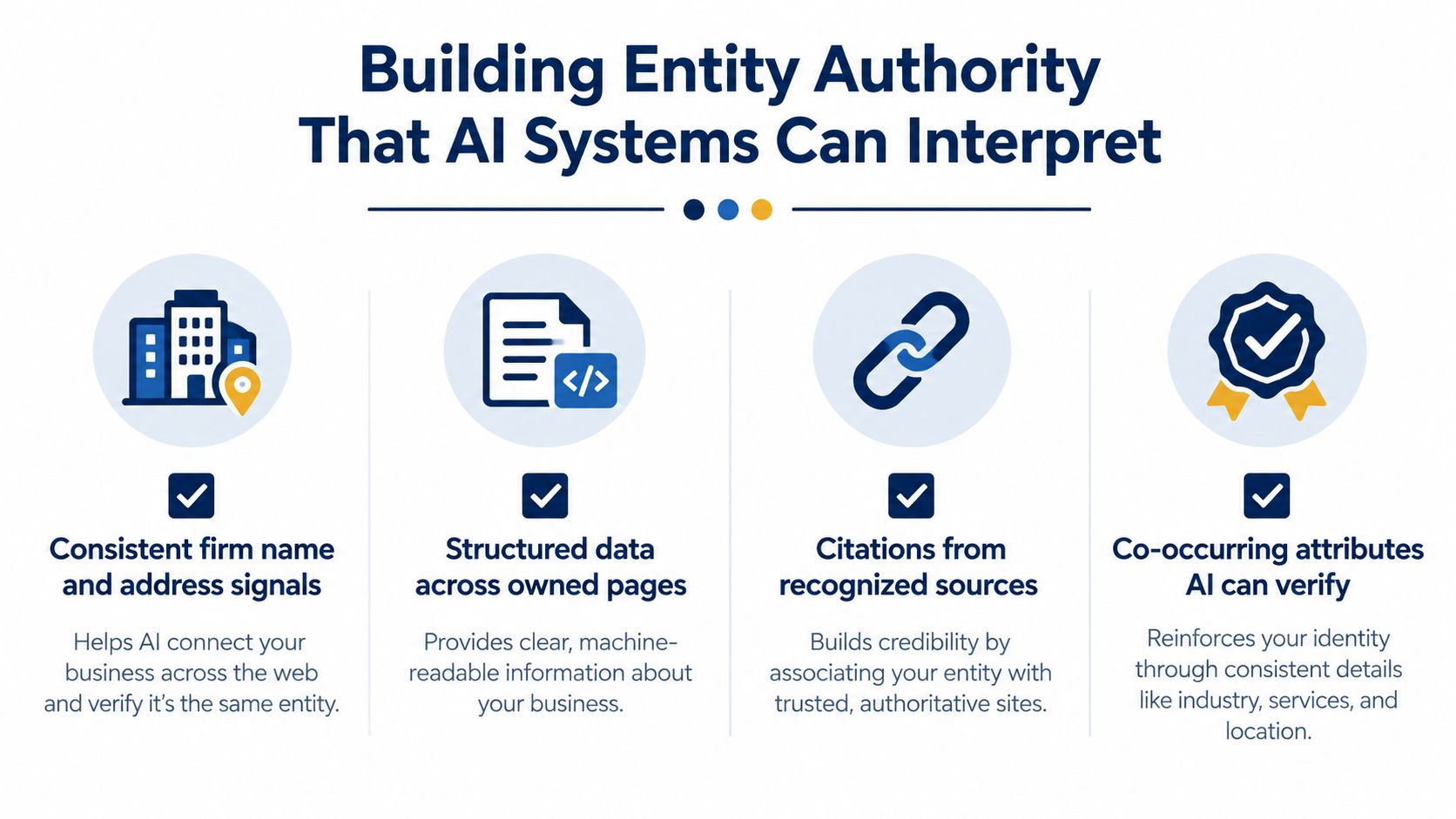
Start with the attributes most likely to affect recommendation:
- Firm identity: Standardize the legal and public-facing firm name, office locations, jurisdictional coverage, and relationship between regional offices.
- Practice meaning: Align descriptions for practice areas, matter types, industries, and client categories. A label such as “business litigation” needs supporting detail if the firm wants to be associated with a narrower category.
- Professional attribution: Check that attorney biographies consistently connect lawyers to the correct firm, office, seniority, credentials, and practice focus.
- Evidence and metadata: Reconcile structured data, page titles, directory listings, publications, awards, and third-party descriptions so they don't create competing interpretations.
Cross-system source selection makes this work more demanding. BrightEdge's analysis found that the share of citations from authoritative domains varied from 10% to 26% across ChatGPT, Perplexity, Gemini, Google AI Mode, and Google AI Overviews. The ten most-cited domains accounted for 18.5% of citations in ChatGPT compared with 26.7% in Perplexity, showing that different systems draw from different source mixes.
A practical audit should therefore begin with the sources that answer systems retrieve, not just the pages the firm prefers to promote. Compare the firm's name, addresses, practice attributes, attorneys, industries, and authority signals across those sources. Then identify which discrepancies could cause misclassification or weaken the firm's relevance for a high-intent prompt.
A detailed entity authority framework for AI interpretation can help teams turn this work into a controlled reconciliation process. The objective isn't to make every source identical. It's to ensure that important differences are explainable and that the core identity remains stable.
Structuring Content for Extraction and Citation
Once an AI system can identify the firm, it still has to select usable passages. Legal content often fails here because it describes capability in broad language without presenting a self-contained, verifiable explanation that an answer system can safely reuse.
Write each substantive passage as if it may be extracted from the page and read without its surrounding context. A strong passage identifies the legal issue, explains the firm's relevant capability, specifies the jurisdiction or client context, and supports material claims with named authorities or source citations. It shouldn't require the model to infer what “full-service expertise” means.
The 10,000-query GEO benchmark found that adding quotations, statistics, and source citations produced substantially stronger visibility gains than keyword-oriented changes, and that keyword stuffing could perform worse than making no optimization changes. (10,000-query GEO benchmark) The implication isn't that firms should insert decorative references. It is that evidence gives retrieval and generation systems clearer material to evaluate.
A passage pattern for legal content
For a practice-area page, begin with the client problem rather than a repeated keyword. State what the firm handles, identify the relevant matter or decision context, and connect the service to a verifiable authority, such as a regulation, court decision, professional body, or clearly documented firm experience.
Attorney biographies need the same treatment. A biography should make the lawyer's jurisdiction, practice focus, industry experience, leadership role, and relevant credentials legible as separate attributes. A list of adjectives doesn't provide the same extraction value as a concise account of what the attorney advises or litigates.
Thought leadership should answer a real high-intent prompt. If a prospective client might ask how a new rule affects a transaction or dispute, the page should provide a direct explanation, identify the source of the rule, and distinguish settled requirements from the firm's interpretation. That structure helps an AI paraphrase the content without losing the distinction between law, commentary, and marketing language.
Content becomes citation-ready when an answer system can reuse a passage without inventing the missing context.
Keyword repetition is a weak substitute for evidence. The better test is whether a passage remains useful when the firm name is removed, whether its claims can be checked, and whether its wording accurately connects the firm to the query. If it can't pass those tests, publishing more of the same won't solve the underlying extraction problem.
A Multi-System Audit Pattern for Citation Readiness
A citation readiness audit should begin with the questions clients ask, not with a list of target keywords. Build a controlled reference set covering practice area, matter type, jurisdiction, industry, urgency, and comparison intent. Include prompts that ask for explanations as well as prompts that ask for recommendations, because a firm may appear as an information source without entering the shortlist.
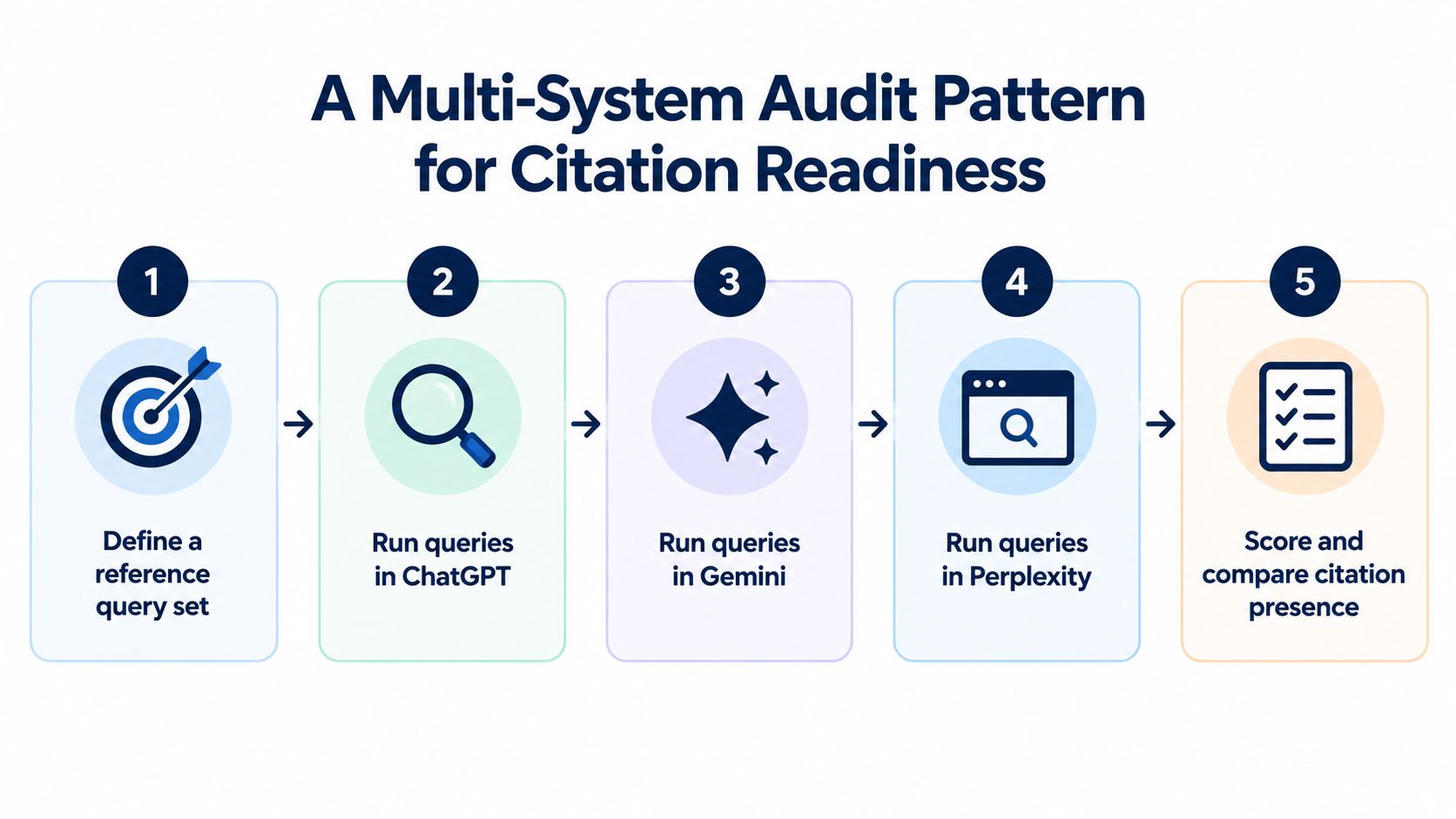
Run the same reference prompts across ChatGPT, Gemini, and Perplexity, then repeat selected prompts with controlled paraphrases. Keep the client need, geography, and comparison criteria constant while varying wording. Record more than whether the firm appears:
- Inclusion: Does the firm appear at all?
- Narrative treatment: What practice attributes does the answer attach to it?
- Citation presence: Which firm pages or third-party sources support the mention?
- Prominence: Is the firm presented as a primary option, a secondary reference, or an incidental example?
- Competitive position: Which named competitors appear, and which attributes justify their inclusion?
A single-engine snapshot can conceal the actual failure. One system may cite a firm's biography, another may rely on a directory, and a third may omit the firm because it interprets the practice category differently. Comparative research has identified significant differences among AI search engines in domain diversity, freshness, cross-language stability, and sensitivity to phrasing, alongside a documented preference for larger brands. (Comparative research on AI search instability)
That means the audit should distinguish a content weakness from an engine-specific behavior. If a firm appears consistently but is described inaccurately, the problem is likely representation. If it appears only for one phrasing, the issue may involve retrieval sensitivity. If competitors appear across paraphrases while the firm doesn't, the authority gap may sit outside the firm's owned pages.
A structured AI search audit process should preserve the raw answers, cited sources, prompt variants, and scoring decisions. Without that record, teams can't determine whether a later change improved recommendation readiness or merely produced a different response.
Measuring AI Recommendation Readiness with Citation Score
Executives need a measurement system that reflects the path from being found to being recommended. A useful framework treats AI visibility as a funnel with separate stages:
| Funnel Stage | What It Measures | Common Failure Mode | Diagnostic Signal |
|---|---|---|---|
| Discoverability | Whether systems can access and identify relevant sources | Important pages or references remain unavailable | The firm is absent before answer construction |
| Retrieval | Whether relevant passages enter the candidate set | Content exists but isn't retrieved for the prompt | Competitors appear with similar topics |
| Citation | Whether the firm or its source is cited | The firm is mentioned without supporting evidence | Unsupported or missing attribution |
| Prominence | How visibly the firm appears in the answer | The firm is buried among generic options | Low position or weak shortlist presence |
| Semantic absorption | Whether the cited material shapes the answer | A citation appears but contributes little meaning | Shallow mention or irrelevant attribute |
| Downstream traffic | Whether users visit and act | Visibility doesn't produce qualified engagement | Referral or conversion activity fails to follow |
The AI Visibility Index, or AVI, can combine these dimensions into an executive view of discoverability, citation presence, narrative depth, and top-3 rate. Citation Score should remain more diagnostic. It can quantify inclusion, narrative strength, entity strength, and relative positioning rather than collapsing every outcome into one visibility number.
A 2026 generative-search measurement framework documented 602 controlled prompts, 21,143 search-layer citations, and 18,151 successfully fetched pages. It found that ChatGPT cites fewer sources than Perplexity or Google but gives cited pages substantially greater average influence. (Generative-search citation measurement framework) That distinction is essential. Ten low-influence citations don't necessarily equal one source that supplies the explanation, evidence, and shortlist rationale.
Citation quality needs two accuracy measures
Citation recall measures the share of verifiable statements that are fully supported. Citation precision measures whether the cited source correctly supports the statement attached to it. Apply both measures to practice pages, biographies, directories, and third-party references.
Track results against named competitors and a fixed prompt set. Review the same prompts on a defined schedule, preserve historical scores, and separate changes in source selection from changes in the firm's content. A rising AVI with flat narrative depth may indicate more mentions without stronger influence. A higher top-3 rate with weak citation precision may indicate greater exposure but greater reputational risk.
The Citation Validity Problem Most Optimization Advice Ignores
Citation presence creates a persuasive appearance of authority, but appearance isn't proof. A large-scale study reported that adding reference links and citations significantly increased trust in AI answers even when the links were incorrect or hallucinated, with the effect stronger among less-educated and less technology-oriented users. (Study on trust in AI answers and citation accuracy)
For law firms, that creates a serious measurement trap. A generated answer can cite a firm while misrepresenting its practice, confusing two entities, attributing another lawyer's experience to the firm, or using a source that doesn't support the claim. The prospective client may form a shortlist before checking the underlying page.
Citation presence is evidence that a system selected a source. It isn't evidence that the system understood the source correctly.
The audit must test validity at the claim level. For every material mention, ask whether the cited page supports the exact statement, whether the firm is the correct entity, whether the jurisdiction is accurate, and whether the answer preserves the difference between a firm's stated capability and independently verifiable authority.
A defensible validation sequence
Start with the answer, not the source. Record the exact wording used to describe the firm, then inspect the cited page and classify the relationship:
- Supported: The source directly substantiates the claim.
- Partially supported: The source supports some attributes but not the full statement.
- Misattributed: The source concerns another firm, person, or matter.
- Unsupported: The answer makes a claim the source doesn't establish.
- Uncited: The statement is material but lacks an identifiable supporting source.
Repeat the prompt with controlled wording and across multiple systems. A stable, accurate description has more practical value than a single persuasive response. The result should also be checked against the firm's intended positioning and against competitor descriptions, because a system may represent the firm accurately but still reserve recommendation prominence for another provider.
A local citation audit should therefore examine both presence and validity. The correct objective isn't more citations at any cost. It's defensible representation, accurate narrative depth, and recommendation authority that survives verification.
Monitoring AI Representation as an Ongoing Discipline
AI search optimization shouldn't be treated as a one-time content project. Source preferences change, answer systems interpret prompts differently, competitors publish new evidence, and a firm's own pages can drift out of alignment. The measurement program must detect those changes before leadership mistakes a temporary mention for durable recommendation authority.
Use a fixed reference set of high-intent prompts and run it across multiple systems on a defined schedule. Preserve the wording, location assumptions, practice context, and competitor set so changes can be compared rather than guessed. Vary selected prompts separately to test sensitivity, but don't mix controlled and exploratory results in the same score.

A practical monitoring routine should review:
- Recommendation inclusion: Whether the firm appears for the prompts that matter commercially.
- Top-3 rate: How often it reaches a prominent shortlist position.
- Narrative depth: Whether the answer explains the firm's relevant attributes or merely names it.
- Citation validity: Whether sources support the claims made.
- Competitive movement: Whether a competitor enters, leaves, or overtakes the shortlist.
- Entity consistency: Whether name, practice, jurisdiction, and attorney attributes remain coherent across cited sources.
- Downstream signals: Whether AI referrals, engagement, and qualified actions follow visibility.
Generative-AI referral traffic expanded from roughly 60 million monthly referrals in October 2024 to approximately 240 million in September 2025, a fourfold increase in eleven months, according to Similarweb. Yet across ten major industries, AI platforms supplied an average of about 1% of overall web traffic in 2025, while visitors from large language model systems converted to sign-ups at 1.66%, compared with 0.15% for search, 0.13% for direct traffic, and 0.46% for social media. (Similarweb analysis of AI search trends) These figures don't justify replacing conventional search measurement. They justify tracking AI visibility and downstream quality separately, especially where a recommendation shapes a shortlist before a visit.
CitationOS is an AI recommendation intelligence platform that measures how law firms are represented, cited, and recommended across leading AI assistants, using confidential audits, competitive benchmarking, entity consistency assessment, Citation Score, and ongoing dashboard monitoring.
The strategic implication is precise. Selection outcomes depend on how confidently an AI system can characterize a firm, not only on how much content the firm publishes. A recurring measurement discipline is the only reliable way to keep that characterization accurate, defensible, and commercially relevant.
CitationOS provides confidential AI citation audits, competitive benchmarking, entity consistency assessment, and ongoing measurement of citation presence, narrative depth, and recommendation inclusion. Visit CitationOS to establish a baseline for how AI systems represent and recommend your firm.