A striking result changes how an AI search audit should be defined. In CitationOS research across 116 firms, 78% of South Florida personal injury firms were invisible to AI recommendations, despite many of them showing strong conventional search signals. That finding came out of 16 months of diagnostics focused on one question most rank trackers still avoid: when a prospective client asks an AI assistant who to hire, does the system name your brand at all?
That is the boundary line. Search visibility tells you whether systems can find your pages. AI recommendation intelligence tells you whether systems select your firm inside the answer.
The distinction matters because the discovery environment has already shifted at scale. One industry summary reported 378 million global active generative AI users as of July 2025, with ChatGPT receiving over 4.7 billion monthly visits, Perplexity over 133 million monthly visits, and Google Gemini about 118 million monthly users. The same summary said 89% of enterprises were actively advancing GenAI initiatives in 2025 and 92% of Fortune 500 companies were using GenAI tools, according to Britopian's generative search statistics summary. For a CMO, that means recommendation surfaces are no longer fringe behavior. They are now part of mainstream market selection.
Table of Contents
- What an AI Search Audit Actually Measures
- What Traditional AI SEO Tools Are Built to Capture
- The Indexing Layer Versus the Recommendation Layer
- The AI Visibility Index Stack and What Each Metric Reveals
- Entity Consistency and the Source Hierarchy Beneath Citations
- How CitationOS Measures What Ranking Tools Cannot Reach
- Reading Audit Findings and Turning Them Into Action
What an AI Search Audit Actually Measures
An AI search audit measures recommendation behavior, not just discoverability.
In practical terms, it asks whether AI assistants name a brand when a buyer uses decision-stage prompts such as “who should I hire,” “best firm for this matter,” or “top options in this market.” That sounds obvious. It isn't how most visibility tooling still works.
Recommendation output is the unit of analysis
The useful output of an AI search audit sits in three observable behaviors.
- Representation means how often the brand is mentioned at all.
- Citation patterns show which sources the assistant relies on when forming its answer.
- Shortlist inclusion tracks whether the brand appears among the first names the system suggests.
Those three behaviors describe the answer layer after the assistant has already filtered the market. By the time a generated answer appears, the model has narrowed a field of candidates and chosen which entities deserve inclusion.
Practical rule: If an assistant never names the firm in evaluative prompts, page-level visibility is a secondary issue. The selection problem is happening upstream.
This is decision-stage intelligence
Traditional search reporting usually treats the results page as the competitive environment. An AI search audit treats the assistant's answer as the competitive environment.
That difference matters more now because user behavior is changing in measurable ways. One 2026 industry data summary reported that about 18% of Google searches in March 2025 produced an AI-generated summary, based on analysis of nearly 69,000 real searches, and 58% of participants encountered at least one search with an AI summary during that period. The same source reported that users clicked a result only 8% of the time when an AI Overview appeared, versus 15% without one. Another 2025 data point from that same research set said 39% of Americans verify AI-generated information using Google, according to LoudSpeaker Marketing's AI search statistics roundup.
That combination changes the audit question. It's no longer only “do we rank?” It's also “are we present in the synthesized recommendation, and if we are, can our facts survive verification?”
A recommendation audit reveals failures rank tracking hides
The 78% invisible across 116 firms finding is useful because it exposes a representation collapse that keyword dashboards don't surface. A firm can have pages, backlinks, and directory profiles and still fail to appear when an assistant is asked for a recommendation by name category, practice area, or location.
That's why an AI search audit belongs closer to market intelligence than to a technical site crawl. It measures whether the system chooses you.
What Traditional AI SEO Tools Are Built to Capture
Most AI SEO tools are built to measure search mechanics at the page and query level. They're good at that.
They typically report ranking distributions, content gaps, technical health, backlink patterns, and forms of share-of-voice against a tracked query set. Some also monitor answer engine optimization (AEO) or generative engine optimization (GEO) signals such as schema coverage, crawl access, and appearance inside AI-generated surfaces.
Their core measurement boundary is still the search surface
That boundary is the important point. These tools usually answer variations of four questions:
- Can a crawler access the page
- Can a model parse and extract the content
- Does the page rank or appear for relevant terms
- Does the brand show up on a monitored search surface
Those are useful questions. They are not the same as asking whether an assistant would recommend the brand in a decision-stage answer.
SEO helps systems discover you. GEO helps systems extract and understand you. AI recommendation intelligence measures whether the system trusts and recommends you.
For a fuller breakdown of that surface-level boundary, see what surface-level AI tools measure.
The tool class is engineered for ranking signals
The measurement model can be summarized plainly.
| Tool Category | Primary Signal | Measurement Boundary | Blind Spot |
|---|---|---|---|
| Rank tracking platforms | Position changes across query sets | Search results page | Whether the assistant names the brand in generated recommendations |
| Technical audit systems | Crawlability, markup, indexability, page health | Site and page infrastructure | Whether technical compliance leads to shortlist inclusion |
| Content gap analysis tools | Missing topics, semantic coverage, keyword opportunities | Content corpus | Whether broader coverage changes recommendation behavior |
| AI appearance monitors | Presence in AI surfaces or summaries | Surface-level mentions | Why one assistant selects the brand while another suppresses it |
Some platforms have added AI modules that track mention frequency or AI overview appearances. That extends visibility monitoring. It doesn't fully solve the recommendation problem.
Surface appearance is evidence that a system saw you. It isn't proof that the system would choose you when a buyer asks for a shortlist.
Why this matters for executives
A CMO doesn't need more dashboards that stop at extraction or mention counts. The harder question is whether recommendation logic treats the brand as selection-worthy.
That's where many reporting stacks flatten important differences. They combine classic SEO, GEO, and AI mention tracking into one visibility story. But those are separate layers with separate failure modes. A clean technical profile can coexist with weak recommendation authority. Strong rankings can coexist with absence from assistant-generated shortlists.
That's why traditional AI SEO tools often diagnose the wrong problem. They're measuring conditions around recommendation, not recommendation itself.
The Indexing Layer Versus the Recommendation Layer
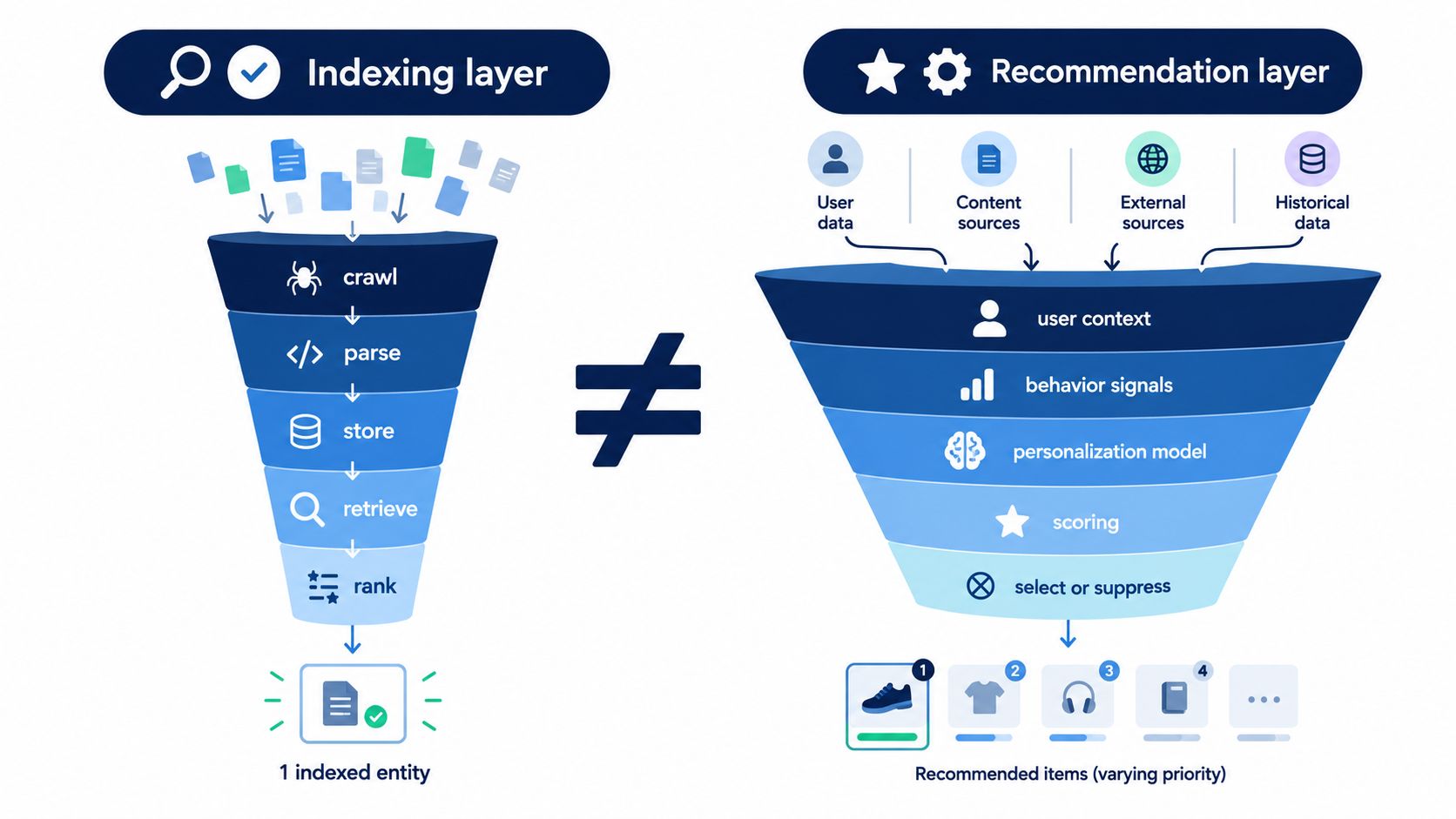
Indexing and recommendation are different systems problems.
Indexing asks whether the system can find and store information about an entity. Recommendation asks whether the system selects that entity when a user asks for a decision.
Retrieval does not guarantee selection
This distinction is visible in legal-market research. One legal-market index said AI engines now mediate more than 37% of legal-buyer research, according to the legal AI visibility index coverage. That matters because mediation changes where competition happens. Buyers increasingly encounter the market through an answer layer that compresses options before a click ever occurs.
Inside that process, indexing is only the entry ticket. Recommendation depends on additional layers such as intent matching, comparative framing, source confidence, and suppression logic.
A brand can therefore be fully indexed and still never be named.
The filtering chain sits above page-level SEO
A simplified pipeline looks like this:
- Retrieval narrows candidates from the broader information set.
- Reranking aligns candidates against the prompt's intent and constraints.
- Answer generation selects names that the model is willing to surface.
- Citation logic attaches support from sources the model deems sufficient.
Each stage can eliminate a brand without any obvious signal in a standard SEO report.
Why the recommendation layer needs its own audit
An AI search audit is the only instrument that observes this layer directly. It doesn't infer recommendation readiness from crawl status or content coverage. It tests the output buyers see.
That's the central blind spot in most AI visibility conversations. They assume extraction equals recommendation. It doesn't.
The AI Visibility Index Stack and What Each Metric Reveals
An audit becomes useful when it produces a repeatable metric stack, not a narrative impression. Independent benchmarking research analyzed more than 10,000 prompts across 12 industries and recommends a prompt basket of 30 to 50 real buyer-intent queries with a 0 to 100 normalization scale, according to the AI Visibility Index benchmark study. That framework is the right starting point because it turns AI visibility into something measurable.
The AI Visibility Index (AVI) should report five separate metrics. Each reveals a different failure mode.
Citation presence shows whether you exist in the answer set
Citation presence is the simplest metric. It tracks how often the brand is named or cited in an AI response across a defined prompt basket.
This is binary, but it's noisy. A single mention doesn't tell you whether the assistant viewed the brand as primary, secondary, or incidental. It only confirms that the entity entered the answer layer at all.
Narrative depth reveals how the system frames you
Narrative depth evaluates how much substance surrounds the mention.
A shallow appearance might be a passing reference in a list. A deeper appearance includes service relevance, market position, geography, credentials, or comparative framing that gives the buyer a reason to remember the name. Many firms underperform. They appear occasionally, but the assistant doesn't develop a coherent case for them.
For a sharper explanation of that gap, see the visibility fallacy.
Analyst's test: A mention without narrative depth is often recall without persuasion.
Top-3 rate measures commercial relevance
Top-3 rate is the commercial metric. It asks how often the brand appears in the first three recommendations for evaluative prompts.
Assistant-mediated selection compresses the market. If the brand appears in position eight of a long answer, that may be functionally irrelevant. A shortlist is where buyer attention concentrates.
Entity authority captures whether the system recognizes a stable entity
Entity authority measures whether the assistant treats the brand as a recognized entity with stable attributes.
Name variants, office ambiguity, thin attorney bios, inconsistent categories, and fragmented third-party references create friction. The model may know the firm exists, but remain uncertain about what it is, whom it serves, or why it belongs in a recommendation set.
AI recommendation authority combines the layers
AI recommendation authority is the composite metric. It weights the prior four signals to estimate whether the system is likely to recommend the brand under real buyer intent.
That composite matters because no single metric is sufficient. A firm can score well on citation presence and still fail on top-3 rate. It can have narrative depth in one assistant and disappear in another. Composite scoring makes those contradictions visible.
| Metric | What It Measures | Selection Layer Reached | Primary Tooling |
|---|---|---|---|
| Citation presence | Whether the brand is named at all | Entry into answer layer | Cross-assistant prompt testing |
| Narrative depth | How the brand is framed when mentioned | Framing and persuasion layer | Response analysis and scoring |
| Top-3 rate | Whether the brand makes the shortlist | Decision-stage selection | Prompt basket benchmarking |
| Entity authority | Stability and clarity of brand identity | Entity resolution layer | Source and profile consistency review |
| AI recommendation authority | Composite likelihood of being recommended | Full recommendation layer | AVI normalization and benchmarking |
| Ranking position | Where a page appears in search results | Discovery layer | Conventional SEO tracking |
| Technical health | Whether content is accessible and parsable | Extraction layer | Site and markup audits |
The strategic point is simple. Ranking metrics describe preconditions. AVI metrics describe selection outcomes.
Entity Consistency and the Source Hierarchy Beneath Citations
The focus often lands on visible citations because they are easy to screenshot. The structural problem sits underneath them.
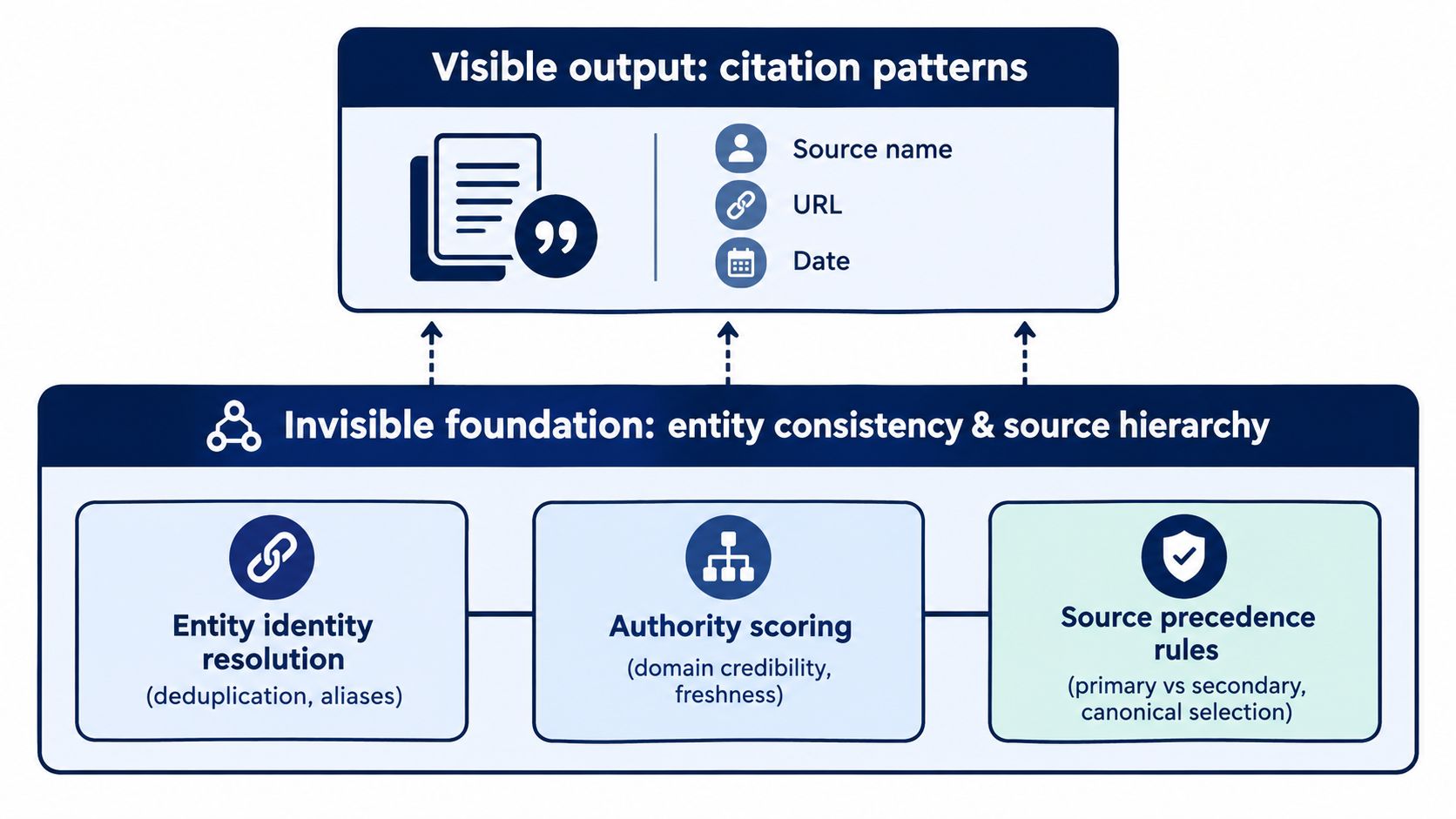
AI systems have to resolve an entity before they can recommend it with confidence. If the firm's identity is inconsistent across profiles, bios, directories, categories, and supporting references, the system may suppress the entity or describe it weakly.
Source hierarchy shapes recommendation quality
Legal visibility research reports that Chambers, Legal 500, Super Lawyers, Best Lawyers, Martindale, Avvo, and Justia dominate the citation layer across many query categories, according to legal-market analysis of source hierarchy. That finding is more important than it first appears.
It means assistants often rely on a relatively narrow source hierarchy when constructing recommendations in high-intent legal contexts. A firm may have extensive web content and still lose selection if those higher-trust profiles are incomplete, inconsistent, or weakly corroborated.
Low citation presence often starts as an entity problem
This is the contrarian point many audits miss. Weak citation presence usually isn't just a content deficit. It's often an entity resolution deficit.
A serious audit should inspect at least these structural layers:
- Canonical identity across firm name, attorney names, office details, and practice categories
- Third-party corroboration in authoritative profiles and professional bodies
- Metadata parity so the same core attributes appear consistently across sources
- Source precedence so primary profiles support, rather than conflict with, secondary references
When assistants rely on a narrow source hierarchy, inconsistency in those sources carries more weight than abundance elsewhere.
That's why entity authority belongs inside the audit stack. Without it, teams misread absence as a publishing problem and miss the source-structure problem suppressing recommendation eligibility.
How CitationOS Measures What Ranking Tools Cannot Reach
The measurement gap sits above SEO and GEO.
SEO determines whether systems can discover the brand. GEO and AEO determine whether systems can parse, structure, and extract the brand's information. CitationOS operates in the third layer: whether AI systems recommend the brand by name across buyer-intent prompts.
Cross-assistant measurement changes the diagnosis
That matters because recommendation behavior isn't uniform across assistants. One system may cite the firm as a strong local option. Another may omit it entirely. A third may mention it but attach weak or conflicting context.
A useful audit therefore has to test multiple assistants against the same decision-stage prompts and compare outcomes by representation, framing, and shortlist inclusion. Without that cross-system view, a firm can mistake isolated mention wins for recommendation strength.
Time-series diagnostics separate model churn from structural change
CitationOS research is grounded in 16 months of diagnostics, which matters because AI surfaces change constantly. A single prompt test captures a moment. A diagnostic arc shows pattern stability.
That's the difference between anecdotal visibility and measurable recommendation behavior. If citation presence rises while top-3 rate stays flat, the issue isn't discovery. If narrative depth improves across one assistant but not others, the issue may be source hierarchy rather than content volume. If entity authority remains unstable, technical improvements alone won't fix selection.
The system measures recommendation, not just appearance
Many AI visibility products stop too early. They report mentions, citations, or answer appearances. Those are useful leading indicators. They don't answer the executive question.
The executive question is whether the assistant selects the brand when a buyer asks for a recommendation.
That's why the earlier South Florida finding matters so much. 78% of 116 firms were invisible to AI recommendations despite the fact that many had respectable conventional visibility. The gap wasn't indexing alone. It was recommendation authority.
For firms in legal, financial, medical, and other high-trust categories, that's the level that deserves measurement. Recommendation behavior is where market filtering becomes commercially consequential.
Reading Audit Findings and Turning Them Into Action
An audit is only useful if the findings map cleanly to structural action.
Most patterns fall into three diagnostic categories. Each implies a different intervention.
Read the symptom, not just the score
Low citation presence usually points to entity ambiguity or weak source corroboration. The assistant doesn't have enough confidence to name the brand consistently.
Thin narrative depth usually means the brand appears, but only with shallow contextual support. The system recognizes the entity without having enough structured evidence to explain why it belongs on a shortlist.
Weak top-3 rate usually means competitors have stronger recommendation authority for the same decision-stage prompts. The issue isn't visibility alone. It's comparative selection.
For a deeper view of that translation problem, see the interpretation gap.
Structural fixes should match the failure mode
| Audit Finding | Structural Intervention | Expected Outcome |
|---|---|---|
| Low citation presence | Normalize core entity data across authoritative sources and corroborating profiles | More consistent inclusion in answer sets |
| Shallow narrative depth | Strengthen source-backed descriptive signals around expertise, geography, and category fit | Richer framing when the brand is mentioned |
| Weak top-3 rate | Improve comparative authority signals in the source hierarchy used for shortlist formation | Higher inclusion in recommendation shortlists |
| Unstable entity authority | Resolve naming conflicts, category mismatch, and profile fragmentation | Cleaner entity recognition across assistants |
| Cross-assistant inconsistency | Identify which systems suppress or distort the brand and trace the source dependencies involved | More stable representation across AI environments |
Executive implication: If the diagnosis is recommendation failure, budget should move toward recommendation intelligence and structural entity correction, not just more ranking instrumentation.
The budget question is now clearer
This is the practical conclusion many firms resist at first. If a brand is indexed, technically sound, and still absent from AI-generated shortlists, additional ranking reports won't explain the commercial loss.
At that point, the problem is no longer pure SEO. It isn't even pure GEO. It is recommendation behavior.
That is where the modern AI search audit earns its place. It measures whether the systems shaping buyer shortlists trust the brand enough to name it.
CitationOS provides AI recommendation intelligence for firms that need to know how they are represented, cited, and selected across major assistants in high-intent queries. If your reporting stack tells you that visibility is strong but AI systems still don't recommend your brand, visit CitationOS to see how recommendation behavior, citation presence, and entity authority can be measured directly.