AI-generated answers have made AI search visibility a selection problem. CitationOS diagnostics covering 116 firms across 16 months found that 78% were effectively invisible to AI recommendations. A firm can rank well, attract branded traffic, and still disappear at the moment an AI system assembles a shortlist for a prospective client.
That moment matters more than a dashboard impression. The relevant question is not whether a law firm appears somewhere in search, but whether an AI system names it, cites it accurately, and presents it as a credible option for a high-intent legal query.
The Selection Moment That Redefines Search Visibility
78% of legal firms were effectively invisible to AI recommendations in CitationOS diagnostic findings covering 116 firms across 16 months. The finding changes the measurement question. Search visibility is not established when a page earns an impression. It is established at the selection moment, when an AI system decides whether to name a firm, cite its evidence, and include it among plausible options.
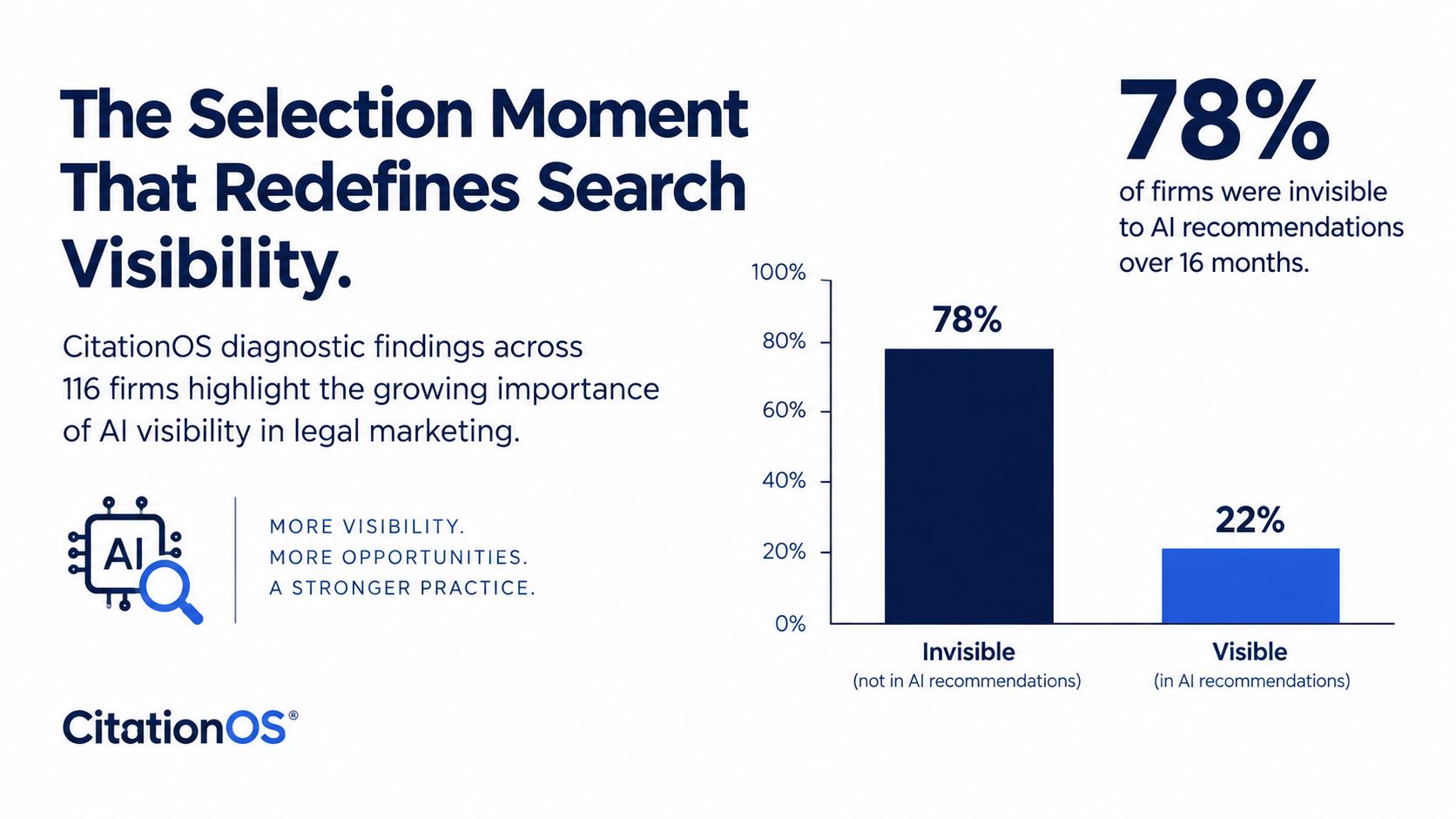
CitationOS diagnostic findings across 116 firms highlight the growing importance of AI visibility in legal marketing.
Presence is not inclusion
A firm can exist in the sources available to an AI system and still be absent from its response. It can appear in the response without a citation, receive a citation without entering the shortlist, or enter the shortlist with an inaccurate description of its jurisdiction, practice focus, or client profile.
These outcomes represent separate stages:
- Discovery means the system can find the firm or information about it.
- Inclusion means the firm appears in the generated response.
- Citation presence means a source supports the representation.
- Recommendation means the firm is presented as a plausible choice for the stated need.
A single visibility score hides the point of failure. Strong conventional SEO may help a system retrieve a firm's pages, while weak recommendation authority prevents it from forming a clear, consistent interpretation of the firm's fit. Measurement must therefore compare these stages across repeated queries and systems, rather than infer recommendation performance from one ranking or prompt.
The invisible loss happens before the click
Pew Research Center's analysis of U.S. browsing activity in March 2025 found that 58% of respondents conducted at least one search producing an AI-generated summary, while 65% encountered an AI reference somewhere on a search-results page. Across all searches in the study, approximately 18% generated an AI summary. Pew's analysis of AI in search also found that summaries appeared for 53% of searches containing 10 or more words, compared with 8% of one- or two-word searches.
Legal queries often include several conditions at once, such as dispute type, jurisdiction, industry, urgency, and desired outcome. The selection moment is where the system weighs those conditions against available evidence, chooses which firms belong in the answer, attaches supporting sources, and determines whether the description is accurate enough to present.
Operational rule: Measure the instant an AI system forms a recommendation set, not merely the traffic that follows it.
The visibility fallacy in AI search arises when a conventional ranking is treated as evidence of AI readiness. A ranking report records retrieval. It does not establish selection, accurate representation, citation support, or displacement by another firm. A defensible visibility report must show what happened at that decision point, across repeated prompts and relevant AI systems.
Why SEO, GEO, and Recommendation Intelligence Are Three Different Layers
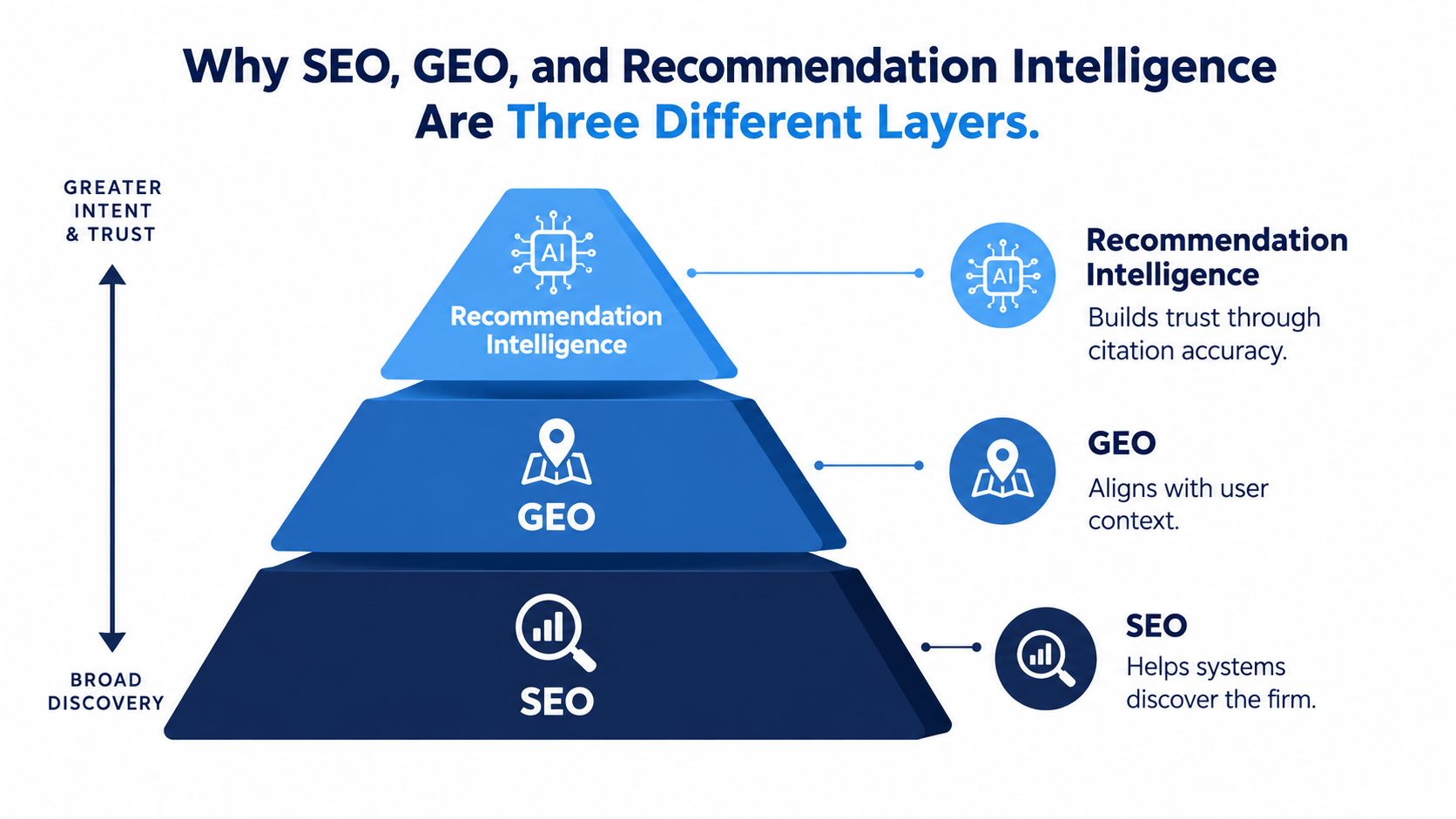
AI search visibility becomes measurable only after the layers are separated. SEO helps systems discover you. GEO helps systems extract and understand you. AI recommendation intelligence measures whether AI trusts and recommends you.
The discovery layer belongs to SEO
Traditional search optimization improves crawlability, retrieval, relevance, and authority signals. It helps a system associate a law firm with topics such as employment disputes, private equity transactions, or medical malpractice. Without this layer, an AI system may not find the firm's evidence at all.
Discovery is necessary, but it isn't sufficient. The firm can occupy a strong position in conventional search and still fail to enter the answer because its content doesn't provide a coherent, extractable account of who it serves and why it fits the query.
The interpretation layer belongs to GEO and AEO
Generative engine optimization, or GEO, and answer engine optimization, or AEO, address what happens after discovery. They make information easier for an answer system to extract, interpret, attribute, and combine with other sources.
This layer depends on evidence units. A practice page might identify a jurisdiction, a partner biography might establish experience, and a third-party source might confirm an award or matter category. If those signals conflict, extraction doesn't produce clarity. It produces competing interpretations.
Research on GEO found that adding citations, quotations, and statistics increased source visibility by more than 40% across queries, while keyword stuffing reduced effectiveness. The study's strongest relative gains occurred for pages around position five, which experienced approximately a 115% lift, while already top-ranked pages saw little change. The GEO developer guide therefore supports a structural conclusion: ranking position alone doesn't determine whether a source will influence an AI answer.
The selection layer belongs to recommendation intelligence
Recommendation intelligence evaluates the output, not just the inputs. It asks whether the firm appears in the answer, whether it occupies a prominent citation position, whether the narrative is accurate, and whether the result holds across systems.
That is why a citation isn't equivalent to a recommendation. A source can be cited as background while another firm receives the shortlist position. A firm can be named once but described so vaguely that the mention has no practical influence. Entity authority exists when the system can consistently connect the firm's name, people, practices, jurisdictions, and client needs.
The three layers should therefore be reported separately. A single blended score can hide whether leadership needs better discoverability, clearer evidence, or stronger recommendation authority.
How AI Assistants Construct Answers Instead of Ranking Pages
Traditional search returns an ordered set of pages. AI assistants retrieve material, interpret the user's request, select supporting evidence, and compose a response. The user receives a synthesized explanation, often with selected citations, rather than a simple list of destinations. Visibility therefore depends on the selection moment, when the system decides which firms and sources belong in the answer.

A legal prompt creates an evidence problem
Consider a prompt asking for firms that handle a cross-border shareholder dispute in a particular jurisdiction. The system must interpret the legal issue, identify relevant firms, retrieve supporting material, assess each firm's relationship to the query, and produce a concise response. Several pages may contribute evidence, so no single page necessarily functions as the answer.
Pew's browsing analysis, cited earlier, found that 88% of AI summaries cited three or more sources, while the median summary contained 67 words. Those figures show why answer-layer visibility requires more than a ranking check. A firm must publish evidence that can be retrieved, synthesized, and attributed without losing its relevance.
A system may find a firm's homepage, an outdated directory profile, a partner bio, and a published matter description. Conflicts among those sources create selection risk. The assistant may omit the firm, qualify its recommendation, or assign the wrong specialization.
Complexity changes the answer layer
Short navigational searches often seek a known destination. Longer professional-service queries require interpretation. As conditions accumulate, the system must assess relevance, evidence, and authority before composing an answer.
High-intent legal queries expose this distinction clearly. An assistant may provide a sufficient shortlist without generating a conventional website visit. Pew recorded traditional-result clicks on 8% of visits when an AI summary appeared, compared with 15% when no summary appeared. The commercial decision can therefore occur before a click opportunity exists.
The AI answer engine analysis describes the same operational distinction. A firm can appear in the retrieval environment yet remain absent from the explanation. The measurable unit is the answer representation, including the sources used, the firm's position, and the wording attached to its mention.
Referral traffic is downstream evidence, not the whole outcome
AI referrals remain useful evidence of discovery. Adobe Analytics reported that U.S. traffic originating from generative AI referrals increased more than tenfold between July 2024 and February 2025. For retail websites, AI-driven traffic rose 12 times during that period, with stronger engagement from AI referrals. Adobe's analysis of AI-driven traffic
Those figures come primarily from retail and should not be transferred mechanically to legal services. They establish that AI systems can influence commercially meaningful discovery, while referral analytics may capture only the final step. A law firm needs answer-layer measurement alongside downstream behavior analysis, with repeated tests across systems rather than conclusions drawn from a single prompt.
The Five Metrics That Actually Measure AI Recommendation Authority
A defensible measurement program treats AI citation as a distribution, not a fixed rank. Repeated tests across Perplexity Search, OpenAI SearchGPT, and Google Gemini found substantial citation variability, unstable rankings, and apparent differences that could fall within the measurement noise floor. The empirical citation study supports repeated sampling with platform, locale, timestamp, exact URL, citation position, and answer inclusion recorded for every run.
Inclusion rate and citation frequency measure different events
Inclusion rate is the share of relevant prompts where the firm appears in the answer. It measures shortlist access.
Citation frequency records how often the firm or its sources are cited. It measures evidentiary recurrence, but not necessarily prominence or recommendation strength.
A firm can have high citation frequency and low inclusion if its pages are used for peripheral facts. Conversely, it may have modest citation frequency but high shortlist inclusion if the system repeatedly names it in the relevant recommendation context.
Citation position and top-3 rate expose prominence
Citation position shows where the firm's evidence appears in the source set. Top-3 rate measures how often the firm earns one of the first three recommendation positions or citation positions defined by the measurement protocol.
Mention count alone is weak because it treats a passing reference as equivalent to a prominent recommendation. A top-3 result is closer to the selection moment. It tells leadership whether the firm is merely present or competing for the first layer of attention.
A controlled comparison covering 252,000 trials across six language models found that topical relevance and list position were the largest drivers of which retrieved source was cited first. The controlled evidence on citation outcomes supports reporting prominent placement separately from total appearances.
Narrative depth and cross-platform consistency test interpretation
Narrative depth measures how specifically the system describes the firm. A shallow mention may identify a name. A deeper representation may connect the firm to a practice, jurisdiction, client type, and case category.
Cross-platform consistency measures whether the same firm earns comparable inclusion and description across systems. Results should remain separate by platform because retrieval and citation behavior can diverge materially.
The AI Visibility Index, or AVI, can combine these dimensions, but only if its components remain visible. A defensible Citation Score should report inclusion rate, citation frequency, citation position, narrative depth, and cross-platform consistency rather than compressing them into an unexplained number.
One-time prompt testing is useful for a baseline. It cannot establish competitive superiority. The audit method should rerun the same prompt set, calculate variance or confidence intervals, and distinguish real movement from normal output fluctuation. A structured AI search audit should therefore resemble an intelligence collection program, not a screenshot exercise.
Citation Recall and Citation Precision as the Quality Layer
Visibility without accuracy can create a misleading picture of authority. A firm may appear in an AI answer, receive a citation, and still be described with the wrong jurisdiction, an outdated practice area, or an incorrect credential.
Research defines two useful quality dimensions. Citation recall is the share of verifiable sentences fully supported by citations. Citation precision is the share of citations that correctly support the sentence to which each citation is attached. The citation quality framework makes the distinction practical for high-trust sectors.
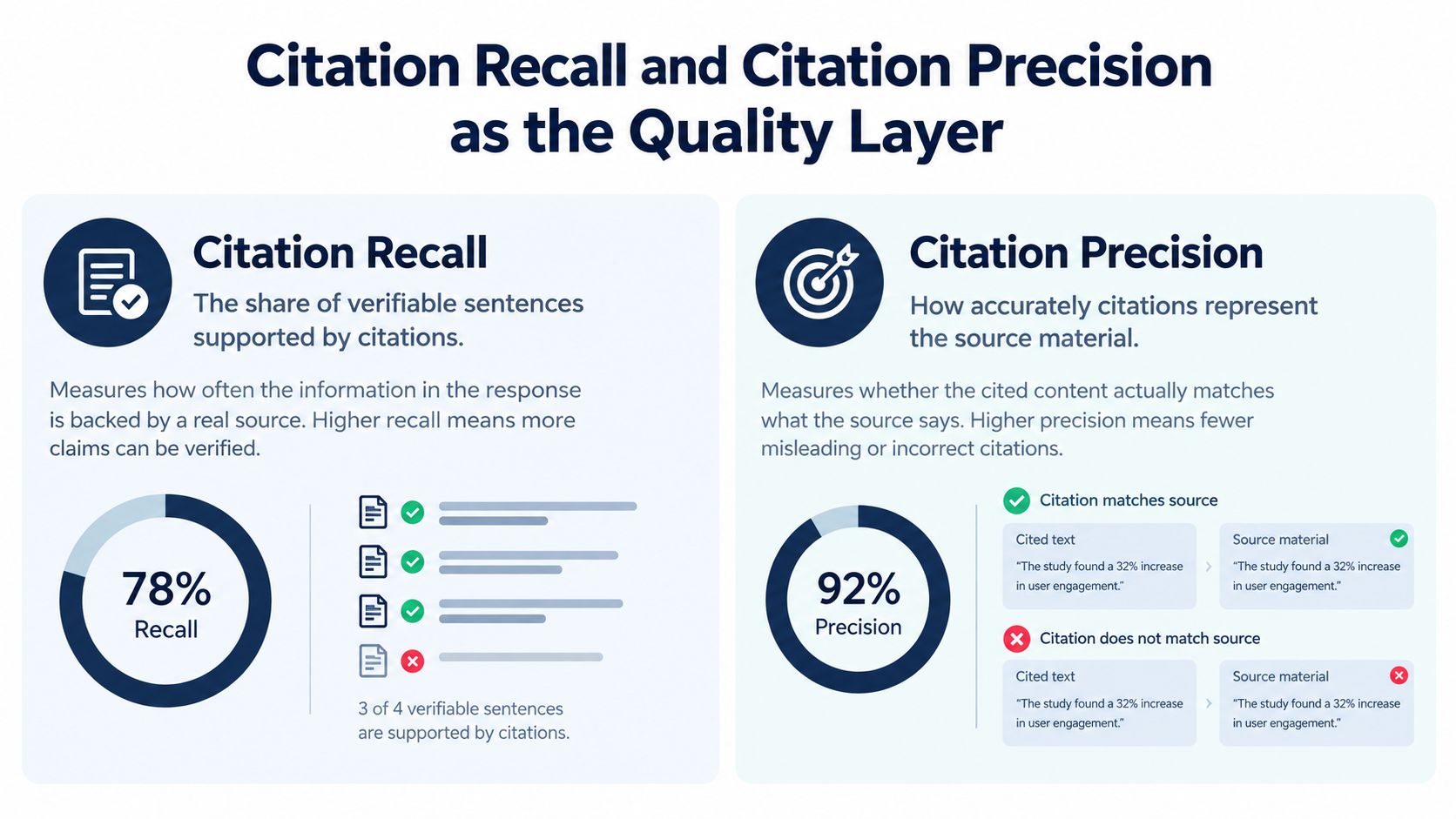
Recall finds unsupported claims, precision finds misleading support
| Dimension | What it measures | Law firm equivalent | Output measure |
|---|---|---|---|
| Citation recall | The share of verifiable sentences supported by citations | Whether claims about practice, jurisdiction, credentials, and matters have supporting evidence | Supported-sentence rate |
| Citation precision | Whether each citation actually supports the attached sentence | Whether a source proves the firm has the stated specialization or experience | Correct-support rate |
| Entity authority | Whether sources consistently identify the same firm and attributes | Whether names, offices, lawyers, practices, and jurisdictions align across the source set | Attribute-consistency assessment |
High recall with low precision is dangerous. The system may attach sources frequently, but those sources may not support the exact statement being made. High precision with low recall is also incomplete. The supported statements may be accurate, while important claims remain ungrounded.
Trust can magnify a wrong representation
Citation presence often signals authority to the reader, even when the cited material is incomplete or wrong. A 2025 study summarized in the available literature found that AI systems cited incorrect news sources 60% of the time, while another experiment found that citations increased trust even when reference links were incorrect or hallucinated. The research on citation reliability and perceived trust makes the legal implication clear: more citations don't automatically mean safer representation.
An outdated directory can identify a lawyer with a former practice focus. A biography can emphasize a broad service line that no longer reflects the firm's priority. A third-party profile can assign the firm to a jurisdiction it doesn't serve. If an AI system combines those sources, citation volume may reinforce the wrong narrative.
A citation audit should ask whether the source supports the recommendation, not merely whether a source exists.
Entity authority is therefore an attribute problem. The audit must test whether the firm's name, people, practices, jurisdictions, and matter categories remain coherent across the sources an AI system is likely to use.
What Authority Gaps Look Like in a High-Intent Legal Query
A boutique firm can rank well for its core services and still lose a recommendation to a less visible competitor. The failure often begins with a fragmented identity rather than weak content.
Suppose a prospective client asks an AI assistant for counsel in a specialized commercial dispute. The firm's website clearly describes the practice, but an outdated directory emphasizes a different service. A partner bio names a former jurisdiction, while a third-party profile uses a broader and less precise category. The system finds all of these sources, but it can't resolve which representation to trust.

The firm is discoverable but not recommendation-ready
The firm may appear in retrieval results because its pages contain relevant terminology. Yet relevance isn't the same as confidence. An answer system must decide whether the firm matches the user's jurisdiction, dispute type, client profile, and requested experience.
If the evidence is fragmented, the model may omit the firm or describe it cautiously. It may mention the firm without placing it in the shortlist. It may select a competitor whose public footprint creates a cleaner narrative, even if that competitor has less conventional visibility for the query.
This is an authority gap. It exists between what the firm knows about itself and what external evidence allows an AI system to conclude.
Narrative depth determines useful inclusion
Narrative depth isn't a measure of word count. It describes the specificity and stability of the representation. A deep narrative connects a firm to the relevant matter category, jurisdiction, client context, and reason for recommendation. A shallow narrative supplies a name with little decision value.
The diagnostic questions are concrete:
- Does the firm appear for the exact case category, or only a broad practice label?
- Do authoritative sources agree on jurisdiction and service scope?
- Can the system distinguish the firm from similarly named entities?
- Does the answer describe current capabilities, or an outdated profile?
- Does the firm appear among the leading recommendations, or only in supporting text?
These questions connect the AVI to corrective work. A low inclusion rate with strong narrative accuracy suggests a reach problem. A high inclusion rate with weak precision suggests a representation-risk problem. A strong traditional ranking with low top-3 rate suggests that discovery is working, while recommendation authority is not.
For a high-trust firm, one accurate inclusion in a relevant shortlist may matter more than many low-intent visits. Adobe's referral findings show that AI can influence commercially meaningful discovery, but legal leadership must also account for users who never click because the recommendation already shaped their shortlist.
A Defensible Measurement Program for AI Recommendation Authority
A managing partner needs a program that separates collection, diagnosis, and action. The operating model should begin with a confidential audit across the AI systems used by prospective clients, including ChatGPT, Gemini, and Perplexity. The audit should test decision-critical prompts, record exact answers and sources, and identify whether the firm is named, cited, shortlisted, or omitted.
The second layer is competitive measurement. Benchmark the firm against named rivals using the same prompt set, locale, timing, and sampling procedure. Report the AI Visibility Index, inclusion rate, top-3 rate, citation position, narrative depth, and cross-platform consistency separately so leadership can see whether the gap concerns discovery, interpretation, or selection.
The third layer is structural diagnosis:
- Representation analysis checks how the firm is described in answer text.
- Entity consistency assessment checks whether names, attributes, practices, and jurisdictions agree across sources.
- Authority Gap Identification isolates missing or contradictory evidence.
- Citation quality review measures recall and precision, not just citation volume.
- Repeated sampling distinguishes durable movement from model variability.
CitationOS provides confidential audits, benchmarking, structural diagnosis, a proprietary Citation Score, and dashboard monitoring for how firms are represented, cited, and recommended across AI systems. Its role fits the recommendation-intelligence layer. It isn't an SEO agency, GEO agency, or digital marketing company.
The governing principle is simple: SEO helps systems discover you. GEO helps systems extract and understand you. Recommendation intelligence measures whether AI trusts and recommends you. Firms that treat the final layer as an intelligence problem can identify exclusion before it becomes a business-development blind spot.
For law firms operating in high-intent, high-trust markets, AI recommendation authority is now a governance issue. The firm that supplies a consistent, evidence-backed identity is easier for an AI system to name with confidence, and that confidence is formed before the prospective client decides whether to visit the website.
CitationOS offers confidential AI citation audits, competitive benchmarking, entity consistency assessment, and ongoing measurement of representation, citation presence, and shortlist inclusion across major AI systems. Visit CitationOS to establish a replicated baseline for your firm's AI recommendation authority and identify the structural gaps affecting selection.