A firm can rank on page one and still not be named. That's the selection problem now facing high-trust firms. When a prospective client asks an AI system to shortlist counsel for a specific matter in a specific jurisdiction, the system doesn't return ten blue links. It returns names, with reasons. Entity SEO determines whether your firm is eligible to be one of those names at all.
Why 78 Percent of Firms Are Invisible to AI Recommendations
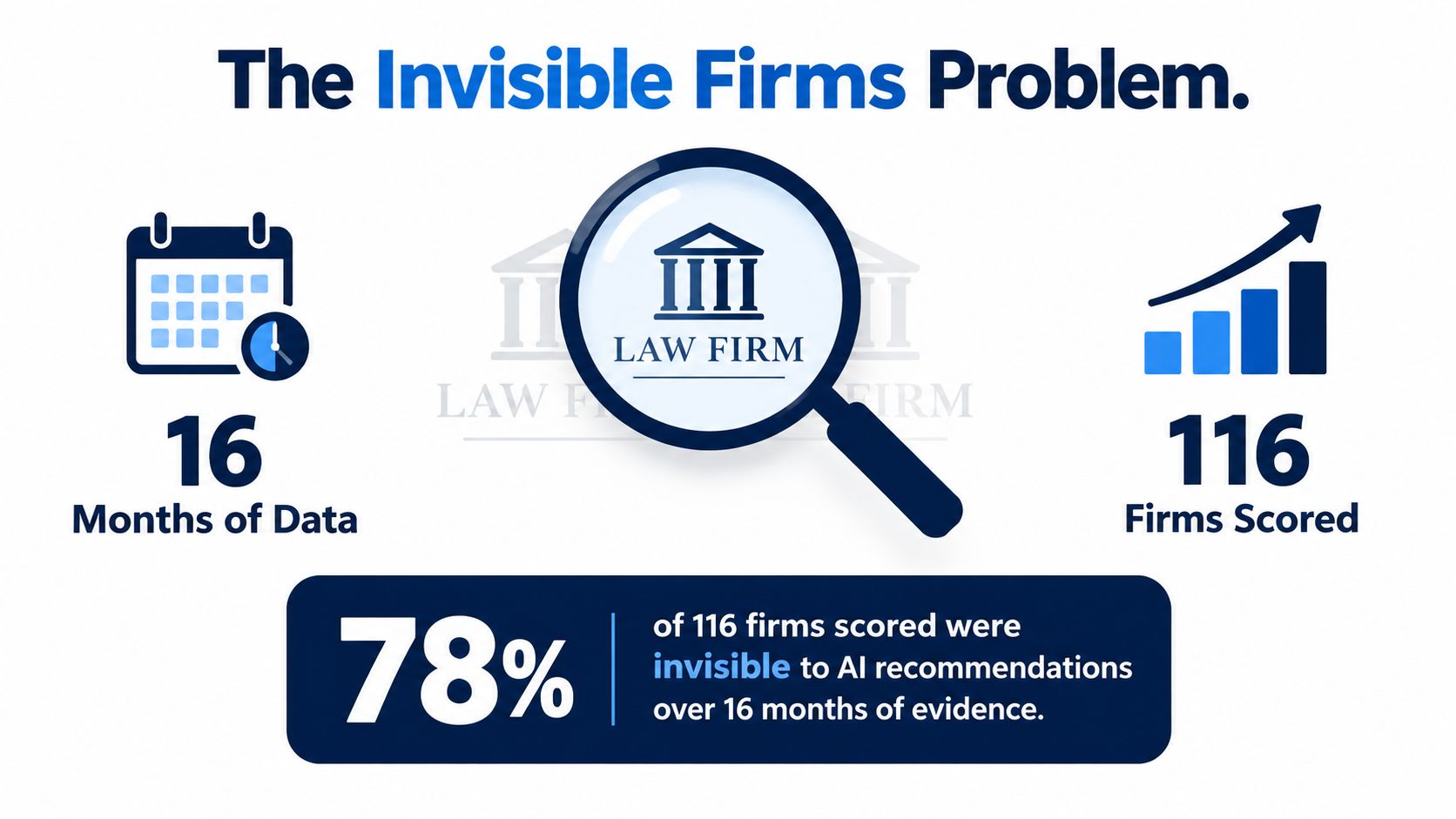
CitationOS diagnostics across 116 firms scored over 16 months of diagnostics found 78% invisible to AI recommendations. These weren't firms without websites, rankings, or content. Many had functional traditional SEO. They were discoverable. They weren't selected when AI systems built a shortlist for a high-intent query.
Consider the moment that matters. A founder asks for firms that handle a defined matter type in a defined market. The system must resolve which organization each mention refers to, what that organization does, where it operates, and which attorneys support the claim. If those facts don't cohere, the system defaults to a competitor whose identity is easier to resolve. No error is shown. Your firm is just absent.
What Entity SEO Is Not
Entity SEO isn't a markup upgrade. Adding schema to a homepage doesn't create AI recommendation authority if directories, biographies, and profiles describe the firm differently. It's also not keyword research with new vocabulary. Keywords are strings. Entities are disambiguated real-world things, a firm, a person, a place, a service, with attributes and relationships systems can verify against other sources.
Finding: Invisibility is usually a resolution failure, not a ranking failure. The system can't confidently identify the firm, so it doesn't recommend it.
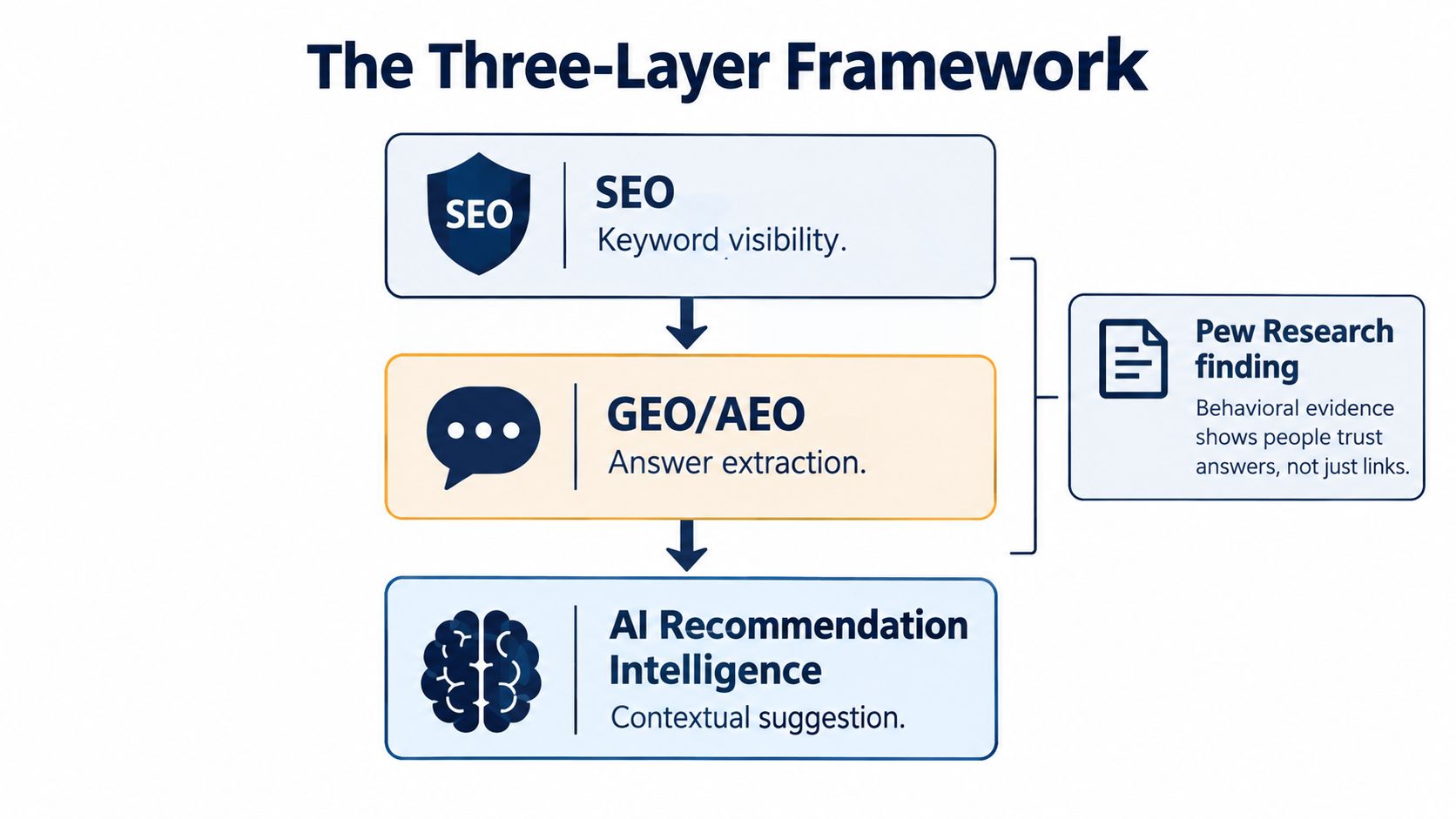
Three layers explain the gap. SEO helps systems discover you. Generative engine optimization (GEO) and answer engine optimization (AEO) help systems extract and understand you. CitationOS measures whether AI trusts and recommends you. Most firms measure only the first layer. They report rankings while losing the shortlist, which is where the client decision now starts.
The trade-off is direct. Entity work is slower and less visible than publishing content. It touches profiles you don't fully control. But it's structural. Once identity, practice taxonomy, attorney relationships, and jurisdiction signals agree, every subsequent piece of content attaches to a clearer entity. Without that base, additional content often adds more conflicting descriptions for systems to reconcile. That's why citation presence, narrative depth, and top-3 rate belong in the same diagnostic conversation as rankings, not after it.
What Entity SEO Actually Means
An entity is a distinct, identifiable thing. A law firm is an entity. So is each attorney, each office, and each practice area. Entity SEO is the work of making those entities and their relationships machine-readable and consistent, so a system can resolve a mention to the correct organization before it decides what to recommend.
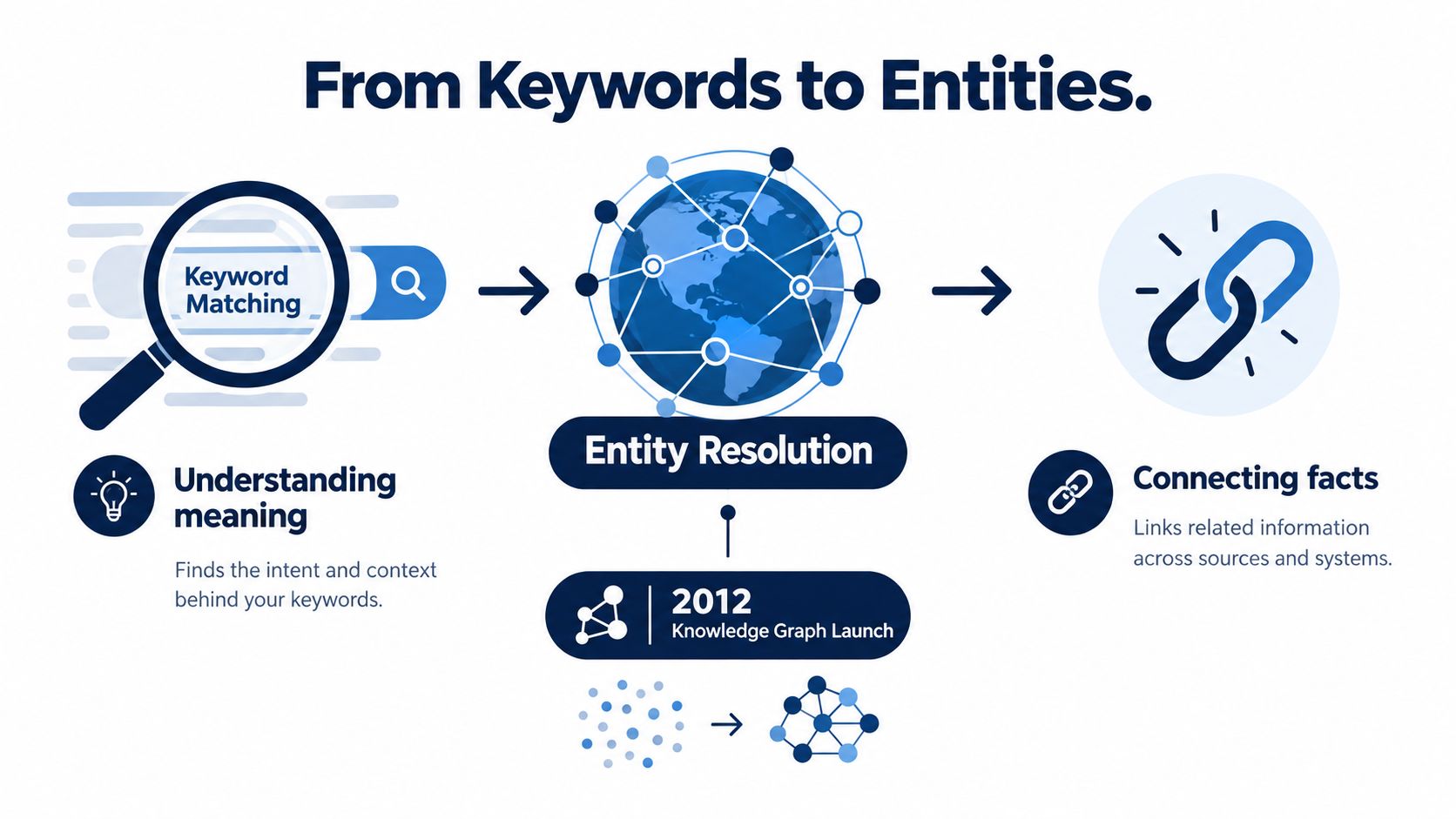
The shift has a date. When Google's Knowledge Graph launched in 2012 with approximately 500 million entities and 3.5 billion facts and relationships, search moved from matching words toward modeling people, places, organizations, and concepts. A firm stopped being only the words on its site. It became a node connected to location, industry, founders, services, and affiliated organizations.
How Resolution Works in Practice
A system detects a mention. It generates candidate entities that could match that name. It then ranks candidates using surrounding text and attributes, assigns an identifier, and indexes that identifier for retrieval. That entity-resolution sequence of detection, candidate ranking, and identifier assignment is why a name alone is insufficient, especially when firms share similar names across markets.
- Name: The label systems encounter first, and the weakest signal on its own.
- Attributes: Location, jurisdictions, practice areas, and credentials that narrow the candidate set.
- Relationships: Attorneys employed by the firm, offices operated by the firm, services offered by the firm.
The wider ecosystem reinforces the point. Wikidata contained more than 123 million items and over 2.5 billion edits by 2025, each item representing a distinct subject connected by structured statements. Your firm doesn't exist in one database. It exists across interconnected knowledge systems, and consistency across names, identifiers, categories, and websites influences whether automated systems resolve the correct entity.
For a structured walkthrough of the underlying concepts, the AI Optimization Services entity SEO guide sets out the entity-based model in accessible terms. The operational conclusion is narrower. Don't ask whether a page targets a keyword. Ask whether a system reading that page, plus your external profiles, would identify one firm, in one market, with one coherent set of practices. If it would hesitate, you have an entity problem before you have a content problem.
Discoverability, Extractability, and Recommendation
These three layers are often reported as one metric. They shouldn't be. Each answers a different question, and success at one layer doesn't establish success at the next.
Discoverability is whether systems can find and index the firm. Traditional SEO governs much of this layer. Extractability is whether systems can pull accurate facts from your pages and profiles. That's the work of generative engine optimization (GEO) and answer engine optimization (AEO), and our treatment of answer engine optimization and extractable answer structure covers that layer in detail. Recommendation is whether the system names the firm when a user asks for options. That is a selection decision, not a retrieval decision.
Why the Click Data Changes the Measurement
Behavioral evidence shows why ranking reports mislead. In Pew Research Center analysis of 68,879 Google searches by 900 U.S. adults in March 2025, users clicked a traditional result in only 8% of visits when an AI summary appeared, compared with 15% when no summary appeared. A link inside the summary itself was clicked in just 1% of visits in that same analysis. The answer layer is absorbing the decision that the results page used to host.
If the shortlist forms inside the answer, measuring only position and clicks measures a shrinking part of the decision.
AI recommendation intelligence therefore measures at the answer layer. The relevant indicators are citation presence, whether the firm is cited at all, narrative depth, whether the system can describe the firm beyond its name, and top-3 rate, how often it appears in the leading positions of a shortlist. CitationOS combines these into an AI Visibility Index (AVI) so leadership can compare recommendation performance against named competitors on the same queries.
The implication is uncomfortable but clear. A firm can improve rankings, publish extractable content, and still lose every contested shortlist. Until recommendation is measured separately, that loss stays invisible in standard reporting.
Schema, sameAs, and the Plumbing of Entity Identity
Treat structured data as plumbing. It carries identity signals between your pages and external profiles. It doesn't create authority, and it doesn't guarantee a rich result or a recommendation.
Start with a persistent JSON-LD @id for the organization. Reuse that exact identifier on the homepage, attorney biographies, office pages, and practice-area pages. Every page then points to the same organization node instead of minting a new, slightly different version of the firm. From that node, link outward to Person nodes for attorneys, Service nodes for practices, and Place nodes for offices, with reciprocal relationships where the visible content supports them.

What sameAs Must and Must Not Do
The sameAs property tells systems that an external profile describes the same entity. Precision matters more than volume. Under Google's structured-data policies requiring markup to represent visible page content, each sameAs value should unambiguously identify the same entity, and one value shouldn't be reused for different entities. A stale profile, a predecessor firm's page, or a similarly named organization in that array creates a competing interpretation.
Practical guidance on how teams optimize for AI search engines often starts with content formatting. Start earlier. Audit contradictions first, then add markup.
- Verify each identifier: Confirm every @id and sameAs target resolves to your firm, not a namesake.
- Match schema to visible text: Don't claim a practice, office, or credential in markup that the page doesn't state.
- Standardize relationships: Each attorney should connect to the correct employer entity, consistently.
A quick validation pass with a schema checker for Organization and Person markup will surface syntax errors. It won't surface semantic errors. Those require comparing legal name, former names, office locations, practice taxonomy, attorney affiliations, and profile URLs across sources for presence, agreement, and provenance. Fix high-impact contradictions before expanding the graph. More markup on conflicting facts gives systems more structured reasons to doubt you.
Why More Mentions Are Not the Same as Better Entity Authority
The current advice is simple. Get more mentions. The evidence behind it is real, but it's being read too loosely.
An analysis of 75,000 brands reporting mention correlations of roughly 0.656 to 0.709 across ChatGPT, AI Mode, and AI Overviews, versus about 0.19 to 0.24 for backlinks is frequently cited as proof that mention volume drives AI visibility. Correlation isn't causation, and the source itself treats the relationship as correlational. Brands that are mentioned often also tend to be larger, older, and more clearly described. Volume may be a symptom of entity authority, not its cause.
Which Mentions Actually Help Resolution
Ask what a mention allows a system to conclude. A name repeated in a directory listing confirms existence and little else. An independent source connecting your firm to a specific jurisdiction, matter type, attorney, and credential does resolution work. It narrows the candidate set and gives the system a reason to select your firm for that query rather than a generalist competitor.
Evaluate mentions on five criteria, not count.
- Specificity: Does it tie the firm to a matter type, market, or named attorney?
- Independence: Is the source editorially separate from the firm?
- Recency: Does it reflect the current firm, partners, and offices?
- Consistency: Does it agree with your canonical description and taxonomy?
- Relevance: Does it match the queries where you want shortlist inclusion?
Conflicting mentions deserve equal attention. When directories, rankings, news coverage, and biographies describe the same firm with different practice labels and markets, each new mention can deepen ambiguity instead of reducing it. The system must choose among versions of you before it can choose you over competitors.
Analytical rule: Count mentions that disambiguate. Discount mentions that merely repeat the name.
The trade-off for leadership is budget allocation. Digital PR that produces specific, independent, consistent coverage supports entity authority. Mention volume bought without those qualities inflates a correlated metric while leaving the underlying resolution problem untouched. You'll see the activity in reports. You won't see it in the shortlist.
Common Entity Failures in Firm Diagnostics
The same failures recur across firm diagnostics. None is exotic. Each produces a predictable interpretation error at the answer layer.
Conflicting practice taxonomies are the most frequent. A practice page uses one set of labels, attorney biographies use narrower or older terms, and directories use a third. The system receives three descriptions of what the firm does and can't determine which matters the firm should be shortlisted for. Narrative depth collapses into generic language because no single specialization is corroborated often enough.
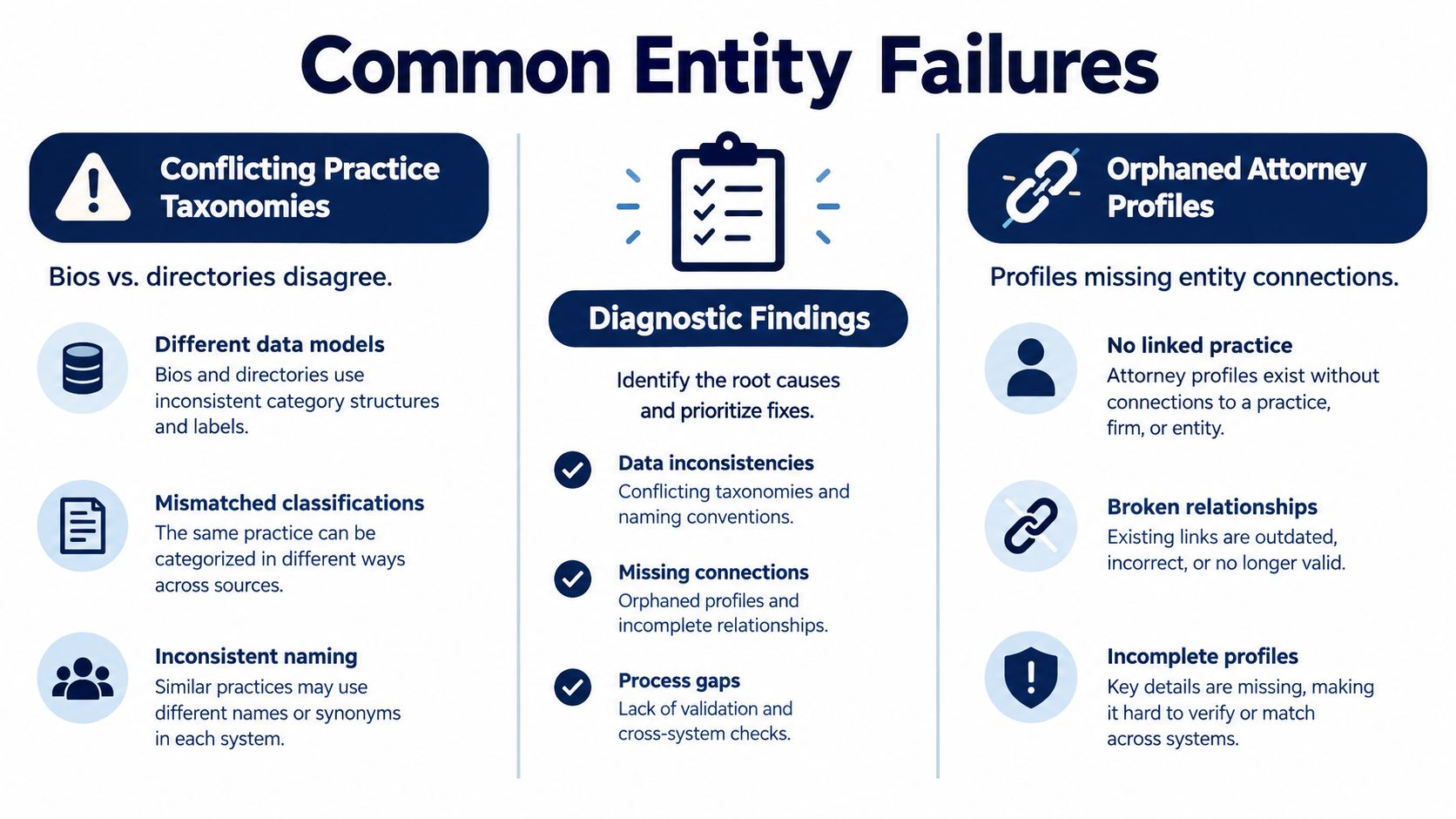
Common Entity Failures and Their Effect on AI Interpretation
| Entity Failure Observed | AI Interpretation Consequence |
|---|---|
| Conflicting practice taxonomies across bios and directories | Specialization can't be confirmed, firm described generically |
| Orphaned attorney profiles with no employer link | Attorney expertise isn't credited to the firm |
| Stale sameAs links to outdated or predecessor profiles | Identity signals split across two organizations |
| Inconsistent jurisdiction references across sources | Firm excluded from market-specific shortlists, or included in wrong ones |
| Name variations without a stable canonical form | Mentions merge with similarly named firms or fragment into duplicates |
Authorship failures compound these problems. Google's documentation states E-E-A-T is not itself a specific ranking factor, while identifying authorship clarity as a practical signal. Pages should make it self-evident who created the content and connect that byline to the author's background. Anonymous insight pages sever the link between a claim and the qualified person making it, which weakens both credibility assessment and entity association.
An AI search audit structured around entity consistency should therefore read less like a keyword report and more like a reconciliation exercise. List every authoritative source describing the firm. Compare the facts. The contradictions you find are, in most cases, the explanation for the shortlist results you're seeing.
A High-Level Remediation Sequence
Sequence matters. Firms commonly start with content production because it's visible and easy to commission. Start with identity instead, because content published onto a fragmented entity inherits the fragmentation.
First, fix the canonical organization page. State the legal name, what the firm does, where it operates, and who leads it, in visible text. Assign the persistent @id there and make every other page reference it. This page becomes the version of record against which external profiles are reconciled.
Second, standardize people and practices. Connect each attorney biography to the organization entity and to the same practice taxonomy used on practice pages and priority directories. Resolve former names explicitly rather than deleting them, so historical mentions still resolve to the current firm. Remove or correct stale profiles that describe predecessor entities as if they were current.
Measure at the Answer Layer, Not the Markup Layer
Third, repair external corroboration. Work through authoritative profiles in order of influence on your target queries. Align descriptions, jurisdictions, and attorney affiliations. Where a source can't be corrected, ensure your canonical page and remaining profiles outweigh it with consistent, specific facts.
Fourth, test repeatedly. Run the same high-intent queries across AI systems and markets on a fixed schedule. Score entity-name accuracy, practice-area accuracy, correct jurisdiction, attorney association, citation presence, and shortlist inclusion. Rankings can stay flat while recommendation improves, and the reverse is also true. Only answer-layer measurement tells you which is happening.
Entity SEO is now a prerequisite for AI recommendation authority. It is not a ranking tactic, and it shouldn't be budgeted as a campaign.
Firms that treat entity identity as infrastructure will hold a structural advantage as AI-mediated discovery deepens, because each new mention, profile, and page reinforces a single resolvable organization. Firms that treat it as a one-time schema project will keep rediscovering the same absence, one lost shortlist at a time. The question for leadership isn't whether AI systems can find your firm. It's whether they can identify it with enough confidence to stake an answer on it.
CitationOS measures citation presence, narrative depth, top-3 rate, and entity authority across the AI systems your prospective clients already use to build shortlists, benchmarked against your named competitors. If your firm ranks but isn't being recommended, request a confidential diagnostic from CitationOS to establish whether entity resolution is the constraint.