The selection moment is binary. An AI assistant either names a law firm, or it doesn't. That difference matters because 84% of respondents in legal-industry research said they would not trust a law firm that did not appear in AI results, and 95% said they would not consider a firm if AI presented inaccurate or negative information (AI Legal Consumer Report 2026). For firms competing in high-stakes categories, answer engine optimization is no longer about visibility in the abstract. It's about whether the system includes you in the shortlist at all.
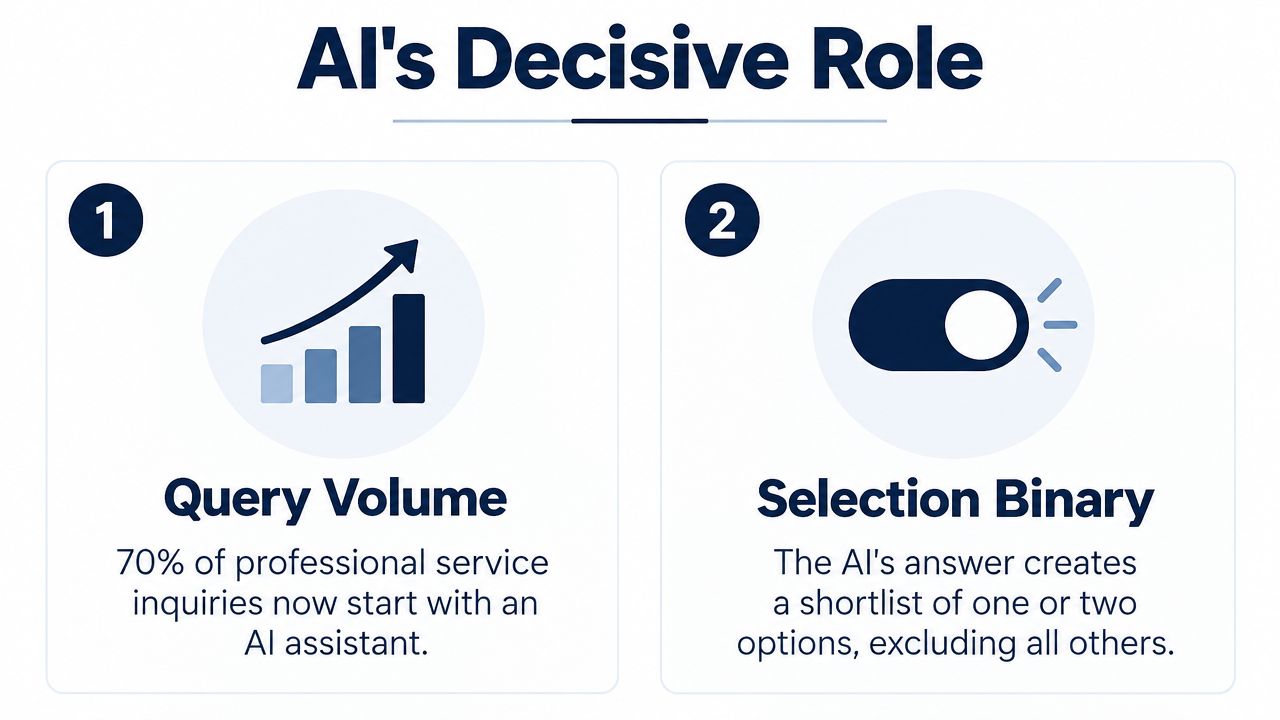
Traditional search created a list. AI search creates a decision boundary. Once the answer is generated, everyone not named is effectively excluded, and the firm often never sees the omission. That is why the commercial stakes changed so quickly as AI-assisted search behavior scaled, with independent benchmarking showing AI referral traffic at 1.08% of total web visits across 10 industries and rising by roughly 1% each month on average.
The practical implication is simple. Blue-link rankings are still useful, but they no longer guarantee entry into the answer layer. For law firms, financial firms, medical practices, and luxury brands, that means competition is shifting from search placement to recommendation readiness. One firm can rank well and still be absent from the AI shortlist. Another can be cited, summarized, and recommended even without dominating classic SERPs.
That gap is where the diagnostic work begins. A firm needs to know whether AI systems can find it, interpret it, and trust it enough to recommend it. The rest of this analysis follows that chain.
Table of Contents
- What Answer Engine Optimization Means Today
- How AI Assistants Form Answers and Choose Citations
- Why Most AI Visibility Tools Stop Before Selection
- Measuring What Matters From Citation Presence to Top Three Rate
- A Practical Roadmap to Improve AI Representation and Inclusion
- What Strong Answer Engine Optimization Changes for High Trust Firms
What Answer Engine Optimization Means Today
Answer engine optimization is the discipline of making a firm usable inside AI-generated answers, not just discoverable in search results. The shift became visible when generative search started to take shape in late 2023, after researchers introduced Generative Engine Optimization in an arXiv paper posted on November 16, 2023. The paper is important because it showed, across roughly 10,000 queries, that adding statistics, citations, and quotations could improve visibility in generative responses by up to 40 percent (history of GEO).
Discovery, interpretation, recommendation
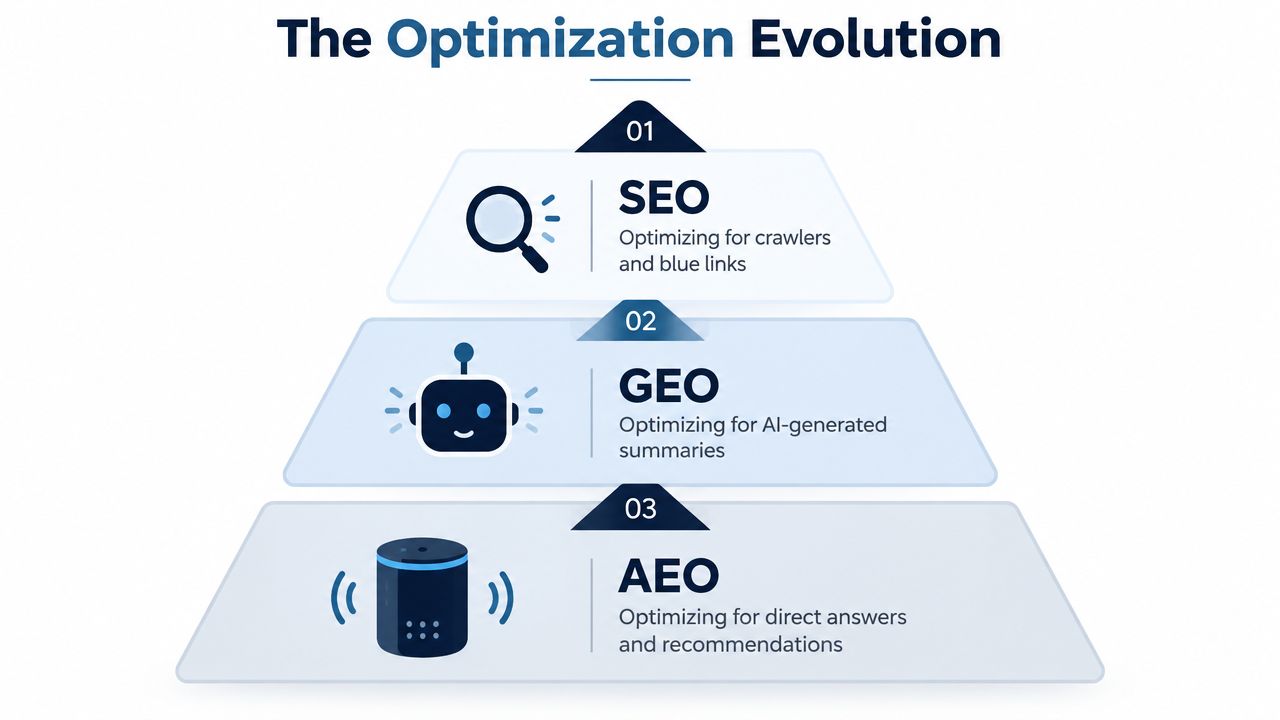
The stack is easier to read in three layers.
SEO helps systems discover you.
GEO helps systems extract and understand you.
AEO measures whether AI trusts and recommends you.
That difference changes the objective. Classic SEO tries to win the click. GEO tries to make source material legible to an engine. AEO asks a harder question, whether the engine included the firm in the answer, and whether that inclusion was favorable, accurate, and decision-relevant. The GEO paper framed the new search approach as optimization for visibility inside AI-generated answers, not only ranking (arXiv GEO paper).
Practical rule: if the page can be found but not quoted, it is still underperforming.
Answer engine optimization is therefore a separate operating discipline. It is not just content formatting with a new label. It shifts the unit of success from page traffic to answer inclusion. In legal and other professional services, that shift is sharp because buyers often ask narrow, high-intent questions where a single cited source can shape the shortlist.
AI-assisted discovery is already changing behavior. In the U.S., Pew-linked reporting in 2025 said 37% of adults had used an AI chatbot for search-style queries in the past month, up from 19% one year earlier. That does not replace search. It moves part of recommendation into the answer layer.
How AI Assistants Form Answers and Choose Citations
Citation selection starts before the answer is written. The system first interprets the query, then retrieves candidate passages, then grounds and synthesizes a response, and only after that does it choose what to cite. A source can be reachable and still lose that selection moment if the relevant passage is too broad, too thin, or mismatched to intent.
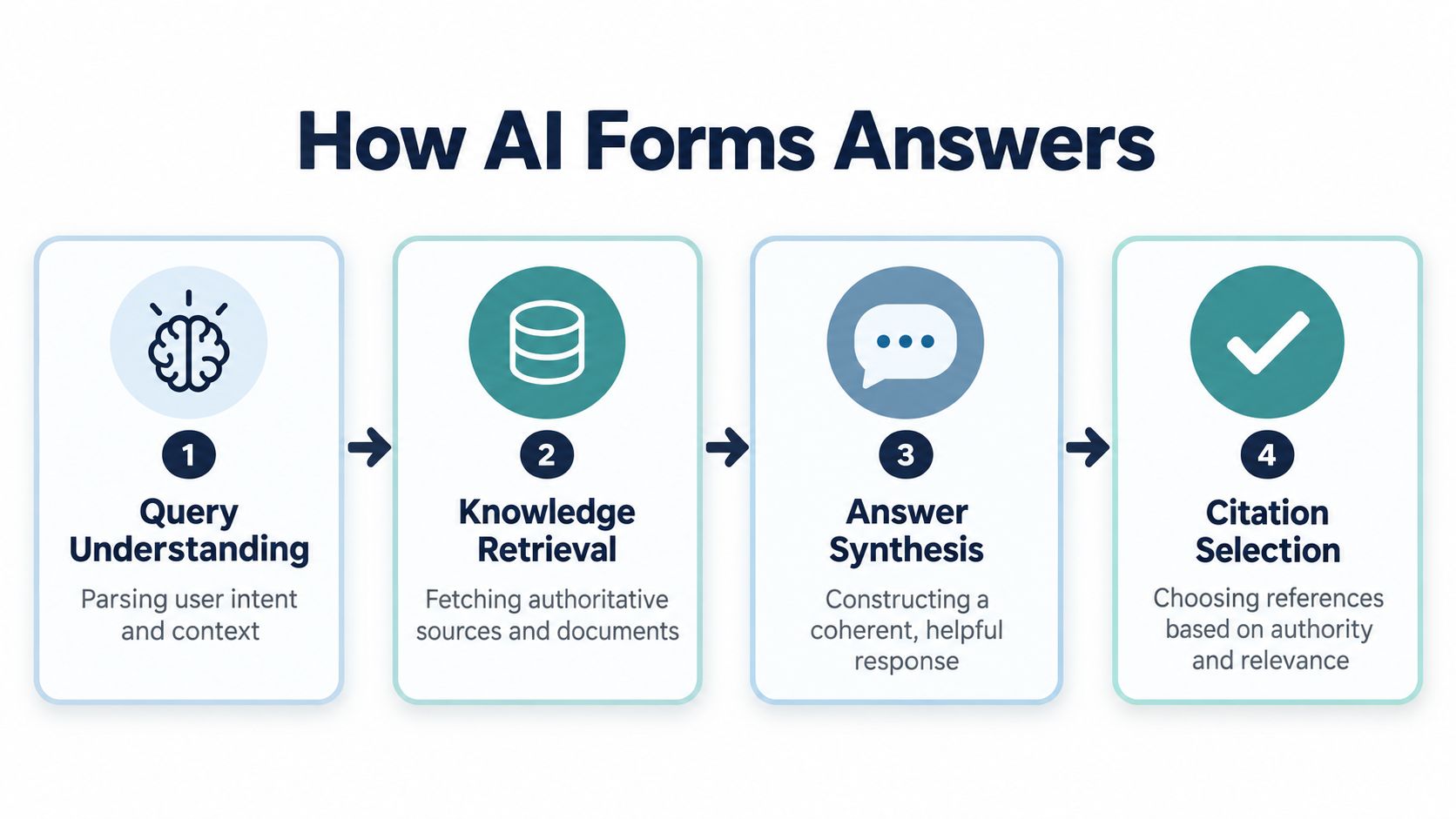
Selection happens before absorption
The current research separates citation selection from citation absorption. Selection is the point where a source enters the answer pipeline. Absorption is the point where its language, evidence, or structure shapes the generated reply (arXiv framework).
A page can clear the first gate and still fail the second. That happens when the passage is retrievable but too vague to support a specific claim. It also happens when the document lacks entity coherence, so the system cannot reliably connect the passage to the firm, practice, or issue it needs to answer. Being indexed is not the same as being used.
CitationOS describes this as the selection moment, the point where recommendation is decided, not just visibility.
What makes a passage eligible
Eligibility depends on answerability. Short, direct passages help. Descriptive headings help. Clean HTML helps. Canonical terminology helps. Explicit disambiguation helps. The chain is straightforward. If the relevant passage is not retrieved, it cannot be cited. If it is retrieved but does not contain clear claims, it is less likely to be grounded into the final answer.
Decision rule: write for a machine that has to defend its answer.
Structure is evidence here. A firm that wants influence over high-intent queries needs passages that are specific enough to be lifted into an answer and consistent enough to be trusted. Entity clarity becomes a technical requirement, not a branding preference.
The same logic explains why AI visibility work has to measure more than presence. A source can be visible, yet fail to cross the threshold into recommendation. The better question is whether the system trusts the firm enough to select and use it.
Why Most AI Visibility Tools Stop Before Selection
AI systems can surface a brand and still refuse to recommend it. That is the gap most visibility tools miss. They measure appearance, then stop before the selection moment, where the system decides which sources are credible enough to support an answer. CitationOS calls this the visibility fallacy. Being present is a starting point. Being chosen is the test.
Appearance is not authority
Recent survey work in the field points to machine scannability, earned media, engine-specific strategies, and language-aware tactics. It also points to persistent big brand bias that disadvantages niche players. That pattern is consistent with a broader body of research that is still mostly observational, snapshot-based, and uneven across commercial engines. The problem is not just what appears. It is how the engine decides what it can trust.
If a smaller firm is already well written but still missing, content volume may not be the issue. The gap may sit in representation and authority repair. Engines seem to favor clearer entities, stronger grounding, and more established signals of legitimacy. For high-trust firms, that means visibility tools can show exposure, but they do not show whether the recommendation layer is working.
The measurement gap is the point
The market has spent too much time counting mentions. It has spent too little time testing recommendation integrity.
A visibility dashboard can show that a firm appears in an answer. It usually cannot tell you whether the answer is accurate, whether the citation is correctly attributed, or whether the engine is favoring a competitor in the same category. That distinction matters because it changes the decision outcome, not just the reporting.
AI visibility answers one question. Recommendation intelligence answers the one that matters in the boardroom.
That is why AEO needs a different lens. The right question is not only whether a brand is cited. It is whether the system trusts it enough to select it when the answer has to hold up under scrutiny.
Measuring What Matters From Citation Presence to Top Three Rate
Citation presence is a starting point. It does not answer the harder question: whether an AI system trusts a firm enough to place it where decision-makers see it. CitationOS research across 116 firms points to that distinction. The selection moment matters more than raw mention counts, because that is where inclusion becomes recommendation.
A usable AEO framework has to measure the layers between being named and being chosen. In practice, that means tracking AI Visibility Index (AVI), citation presence, narrative depth, top-3 rate, entity authority, and AI recommendation authority. Each metric captures a different part of the selection process.
The metric stack tells different stories
Citation presence shows whether the firm appears at all.
Narrative depth shows whether the system gives a useful description or just a name.
Top-3 rate shows whether the firm appears near the top of the answer set, where shortlist effects are strongest.
Entity authority shows whether the system consistently understands the firm as the same entity across the sources it reads.
AI recommendation authority shows how often the system treats the firm as a credible option in context.
A Citation Score-style framework makes those layers visible in one diagnostic view. A score that only counts mentions can hide weak representation. A score that only checks rank can miss authority problems. A score that separates inclusion, narrative strength, entity strength, and relative positioning gives leaders a clearer read on recommendation quality.
Cross-system evaluation exposes the gaps
One assistant can surface a firm while another overlooks it or describes it differently. That variation matters. It shows whether the firm is consistently represented or only intermittently visible.
| Diagnostic layer | What it reveals |
|---|---|
| Citation presence | Whether the firm enters the answer at all |
| Narrative depth | Whether the description is thin or decision-relevant |
| Entity authority | Whether the system can confidently identify the firm |
| Top-3 rate | Whether the firm reaches high-value answer positions |
| Recommendation authority | Whether the system appears to favor the firm in context |
For firms in competitive legal markets, this structure separates noise from signal. A name in an answer can look reassuring. A high top-3 rate across important query sets is more meaningful. The executive question is not whether AI can mention the firm. It is whether it keeps choosing it when the query implies a shortlist.
A Practical Roadmap to Improve AI Representation and Inclusion
CitationOS research across 116 firms shows a clear pattern, AI does not just read for mention, it evaluates whether a firm is coherent enough to recommend. That shifts the task from content formatting to recommendation intelligence. The question is whether the system can trust the firm enough to include it in the selection moment.
Start with the entity, not the page. If a firm's name, practice labels, attorney bios, awards, and market descriptions do not line up across the sources AI systems read, the engine has to reconcile conflicting signals. That raises interpretive ambiguity. The fix is tighter entity consistency across the firm's own site, bios, and directory-style references.
Audit the structure before you edit the copy
The first pass should ask three questions.
Is the firm described the same way everywhere? If the practice mix changes from page to page, the system gets mixed signals.
Are the decisive claims explicit? Answer engines work better with passages that state what the firm does, who it serves, and where it is differentiated.
Can the passage be lifted cleanly? If the answer requires a long inferential chain, it is less likely to be absorbed.
Authority gap identification comes next. Compare how the firm is represented in the practice areas and decision contexts that matter most. A firm can look strong in one category and weak in another. If AI associates it with the wrong matter type or a thinner service line, the shortlist can shift without warning from traditional analytics.
Use a dashboard approach
A Citation Dashboard is useful only if it tracks change over time, not just snapshots. The point is to monitor how inclusion, narrative strength, and relative positioning move after entity repairs, structure changes, and content updates. That creates a baseline for governance, not just marketing.
Operational focus: fix ambiguity first, then expand coverage.
A practical sequence looks like this.
- Inventory names and attributes. Check how the firm is described on owned pages and in the places it relies on for reputation signals.
- Map decision queries. Identify the questions prospects ask when they are close to choosing counsel or a service provider.
- Rewrite for directness. Use short, extractable passages with clear practice and authority statements.
- Re-test across systems. Compare whether the firm is cited, how it is framed, and whether the narrative is consistent.
That is a structural program, not a content campaign. It reduces ambiguity, strengthens grounding, and gives leadership a read on whether the firm is becoming easier for AI to recommend.
What Strong Answer Engine Optimization Changes for High Trust Firms
For high-trust firms, answer engine optimization changes the discovery risk profile. A firm can be visible and still be misrepresented, reduced to a thin description, or framed against its own interests. In legal, financial, medical, and luxury categories, the selection layer is a trust filter. AI systems are increasingly acting as that filter, and the recommendation that emerges can shape who gets considered before a human visits the website.
That makes citation integrity and entity coherence operational issues, not marketing details. If a firm's identity is inconsistent, the system has to infer. If the answer is incomplete or wrong, the user may never know the firm existed. The executive question is not whether the firm appears. It is whether the firm is understood correctly at the moment the shortlist forms.
A confidential cross-system audit gives leadership a baseline. It shows whether the firm is discoverable, whether its narrative is strong enough to be absorbed, and whether AI recommendation authority is building or stalling. Analysts at CitationOS use that kind of review to measure how AI systems represent, cite, and recommend professional services brands across the selection layer. For firms that depend on trust, the goal is not more mentions. It is accurate inclusion at the decision point.
CitationOS measures how AI systems represent, cite, and recommend law firms and other professional services brands across the selection layer. If you need a confidential read on AI visibility, citation presence, narrative depth, and entity authority, visit CitationOS and request a baseline audit.