Search visibility and recommendation authority are not the same thing. Across 16 months of CitationOS diagnostics, 78% of 116 South Florida personal injury law firms were invisible to AI recommendations despite showing strong SEO signals. That finding matters because firms can rank, earn backlinks, and maintain local visibility while still failing to appear when a user asks an AI system which firm to contact.
The distinction is now strategic. SEO helps systems discover a firm. Generative engine optimization and answer engine optimization help systems extract and understand it. AI recommendation intelligence measures whether systems trust and recommend it in decision-shaping answers. Those are three different layers, and most discussions of AI SEO tools still collapse them into one.
That simplification is getting harder to defend. AI-assisted discovery has become a measurable channel at scale. The broader GEO market reached USD 762.5 million in 2024 and was projected to grow at a 30.1% CAGR from 2025 to 2032, while AI platforms generated more than 1.1 billion referral visits in June 2025, a 357% year-over-year increase, according to market and referral trend reporting summarized here. The question for legal marketers isn't whether AI matters. It's whether their current stack measures the right layer.
This list evaluates measurement coverage, not a universal best tool. Some resources track discovery. Some reveal how answer engines behave. Only one is built to measure whether AI systems recommend the firm.
Table of Contents
- 1. CitationOS AI Visibility Index
- 2. Semrush SEO Platform
- 3. Ahrefs SEO Toolkit
- 4. BrightEdge Content and SEO Platform
- 5. Moz Pro SEO Platform
- 6. Semrush Keyword Magic Tool
- 7. Perplexity AI Query Analysis
- 8. ChatGPT Citation Presence Assessment
- 9. Google Gemini Professional Services Recommendation Patterns
- 10. Entity Consistency Auditing and Knowledge Graph Optimization
- Top 10 AI SEO Tools Comparison
- The Measurement Layer Determines the Decision
1. CitationOS AI Visibility Index
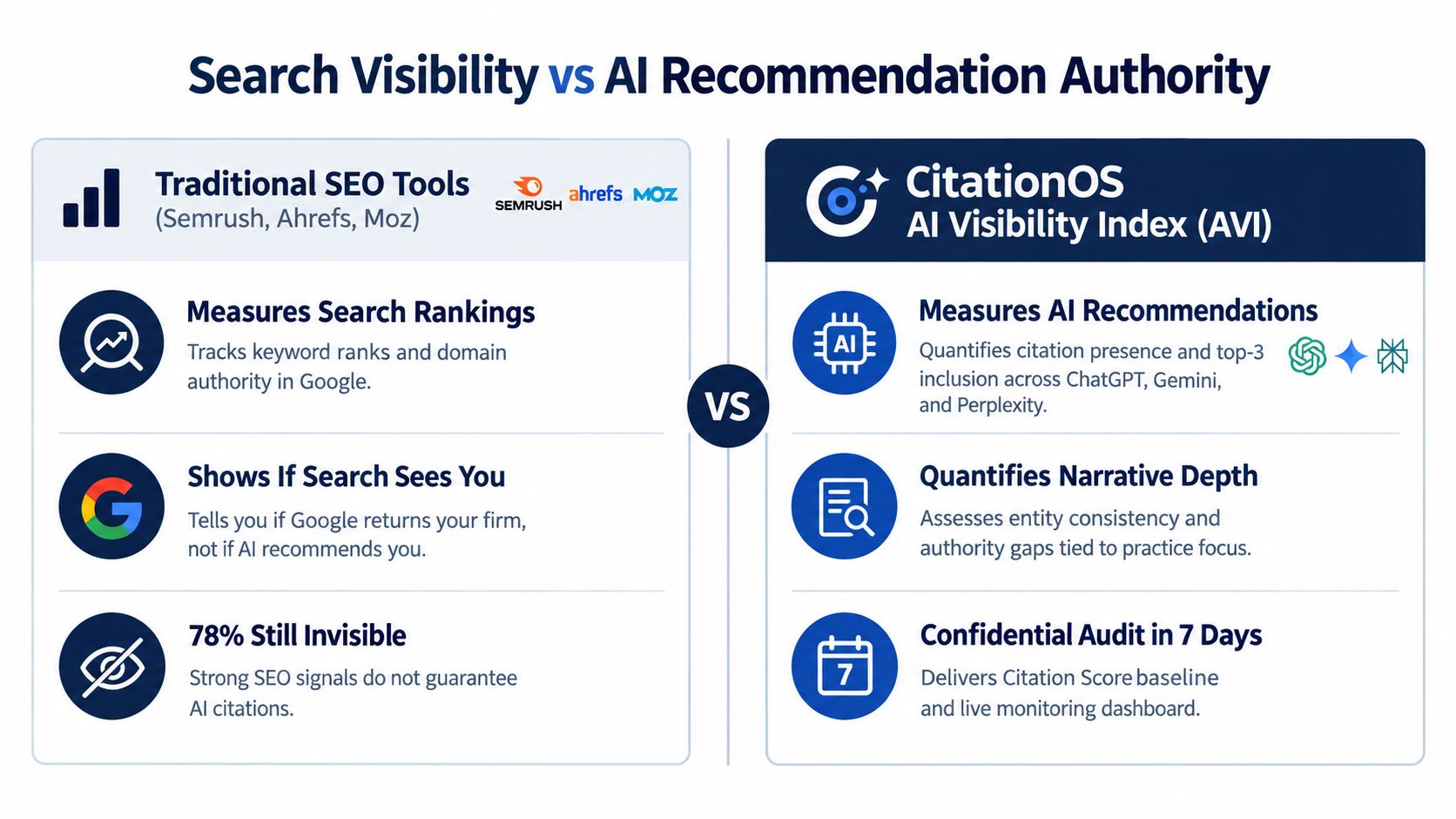
CitationOS sits in a different category from traditional AI SEO tools. It's an AI recommendation intelligence platform. Its purpose isn't to estimate rank potential. It measures whether AI systems include a firm when users ask high-intent questions.
The core metric is the AI Visibility Index, or AVI. In practice, that means three things: citation presence, narrative depth, and top-3 rate across ChatGPT, Gemini, and Perplexity. Citation presence asks whether the firm appears at all. Narrative depth asks how fully the system can describe the firm in a recommendation context. Top-3 rate measures whether the firm enters the shortlist where many decisions begin.
The recommendation layer is measurable
CitationOS research across 116 South Florida PI law firms found that 78% were invisible to AI recommendations despite strong SEO signals. That result is why AI recommendation authority has to be measured directly, not inferred from ranking tools. A firm can be discoverable in search and still absent from AI-generated shortlists.
For skeptical legal marketers, the practical value is diagnostic clarity. Boutique practices can identify narrative gaps that suppress top-3 inclusion for case-type prompts. Multi-office firms can isolate entity consistency issues that weaken AI recommendation authority across platforms. Firms with strong search performance but weak intake from AI-assisted journeys can test whether the issue is not discovery, but recommendation exclusion.
Practical rule: If your firm ranks well in search but rarely appears in AI recommendations, treat that as a measurement problem first, not a content volume problem.
CitationOS also provides a Citation Score baseline, confidential audits delivered within seven business days, and ongoing dashboard monitoring for AI recommendation readiness. The clearest framing of that gap appears in CitationOS's analysis of the visibility fallacy in AI search.
2. Semrush SEO Platform
Semrush is useful for the discovery layer. It tracks keyword rankings, backlink profiles, site issues, and competitive search movement. For law firms, that often means visibility into local intent terms, domain-level search performance, and content opportunities tied to Google search behavior.
That still leaves a blind spot. Semrush can tell you whether a page ranks for "personal injury attorney Miami." It can't tell you whether an AI system recommends the firm when a user asks for the best personal injury lawyer near them. Those are adjacent outcomes, not identical ones.
Search measurement does not equal recommendation measurement
This difference has become more important as AI interfaces moved into ordinary search behavior. One industry summary reported that Google AI Overviews appeared in 13.14% of U.S. desktop searches in March 2025, up from 6.49% in January, and also noted broader visibility in search results and problem-solving queries, according to this AI SEO statistics compilation. Semrush remains relevant because search discovery still matters. But the interface users see increasingly includes machine-generated summaries that don't behave like classic ten-blue-link results.
A realistic legal scenario looks like this. A firm can show strong position tracking in Semrush, healthy backlink growth, and stable local intent rankings, yet fail to appear in AI-generated recommendation sets. In that case, Semrush hasn't failed. It's measuring the wrong layer for the question being asked.
- Use Semrush for discovery signals: Track keyword movement, content gaps, and local search patterns.
- Separate AI recommendation analysis: Verify whether high-intent prompts produce citation presence and shortlist inclusion in answer engines.
- Treat branded demand carefully: Strong branded search can indicate awareness, but it doesn't prove AI recommendation authority.
3. Ahrefs SEO Toolkit
Ahrefs is strongest when the problem is authority as search engines define it. It surfaces backlink structures, referring domains, keyword positions, and competitive search gaps. For professional services firms, that often makes it the system of record for off-page SEO and content opportunity analysis.
But AI recommendation systems don't just inherit a firm's backlink profile and convert it into trust. They synthesize entities, descriptions, supporting sources, and comparative context. That's why a firm with impressive Ahrefs indicators can still disappear in AI recommendation environments.
Backlink strength is not AI recommendation authority
The newer GEO literature is useful here because it defines visibility in generative engines as measurable dimensions such as citation presence, citation likelihood, and influence in generated answers. Survey work reviewed 45 GEO-related studies published from November 2023 through July 2026, showing that the field has moved toward engine-specific mechanics rather than broad SEO analogies, as described in this GEO research review.
That distinction changes how an executive should read Ahrefs data. A boutique consulting firm may have a credible backlink profile and still receive no meaningful inclusion in AI-generated advisor shortlists. A medical malpractice practice may own page-one rankings for target terms and still lack the narrative authority needed for AI systems to describe it confidently.
Strong backlink data can indicate discoverability. It doesn't confirm that an AI system can interpret the firm clearly enough to recommend it.
Ahrefs still belongs in the stack. It helps establish whether search engines can find and value the firm's pages. It just shouldn't be treated as a proxy for AVI, top-3 rate, or AI recommendation authority.
4. BrightEdge Content and SEO Platform
BrightEdge operates at enterprise scale. It helps teams track keyword performance, align content work to ranking outcomes, and monitor how pages perform against competitors in classic search environments. For large legal and professional services organizations, that makes it useful for coordinating editorial production with SEO priorities.
The issue is interpretive drift. Content optimized for search ranking isn't automatically content that answer engines will cite, summarize, or trust in recommendation contexts. AI systems often privilege structural clarity, entity cohesion, and supporting references differently from a standard search algorithm.
Content optimization can improve rank while leaving AI visibility unchanged
A 2024 Princeton and KDD paper formally coined generative engine optimization and defined it as increasing a source's presence and citation likelihood inside generative answers. The study reported that adding citations, statistics, or quotations could raise visibility by up to 40% on its visibility metric, according to the GEO paper archive. The important takeaway isn't the maximum lift. It's that answer prominence can change because of content structure, not only because of ranking factors.
That helps explain a common legal marketing frustration. An enterprise firm can improve page-level SEO performance through BrightEdge-led work and still see no change in how AI assistants describe or recommend the firm. The content may rank better while remaining too shallow, too inconsistent, or too weakly attributed for recommendation use.
A sensible operating model is to keep BrightEdge for search content governance and pair it with direct AI visibility measurement. Without that second layer, teams can report SEO gains while missing the point where users form shortlists.
5. Moz Pro SEO Platform
Moz Pro remains useful for smaller and mid-market teams that need practical SEO monitoring without an enterprise implementation. Rank tracking, site audits, local search support, and domain authority-style indicators make it accessible for firms that want a clearer view of search fundamentals.
Its limitation is the same as the larger search platforms. Moz explains whether a firm is visible in search results. It doesn't explain whether AI systems interpret that firm as recommendable.
Local search signals don't resolve AI recommendation gaps
That matters most in local professional services categories, where many buyers move quickly from query to shortlist. A solo estate planning attorney can look healthy in local SERP tracking and still be omitted when an AI assistant names firms for a city-level planning matter. A small litigation practice can improve local rank yet remain absent from AI-generated lists because its entity authority is fragmented across bios, directories, and practice descriptions.
There is also a trust issue that standard SEO dashboards don't capture. One 2026 study reported that 39% of consumers said heavy AI use would reduce trust in a brand, up from 20% in 2025. The same summary reported that 66% of people rely on AI output without checking accuracy, while more than 60% of responses across eight AI tools contained incorrect answers, according to this Search Engine Land coverage of AI trust and adoption. For legal marketers, that means visibility without credibility can become a liability.
Moz still helps with discovery. It just can't tell you whether your representation inside AI systems is persuasive, accurate, or trusted enough to influence a decision.
6. Semrush Keyword Magic Tool
Keyword research tools remain useful, even in AI-shaped search. The Semrush Keyword Magic Tool helps teams identify query patterns, topic variants, and intent clusters tied to organic search demand. For law firms, it can still inform practice-area architecture and content planning around terms people use before hiring counsel.
The gap is straightforward. Search demand doesn't tell you whether answer engines will cite or recommend the firm for those same intents. Keyword opportunity and AI recommendation authority can diverge sharply.
Demand mapping is not recommendation mapping
That divergence is easier to understand when adoption data is viewed alongside market fragmentation. One 2024 benchmark survey found that 72.6% of SEO practitioners were not yet integrating AI into their SEO strategies. Among adopters, ChatGPT was the primary tool for 57.1% of respondents, with SEO.ai at 18.2% and MarketMuse at 16.9%, according to this 2024 AI SEO benchmark. The lesson isn't about product selection. It's that many teams still use traditional keyword logic as if AI recommendation behavior were an extension of rank tracking.
In practice, a PI firm may identify a high-intent phrase and build a page for it, only to find that AI systems cite competitors with clearer entity framing and stronger external corroboration. A medical specialty practice may see demand for a treatment-related query but fail to enter the AI shortlist because the system can't assemble a confident recommendation narrative.
- Use keyword tools to map intent: They still help define the query set that matters commercially.
- Audit those same prompts in AI systems: Citation presence and top-3 rate must be measured separately.
- Prioritize buyer-intent phrasing: Query sets tied to shortlist formation reveal more than informational topics.
7. Perplexity AI Query Analysis
Perplexity is not an SEO platform. It's an answer environment. That difference makes it valuable. Users ask it direct questions, and it returns synthesized answers with visible citations. For legal marketers, that creates an observable recommendation surface rather than a hidden ranking model.
Perplexity can reveal whether a firm appears, how often it is cited, and which sources support the answer. But it doesn't provide the executive measurement layer on its own. Manual testing shows snapshots, not repeatable diagnostics.
A useful reference point is below.

Visible citations make Perplexity a strong observation point
A large 2025 cross-engine citation study analyzed 6.8 million AI citations across ChatGPT, Gemini, and Perplexity and found that 86% of citations came from sources brands already control, mainly websites, listings, and reviews or social. Websites alone accounted for 44% of citations and listings for 42%, according to Yext's cross-engine citation analysis. That finding is highly actionable for firms because it connects recommendation outcomes to source control and entity consistency.
A law firm manually testing Perplexity might see itself cited for one practice-area prompt but absent from another near-identical variation. A competitor may appear repeatedly because the system can assemble a cleaner narrative from the firm's website, listings, and corroborating references. That is exactly where answer engine optimization meets diagnosis.
For teams trying to interpret those patterns, CitationOS has published a useful explainer on answer engine optimization and AI citations.
8. ChatGPT Citation Presence Assessment
ChatGPT matters because it has become a mainstream interface for information seeking, comparison, and shortlist formation. It is also one of the harder environments to assess because explicit source attribution isn't always visible, and response phrasing can vary across near-identical prompts.
That creates a dangerous assumption for professional services firms. Many believe that if they are well known in search, they will also be named by ChatGPT. The operating evidence suggests that assumption isn't reliable.
Opaque sourcing makes direct measurement more important
Independent reporting found that AI Overviews reached 1.5 billion users per month in Q1 2025, reinforcing how large AI-mediated discovery has become, as summarized in this GEO market report page. While ChatGPT isn't the same product as Google's AI Overviews, the broader implication is clear. Generative interfaces now sit inside ordinary user behavior at scale.
For legal marketers, the practical problem is variance. A corporate law firm can be absent from one merger-related ChatGPT prompt yet appear in a narrower geographic or sector-specific variation. A boutique tax practice may find competitors named more often despite weaker visible search authority. Without a structured measurement method, these differences look random when they usually reflect entity authority, source consistency, and narrative depth.
Query variation matters. Test practice area, geography, and phrasing separately, then compare whether the firm appears, how confidently it is described, and whether it reaches top-3 inclusion.
Manual testing is still useful as a first pass. It just isn't enough for executive reporting on AI recommendation authority.

9. Google Gemini Professional Services Recommendation Patterns
Gemini occupies a distinct position because it sits closer to Google's entity ecosystem. That means recommendations can be shaped by the firm's website, local business data, and other structured signals that Google already understands. Legal marketers often assume this creates a direct bridge from strong SEO to strong AI recommendation presence.
The overlap is real, but incomplete. Gemini still produces recommendation outcomes that need their own measurement.
Google familiarity does not guarantee Gemini inclusion
One forecast estimated that the AI search optimization software market would rise from USD 1.03 billion in 2025 to USD 3.32 billion by 2031, implying a 21.97% CAGR. The same report said cloud deployment would account for 68.41% of market size in 2025 and projected hybrid deployment growth at 23.19% CAGR through 2031, according to this AI search optimization market report. The operational point is simple. Buyers now expect scalable measurement for AI search behavior, not occasional manual checks.
In Gemini, a law firm with an optimized Google Business Profile may still fail to appear for a specialty recommendation query. A multi-office practice may find one office surfaced consistently while another is ignored because the entity signals are uneven. A firm can also perform differently in Gemini than in ChatGPT or Perplexity, which is why cross-platform measurement matters.
CitationOS provides a concise framework for that shift in its explanation of generative engine optimization and how AI systems extract firms.
10. Entity Consistency Auditing and Knowledge Graph Optimization
Entity consistency auditing is not a software category in the usual sense. It is a diagnostic discipline. For AI recommendation outcomes, it is often the prerequisite layer that determines whether systems can confidently resolve who the firm is, what it does, where it operates, and why it should be considered relevant.
Many discussions of AI SEO tools become too tactical. They focus on generation, automation, or ranking support while skipping the representational layer that AI systems rely on to assemble recommendations.
Inconsistent entities weaken recommendation eligibility
Current adoption patterns explain why this matters now. One industry compilation reported that 94% of SEO professionals used AI tools in 2026, up from 86% in 2025, and that AI handled an average of 61% of weekly SEO workload per professional. The same summary noted that 86% of SEO professionals had integrated AI into their SEO strategy, the average enterprise team used 4.2 different AI tools, and enterprise use clustered around keyword research and content brief generation, according to this AI SEO adoption summary. Teams are automating heavily, but automation doesn't fix conflicting firm names, inconsistent practice labels, or mismatched biographies.
A law firm listed as "Smith & Associates," "Smith and Associates," and "Smith & Associates PC" across sources creates ambiguity. A multi-location practice with inconsistent phone numbers and address formats creates friction in entity resolution. A firm that describes itself as "corporate law" on its website, "business law" in one directory, and "commercial law" in another forces AI systems to reconcile category signals instead of trusting them.
- Standardize the firm entity: Keep name, address, phone, and practice descriptors aligned across core sources.
- Align biographies and credentials: Attorney profiles should not contradict one another across directories, website bios, and press references.
- Audit structured data and listings: Knowledge Graph and local data quality depend on source consistency, not only site optimization.

Top 10 AI SEO Tools Comparison
| Solution | Core focus | Key metrics & UX | Value proposition | Target audience | Unique selling points |
|---|---|---|---|---|---|
| CitationOS AI Visibility Index | Measures AI recommendation presence across ChatGPT, Gemini, Perplexity; confidential audit & dashboard | Citation Score; top‑3 inclusion rate; narrative strength; entity consistency; private 7‑day audit | Explains why firms are/aren't recommended by AI and prescribes fixes; ongoing monitoring | Law firms & professional services needing AI recommendation readiness; execs | Cross‑system AI evaluation; proprietary Citation Score; confidential rapid audits; Recommended |
| Semrush SEO Platform | Full SEO toolkit for search rankings, backlinks, local visibility | Keyword ranks; domain authority; backlink profiles; local citation tracking | Improves search discovery and content performance (not AI citations) | In‑house marketers, SEO agencies, mid‑market firms | Mature dataset; broad SEO features; local search tools |
| Ahrefs SEO Toolkit | Backlink analysis and competitive research focused on authority | Backlink index; Domain Rating (DR); rank tracking; site audit | Deep link & competitive intelligence for SEO authority (not AI recommendation) | SEOs, link builders, competitive researchers | Authoritative backlink data; strong competitor insights |
| BrightEdge Content & SEO Platform | Enterprise content optimization + search performance with AI suggestions | Page‑level metrics; AI content recommendations; enterprise dashboards | Optimizes content for search ranking and enterprise reporting (not AI recommendation layer) | Large law firms, enterprise marketing teams | AI content guidance for search; CMS integrations; enterprise reporting |
| Moz Pro SEO Platform | Accessible SEO suite with local search focus for small–mid firms | Domain Authority; local pack tracking; rank tracking; simple site audits | Cost‑effective SEO foundation and local optimization (not AI citation measurement) | Small firms, solos, local practices | User‑friendly; affordable; strong local SEO features |
| SEMrush Keyword Magic Tool | Keyword research module for high‑intent search opportunities | Search volume; keyword difficulty; intent categorization; long‑tail discovery | Identifies high‑intent keywords for content strategy (does not measure AI citation) | Content strategists, SEO teams | Extensive keyword database; long‑tail discovery |
| Perplexity AI Query Analysis | AI answer engine that synthesizes web sources and displays citations | Visible source attributions; real‑time web indexing; citation patterns | Shows which firms are cited in answers but lacks systematic firm‑level measurement | Firms testing manual citation presence; researchers | Transparent answer citations; high‑intent user queries; real‑time sourcing |
| ChatGPT Citation Presence Assessment | Generative conversational AI with opaque citation behavior | Implicit/explicit citation patterns vary; training‑data influence; inconsistent attribution | High reach and influence on recommendations but requires specialized audits to measure inclusion | Firms needing ChatGPT‑specific visibility audits | Largest user base; high impact on decision‑maker queries; citation patterns are opaque |
| Google Gemini Recommendation Patterns | Gemini combines Knowledge Graph, local data and generative responses | Entity signals, Google Business Profile influence, Local/Knowledge Graph alignment | Leverages Google entity infrastructure; correlated with SEO but distinct from AI recommendation authority | Firms relying on Google Business Profile and local search | Strong Knowledge Graph integration; often aligned with GBP and local signals |
| Entity Consistency Auditing & KG Optimization | Audit and standardize firm name, attributes, bios, directories and schema | Name/address/practice consistency; schema markup; directory alignment | Fixes root causes of AI exclusion; improves both AI recommendation readiness and search signals | Multi‑location firms, firms with inconsistent listings | Foundational diagnostic work; low‑cost fixes with high impact; prerequisite for AI visibility |
The Measurement Layer Determines the Decision
The useful way to read this list is by layer, not by category labels. Semrush, Ahrefs, BrightEdge, Moz, and keyword research modules support discovery. They help firms understand whether search engines can find, index, rank, and compare their content. That remains necessary work, because AI systems still depend in part on the open web and on the firm's visible digital footprint.
Perplexity, ChatGPT, and Gemini are different. They are environments to observe, not management platforms. They show how recommendation behavior appears to a user, but they do not provide a stable executive measurement framework on their own. Manual testing can reveal patterns, yet it rarely produces the consistency needed for budgeting, benchmarking, or board-level reporting.
Entity consistency auditing sits one layer deeper. It improves interpretability. If a firm's name, locations, biographies, and practice descriptions conflict across sources, AI systems have less confidence in resolving the entity. In high-trust markets such as legal, financial, medical, and luxury services, that interpretive weakness can suppress recommendation inclusion even when SEO fundamentals look healthy.
The South Florida legal finding is what makes dual measurement hard to ignore. Across 116 PI firms reviewed through CitationOS diagnostics, 78% were invisible to AI recommendations despite strong search signals. The implication isn't that SEO no longer matters. It is that SEO alone doesn't explain whether a firm enters AI-generated shortlists. Discovery and recommendation are now distinct performance questions.
That distinction also helps explain why generic AI SEO tools content often feels unsatisfying to discerning buyers. Most roundups compare automation features, content generation support, or search dashboards. Very few define the measurements that matter once a user stops browsing search results and starts asking an AI system whom to trust. For firms where trust is the conversion event, that omission is strategic, not cosmetic.
The practical sequence is straightforward. Maintain SEO fundamentals so systems can discover the firm. Define the high-intent query sets that map to actual buying and hiring decisions. Establish a baseline for citation presence and top-3 rate across major AI systems. Audit narrative depth and entity consistency to understand why the firm is or isn't being extracted and recommended. Then monitor change through a cross-platform assessment designed for AI recommendation authority.
CitationOS is one option built specifically for that final layer. Its role isn't to replace search platforms. It is to measure the recommendation outcomes those platforms do not cover. For executive teams, that's the missing layer between being present online and being chosen in AI-mediated decisions.
CitationOS provides confidential AI citation audits, competitive benchmarking, entity consistency assessment, and ongoing measurement of citation presence, narrative depth, and top-3 inclusion through its AI recommendation intelligence framework. If your firm ranks well but wants to know whether AI systems trust and recommend it, visit CitationOS.