AI answer engines are already part of mainstream search behavior. In 2025, 34% of respondents said they used generative AI weekly, and 54% said they had seen an AI-generated answer in response to a search query in the last week. For professional service firms, the question is no longer whether people can find you, it's whether the system selects you inside the answer layer.
The Selection Moment in AI Answer Engines
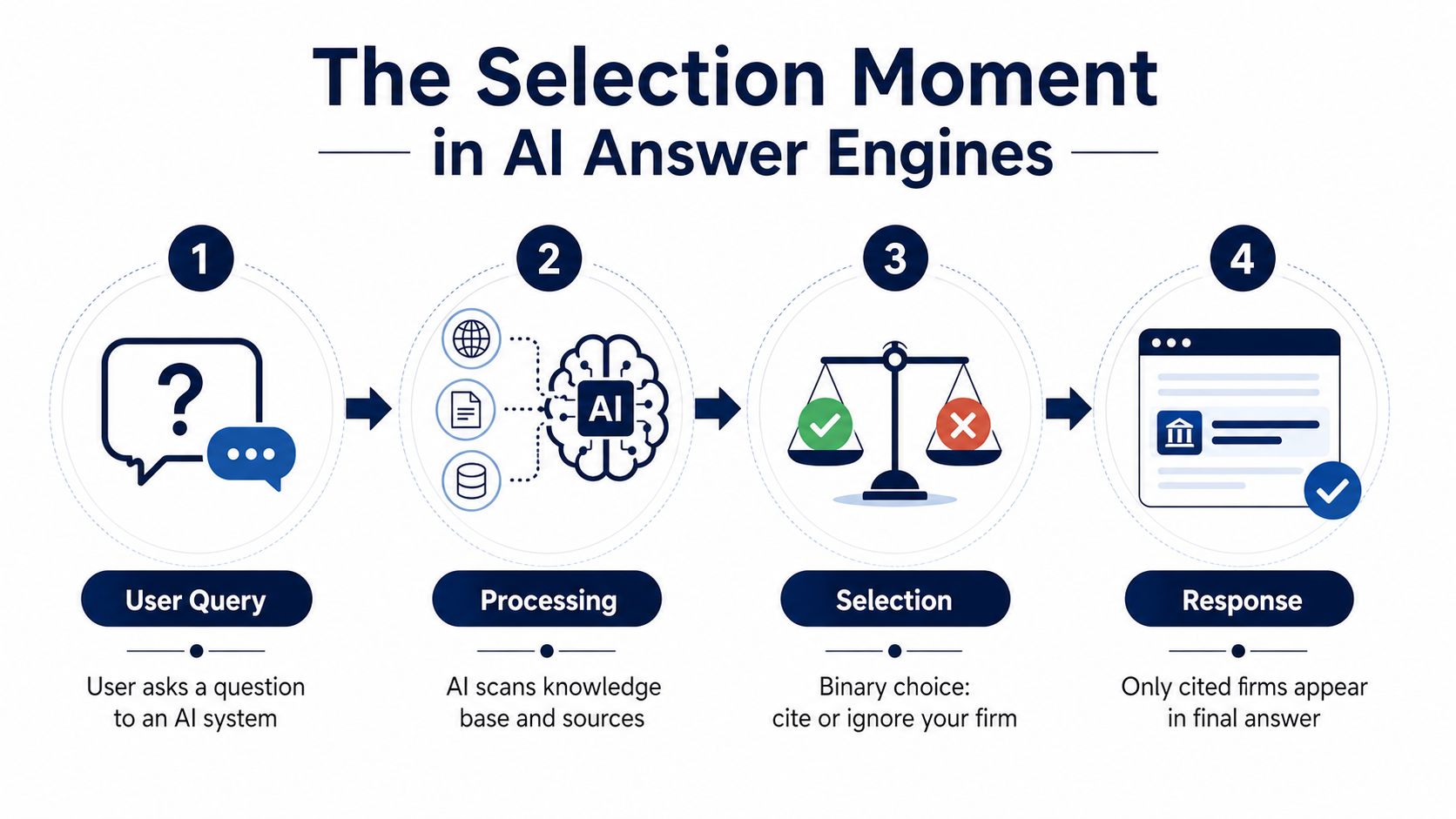
The selection moment is the point where an AI answer engine decides whether to name your firm at all. That matters more than raw visibility, because a firm can be indexed, mentioned, or even well known and still fail to enter the generated shortlist that a buyer reads. The Reuters Institute's 2025 data shows why this matters now, not later, with 34% weekly generative AI use and 54% seeing AI answers in search in the last week (Reuters Institute, 2025).
The practical distinction is simple. SEO helps systems discover you. GEO helps systems extract and understand you. AI recommendation intelligence measures whether the system trusts you enough to recommend you. Those are different outcomes, and high-trust firms often confuse them.
Why absence is more serious than low ranking
A firm that doesn't appear in the answer layer isn't “ranked below” another firm in the normal sense. It's outside the system's coherent recommendation. That's a structural problem, not a tactical one. Traditional traffic metrics can miss it because they measure visits, not selection.
Practical rule: if an AI system doesn't name your firm in a high-intent query, your market can't assume it has evaluated you fairly.
That's why the first diagnostic question is binary. Do you appear in the answer at all? If not, the issue isn't conversion rate optimization or headline tuning. It's recommendation absence.
For high-intent services, that distinction changes the whole brief. A firm can invest in content, backlinks, and technical cleanup, but if the answer engine doesn't retrieve and synthesize the right evidence, the shortlist goes to someone else. That is why answer-engine strategy starts with selection, not traffic.
How AI Answer Engines Generate Shortlists
AI answer engines don't write from memory alone. They use retrieval-augmented generation, which means they rewrite the user query, retrieve candidate passages from an index or live web search, rank those passages, and then synthesize an answer from the selected evidence (FastLook). Only content that can be retrieved and scored can enter the final response.
Retrieval comes before reputation
That architecture creates three separate layers. Retrieval decides whether your content is found. Ranking decides whether it's seen as relevant and trustworthy. Synthesis decides whether it's named in the final answer. A firm can win one layer and still lose the others.
This is why page authority alone doesn't guarantee inclusion. If the system can't retrieve the right passage, the rest of the pipeline never gets a chance to evaluate it. If it retrieves the passage but scores it as weak, the system can still leave you out. If it retrieves and ranks you well, but the synthesis step prefers a cleaner competitor narrative, you still don't appear.
Audit each layer separately
That separation matters operationally. Marketing teams often treat “AI visibility” as a single metric, but the pipeline is staged. A good audit asks different questions at each stage.
- Retrieval: can the engine find a passage that clearly identifies the firm, practice, and context?
- Ranking: does that passage look relevant, current, and trustworthy enough to surface?
- Synthesis: does the final answer name the firm, or only describe the category?
Only retrievable content can be cited, so the real unit of visibility is the passage, not the page.
That point changes how teams build content. Long articles with buried claims can be useful to humans and still weak for extraction. Clean sections with explicit entities, dates, and definitions are easier for answer engines to reuse.
For firms that care about recommendation inclusion, the diagnostic move is to separate those layers before changing content. Otherwise, teams end up fixing the wrong problem and calling it optimization.
Why Different AI Systems Select Different Firms
Different AI systems do not behave like a single market. They reward different source patterns, and that's why the same query can produce different firm shortlists across systems. A 2025 Yext study reports that Gemini leans on what a brand says about itself, ChatGPT leans on broad internet consensus, and Perplexity leans on industry experts and customer reviews.
One playbook doesn't fit all three
That difference matters because firms often overinvest in one evidence type. A practice with disciplined self-authored content can look coherent to one system and weak to another. A firm with stronger third-party validation can do the opposite. The issue isn't just citation count, it's source mix.
The same reporting also notes that AI search exposure expanded from 7 to 229 countries from 2024 to 2025, though some countries are still excluded. That tells you the market isn't just fragmented by platform, it's fragmented by geography too.
Cross-system consistency is the real requirement
For executives, the implication is straightforward. A firm doesn't need to “win AI” in a general sense. It needs stable citation presence across the systems its buyers use. If one assistant sees you clearly and another doesn't, the market doesn't experience your visibility as consistency, it experiences it as uncertainty.
That's especially important in professional services, where buyers compare firms through cumulative signals. When one system leans on your owned narrative and another leans on outside consensus, your entity authority can look inconsistent even if your website is strong.
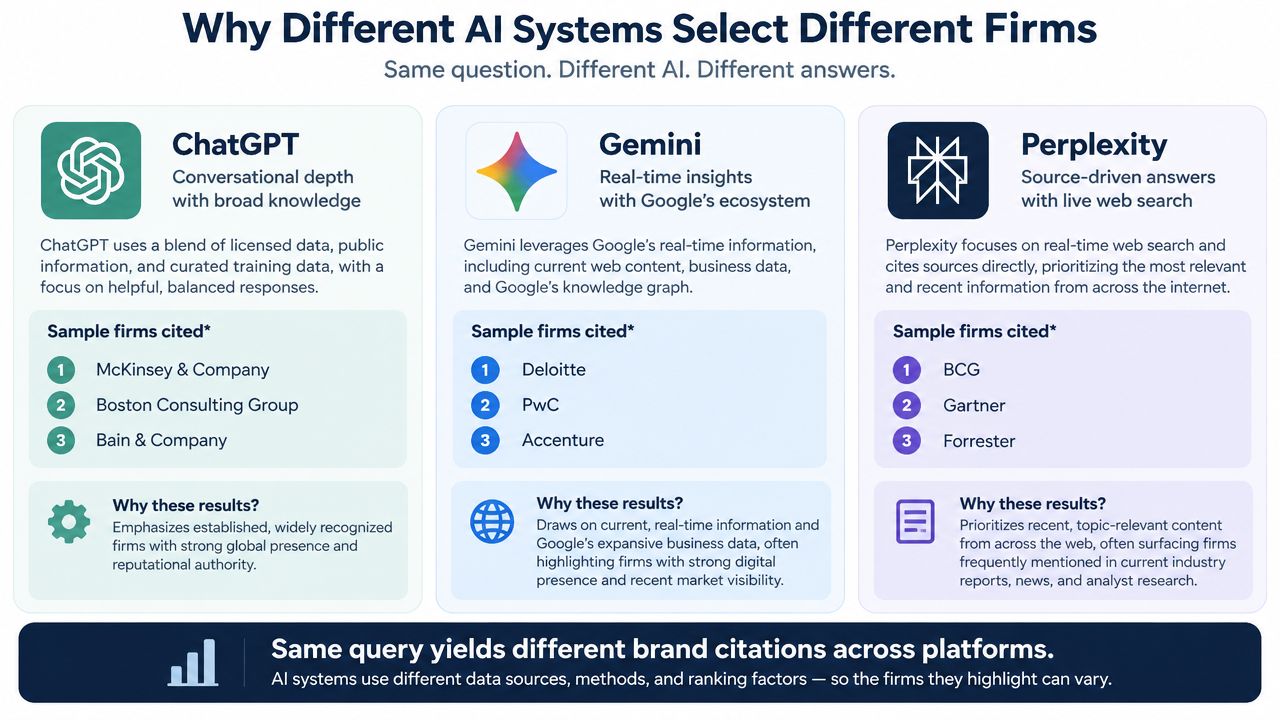
The practical answer is to measure each system separately, then compare the gaps. A single optimization playbook is too blunt for a market where citation rules differ by platform.
The Narrow Lane of Legal AI Recommendations
In legal queries, the recommendation layer is narrow enough to matter strategically. A peer-reviewed-style benchmark reports that AI models name a specific law firm or attorney in only 5 to 7.5% of legal answers, with just 0.2 to 0.3 specific providers named per answer on average (Authority Specialist). In plain terms, specific providers are named in fewer than one in twelve responses.
Visibility, extraction, and recommendation are not the same
That finding separates three outcomes that teams often blur together. A firm can be visible on its own site, extracted into a passage, and still not be recommended in the answer. The last step is the one that matters most when a buyer is making a shortlist.
The legal citation layer also concentrates around a small directory set, including Chambers, Legal 500, Super Lawyers, Best Lawyers, Martindale, Avvo, and Justia. That concentration shows how entity authority clusters around a narrow evidence base in high-trust services.
Entity authority beats broad content volume
For managing partners, the implication is uncomfortable but useful. Publishing more content does not automatically increase recommendation odds. If the system sees stronger third-party signals elsewhere, your own site may still lose the shortlist.
This is why legal and other high-trust firms need to think in terms of entity authority rather than page count. The AI answer engine is looking for a coherent entity with consistent signals across sources, not a large archive of disconnected content.
A firm that appears frequently on its own domain can still be absent from AI recommendations if the external evidence set is thin or inconsistent.
That's the core lesson from the legal benchmark. Recommendation is not a byproduct of being online. It's a separate layer with its own source geometry, and in legal search that geometry is narrow.
Measuring AI Recommendation Authority
AI recommendation authority is not a single score. It's a set of measurable properties that together show whether a system is likely to name your firm. CitationOS uses diagnostics built around citation presence, narrative depth, entity consistency, and top-3 rate, plus a broader AI Visibility Index (AVI) and proprietary Citation Score framework. Those terms matter because they separate appearance from quality of appearance.
Four signals tell you more than one metric
Citation presence asks whether the firm is named at all. Narrative depth asks how much meaningful detail the system gives you. Entity consistency checks whether the firm's name, attributes, and practice signals stay coherent across sources. Top-3 rate tracks how often the firm appears in the highest-confidence positions of generated answers.
Those four signals are different failure modes. A firm may appear but be described generically. It may be described well in one system and inconsistently in another. It may enter the answer but not the shortlist positions that users notice. One score can't expose all of that.
Structured diagnostics create better decisions
A practical benchmark should therefore answer three questions. Does the firm appear? Does the system understand the firm correctly? Does the system place the firm near the top of the answer?
Measurement rule: if a metric doesn't distinguish between appearance and recommendation, it's too coarse for executive decision-making.
CitationOS's framework also matters because it treats AI visibility as a representation problem, not a traffic problem. That difference is important for legal, financial, medical, and luxury brands, where trust is built through evidence quality and consistency, not click volume.
For firms looking for a structured audit process, a confidential AI search review can be paired with CitationOS's AI search audit to map where the selection layer breaks. The goal isn't more content for its own sake. It's a clearer diagnosis of why a firm is, or isn't, being recommended.
What Professional Service Firms Should Do Next
The next move isn't a broad SEO refresh. It's a confidential AI citation audit across ChatGPT, Gemini, and Perplexity, then a correction plan built around entity consistency and citation presence. CitationOS reports that 116 firms were scored in its diagnostics and 78% were invisible to AI recommendations, which is a reminder that unmeasured absence is often the default state.
Three tiers of action make the work manageable
Tier 1, diagnostic: establish whether the firm appears, how it's described, and where it disappears across systems.
Tier 2, structural correction: fix source coherence, directory consistency, and entity signals across third-party references.
Tier 3, ongoing measurement: monitor AVI, top-3 rate, and competitive position over time.
That sequence matters because firms usually move too quickly to content changes. If the underlying entity signals are inconsistent, more publishing just adds noise. If the selection layer is already weak, the team needs structural correction before it needs volume.
The GEO-16 audit framework in current research adds another useful threshold. A score of at least 0.70 and at least 12 pillar hits aligned with substantially higher citation rates in one preprint study (arXiv, 2025). That doesn't replace judgment, but it gives executives a concrete diagnostic reference.
Treat absence as a business risk
For firms in high-intent markets, being structurally absent from AI recommendations is not a future issue. It's a present competitive risk that grows every month it goes unmeasured. The market is already using AI summaries, and buyers are already stopping their evaluation there.
If your firm needs a direct read on whether AI systems are naming you, describing you accurately, and placing you where buyers can see you, CitationOS measures that selection layer with private diagnostics and competitive benchmarking. Visit CitationOS to review the platform and evaluate whether your firm is being recommended when the answer engine makes its choice.