Only 74.5% of the scholarly references examined in a 2024 study of generated citations could be confirmed to exist in published literature, according to the Journal of Medical Internet Research. That finding concerns a specific citation-generation task, not law-firm recommendations. But it establishes the central verification problem: a reference can look credible without being valid.
For professional firms, the question goes further. An AI citation checker must distinguish whether a firm appears, whether the attached source is authentic, and whether that source supports the assistant's description. Counting links answers none of those questions reliably on its own.
What an AI Citation Checker Measures and Why Firms Need It
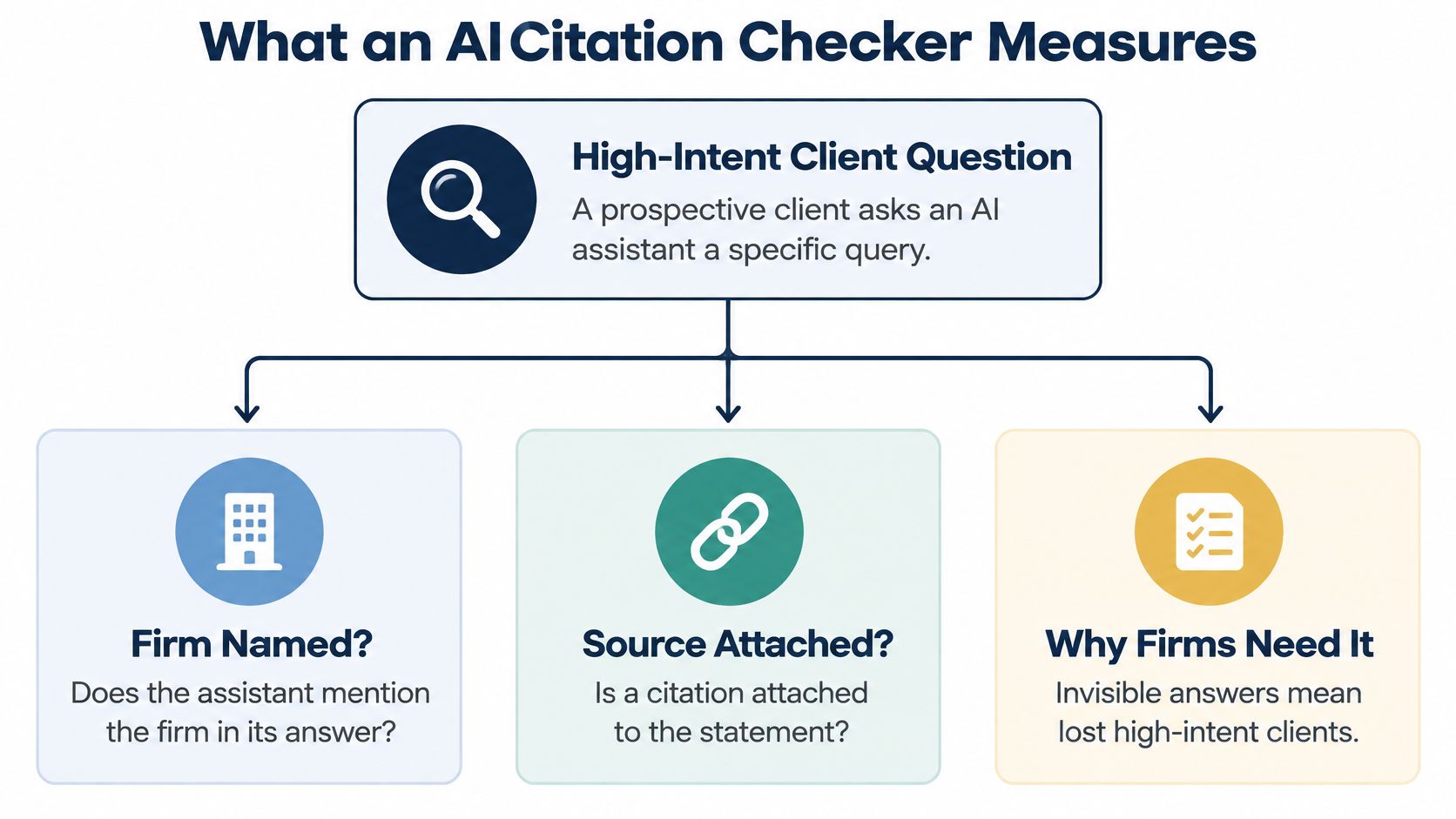
An AI citation checker tests whether an assistant names a firm when a prospective client asks a high-intent question, whether it attaches a source to its statements, and whether its description is accurate. In a professional-services audit, this combines source verification with measurement of selection and representation.
A mention is any appearance of the firm's name. A citation is a source attached to a claim. A recommendation places the firm on a prospective client's shortlist, rather than merely identifying it in background information or a comparison.
Three layers answer different business questions
SEO helps systems discover a firm. Generative engine optimization (GEO) and answer engine optimization (AEO) help systems extract and understand its information. AI recommendation intelligence measures whether assistants select and recommend it, using observable answers rather than assuming access to a model's internal judgment.
Three layers of AI visibility work
| Layer | Question it answers | What it measures | Output |
|---|---|---|---|
| SEO | Can systems find the firm? | Crawlability, indexing and search rankings | Position in search results |
| GEO and AEO | Can systems extract and understand the firm? | Structure, answer compatibility and extractable claims | Extraction readiness of firm content |
| AI recommendation intelligence | Does AI trust and recommend the firm? | Citation presence, top-3 rate and narrative depth | AI Visibility Index and Citation Score |
CitationOS is an AI Recommendation Intelligence platform, not an SEO agency, GEO agency, or digital marketing company. Its category concerns the selection layer: whether a firm reaches the answer and how the assistant represents its suitability.
For teams separating technical accessibility from recommendation outcomes, Agentable's resource on agent-readiness scoring and fixes provides a complementary starting point. Readiness and observed recommendation are distinct questions.
Internal adoption doesn't establish external authority
The American Bar Association's 2025 Legal Industry Report surveyed more than 2,800 legal professionals and found that 31% personally used generative AI at work. Professional exposure, however, doesn't establish how accurately an external assistant describes a firm.
A buyer sees the answer, not the firm's internal technology policy. AI recommendation authority therefore needs evidence from client-style queries, accurate descriptions, and supported shortlist inclusion. The decisive test is whether the cited material justifies what the assistant says.
How a Checker Tests Each Citation Against Its Claim
A functioning URL proves that a page is accessible. It doesn't prove that the assistant identified the right firm, interpreted the page correctly, or preserved the source's limitations.
The Tow Center tested 1,600 citation-based queries across eight AI search systems and found incorrect information in more than 60% of tests, according to Nieman Lab's account of the study. That result describes the tested task, not an error rate for legal recommendations, but it demonstrates why citation existence isn't enough.
Verification follows a reproducible sequence
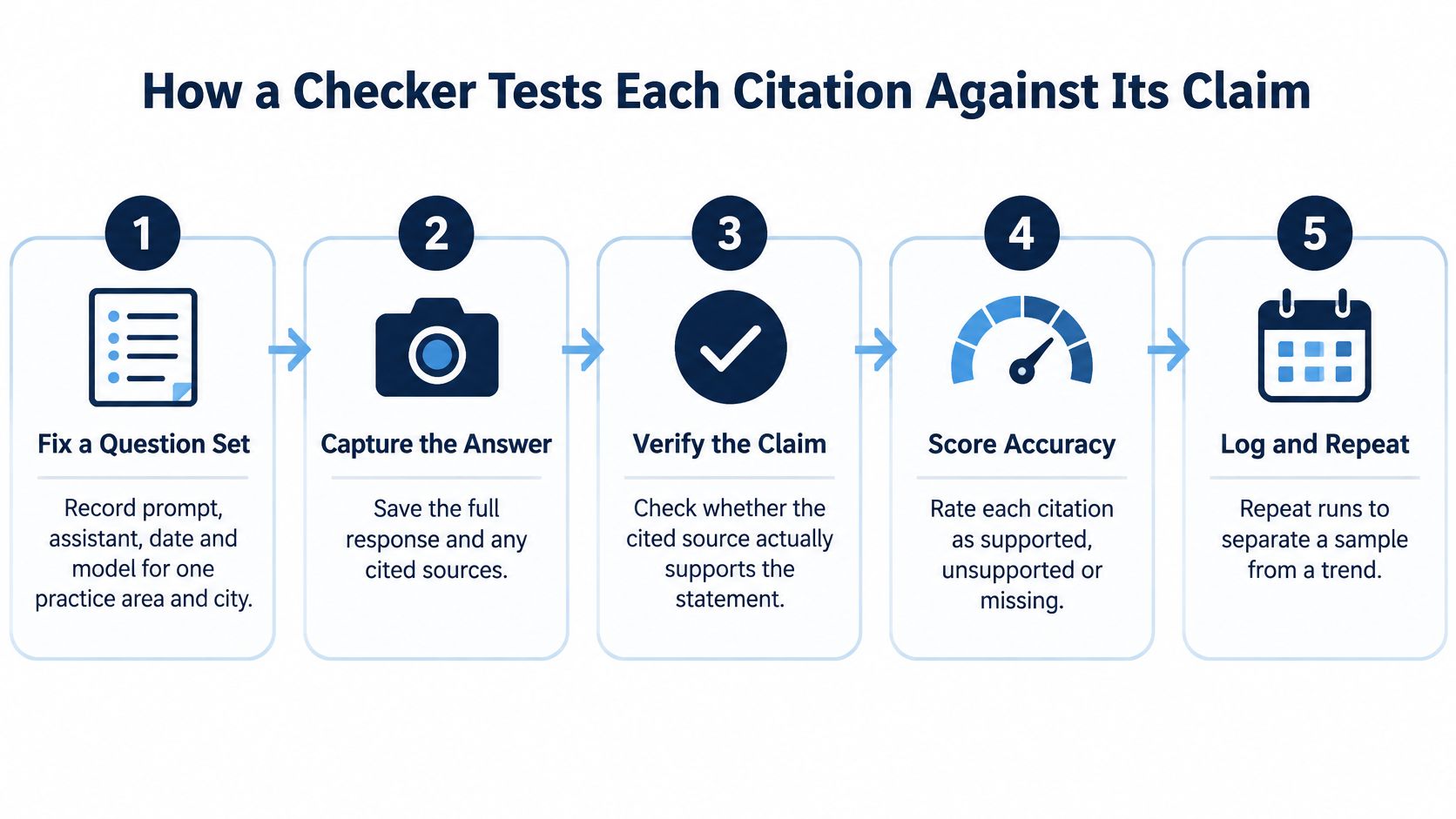
Fix the question set. Select prospective-client queries for a defined practice area and city. Record the prompt, assistant, date, and model version where disclosed, because a result without testing conditions can't be reproduced meaningfully.
Separate the answer into atomic claims. Treat location, practice focus, attorney identity, and outcomes as independent propositions. A sentence can contain an accurate address and an unsupported claim about expertise.
Map each claim to its evidence. Identify the attached citation or inspect retrieved material when the interface exposes it. If the assistant doesn't disclose its retrieved sources, record that limitation rather than inventing a source trail.
Check existence and identity. Open the URL, inspect the destination, and compare the title and author where relevant. For scholarly references, confirm that any DOI resolves to the cited work, not merely to a real publication.
Judge specific support. Classify the claim as supported, partial, unsupported, or contradicted. A biography describing employment litigation doesn't automatically substantiate a recommendation for every employment-related matter.
Repeat under controlled conditions. Run the same questions repeatedly and across assistants. Keep the core wording stable so that prompt changes don't become confused with changes in representation.
Preserve an inspectable record. Save the full answer, cited passage, source snapshot, and judgment. Every CitationOS finding points to a query, an answer, or a source that the client can check.
Existence checks and support checks need separate verdicts
The existence check catches fabricated references and incorrect destinations. The support check catches misattribution, outdated descriptions, and conclusions broader than the source warrants.
For content teams addressing extraction after diagnosis, Magnitude Marketing's AI search playbook offers an adjacent implementation resource. Content optimization still needs an independent verification standard.
Verification standard: A citation is verified only when the source, the specific supported claim, and the answer date can all be shown.
Metrics That Quantify Inclusion and Narrative Strength
An audit needs a ladder of measures, not a single count. Citation Presence establishes inclusion, Top-3 Rate establishes position, and Narrative Depth establishes how substantively the assistant describes the firm. Claim-level measures then test whether that description is supported.
NIST's evaluation framework for machine-generated reports separates discrete information requirements from the mapping of claims to source documents. Applying that distinction to firm recommendations prevents an auditor from treating a related link as proof of a specific assertion.
Presence and support measure different outcomes
Metrics a citation checker reports
| Metric | What it measures | Low value signals | Data source |
|---|---|---|---|
| Citation Presence | Share of query runs in which the firm is named | Absence across many runs of the same question set | Repeated assistant responses |
| Top-3 Rate | Share of runs in which the firm is named among the first three | Named, but rarely placed in the top three | Repeated assistant responses |
| Narrative Depth | How substantively the assistant describes the firm | Name only, with no practice, geography or track record | Assistant response text |
| Citation Recall | Share of material claims backed by at least one valid source | Claims that carry no valid supporting source | Claim-level scoring |
| Citation Precision | Share of supplied citations that support their claim | Citations that are unrelated or overextended | Claim-level scoring |
Here, Citation Presence is an operational label for being named. A mention counts even when no source accompanies it.
CitationOS combines the three representation measures into the Citation Score, a single number for how AI systems see a firm when a client is choosing, benchmarked against the firm's competitors. The claim-level measures sit outside that composite. They grade the evidence behind what the assistant says, not the visibility the firm receives, and collapsing the two into one figure hides exactly the failure a checker exists to find.
Recall and precision must remain separate
Citation recall asks whether material claims have valid evidence. Citation precision asks whether the citations supplied support their associated claims. Low recall identifies missing coverage; low precision identifies misleading or overextended sourcing.
Don't average these into an undifferentiated accuracy score. An answer with few citations and an answer with many irrelevant citations require different corrections.
Citation placement deserves its own score as well. A supporting link beside its claim is easier to verify than a collection of links stacked at the end without clear attribution. A checker that ignores placement rates a well-attributed answer and a disorganized one identically, even though only the first lets a reader trace each claim to its source.
For reporting design, AI Optimization Services' visibility framework for marketing managers provides a complementary measurement reference. A scoreboard that reports presence without support reads a wrongly cited firm as healthy.
Data Sources Behind Every Citation Result
A checker builds an evidence picture from distinct public source categories. Each category answers a different question, so no single page should stand in for the whole entity.
The method reads only publicly accessible sources. An audit methodology built on public representation and entity consistency keeps each finding tied to a query, an answer, or a record the firm can check itself.
For every source it touches, the checker records two findings separately: whether the firm appears at all, and whether the source supports the specific claim attached to it. A directory listing can confirm the firm's name while contradicting its stated practice focus. Scoring only the first finding hides the second.
Firm-controlled records establish the claimed identity
The firm's own pages establish its stated practice areas, locations, and attorney biographies. Compare the language on a practice page with the labels used elsewhere; a narrow specialty on the website may appear under a broader or outdated directory category.
Bar and directory profiles provide another record of admission, location, and professional identity. Check name variants, office addresses, attorney affiliations, and whether the profile describes the same current practice.
Structured data and knowledge graph records show how organizations and people are identified across the web. Inspect whether organization and person records agree, whether relationships are explicit, and whether conflicting markup points to a different entity.
Independent and observed records test that identity
Third-party press and legal media can corroborate expertise beyond the firm's own assertions. Read the actual coverage: an article about an attorney's former role may not support the current firm's claimed capabilities.
Assistant responses reveal the observed result on each tested system. Sample each assistant separately, preserving both the answer and its sources, so strong performance on one cannot conceal absence on another.
Competitors named instead establish the relevant comparison set. Examine the evidence supporting their descriptions, including whether independent profiles substantiate the practice focus the assistant attributes to them.
A source conflict is a diagnostic lead. It cannot by itself prove how an assistant made its selection.
CitationOS tests the questions clients ask in the firm's own city and practice area. A national reputation does not establish inclusion for a local, matter-specific query, so the sample must match the decision context.
The most actionable finding is often a disagreement between records: a current website practice label against an obsolete directory listing, for example. An audit documents such conflicts directly; claiming they explain most selection failures would overstate the evidence.
What a Legal Market Audit Reveals in Practice
An audit earns its keep by separating two things most tools merge: whether the firm appears at all, and whether the citation attached to that appearance supports the specific claim being made. A firm can be named in an AI answer while the source behind the name confirms something outdated or wrong, and a checker that only counts appearances reports success where the evidence says otherwise.
The law-firm benchmarking analysis places inclusion alongside competitive representation. CitationOS began after its founders ran assistant questions themselves, city by city and practice by practice.
An illustrative boutique shows the distinction
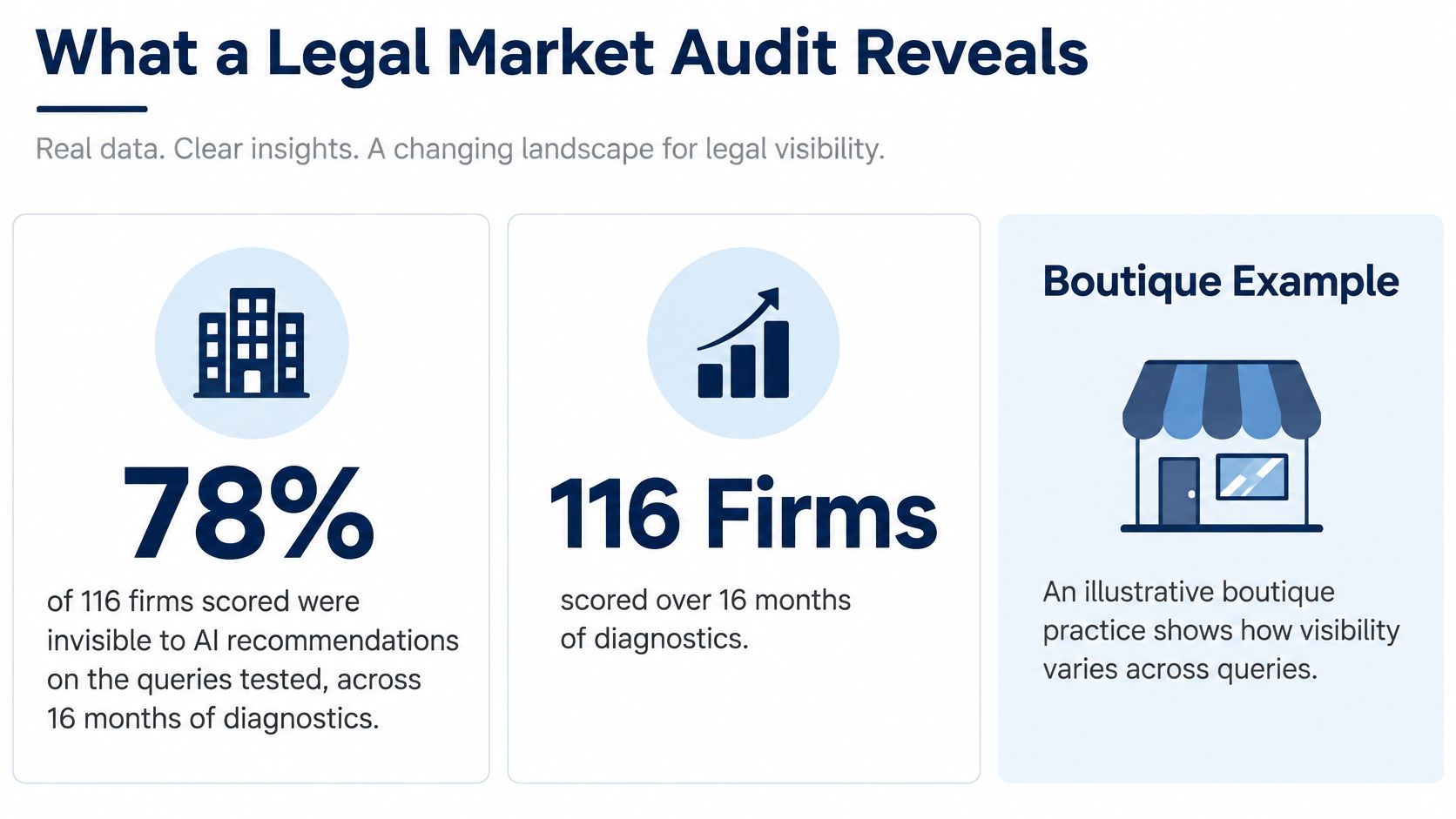
Consider an illustrative, hypothetical boutique employment firm, not a reported client case. Its initial test contains ten practice-specific questions about its city, submitted to four assistants, producing forty answers.
The firm is named in three answers and placed first in one. Even that appearance carries a qualification: the assistant describes the firm with a single practice label drawn from an outdated directory listing, so the citation exists without supporting what the firm does today.
A competing firm appears in most of the remaining answers. Its descriptions are more detailed and match the substance of an independent legal-media profile.
Forty answers make a thin sample. They suffice to set the questions for the next diagnostic pass, not to settle performance.
The findings require different explanations
- Low presence: The boutique rarely enters the tested answers, so leadership cannot infer shortlist inclusion from its website's discoverability.
- Citation without support: Where the firm is named, the cited source confirms an obsolete label rather than the practice the firm claims now. Appearance and accuracy score separately.
- Shallow narrative depth: The assistant supplies a label rather than a substantive account of practice, geography, or relevant experience.
- Competitor substitution: Another firm occupies the answer space with a more specific, independently corroborated description.
The auditor then checks the boutique's website against the directory. The website describes its current employment practice, while the directory retains the obsolete label reproduced in the answer.
That textual match identifies a plausible source of the shallow description. It doesn't prove the directory caused every omission, and correcting it may not displace the competing firm.
The useful diagnosis is narrower than a request for more content: existing public records give inconsistent accounts of what the firm does.
Within this hypothetical example, the audit locates a correctable source conflict before anyone commissions another page. Reconcile the evidence first, then test whether the assistant's description changes.
Limits and Misreadings Checkers Cannot Resolve
A checker records the answer a model returns: which firms appear, how they are described, and whether each cited source supports the specific claim attached to it. That evidence can document absence, inaccurate characterization, and citations that are present yet wrong; it cannot prove the private reasoning behind a selection.
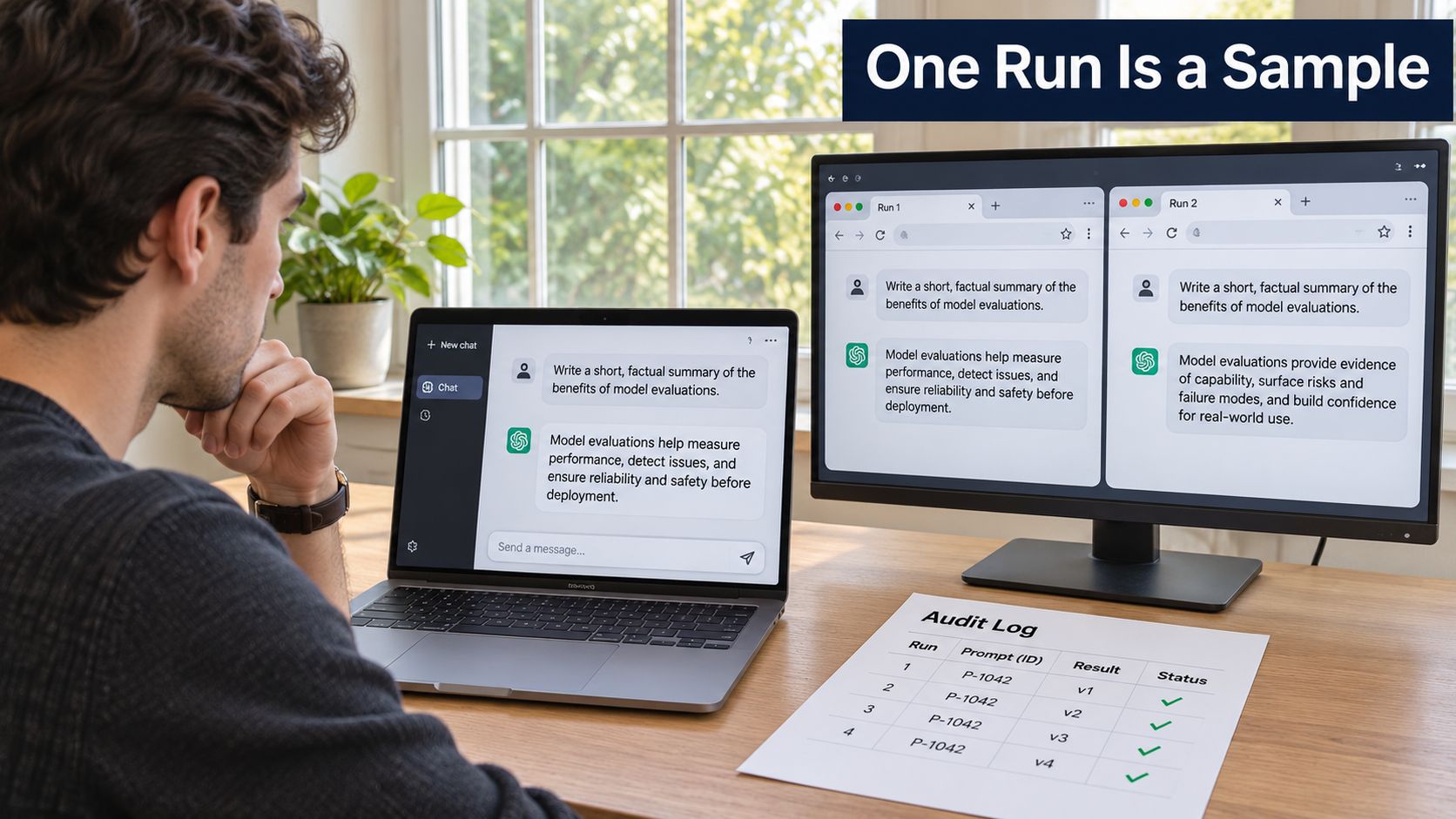
Responses also vary between sessions. Dated snapshots and repeated runs create a defensible sample, while the underlying system remains a moving target rather than a fixed ranking.
Public evidence places a boundary on diagnosis
A corrected public record may not appear immediately in an assistant's answer. The checker can confirm the correction and observe later responses, but it cannot promise an update timetable it cannot verify.
Retrieval grounding narrows the problem without closing it. A study integrating a language model with structured biomedical retrieval found improved citation reliability in the tested configurations, while some cited articles still failed to support the stated relationships.
Buyer relevance is a separate boundary. An accurate citation about location may be factually sound and still carry little weight for a complex matter.
Familiar signals are easy to misread
A surfaced link shows that a source entered the answer. A higher citation count shows how often the firm was named across the run. A citation score summarizes AI representation, with no claim about search-engine ranking. The important contrast is narrower: inclusion can be recorded while recommendation remains absent.
Before relying on an audit, examine its measurement record:
- Sampling: How many runs support each figure?
- Provenance: Does each run retain its prompt, assistant, date, and disclosed model version?
- Scoring: Are judgments claim-level, or do they merely count URLs?
- Separation: Are recall and precision reported independently from presence?
A checker that can't answer these questions hasn't earned confidence in its metrics. The remediation boundary is accuracy: correct entity signals, practice descriptions, and corroborating records. Manufactured authority rarely withstands a prospective client's own checks.
Confirm Your Baseline Before You Change Anything
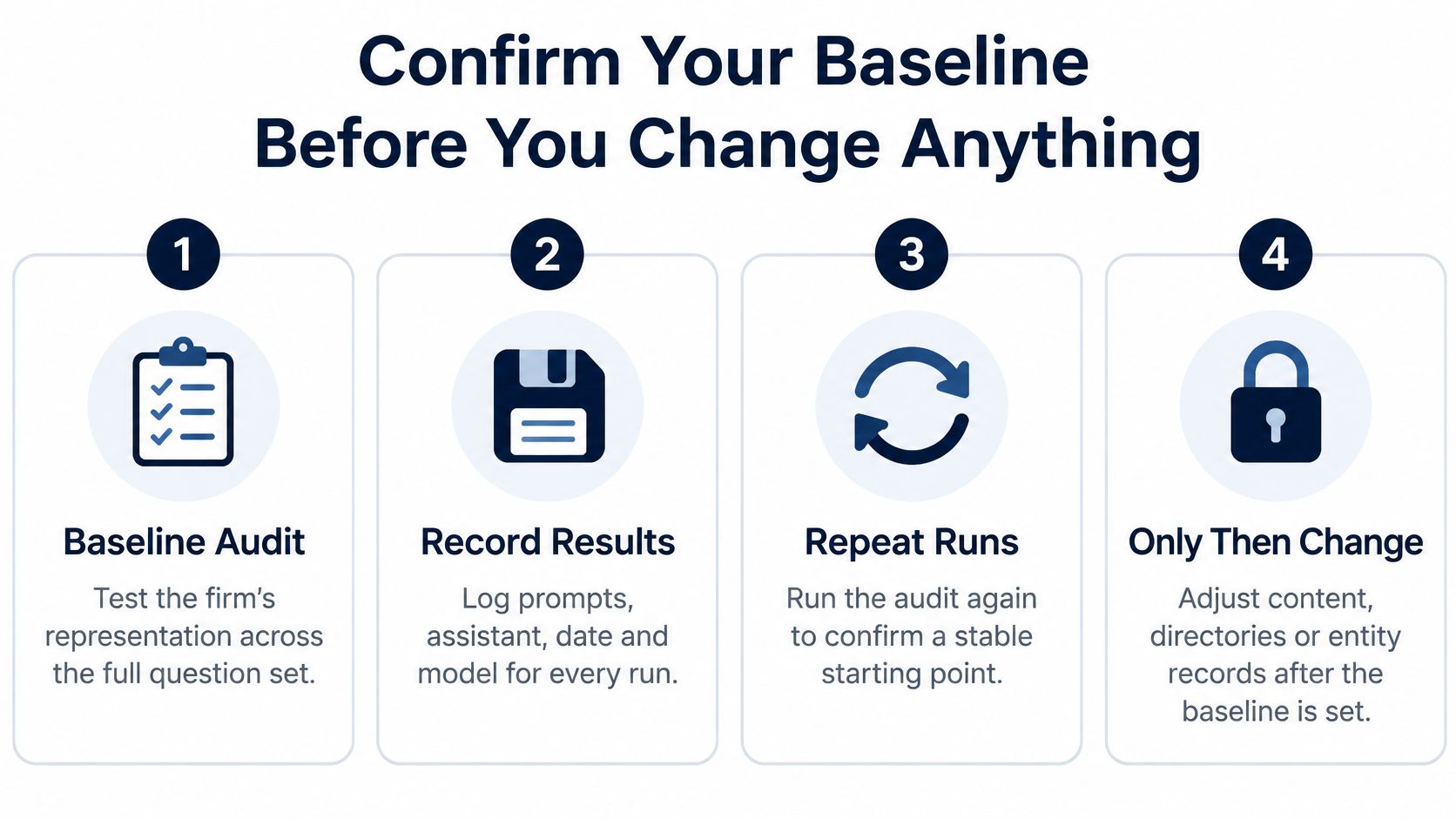
Establish the baseline before changing content, directories, or entity records. Otherwise, leadership cannot distinguish a genuine improvement from ordinary answer variation or a different question set.
The AI search audit framework supports a measurement-first decision. Preserve the starting evidence before intervening.
Keep the sequence controlled
First, establish representation under defined conditions. Test priority practice-and-city queries across the selected assistants. Date and log every run, and repeat the initial set to assess how stable the starting picture is.
Second, read the score through its underlying gaps. Compare the firm with the entities named instead, not merely the competitors leadership expects to see. Separate weak inclusion from inaccurate characterization and unsupported claims.
Third, correct documented inconsistencies. Start with conflicting names, practice labels, directory entries, and entity records. Record each change and its date so that later observations can be interpreted against an intervention history.
Fourth, rerun the same question set on a fixed schedule. Compare presence, top-3 rate, narrative depth, and claim support against the recorded baseline. If the question set changes, preserve the original series rather than replacing it.
A limited start still needs an evidence trail
A firm can begin with a small set of priority questions, its own public pages, and saved assistant responses. A smaller sample narrows the conclusion; it doesn't justify looser logging or broader claims.
For a formal starting point, our free snapshot analyzes publicly available website pages, asks an assistant a small set of market questions, and emails the report. Our private audit is delivered within 7 business days; Kivanc Acikgoz leads the research behind the Citation Score and reviews every audit before delivery.
The baseline is the most valuable initial output because it makes later decisions testable. A firm that has never measured its AI representation can't confidently establish whether a correction worked, even when the correction was sensible.
CitationOS offers a confidential assessment of how assistants describe, cite, and recommend your law firm, with findings tied to inspectable answers and sources. Visit CitationOS to establish a baseline and distinguish missing inclusion from unsupported representation before deciding what to change.