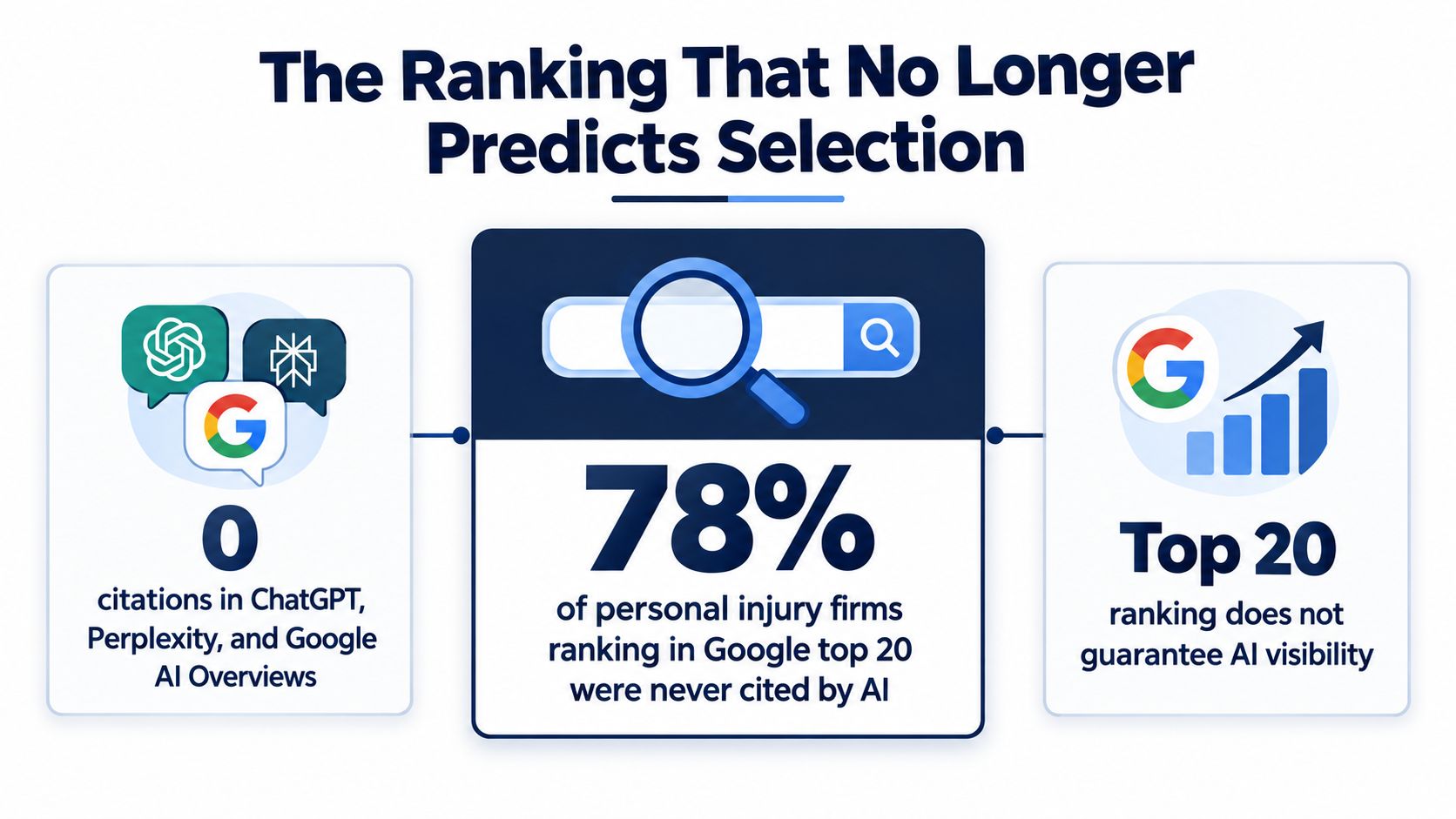
A law firm can hold strong Google positions and still fail at the moment that matters most: selection. In a CitationOS diagnostic spanning 116 firms and 16 months of diagnostics, 78% were invisible to AI recommendations. That finding matters because attorney SEO still drives discovery, but discovery is no longer the same as being named when a prospective client asks an AI system which firm to call.
That distinction sits at the center of legal visibility in 2026. Attorney SEO remains a measurable acquisition channel. One 2025 benchmark estimated average annual SEO spend for law firms at $120,000, a 14-month break-even period, 21% annual organic traffic growth, a 7.4% visitor-to-lead conversion rate, and a 526% three-year ROI for the average firm, according to this legal marketing benchmark. Those economics are real.
They are also incomplete. SEO helps systems discover you. GEO helps systems extract and understand you. CitationOS measures whether AI trusts and recommends you. That third layer is where many firms now disappear.
Table of Contents
- The Ranking That No Longer Predicts Selection
- What Attorney SEO Still Gets Right
- Why Google Rankings Miss the Recommendation Layer
- What AI Systems Actually Evaluate When Recommending a Firm
- Inside the South Florida Diagnostic
- Measuring Beyond Rankings with the AVI Framework
- The Strategic Implication for 2026
The Ranking That No Longer Predicts Selection
78% of the 116 law firms evaluated in 16 months of CitationOS diagnostics were invisible in AI recommendations. Many of those firms were still visible in traditional search. The operating assumption behind attorney SEO has changed faster than reporting practices have.
The old model treated ranking as a reasonable proxy for selection. If a firm appeared near the top of search results, partners could infer that it was entering the client's consideration set. That proxy is weaker now because AI interfaces often compress research into a direct answer, a short comparison, or a narrow list of named firms.
Traditional rank reporting was not built for that environment. It records position on a results page. It does not test whether an AI system can interpret the firm clearly enough to describe its strengths, distinguish its practice focus, or include it in a recommendation. Those are different evaluation tasks, and they produce different winners.
That is the core audit problem. A firm can perform well on discovery signals and still fail on recommendation signals.
CitationOS examined this failure pattern directly in its analysis of the visibility gap between rankings and AI recommendation. The pattern matters because attorney SEO still does useful work. It helps search engines and AI systems find the firm's digital record. But discovery is not the same as selection, and selection is where value concentrates.
For managing partners, the oversight question changes with it. The relevant issue is no longer whether rankings improved in isolation. The relevant issue is whether the firm appears at the moment an AI system reduces a wide field into a shortlist.
What Attorney SEO Still Gets Right
Attorney SEO still matters because it governs whether a firm can be found, parsed, and classified before any system can decide whether to recommend it. That makes SEO a foundation, not the end state.
The investment case remains intact. Earlier benchmark data in this article showed that legal SEO can produce strong returns, but the returns vary sharply by practice area, budget level, and time to break-even. That variation matters more than the headline ROI figure. It suggests that firms should audit SEO economics by matter type and geography, rather than accept generic advice built for the legal category as a whole.
Local visibility also remains highly operational. Firms do not usually lose local discovery because of abstract brand weakness. They lose it because identity signals conflict across profiles, reviews are unmanaged, location pages are thin, or practice and geography are described inconsistently. Those are controllable failures.
The practical takeaway is straightforward.
| Attorney SEO Fundamentals | Why They Still Matter |
|---|---|
| Google Business Profile management | It helps search systems connect the firm to a service area, office location, and category intent. |
| Review acquisition and response | It adds current third-party validation and clarifies whether the firm is active and credible. |
| On-page location and service relevance | It reduces ambiguity about what the firm does and where it does it. |
| Links and citations | They reinforce entity consistency and support trust in the firm's digital record. |
Technical execution still carries real weight. Clean crawl paths, usable internal linking, distinct service pages, structured attorney bios, schema markup, and consistent firm identifiers across directories all improve retrieval. They also improve interpretation. An AI system cannot reliably summarize a firm whose practice focus, office footprint, or attorney roles are described differently across its own site and external references.
That point is often missed in board-level reporting. Ranking improvements can confirm that the foundation is functioning. They do not show whether the firm is ready for recommendation inside AI-mediated search. CitationOS examines that gap in its review of what surface-level AI tools measure.
For managing partners, the right conclusion is narrower than conventional SEO messaging suggests. Keep funding attorney SEO because weak foundations suppress both search visibility and machine interpretation. Do not treat those foundations as proof of market selection. They are the precondition for it.
Why Google Rankings Miss the Recommendation Layer
Nearly every law firm dashboard still treats rank position as a proxy for market visibility. That proxy is weaker now because a growing share of legal discovery happens inside AI-generated answers before a prospect ever reaches the organic results.
Discovery now includes a pre-click selection stage
In a click-based model, a strong ranking increased the odds that a prospect would visit the firm's site and evaluate it there. In an AI-mediated model, part of that evaluation occurs earlier. The system retrieves sources, compresses them into an answer, and may name a small set of firms while ignoring others that also rank well.
That changes the meaning of a top-three position.
A firm can hold first-page rankings for high-value queries and still lose visibility at the moment that increasingly shapes consideration. The issue is not that rankings stopped mattering. The issue is that rankings measure page exposure, while AI recommendation measures whether the firm is selected for inclusion during synthesis.
Rank trackers record placement, not inclusion
Standard SEO reporting answers a narrow question: where did a page appear after the result set was generated? It does not answer a different and now more commercially important question: was the firm retrieved, cited, or named inside the answer layer that many users see first?
Those are separate events. A page can rank well and still contribute little to recommendation if the firm's broader digital record is thin, inconsistent, or hard for machines to reconcile. That distinction is the core of the interpretation gap in AI search.
Selection often starts before the click
For managing partners, the practical implication is straightforward. Ranking reports still show whether attorney SEO is doing its foundation-level job. They do not show whether the firm is being chosen as a credible option inside AI-mediated discovery.
That is the recommendation layer. It sits between visibility and inquiry, and it is where many reporting stacks still go dark.
What AI Systems Actually Evaluate When Recommending a Firm
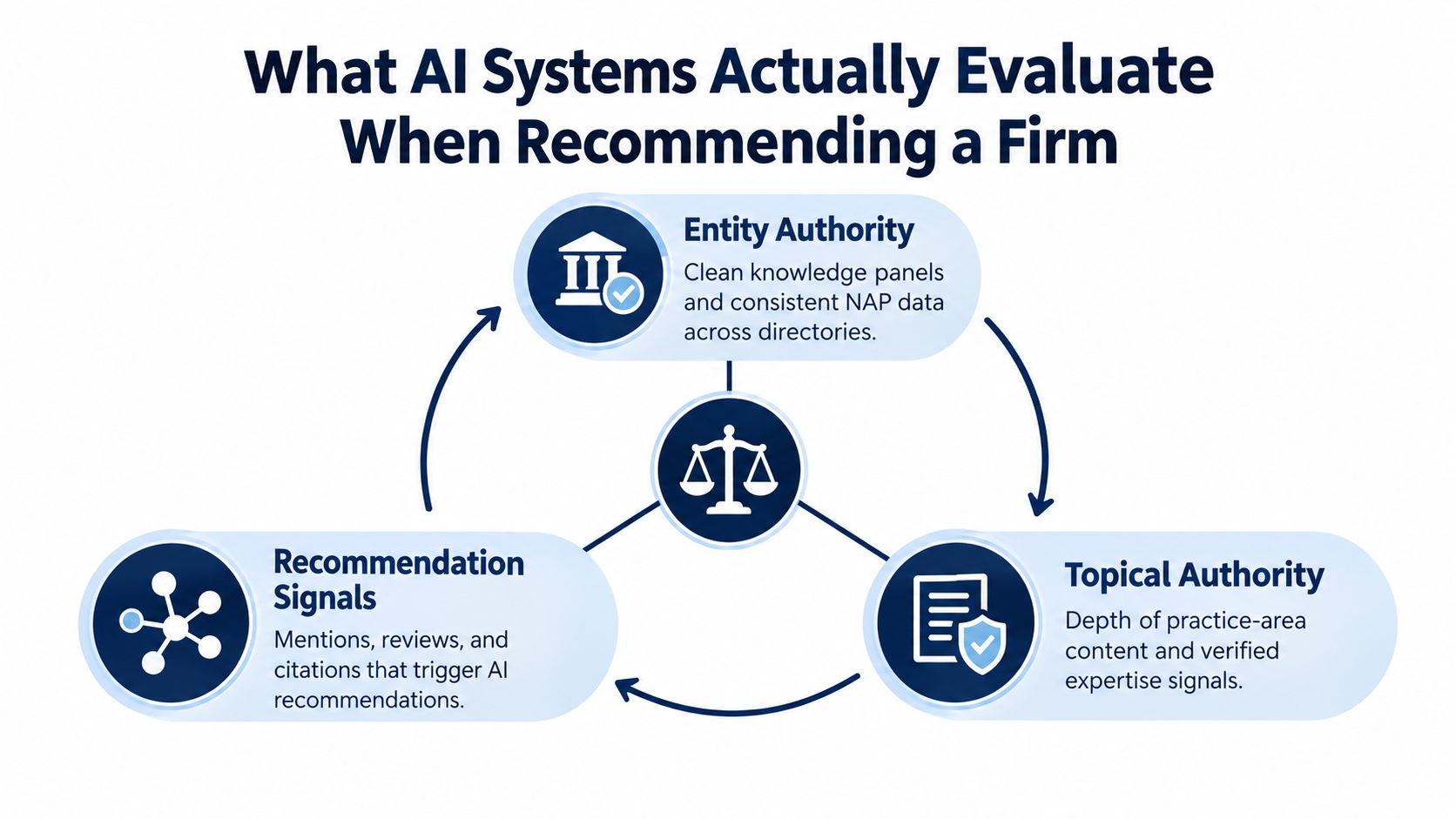
Firms that want AI-mediated discovery cannot treat ranking as the finish line. Recommendation systems assess whether a firm can be identified clearly, retrieved from multiple sources, and described with enough specificity to justify inclusion.
Entity authority determines whether the firm can be resolved correctly
The first test is entity clarity. AI systems need to determine that the firm named on a website is the same organization referenced in attorney bios, directory profiles, bar records, local listings, and office pages. If names vary, office locations blur together, or practice descriptions shift from source to source, the firm becomes harder to resolve with confidence.
This is one reason attorney SEO still matters as a foundation. Clean site architecture, consistent naming conventions, attorney-level attribution, and jurisdiction-specific service pages help machines map the firm to a stable entity rather than a loose set of pages.
Citation presence determines whether the firm can be retrieved and corroborated
Retrieval depends on more than the firm's own website. AI systems pull from a wider record that can include professional listings, earned mentions, legal directories, public records, and on-site content. What matters is not sheer volume alone. Coverage, consistency, and corroboration matter more because recommendation systems tend to prefer facts that appear in more than one place.
A firm with scattered mentions and weak alignment across sources often loses ground at this stage. The issue is usually structural. The firm exists online, but the record is thin, uneven, or difficult to verify. That weakens the odds of being surfaced during synthesis even if individual pages perform adequately in search.
Narrative depth determines whether the firm sounds selectable
After retrieval, systems still need usable language. Generic service copy gives them very little to work with. Pages that describe actual case types, procedural questions, client concerns, local court context, and jurisdictional constraints give systems clearer material to summarize.
That distinction is often missed in conventional SEO advice.
A page written mainly to cover a keyword can still be crawlable, indexed, and visible. It may even rank. But if it does not explain who the firm helps, in what situations, under which legal conditions, and with what demonstrated focus, it provides little basis for recommendation. AI systems do not just extract topics. They infer fit.
Recommendation authority sits above SEO
Entity authority, citation presence, and narrative depth combine into something different from ranking strength. They form recommendation authority. That is the layer between being found and being named.
GEO and AEO address part of the problem because they improve extractability and answer-format alignment. They do not answer the harder question. Whether the firm's full digital record is strong enough for an AI system to include it confidently when compressing many sources into a short list.
That gap is why attorney SEO should be treated as necessary infrastructure, not the objective itself. The missing measurement layer is AVI. It evaluates whether the firm is only visible in search, or visible in the environments where AI systems decide which firms to recommend.
Inside the South Florida Diagnostic
The most useful way to understand this shift is to examine one competitive market in detail.
CitationOS scored 116 South Florida personal injury firms across a 16-month diagnostic period. The objective was not to produce another rank report. It was to test whether firms that were visibly active in attorney SEO also appeared in AI-generated recommendation environments.
The pattern was not random
The headline finding was stark. 78% of the firms scored were invisible to AI recommendations.
That result did not mean those firms lacked websites, content, reviews, or search activity. Many had recognizable digital footprints. Some ranked well for commercially meaningful queries. Yet their AI Visibility Index (AVI) and citation presence remained weak.
| South Florida PI Firm Diagnostic. SEO vs. AVI Distribution | Firms Audited | AVI Score Below 40 | AVI Score 40–70 | AVI Score Above 70 |
|---|---|---|---|---|
| Personal injury firms scored in the South Florida diagnostic | 116 | Majority of firms fell below the AI visibility threshold qualitatively | A smaller middle band showed partial citation presence qualitatively | A limited cohort surfaced repeatedly in AI recommendations qualitatively |
Why ranking firms still disappeared
The common failure pattern was structural, not cosmetic. Firms that remained recommendation-invisible often showed some combination of these weaknesses:
- Thin service narratives: Practice-area pages existed, but they didn't answer situational client questions with enough specificity to create narrative depth.
- Ambiguous entity signals: Office pages, attorney bios, and directory records described the firm inconsistently, which weakened entity authority.
- Shallow corroboration: The firm had limited third-party references that reinforced its stated practice focus and jurisdiction.
- Weak jurisdictional disambiguation: The firm appeared present online, but not clearly enough tied to the local decision context AI systems were trying to answer.
The visible minority shared a different profile
The firms that surfaced repeatedly were not always those with the loudest conventional SEO footprint. They tended to present a tighter institutional story. Their signals aligned. Their practice scope was easier to interpret. Their third-party references supported their own descriptions. Their content answered narrower legal scenarios, not just broad service keywords.
The recommendation layer rewards coherence more than volume.
That's the important audit finding. Traditional SEO activity explains only part of legal discovery now. Citation presence, narrative depth, top-3 rate, and overall entity authority explain much more of why one firm is named while another is ignored.
Measuring Beyond Rankings with the AVI Framework
Rankings still matter. They just answer a narrower question than most law firm dashboards assume.
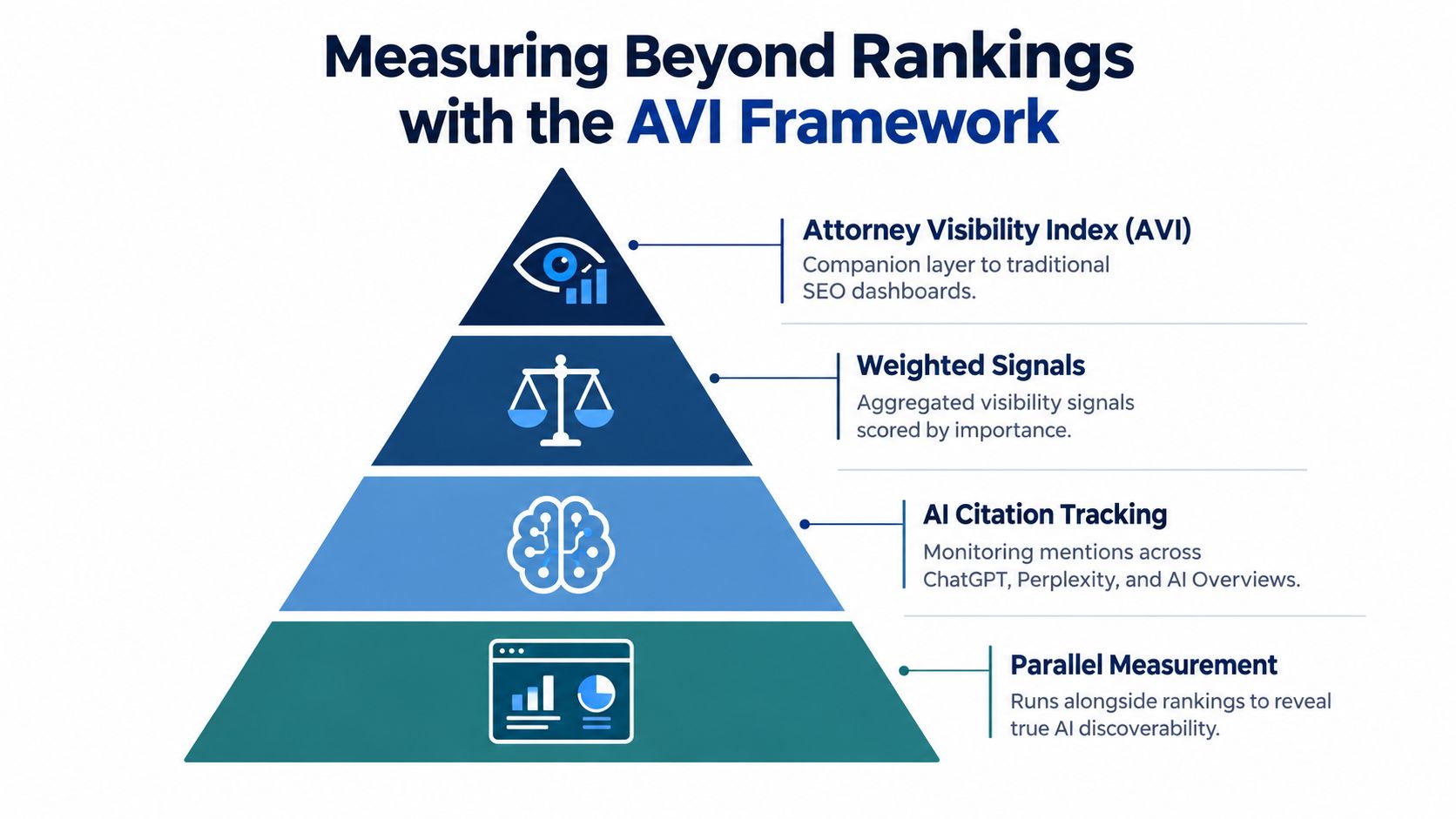
The AI Visibility Index (AVI) adds a second measurement layer. It assesses whether a firm's digital footprint is strong and coherent enough to produce inclusion in AI-generated recommendations, not merely visibility in search results. That requires a different scoring logic. Rank trackers measure position. AVI measures whether the firm is legible enough to be selected.
In practice, AVI examines the inputs that shape recommendation outcomes: entity authority, citation presence, narrative depth, and observed inclusion across high-intent prompts, including top-3 rate.
AVI answers a governance question, not just a reporting one
SEO reporting shows whether a firm can be found. AVI shows whether a firm is likely to be named.
That distinction matters because recommendation systems compress the decision path. A prospective client may never compare ten blue links if an AI interface presents three firms with apparent confidence. In that environment, a ranking gain can still leave the firm operationally absent from the shortlist that shapes selection.
The practical implication is straightforward. Attorney SEO remains the foundation. It builds crawlability, relevance, and discoverability. AVI measures whether that foundation is converting into recommendation visibility, which is the layer between being present online and being chosen by AI-mediated systems.
AVI belongs beside SEO, GEO, and AEO
For managing partners and CMOs, the measurement stack is becoming clearer:
- SEO metrics track search discovery and ranking movement.
- GEO and AEO diagnostics assess whether content is structured clearly enough for retrieval and answer generation.
- AVI tests whether those conditions result in actual recommendation presence.
That last point is the gap many firms still do not measure. A firm can publish location pages, improve technical SEO, and expand practice content, yet remain weakly represented in recommendation environments if its signals do not resolve into a coherent institutional profile.
CitationOS is one AI recommendation intelligence platform built to measure that problem. Its function is diagnostic. It evaluates how AI systems represent, cite, and recommend a firm, then identifies where recommendation visibility breaks down.
The Strategic Implication for 2026
Law firm leadership now has a measurement decision to make.
One path is to continue treating ranking reports as the primary evidence of digital performance. That will remain partially useful and increasingly incomplete. The other path is to pair attorney SEO with a recommendation-layer diagnostic that shows whether AI systems include the firm when prospective clients ask for guidance.
This is a governance issue, not a channel tweak
The stakes sit upstream of marketing attribution. If AI systems form the shortlist before a click, then recommendation visibility affects business development before intake ever sees a lead source field.
The firms that adopt a dual-metric posture gain something more valuable than another visibility chart. They gain a way to identify which content assets build AI recommendation authority, which citations strengthen entity authority, and which market narratives are decorative but operationally irrelevant.
The cost of inaction is quiet exclusion
A firm can keep spending on attorney SEO, continue winning rankings, and still watch competitors capture the recommendation layer. That loss is hard to see in a standard dashboard because the omission happens before site traffic appears.
The practical move for the first quarter of 2026 is straightforward. Establish an AVI baseline before renewing any annual SEO retainer. A ranking report can tell you whether the market can find you. It cannot tell you whether AI systems trust you enough to name you.
CitationOS provides confidential AI recommendation intelligence for law firms that need to know how systems such as ChatGPT, Gemini, and Perplexity represent and recommend them. If your firm is investing in attorney SEO but lacks a baseline for citation presence, narrative depth, top-3 rate, and overall AVI, review CitationOS before finalizing next year's search strategy.