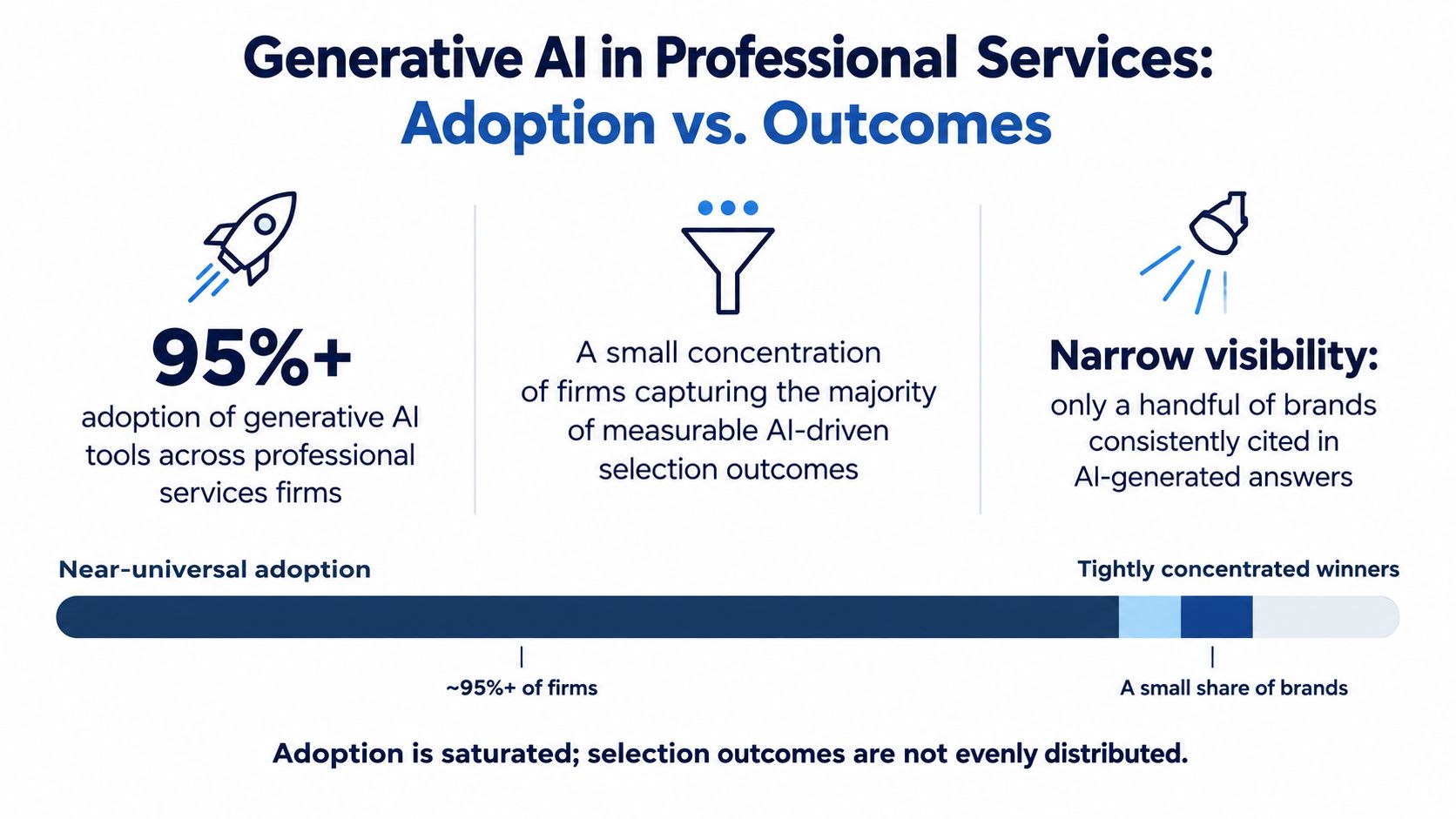
Generative AI adoption has crossed into mainstream marketing use, but recommendation outcomes remain uneven. A 2025 survey of more than 1,000 go-to-market professionals found that 85% of marketers use GenAI, while only 15% say it's fully integrated into daily workflows and 93% report dedicated GenAI budgets for 2025/26. That contrast defines the problem for law firms: internal use is widespread, but a firm's appearance in an AI-generated shortlist is a separate, much narrower outcome. (SAS survey)
CitationOS research makes the selection gap concrete. Across 116 firms and 16 months of diagnostics, 78% were invisible to AI recommendations. The implication is uncomfortable for firms investing in content, automation, and experimentation. Producing more material doesn't prove that AI systems can retrieve the firm, identify it correctly, or defend it when a prospective client asks for a recommendation.
What Generative AI Marketing Actually Means for Professional Services
Generative AI marketing for law firms isn't merely the use of language models to draft posts, practice pages, or campaign copy. It's the discipline of shaping how AI systems retrieve, attribute, and recommend a firm when a buyer asks a high-intent question.
That definition separates internal activity from external representation. A firm may use AI to summarize matters, draft a pitch, or accelerate research while remaining absent from the answers that prospective clients rely on. The relevant question isn't whether lawyers and marketers have access to GenAI. It's whether the firm appears as a credible, correctly described option at the moment a buyer asks for guidance.
Three observable behaviors define the category
A useful operating definition starts with three behaviors.
First, retrieval. Does the firm appear when a user asks for firms by jurisdiction, matter type, client profile, or legal problem? A firm that never enters the model's evidence set can't be recommended, regardless of its internal AI maturity.
Second, attribution. Does the system connect the right capabilities, people, locations, and outcomes to the right entity? A model may mention a firm while confusing its offices, practice areas, or authorship signals. That produces visibility without usable authority.
Third, defense. Does the recommendation survive follow-up questions? A buyer may ask why a firm fits a particular dispute, whether it handles a specific industry, or which sources support the choice. A defensible recommendation requires more than a name appearing once.
Practical rule: Treat AI recommendation intelligence as an external representation problem, not an internal software-adoption problem.
Adoption metrics answer the wrong executive question
The broader marketing market has moved quickly. One 2025 survey found that 73% of marketing teams use generative AI, while 27% of CMOs reported limited or no use in campaigns. Another industry survey reported that nearly 90% of marketers had used GenAI at work, with 71% using it weekly or more and almost 20% daily. (SAS survey)
Those figures establish adoption. They don't establish selection. For professional services, generative AI marketing becomes commercially meaningful only when teams measure the firm's citation presence, narrative depth, top-3 rate, and AI recommendation authority across the queries that shape buyer shortlists.
The Three Layers Between Discovery and Recommendation
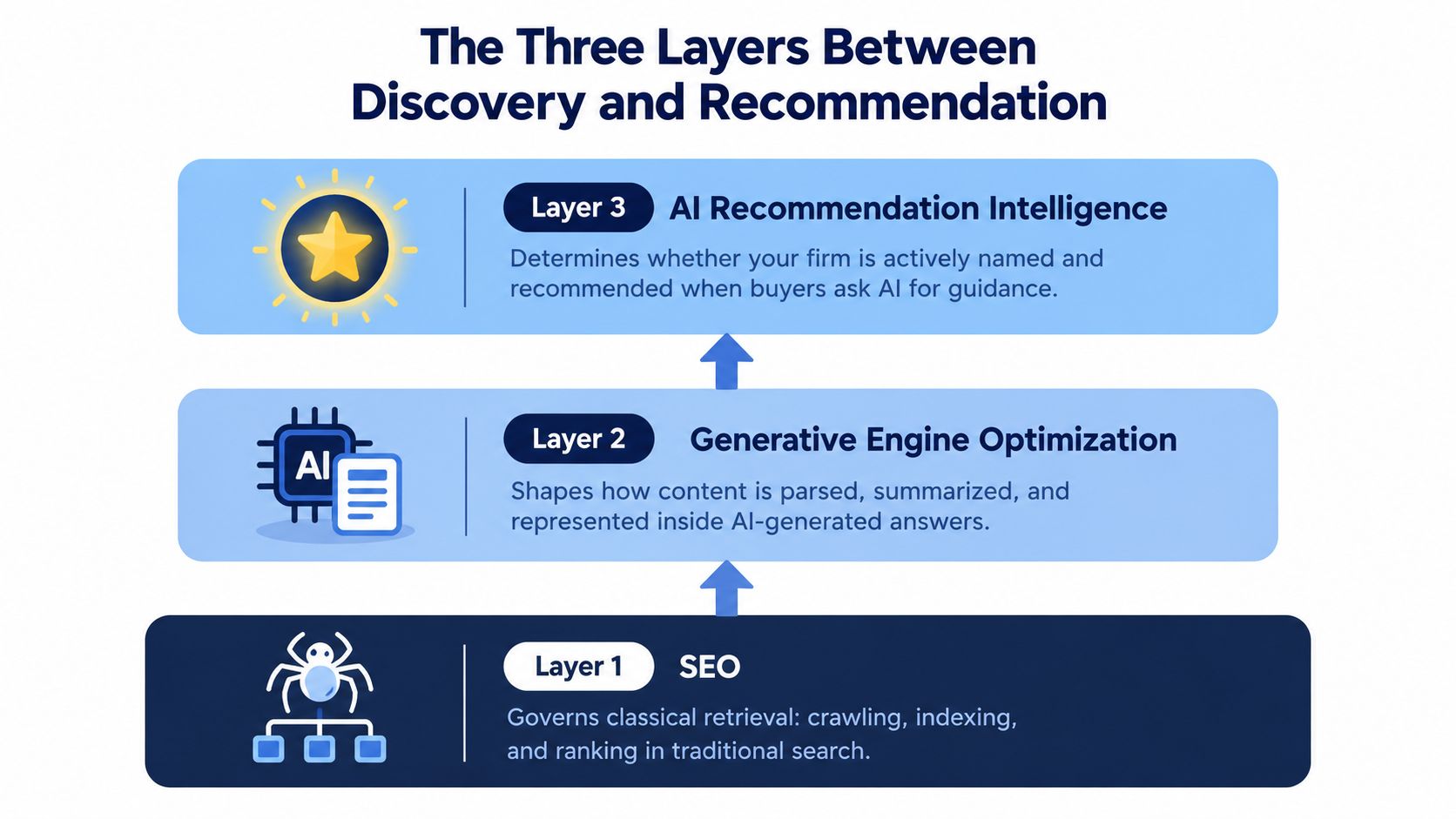
AI recommendation intelligence sits downstream from search visibility. SEO, generative engine optimization, and recommendation measurement address different stages of how a prospective client moves from finding information to receiving a firm recommendation. Treating them as equivalent turns a visibility signal into a selection claim.
Layer one governs discovery
SEO helps systems discover you. Crawling, indexing, and traditional search ranking determine whether public pages, directory records, biographies, and firm profiles enter the information environment from which answers may be built.
SEO answers a visibility question. A page can rank for a query without the firm appearing in an AI-generated shortlist. Search ranking and model selection are connected, but they measure different outcomes.
Layer two governs extraction and understanding
GEO helps systems extract and understand you. Generative engine optimization, together with answer engine optimization, concerns whether content can be parsed, summarized, and represented accurately in generated answers.
This layer relies on clear entity signals, consistent authorship, jurisdictional detail, practice descriptions, and machine-readable corroboration. Structured content can make a firm easier for a system to interpret. Interpretation still falls short of recommendation.
Layer three governs selection and defense
AI recommendation intelligence measures whether AI trusts and recommends you. It tracks whether a system names the firm, includes it in a relevant shortlist, cites supporting sources, and maintains that recommendation when the user asks follow-up questions.
For a query seeking a New York litigation boutique, SEO may bring the firm's website into the discovery set. GEO may help a model summarize its litigation capabilities accurately. The third layer determines whether the model selects the firm, gives it meaningful narrative depth, and can explain its inclusion.
SEO helps systems discover you. GEO helps systems extract and understand you. CitationOS measures whether AI trusts and recommends you.
AI Visibility Index (AVI) therefore functions as a selection diagnostic, not a substitute for traffic reporting. Citation presence shows whether the firm enters an answer. Narrative depth shows whether the system provides useful detail. Top-3 rate indicates whether the firm is only mentioned or repeatedly positioned near the decision point. These measures expose the gap between being available to an AI system and being selected by it.
Where Law Firms Are Using Generative AI Right Now
Law firms are applying GenAI across operational workflows, but each application creates a distinct control requirement. A useful review should examine the workflow shift and the governance gap together.
| Use Category | Workflow Shift | Governance Gap |
|---|---|---|
| Content drafting | Teams produce first drafts for practice pages, alerts, articles, and thought leadership more quickly. | Shallow human review can introduce unsupported claims, unclear provenance, or inconsistent descriptions of the firm's expertise. |
| Intake triage and matter screening | Automated conversational systems handle initial questions, collect information, and route potential matters. | Firms must address unauthorized-practice concerns, confidentiality boundaries, escalation rules, and the risk that a user mistakes an intake system for legal advice. |
| Internal knowledge management | Lawyers can search, summarize, and reorganize internal materials through natural-language prompts. | Per-matter isolation matters. Without it, confidential information can cross matter boundaries or appear in an unrelated response. |
| Competitive and market intelligence | Analysts compress large volumes of public information into shorter working summaries. | Uncorroborated model summaries can turn an uncertain inference into an apparent fact, especially when teams skip source verification. |
| Pitch and RFP generation | Business development teams accelerate responses by reusing approved matter descriptions, credentials, and practice narratives. | Client-facing output still requires rigorous checking for accuracy, current capabilities, conflicts, named experience, and commercial commitments. |
Content production creates a representation risk
The most visible use case is drafting. The problem isn't that a model can produce fluent copy. The problem is that repeated drafts can spread a vague or inaccurate practice description across the firm's digital footprint.
That matters to AI recommendation systems because entity authority depends on coherent signals. If one page describes a firm as a national trial practice and another presents it as a regional commercial boutique, the model receives conflicting evidence about the entity.
Law firms evaluating AI tools for law firms should therefore assess the control layer, not just generation speed. Every workflow needs an owner, an approved source set, a review threshold, and a record of what reached publication or a client.
Client-facing automation changes the first interaction
Intake systems deserve separate scrutiny because they sit close to legal judgment. A screening chatbot can make the first interaction more efficient, but it can also collect sensitive information before the firm has established an appropriate confidentiality posture.
Internal systems carry a different risk profile, but not a lower one. A model that summarizes knowledge across matters must respect access boundaries, retention rules, and the firm's obligation to prevent confidential information from entering an inappropriate context.
Why Adoption Is Not the Same as Selection
Internal adoption measures how a firm uses GenAI. Recommendation measurement examines how external AI systems represent and select that firm. These datasets have different owners, different controls, and different failure modes. A marketing team can report expanding usage while the firm remains absent from answers to high-intent legal queries.
Market adoption is accelerating. A Duke University CMO Survey data series summarized in 2025 industry reporting found that GenAI accounted for 15.1% of all marketing activities, up from 7.0% in Spring 2024, a 116% year-over-year increase. The same reporting placed recurring workflow use at 87% in 2026, compared with 51% in 2024 and 76% in 2025. (Marketing AI statistics overview)
Those figures describe activity, not selection. CitationOS diagnostics of 116 firms across 16 months found that 78% were invisible to AI recommendations. Firms can therefore increase GenAI use without entering the recommendation layer that shapes legal shortlists. The operational question is whether public evidence causes a system to mention the firm, cite it, and retain it among plausible choices. This is the selection moment in AI recommendations.
| Metric Category | Reported Value | What It Actually Predicts |
|---|---|---|
| Internal GenAI adoption | Widespread across professional marketing teams | Whether teams use AI in content, workflows, or campaign execution |
| Dedicated GenAI budgeting | 93% of marketing teams reported dedicated budgets for 2025/26 | Whether GenAI has become an operating investment |
| AI recommendation visibility | 78% of 116 firms were invisible in CitationOS diagnostics | Whether a firm appears in AI-generated recommendations |
| Legal AI shortlist size | ChatGPT returned about 7.8 recommendations per legal query, while Perplexity returned about 12.3 | How differently systems expose candidates |
| Citation source concentration | Major legal citation sources included Chambers, Legal 500, Super Lawyers, Best Lawyers, Martindale, Avvo, and Justia | Which authority layers repeatedly support legal recommendations |
The citation layer is narrower than the open web. AI systems assign unequal evidentiary weight to online mentions, and legal visibility reporting identified a concentrated directory layer that repeatedly supports recommendations. Citation presence is therefore a measurable diagnostic, not a substitute for reputation.
A firm may publish frequently and rank well while lacking corroboration in the sources recommendation systems consult. Citation intelligence connects entity work to observable selection outcomes. It shows whether the firm is merely discoverable or has enough consistent, supported evidence to enter and remain in an AI-generated answer.
The Effectiveness Gap Behind the Productivity Story
Productivity is an internal outcome. Marketing effectiveness is an external one. Treating the first as proof of the second allows firms to report activity while avoiding the harder question of whether AI-generated systems are sending qualified attention toward the firm.
The evidence is direct. Seven in ten organizations use GenAI in marketing, but only 7% of marketers strongly agree that it has boosted marketing effectiveness, and only 15% say low-value tasks are automated within marketing. (Marketing AI Institute report)
Three mechanisms explain the disconnect
Attribution blindness comes first. Firms often track website sessions, form submissions, and referrals without isolating whether an AI assistant named the firm before the buyer arrived. A referral may appear as direct traffic even though the decision began in an AI conversation.
Silo incentives create another obstacle. Practice groups may measure published output, while business development teams measure opportunities and marketing measures reach. No single owner tracks whether the firm's AI representation improves across target queries.
Production does not equal retrieval. Faster drafting can increase the volume of published material without improving the evidence systems use to construct recommendations. Content that lacks distinct authorship, clear jurisdiction, specific capabilities, or corroborating citations may add pages without adding authority.
The credible KPI isn't hours saved. It's whether the right AI systems name and defend the firm for the right buyer queries.
A serious measurement program should monitor cited mentions, recommendation frequency, citation presence, narrative depth, top-3 rate, and share of AI-generated answers within a defined practice area. These metrics measure external representation. They don't replace traditional marketing analytics, but they expose an outcome that traffic dashboards cannot see.
The interpretation gap in AI visibility is therefore operational, not semantic. A firm can interpret its content output as progress while the model interprets the firm as peripheral, ambiguous, or unsupported.
Governance, Risk, and the Case for Measurement Before Scale
Governance isn't administrative friction that firms can add after adoption. It's a precondition for scaling GenAI without compromising confidentiality, accuracy, or the entity signals that influence recommendation.
The risk begins with the prompt. Lawyers and marketers may expose confidential client information, matter details, or privileged material when they use an uncontrolled environment. ABA Model Rule 1.6 makes confidentiality a central professional obligation, so any workflow involving client data needs defined access, retention, review, and refusal rules.
Legal exposure appears at multiple points
Unauthorized practice risk can arise when an intake system moves beyond collecting information and starts presenting individualized legal conclusions. The system's tone doesn't change the underlying risk.
Confidentiality risk appears when prompts include facts that identify a client or matter. Firms need clear prohibitions on entering privileged or sensitive information into systems that haven't been approved for that use.
Accuracy risk reaches clients through pitches, alerts, website pages, and responses. A fluent statement can still be wrong, outdated, or unsupported. Human review must verify every material claim before publication or delivery.
Entity consistency affects recommendation authority
AI systems also assess the firm through a distributed citation footprint. The firm name, office locations, lawyers, practice areas, industry experience, and authorship signals should tell a coherent story across the sources that matter.
Contradictions create interpretive ambiguity. If a firm's own pages, directory profiles, lawyer bios, and third-party references disagree about its focus, the model has less reason to assign strong authority to any one description.
Measurement before scale: Instrument assistant answers and citation sources before increasing GenAI content spend.
Confidential measurement lets leadership see whether governance changes improve representation or merely constrain production. It also gives marketing, business development, risk, and practice leaders a shared evidence base. The objective isn't to make every output cautious and generic. It's to ensure that the firm's public representation is accurate enough for an AI system to cite, summarize, and defend.
What Responsible Application Looks Like in 2026
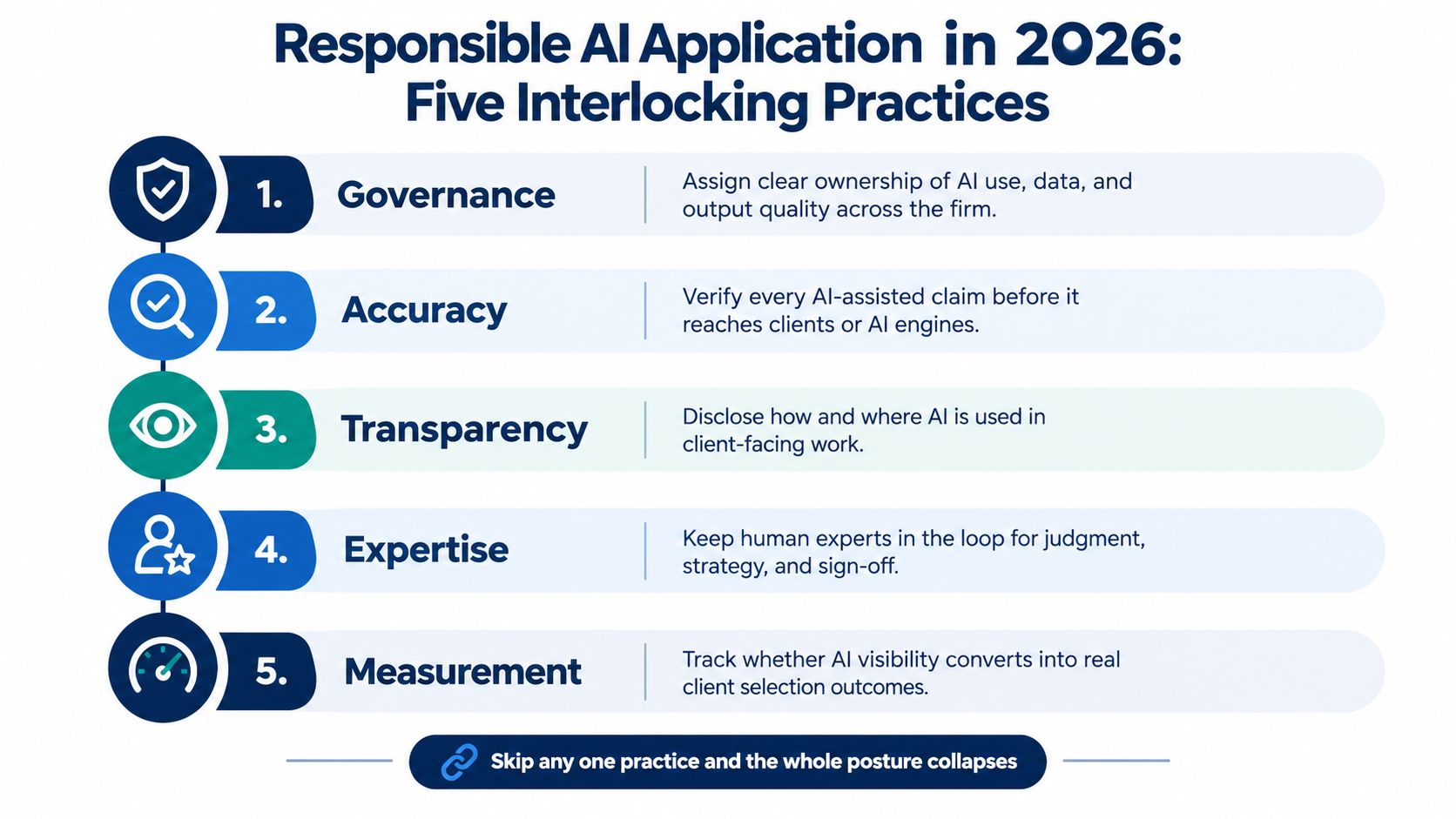
The firm that wins the selection moment is the firm whose representation AI systems can defend. Responsible generative AI marketing therefore joins workflow governance to external measurement instead of treating them as separate programs.
Five practices hold the posture together
Entity and authorship consistency comes first. Names, practice descriptions, jurisdictions, lawyer biographies, and source references should reinforce one another. Consistency gives systems a stable entity to interpret.
Human review of every published artifact remains essential. AI can draft, reorganize, and summarize, but a qualified person must verify substantive claims, attribution, client references, and legal nuance before anything reaches the public.
Confidential measurement of citation share should sit apart from traffic reporting. Track whether target assistants cite and recommend the firm, how often it enters the shortlist, and whether the narrative remains accurate under follow-up prompts.
Governance documented before deployment assigns ownership for data, prompts, outputs, review, escalation, and retention. A policy that exists only in informal guidance won't scale across practice groups.
A documented refusal policy should cover prompts that touch privileged matters, confidential client information, unresolved legal analysis, or requests that could create individualized legal advice. Refusal is a control, not a failure of the system.
A 90-day operating checklist
In the first phase, leadership should define target practice areas, priority jurisdictions, buyer questions, and the systems to test. Establish a baseline for AI Visibility Index, citation presence, narrative depth, top-3 rate, and entity consistency before changing the content program.
Next, appoint owners across marketing, business development, knowledge management, risk, and representative practice groups. Review the firm's public descriptions against the sources that AI systems cite, then correct contradictions before increasing production.
Finally, run recurring prompt tests across assistants and record the recommendation, cited sources, factual accuracy, and follow-up defense. This creates a practical feedback loop. The firm can see whether changes improve selection rather than assuming that more output means more authority.
Adoption without recommendation intelligence is blind. Productivity without measurement is incomplete. Responsible application isn't slower than scaling. It's the condition that makes scaling defensible to clients, regulators, and firm leadership.
CitationOS provides confidential AI citation audits, representation analysis, competitive benchmarking, entity consistency assessment, and ongoing monitoring across major AI assistants. To establish whether your firm is cited, shortlisted, and accurately represented for high-intent queries, visit CitationOS and request an AI recommendation intelligence assessment.