CitationOS scored 116 firms across 16 months of diagnostics and found that 78% were invisible to AI recommendations. That finding changes how executives should evaluate AI tools for law firms. A firm can operate research, contract, discovery, and workflow software internally while remaining absent when ChatGPT, Gemini, or Perplexity produces a shortlist for a high-intent legal query.
The distinction matters. SEO helps systems discover you. Generative engine optimization, or GEO, helps systems extract and understand you. AI recommendation intelligence measures whether those systems trust and recommend you. Internal efficiency and external selection are related, but one doesn't establish the other.
Legal adoption has moved beyond isolated pilots. In 2025, 80% of surveyed respondents said their firms were using or exploring generative AI, including every firm with 700 or more attorneys and 63% of firms with 50 or fewer attorneys, according to Law360's report on law firm AI adoption. The practical question is no longer whether firms should experiment. It's which workflow deserves automation, what review controls are required, and whether the investment changes how clients and AI systems perceive the firm.
The tools below are organized by the legal work they perform. The final distinction is the important one: using software to improve legal work isn't the same as building independent AI recommendation authority.
Table of Contents
- 1. Westlaw AI-Assisted Research
- 2. LexisNexis+ AI Research Suite
- 3. Harvey AI Contract Intelligence
- 4. Thomson Reuters DISCO E-Discovery Platform
- 5. Relativity AI-Assisted Review
- 6. Practical Law AI Practice Notes and Checklists
- 7. Everlaw AI-Powered Analytics
- 8. Casetext CoCounsel AI Legal Assistant
- 9. LexisNexis Legal Workflow Automation
- 10. Symantec Legal Manager AI-Enhanced Practice Management
- 11. CitationOS AI Recommendation Intelligence
- 12. Selecting Tools by Workflow and Recommendation Layer
- 12 AI Tools for Law Firms, Features, Workflow & Recommendations
- The Stack Is Not the Strategy
1. Westlaw AI-Assisted Research
Westlaw AI-Assisted Research is designed for lawyers who need to move from a natural-language legal question to relevant authority without relying entirely on carefully constructed Boolean searches. Its value sits in the research layer, where the quality of the result depends on identifying controlling cases, statutes, and secondary materials rather than returning documents containing matching words.
A litigation team handling a complex jurisdictional issue might begin with a plain-language question about how courts treat a particular procedural argument. The system can help surface relevant material, but the output still requires attorney review. A useful result accelerates the path to authority. It doesn't replace doctrinal judgment, source verification, or the lawyer's responsibility to distinguish binding precedent from persuasive material.
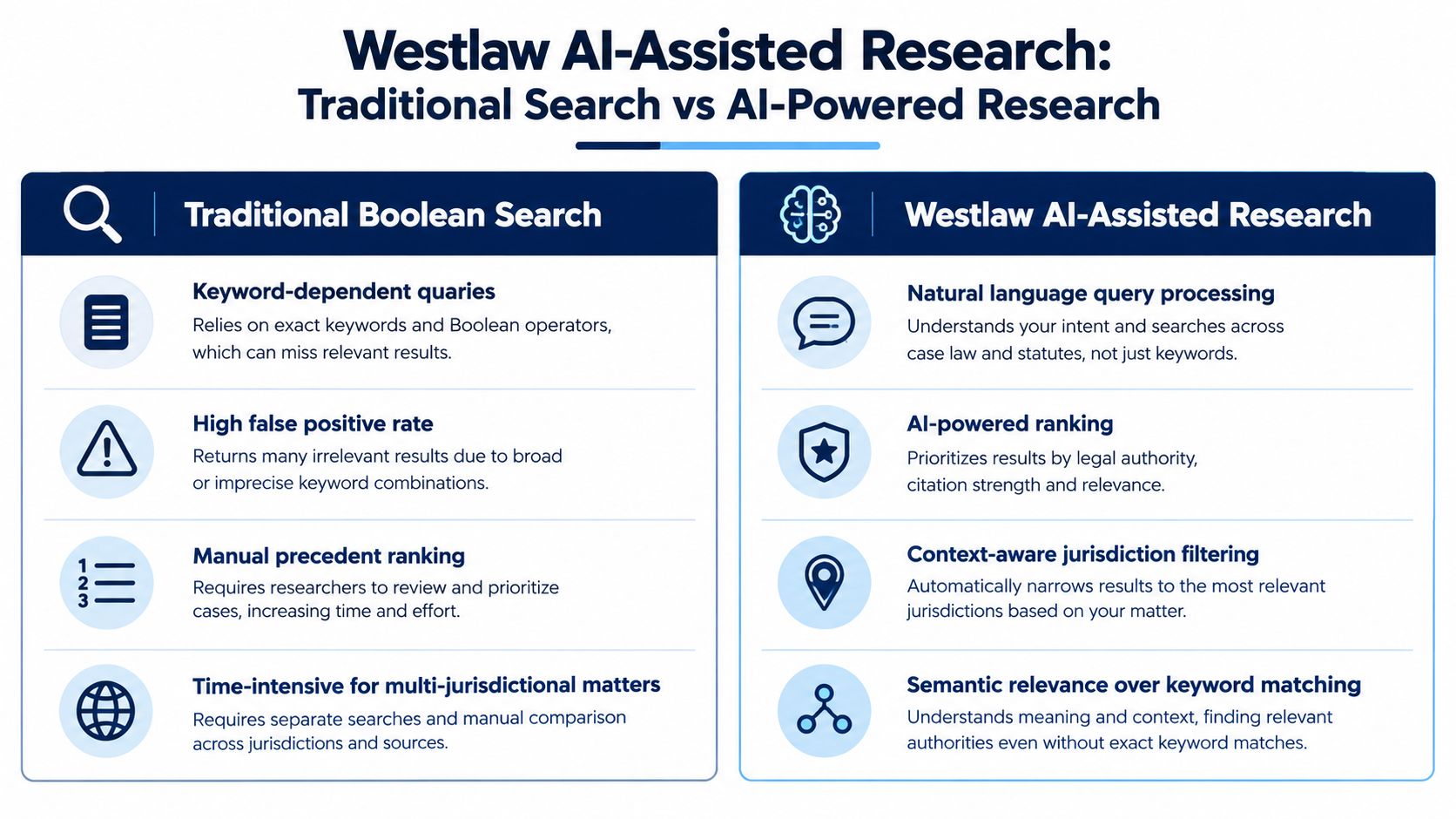
Research speed doesn't establish firm authority
Use natural-language questions to frame the legal issue, then inspect the underlying authorities manually. Teams should separate primary authority, commentary, and exploratory leads rather than treating every surfaced result as equally reliable.
Practical rule: Treat AI-assisted research as a faster route to review, not as a substitute for review.
Westlaw's operational benefit remains internal. It can help a lawyer research a matter more efficiently, but a firm's improved research process doesn't automatically change how external systems describe its expertise. That is the interpretation gap addressed by CitationOS's analysis of the interpretation gap, which separates being present in source material from being understood as the right recommendation.
2. LexisNexis+ AI Research Suite
LexisNexis+ AI Research Suite extends legal research into case assessment. Instead of limiting the workflow to finding authorities, a lawyer can use research and analytics to examine litigation context, judicial history, and patterns that may inform early decisions about forum, settlement posture, and matter strategy.
That makes the tool particularly relevant to partners assessing a new claim before committing substantial resources. A personal injury practice could use analytics as one input when preparing for mediation. A federal litigation team might review judicial history alongside recent decisions before discussing forum strategy with a client. In both scenarios, the system supports structured judgment rather than delivering a defensible decision by itself.
Predictive output needs temporal discipline
Historical patterns can become less useful when judicial philosophy, procedural posture, or governing law changes. Lawyers should compare analytics with recent opinions and identify which parts of the output are evidence, which are inference, and which require professional judgment.
The operational trade-off is clear. Predictive analytics can make early case assessment more structured, but it can also create false confidence if partners treat a probability-oriented output as a conclusion. Client conversations should connect any analytical view to the assumptions behind it, including expected costs, timing, and the limits of historical comparison.
The tool may improve internal decision quality. It doesn't, on its own, create entity authority for the firm in public information environments. A firm can make better case decisions while remaining poorly represented in AI-generated answers about who handles a particular type of matter.
3. Harvey AI Contract Intelligence
Harvey is built for legal drafting, contract review, research, and due diligence workflows. Its strongest fit is work where lawyers repeatedly interpret structured documents, identify deviations from a preferred position, and prepare a first analytical pass for attorney review.
A private equity team reviewing transaction documents might use Harvey to identify provisions requiring closer attention before a human-led negotiation. Corporate counsel could apply it to recurring agreements and reserve associate time for unusual risk allocation or commercial judgment. The same logic applies to multilingual or cross-border materials, provided the firm validates the system's handling of the relevant language, law, and document conventions.

Begin with bounded document categories
Firms should start with lower-risk materials, such as template reviews or financing schedules, before applying the tool to core deal documents. That sequence allows teams to test confidentiality controls, output quality, escalation rules, and the effort required to correct errors.
Human review remains central. An attorney should confirm that identified clauses are complete, that the system hasn't missed a material exception, and that the analysis reflects the transaction's commercial context. The tool's legal orientation may reduce the risks associated with general-purpose systems, but no product label eliminates privilege, confidentiality, or accuracy obligations.
Harvey can improve the work performed inside a firm. It doesn't prove to a prospective client, panel, or AI assistant that the firm has authority in a practice area. Internal contract intelligence and external AI recommendation authority belong to different measurement layers.
4. Thomson Reuters DISCO E-Discovery Platform
DISCO is suited to litigation teams managing large collections of emails, messages, transactional records, and other electronically stored information. Its AI-assisted capabilities support classification, relevance assessment, privilege workflows, and review prioritization, turning an unstructured document population into a more manageable review environment.
The most important implementation issue isn't the interface. It's the quality of the training set and the clarity of the coding instructions. If reviewers begin with inconsistent definitions of responsiveness or privilege, the model can reproduce that inconsistency at scale. Senior lawyers therefore need to define the review logic before expanding automation across the collection.
Review controls determine the practical result
Teams should use confidence signals to route uncertain documents to experienced reviewers. They should also compare model performance with known responsive sets and document the decisions that shaped the system's classifications.
A financial services matter with extensive communications illustrates the operational fit. The platform can help identify patterns and reduce manual sorting, but discovery counsel still needs to defend the review methodology, preserve chain-of-custody records, and explain how privilege decisions were controlled.
The platform's output is primarily an internal litigation workflow. Its success may be measured through review quality, defensibility, and matter management. None of those measures establish that an AI system will recommend the firm for financial services litigation. That external question requires separate analysis of citation presence, narrative depth, and the firm's representation across decision-critical sources.
5. Relativity AI-Assisted Review
Relativity AI-Assisted Review fits firms that already depend on the Relativity environment and want machine learning inside an established discovery process. The system learns from reviewer decisions and can refine document classification as attorneys code material, making the workflow responsive to new patterns that emerge during review.
That adaptive quality is useful in multidistrict litigation, regulatory investigations, and compliance matters where the review population changes as lawyers understand the facts. A team might begin by identifying responsive communications, then discover a new risk category that requires revised instructions. The model can support that evolution, but the review team must monitor whether its decisions remain consistent.
Coding discipline is a governance requirement
Before training begins, reviewers need clear instructions for privilege, responsiveness, issue tags, and escalation. Low-confidence documents should receive senior review, and the team should watch for drift rather than assuming that continuous learning automatically means continuous improvement.
The principal trade-off is integration against model governance. Existing Relativity users may avoid a platform migration, but the firm still carries responsibility for instruction quality, performance monitoring, and defensible documentation of the process.
That distinction resembles the difference between surface metrics and selection outcomes described in CitationOS's analysis of what surface-level AI tools measure. A platform can show that a firm has adopted AI-assisted review. It can't show that external AI systems recognize the firm as a leading recommendation for a matter type.
6. Practical Law AI Practice Notes and Checklists
Practical Law AI Practice Notes and Checklists support lawyers who need structured guidance rather than an unfiltered research result. The platform's value is strongest in repeatable transactional and corporate workflows, where teams need forms, checklists, market guidance, and matter-specific starting points.
An M&A practice with multiple offices could use standardized checklists to reduce variation in how teams prepare for a deal. A capital markets group could surface relevant precedents before drafting. Corporate counsel might use the structured material to give junior lawyers a clearer framework for recurring assignments.
Standardization must reflect the firm's risk posture
A checklist copied directly into firm practice may be too broad, too narrow, or inconsistent with the firm's preferred allocation of risk. Partners should customize workflows, validate recommendations against current market practice, and preserve the firm's own institutional precedent in a searchable knowledge system.
The product addresses a knowledge-management problem that generative drafting alone doesn't solve. It gives lawyers a repeatable path through work, which can improve consistency across offices and experience levels. Yet consistency internally doesn't necessarily create distinction externally. If every competitor communicates similar practice descriptions and publishes similar resources, a firm's AI recommendation authority depends on the coherence, specificity, and corroboration of its broader entity signals.
That is why structured guidance should be paired with a clear view of how the firm is represented outside its own document systems. The practice note improves execution. It doesn't independently establish shortlist inclusion.
7. Everlaw AI-Powered Analytics
Everlaw is aimed at litigation teams that need to understand relationships and chronology across large factual records. Its analytics can assist with entity extraction, timeline construction, communication analysis, and pattern identification, helping lawyers turn a document collection into a navigable factual model.
Consider a fraud matter involving numerous accounts and transactions. A team could use extracted entities and relationships to identify potential financial flows, then investigate the relevant source documents. In employment litigation, the same approach could help organize reporting relationships and communications before depositions. In antitrust work, pattern analysis may help surface communication threads that deserve closer legal review.
Automated structure still needs evidentiary grounding
An extracted timeline is a research aid, not an evidentiary record. Lawyers should validate dates, names, relationships, and inferred patterns against source documents. Visualizations can support deposition preparation or case presentations, but every material proposition needs a traceable underlying document.
The key trade-off is breadth versus interpretive confidence. Analytics can expose connections that are difficult to see through sequential review, but extraction errors can propagate through the resulting timeline or relationship map. Teams should use the system to prioritize questions, not to eliminate factual verification.
Everlaw may improve how a litigation group prepares a matter. That improvement remains distinct from how an AI assistant selects firms for litigation recommendations. A better internal factual model is valuable, but it doesn't automatically change the firm's narrative depth or top-3 rate in external answers.
8. Casetext CoCounsel AI Legal Assistant
CoCounsel is a conversational legal assistant for research, summarization, contract analysis, due diligence, and related document work. Its workflow is attractive to lawyers who want to ask questions in ordinary language while retaining access to cited underlying authority for verification.
A solo practitioner or small firm might use it to accelerate routine research without building a large internal knowledge team. Corporate counsel could apply it to first-pass contract analysis or compliance materials. Government lawyers may use a similar workflow to organize agency guidance and identify questions that require deeper review.
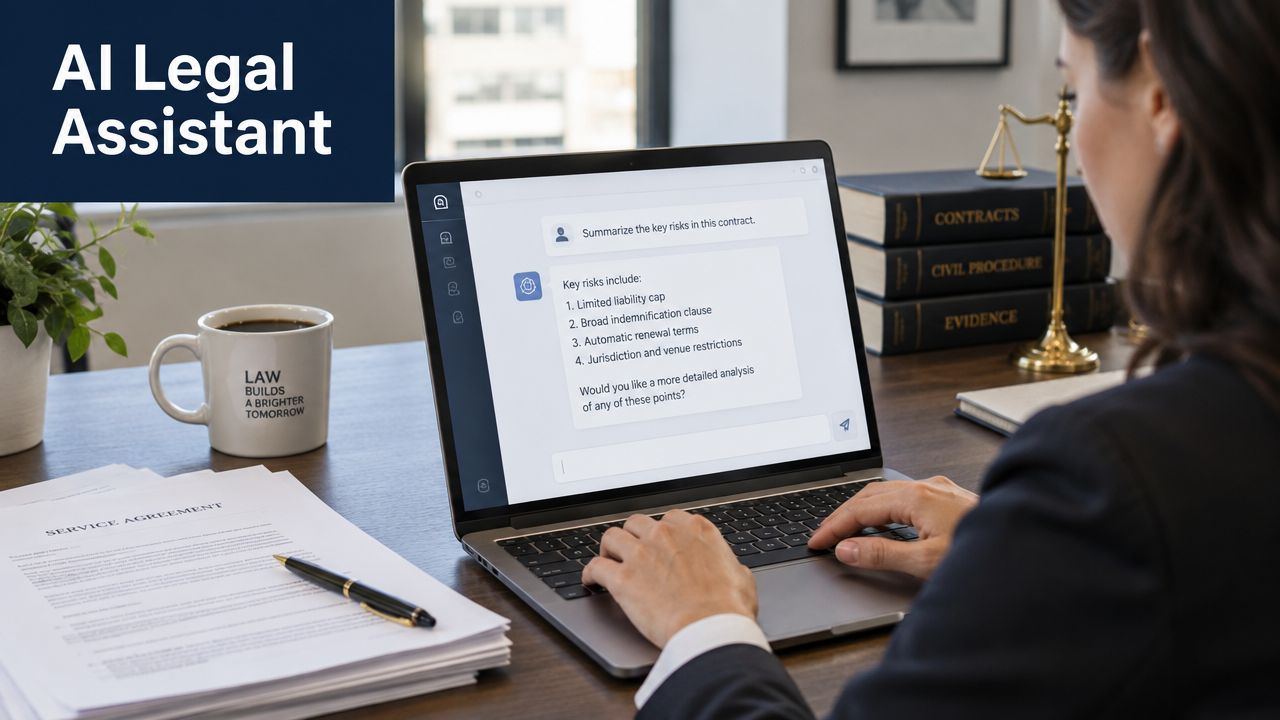
Citations make verification possible, not optional
A response with citations is more useful than an unsupported answer, but citations still need independent review. Lawyers should confirm that the authority says what the response claims, that the jurisdiction is correct, and that the reasoning hasn't skipped a material qualification.
Firms should also define which repositories and document categories the assistant may access. Customization around firm precedent and deal templates can improve relevance, but it increases the importance of access controls and confidentiality boundaries.
The adoption pattern reinforces the tool's internal role. In Thomson Reuters' 2025 professional-services findings, document review accounted for 77%, legal research for 74%, document summarization for 74%, and brief or memo drafting for 59% of reported legal AI use cases, as summarized in Thomson Reuters' overview of AI in the legal profession. Those are high-volume production tasks. They don't demonstrate that the firms using them are independently recommendable to AI systems.
9. LexisNexis Legal Workflow Automation
LexisNexis Legal Workflow Automation addresses repeatable processes such as document assembly, contract generation, compliance screening, and filing management. The strongest candidates are workflows with stable inputs, predictable decisions, and enough volume for the firm to benefit from removing manual handoffs.
A collections practice could automate recurring demand letters and filing steps. A corporate legal department might standardize contract generation for familiar transaction types. A real estate practice could connect document assembly with recording management across a portfolio. In each example, the system's value depends less on novelty than on whether the process has been mapped accurately.
Automation begins with process definition
Teams should document the current workflow before configuring automation. That means identifying approvals, exceptions, data sources, handoffs, and points where a lawyer must exercise judgment.
A sensible first pilot uses a high-volume, low-variance process. Human checkpoints should remain at decision-critical stages, even when the surrounding steps are automated. Firms should also measure whether the workflow improves completion quality and matter visibility, rather than assuming that fewer manual actions equal better client service.
Automation can compress internal turnaround and reduce routine work. It won't necessarily improve external AI representation. A firm that automates intake or filing may still be categorized vaguely by generative systems if its practice descriptions, biographies, publications, and third-party references don't communicate a coherent area of authority.
10. Symantec Legal Manager AI-Enhanced Practice Management
Symantec Legal Manager is positioned at the business layer of legal practice management. Rather than focusing mainly on documents or case authorities, it analyzes firm data to support profitability analysis, resource allocation, opportunity identification, revenue forecasting, and client relationship decisions.
That makes it relevant to managing partners and practice leaders deciding where to invest. A mid-market firm might examine whether existing clients have adjacent needs served by other practices. A boutique could use relationship signals to identify clients at risk of disengagement. A larger firm might analyze matter economics before restructuring a practice group.
Business analytics needs partner interpretation
Profitability models can miss relationship value, market reputation, referral significance, or the strategic importance of a client that isn't immediately profitable. Churn indicators can identify questions for relationship partners, but they shouldn't determine a client strategy without context.
The operational risk is not only inaccurate data. It's overconfident interpretation. Partners should test AI-generated conclusions against their experience and incorporate the analysis into formal planning rather than acting on isolated alerts.
Firm operations influence positioning indirectly. Better client knowledge may sharpen the practices a firm chooses to develop, and clearer strategic focus can improve its public narrative. But the software doesn't measure whether AI systems cite or recommend the firm. That remains a distinct AI recommendation intelligence problem.
11. CitationOS AI Recommendation Intelligence
CitationOS measures an external decision layer that ordinary legal work and practice-management software does not expose. It examines how generative systems represent, cite, and recommend law firms for high-intent queries, including whether a firm appears in a shortlist and how clearly its capabilities are described.
A firm may have strong search visibility and publish consistently yet remain absent from AI-generated recommendations for a core practice area. Another firm may be mentioned but receive less explanation, weaker context, or less consistent placement than competing practices. These outcomes affect discoverability at the point where a prospective client narrows options.
Measurement separates presence from authority
CitationOS evaluates citation presence, narrative depth, top-3 rate, entity consistency, and AI recommendation authority. Its AI Visibility Index, or AVI, separates a basic mention from a description that gives users enough specific, consistent information to assess the firm.
A useful audit asks four separate questions:
- Representation: Does the system describe the firm accurately in decision-critical queries?
- Entity authority: Are the firm's name, practices, people, locations, and attributes consistent across external sources?
- Competitive positioning: How does the firm's description compare with other named firms in the same query environment?
- Selection outcome: Does the firm appear among the recommendations a prospective client is likely to consider?
The platform is diagnostic. It does not establish that a firm can control generative outputs. Its findings can help identify whether a visibility problem relates to search discovery, GEO or answer engine optimization, often called AEO, source extraction, or the recommendation layer. Appearing somewhere in an answer is not the same as being selected when a user forms a shortlist, and that difference is measurable.
The sample also shows why broad visibility claims need query-level inspection. Across 116 firms, 78% were invisible to AI recommendations over 16 months of diagnostics. That result describes recommendation performance in the measured environment, not a universal market rate. Partners should therefore examine which practice queries produce omissions, how competitors are framed, and whether the firm's own descriptions remain consistent across sources before changing content or positioning.
12. Selecting Tools by Workflow and Recommendation Layer
A firm should select software by the legal decision or handoff it is meant to improve. Litigation teams may prioritise authority research, case assessment, and document review. Corporate practices may need contract analysis, precedent guidance, and repeatable workflow automation. Leadership may require operational reporting, while marketing and business-development teams need a separate way to assess AI recommendations.
Evaluate each category against its actual workflow:
- Authority research: source-backed material for lawyer analysis, with verification requirements made explicit.
- Case assessment: structured evidence for early strategy and risk discussions.
- Contract and due diligence: extracted provisions, identified issues, and drafting support.
- E-discovery: ranked, classified, and reviewable document collections.
- Practice guidance: checklists, forms, and repeatable institutional procedures.
- Firm operations: business, staffing, and relationship information for planning.
- AI recommendation intelligence: evidence of how a firm is represented, cited, and included in prospective shortlists.
Feature breadth is only one test. Review source verification, confidentiality controls, human-review requirements, system integrations, jurisdictional fit, and performance with incomplete or inconsistent inputs. A tool that performs well in a controlled demonstration may still create verification work or fail at a critical handoff.
Pilot one bounded workflow with documented review checkpoints and a defined success measure. Record internal outcomes separately from external indicators, including citation presence, narrative depth, top-3 rate, and competitive positioning. CitationOS's selection-layer framework explains why appearing in an answer does not establish that a firm was shortlisted.
A practical distinction follows:
A firm's software stack can improve execution without improving its position in an AI-generated shortlist.
CitationOS's diagnostics covered 116 firms, found 78% invisible to AI recommendations, and examined 16 months of data. These findings support a measurement question, not a promise about any particular tool: does improved internal work also change how generative systems represent and recommend the firm?
Leadership should therefore define the intended outcome before procurement. Internal efficiency, evidence quality, and external recommendation visibility are related, but one does not prove the others.
12 AI Tools for Law Firms, Features, Workflow & Recommendations
The useful way to group AI tools for law firms is by the work they do. Research systems help lawyers find authority. Contract-intelligence tools support clause review and due diligence. E-discovery platforms sort large document sets for relevance and privilege. Practice-automation tools reduce repetitive handoffs. Firm-operations analytics help leadership track resource use and profitability. AI recommendation intelligence sits in a separate layer, because it measures whether a firm is surfaced, cited, or shortlisted by generative systems.
That separation matters. Adoption inside the firm does not establish external discoverability. CitationOS scored 116 firms across a 16-month diagnostic window and found that 78% were invisible to AI recommendations. The implication is straightforward. A stack can improve internal execution while leaving a firm absent from the answer layer that clients may now see first.
| Work category | Core capability | Primary benefit | Target audience | Operational note |
|---|---|---|---|---|
| Authority research | Natural-language legal research with citation ranking | Faster research centered on authority | Litigation teams handling complex matters | Best judged by accuracy, source coverage, and verification burden |
| Case assessment | Predictive and judge-level analytics | Supports early strategy and risk discussion | Litigation teams that need case-pattern analysis | Useful only where the underlying data is current and comparable |
| Contract and due diligence | Legal document review with precedent-aware analysis | Speeds review of sensitive documents | Corporate, PE, and M&A teams | Trade-off is model confidence versus the need for lawyer review |
| E-discovery | Classification, privilege detection, relevance scoring | Reduces manual review in large matters | Teams managing high-volume discovery | Operational value depends on data hygiene and review protocol |
| Practice guidance | AI-assisted notes, checklists, and clause comparison | Standardizes repeatable drafting workflows | Transactional and commercial teams | Best for controlled workflows, not open-ended legal judgment |
| Discovery analytics | Entity extraction, timelines, and relationship mapping | Turns document sets into case narratives | Civil litigation and fraud or antitrust teams | Strong for pattern finding, weaker for final legal conclusions |
| Legal assistant | Conversational research and drafting with source support | Quick first-pass work and cite checking | Solo, small, and mid-market firms | Output still requires lawyer verification before filing or client use |
| Workflow automation | Process mapping and document automation | Cuts repetitive internal work | High-volume transactional practices and legal ops | Setup quality determines whether automation saves time or creates exceptions |
| Practice-management analytics | Profitability, resource, and matter-flow analysis | Supports staffing and business decisions | Firm leadership and legal operations teams | Only as good as timekeeping, matter coding, and other source data |
| CitationOS AI Recommendation Intelligence | Confidential audits, cross-system AI representation analysis, Citation Score, dashboard | Diagnoses why firms are absent from AI shortlists | CMOs, managing partners, marketing, and strategy teams | Measures the recommendation layer, not practice software |
| Selecting tools by workflow and recommendation layer | Workflow-to-tool mapping and evaluation criteria | Matches a business problem to the right tool and metric | Procurement teams, legal ops, decision makers | Selection should separate internal efficiency from external AI visibility |
The selection question is narrower than the category list suggests. A firm should start with the highest-cost workflow, then test whether the data behind that workflow is clean enough for automation or analysis. That is where confidentiality, verification burden, and implementation risk become practical constraints rather than abstract concerns.
A research tool can speed authority gathering. A contract system can compress review cycles. E-discovery software can organize review at scale. Workflow automation can remove repetitive steps. Practice-management analytics can improve resourcing decisions. None of those outcomes proves that a firm is understandable to AI systems outside the firm, or that it will be recommended when a client asks a generative system for options.
The diagnostic evidence points to that gap. CitationOS reported that many firms remain unseen even while they continue to invest in AI internally. That does not mean adoption is wasted. It means software choice and recommendation visibility are separate problems, and they need separate measurement.
The Stack Is Not the Strategy
Procurement should start with the workflow that carries the highest cost, then test the quality of the data behind it and the firm's tolerance for confidentiality, verification, and implementation risk. Category popularity is a weak filter. A tool can fit a task and still leave the firm exposed to avoidable review burden or weak evidence discipline.
Research systems help lawyers locate authority. Contract intelligence shortens document review. E-discovery platforms organize large collections for review. Workflow automation removes repetitive handoffs. Practice-management analytics improve decisions about clients, staffing, and profitability. Each function solves a real operational problem, but none of them, by itself, establishes how a firm will be perceived by external AI systems that assemble a shortlist for a prospective client.
Adoption data shows why that distinction matters. The American Bar Association's summary of the 2025 legal industry report reports that 53% of Am Law 200 firms had purchased generative AI solutions, 45% were already using them for legal work, and 43% had a dedicated budget line for generative AI. Those figures describe investment and use. They do not show which firms are trusted, cited, or recommended outside the firm.
Thomson Reuters reported that active generative AI use among legal organizations reached 26% in 2025, up from 14% in 2024, with adoption at 28% in law firms and 23% in corporate legal departments, in its 2025 generative AI adoption summary. That growth expands internal capability, but it does not create external differentiation on its own. If many firms buy similar tools for similar work, the software stack becomes an uneven signal of market position.
Executives need two separate measurement systems. One tracks internal performance, including review quality, source verification, workflow completion, escalation rates, and implementation discipline. The other tracks external selection outcomes, including citation presence, narrative depth, top-3 rate, entity authority, and competitive positioning.
The CitationOS diagnostics make the gap concrete. They scored 116 firms across 16 months and found 78% invisible to AI recommendations. A firm can be visible in search, appear in isolated content, and run efficient internal processes while still missing the shortlist generated by an AI system for a high-intent prospect.
Discovery, extraction, and recommendation are separate tests. A firm that clears the first two can still fail the third at the moment a shortlist is built. That is the boundary between internal efficiency and external AI visibility. CitationOS sits on the recommendation side of that boundary, measuring whether a system trusts a firm enough to cite and recommend it.
A tool investment should begin with the workflow, then be checked against the selection layer. Leadership should ask whether the firm's practice focus, entity signals, and narrative are legible when an AI system assembles options. Otherwise, the firm may be improving work that clients never see while overlooking the layer that increasingly shapes the first shortlist.