AI marketing for lawyers has moved beyond content production. A 2026 legal-industry release reports that 78% of legal queries trigger a Google AI Overview, while AI referral traffic to legal sites grew 527% between January and May 2025. The same release says AI-referred prospects convert at 4.4 times the rate of standard organic visitors, yet only 8% of users click a traditional result when an overview appears, compared with 15% without one. These figures point to a change in the economics of discovery, not merely another search feature. The legal-search findings suggest that firms are increasingly evaluated before a prospective client reaches their website.
That creates a leadership problem. A firm can invest heavily in rankings, publish authoritative pages, and still fail to enter the shortlist an AI system produces for a high-intent query. The relevant question is no longer only whether the firm can be found. It's whether the firm is represented accurately, cited consistently, and recommended among the options a buyer considers.
The Visibility Problem Most Law Firms Have Not Named
CitationOS research provides a sharper starting point than traffic reporting alone. Across 116 firms, measured through 16 months of diagnostics, 78% were invisible to AI recommendations. That result challenges a familiar assumption: strong traditional search visibility doesn't necessarily translate into inclusion when an assistant summarizes a market or recommends firms for a specific matter.
The distinction matters because legal research now happens across several surfaces. A prospective client may still use a conventional search result, but may also ask an AI system to identify firms for a practice area, compare capabilities, or narrow a long list into a few names. A referral source can follow a similar path. If the firm's public information is incomplete, inconsistent, or weakly corroborated, the system may omit it even when the firm holds respectable page-one positions.
The visibility fallacy in legal search is treating ranking as proof of consideration. Ranking measures where a page appears in a traditional results environment. It doesn't measure whether an AI system extracts the firm's practice focus, associates it with the right matter type, or includes it in a recommendation.
The click is no longer the first decision
The reported change in click behavior reinforces that point. When Google AI Overviews appear, organic CTR has been reported to fall from 1.76% to 0.61%, a 61% decline, while paid CTR fell 68%. Zero-click search rose from 56% to 69%, meaning more than two-thirds of searches ended without a website click. The legal-search analysis frames the commercial consequence clearly: a firm can lose the click while still competing for inclusion in the answer.
That creates a new causal chain: answer inclusion, shortlist consideration, direct contact. The website remains important, but it increasingly supplies evidence to the systems that summarize and compare firms. Branded traffic can conceal this shift because known prospects may access it directly while new prospects never reach the site at all.
The underlying issue is representation
A firm's AI visibility depends on more than publishing additional articles. Systems need coherent signals about the firm's identity, locations, practice areas, attorneys, credentials, and relationship to recognized sources. If one directory uses a broad practice label, a bio uses a narrower one, and a third-party profile omits the relevant experience, the system receives an ambiguous entity.
That ambiguity is especially costly in legal services because trust is already constrained. Only 25% of legal executives currently trust generative AI to handle legal work, while 37% say their firms already use AI tools, according to LexisNexis research. A low-trust environment makes citation quality and corroboration more important, not less. AI recommendation intelligence begins with diagnosing that representation gap.
SEO, GEO, and AI Recommendation Intelligence Defined
Think of the three layers as three separate checkpoints in a referral process.
SEO determines whether a traditional search system can discover and rank a page. Generative engine optimization, or GEO, determines whether an AI system can extract information from that page and use the domain as a source. AI recommendation intelligence evaluates what happens after extraction, when the system decides how to characterize the firm and whether to place it among the leading options.
These layers overlap, but they don't answer the same question.
SEO governs discovery
SEO is the conventional retrieval layer. It concerns crawlability, relevance, page structure, links, technical accessibility, and the relationship between a query and a result. Its common indicators include rankings, impressions, organic sessions, and conversions attributed to search.
A firm can perform well here and still be absent from an AI answer. A page may rank for “commercial litigation firm” but fail to communicate the jurisdictions served, the industries handled, or the matter types that distinguish the firm. Traditional ranking can expose a page without giving an assistant enough structured meaning to recommend the firm confidently.
GEO governs extraction and citation
GEO focuses on whether generative systems can identify, retrieve, summarize, and cite the firm's information. The relevant signals include citation presence, source selection, answer-shaped content, corroborating references, and clear claims.
The practical analogy is a briefing document. SEO gets the document into the research room. GEO makes its relevant passages easy to locate and safe to reuse. If a practice-area page buries its principal claims in vague promotional language, the system may understand less than a human visitor does.
GEO doesn't guarantee selection. A firm can be cited as background while another firm is recommended as the stronger fit.
AI recommendation intelligence governs selection
AI recommendation intelligence measures the decision layer. It asks how a firm is described in commercial prompts, whether its entity is complete, whether its narrative matches its intended position, and how often it appears in the top-3 rate for relevant recommendations.
AI recommendation authority and entity authority become operational concepts. Entity authority concerns whether systems can connect the firm's name, attributes, people, locations, and capabilities across sources. Narrative depth concerns whether the system can explain why the firm fits a particular matter, rather than merely recognizing its name.
Practical rule: Treat ranking, citation, and recommendation as separate outcomes. Improving one doesn't prove that the other two improved.
A useful diagnostic sequence is therefore: SEO asks, “Can the system find us?” GEO asks, “Can it use us as evidence?” AI recommendation intelligence asks, “Does it select and describe us correctly when a buyer needs a shortlist?” CitationOS belongs to the last category. It's an AI recommendation intelligence platform, not an SEO agency, GEO agency, or digital marketing company.
High-Impact AI Marketing Use Cases for Law Firms
The highest-value applications aren't the ones that generate the most content. They're the ones that change how a firm enters a decision set.
The market is already moving in that direction. 41% of law firms said their legal teams were using generative AI in 2026, up from 28% in 2025, and marketing represented a 35% use case share, according to Thomson Reuters. That adoption makes prioritization more important. Firms need to direct AI marketing toward selection outcomes, not just internal efficiency.
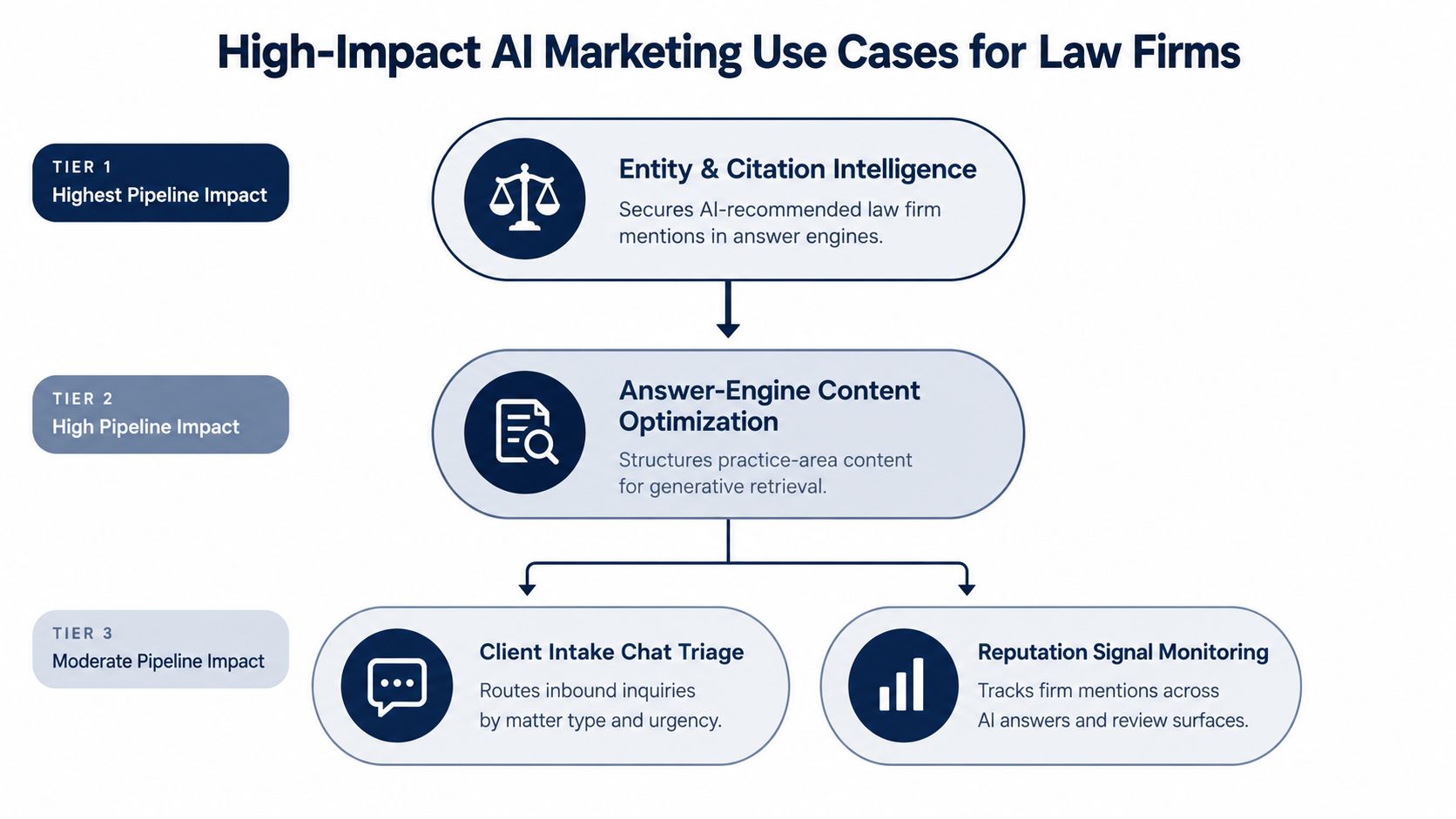
First priority is entity and citation calibration
The first use case is auditing how the firm appears across the sources AI systems rely on. That includes firm names, attorney profiles, locations, practice labels, representative matters, credentials, and external references.
The objective isn't to add identical text everywhere. It's to resolve contradictions and fill structural gaps that force an AI system to infer too much. For example, a firm may want recognition for cross-border investigations, while its most authoritative external profiles describe it only as a general business law practice. The gap affects recommendation fit.
Second priority is answer-engine content optimization
Practice-area content should make material claims explicit, support them with authoritative citations, and organize information around questions a buyer asks. This doesn't mean writing for machines at the expense of human readers. It means reducing ambiguity so an answer engine can identify the firm's relevant expertise and reuse it accurately.
The strongest content is specific about scope, jurisdiction, client type, matter type, and attorney responsibility. It distinguishes general legal information from advice and gives reviewers enough context to approve every substantive statement. Guidance on AI tools for law firms is most useful when it connects production workflows to these verification requirements.
Third priority is competitor displacement diagnosis
A firm should test which competitors appear in commercial prompts for its priority matters, what attributes the system assigns to them, and which sources support those descriptions. The point isn't to imitate a rival's language. It's to identify an authority gap, such as stronger external corroboration, clearer practice categorization, or more complete attorney-level information.
Lower in the stack, AI can support persona research, pitch synthesis, intake routing, and marketing-performance analysis. Those uses may save time, but they don't automatically improve recommendation authority. Intake systems should collect matter type and urgency without offering legal advice, and confidential matter information should remain outside unapproved marketing workflows.
Governance, Confidentiality, and Ethical Boundaries
Legal marketing cannot treat governance as an editing step after content generation. The firm needs a decision system that determines what information may enter a model, what requires attorney review, and what must never be generated.
The first control is data classification. Every prompt input should be labeled as public, firm-confidential, or matter-privileged. Public practice descriptions may be eligible for approved workflows. Internal strategy, unpublished deal information, and client-specific details require stricter controls. Matter-privileged content should be blocked from general marketing models and vendor retention systems unless the firm has expressly approved the environment and use.
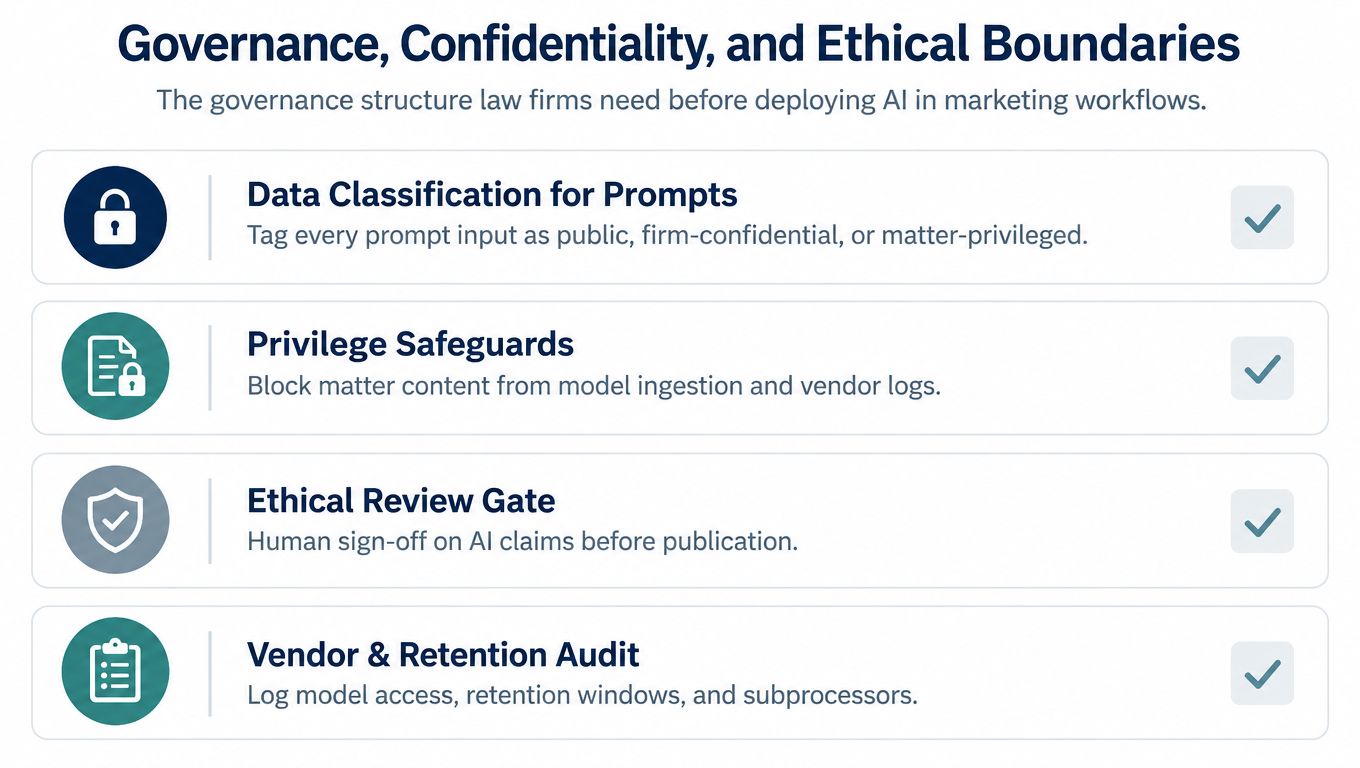
Four controls should precede publication
Source verification comes first. A writer or attorney must verify every case citation, credential, outcome, date, statistic, and regulatory statement against an approved source. Generative systems can produce plausible but fabricated authorities, and a polished sentence can make the error harder to detect.
Human review then determines whether the language accurately represents the firm and avoids unauthorized legal advice. A practice-area page can explain services and legal concepts, but an automated intake exchange must not make substantive representation calls or imply an attorney-client relationship.
Disclosure standards should be explicit where a user may believe they're communicating with a lawyer. Intake triage can route inquiries by location, matter type, and urgency. It shouldn't provide a legal opinion, promise an outcome, or disguise automated interaction as attorney communication.
Vendor and retention controls complete the chain. The firm should log model access, retention windows, subprocessors, and the classes of information each workflow can process. A marketing director may approve public drafting assistance, while a practice-group leader or ethics officer may need to approve claims involving regulated areas or client outcomes.
The publication decision should be categorical
A simple rule set reduces inconsistent judgment:
- AI-assisted content: outlines, public-source summaries, formatting, metadata drafts, and non-substantive editing, subject to review.
- Attorney-led content: legal interpretations, jurisdiction-specific analysis, case descriptions, outcome claims, and material statements about professional experience.
- Prohibited generation: fabricated citations, invented results, confidential matter details, individualized legal advice, and unreviewed claims presented as firm fact.
Governance is what makes scale possible. Without it, one hallucinated citation or confidentiality incident can cause leadership to suspend every useful workflow, including those that never touched sensitive information.
Measurement Beyond Mentions
A firm can be mentioned by an AI system and still be commercially irrelevant. The system may name the firm in a long list, attach the wrong practice area, cite a weak source, or omit it when the prompt asks for the best options. Measurement must therefore follow the path from recognition to recommendation.
The first tier is surface mention. It answers whether the firm's name appeared. This is useful for monitoring, but it says little about fit or influence.
The second is citation presence. It measures whether the system used the firm or its sources as supporting evidence. Citation presence is stronger because it indicates that the firm contributed information to the answer, not merely that its name was recognized.
The third is narrative depth. This evaluates whether the system can explain the firm's practice focus, relevant experience, locations, client types, and distinguishing attributes. A shallow narrative can produce a technically accurate mention that fails to support selection.
The fourth is top-3 rate. This measures whether the firm appears among the leading recommendations for defined commercial prompts. It is the closest of these indicators to shortlist formation, though it must be segmented by practice area, geography, matter type, and prompt intent.
| Metric Tier | Indicator | Decision Relevance |
|---|---|---|
| Surface | Firm name appears | Detects recognition, but not selection |
| Citation | Firm or authoritative source is cited | Shows evidentiary inclusion |
| Narrative | System describes relevant capabilities accurately | Indicates interpretive strength |
| Recommendation | Firm enters the top three options | Measures shortlist-level visibility |
Testing must reflect real buying situations
A useful diagnostic set contains prompt classes rather than isolated keywords. Test questions should cover discovery, comparison, urgency, geography, industry, and matter complexity. The same firm may be visible for “find a lawyer” and absent for “compare firms for a cross-border investigation involving a regulated company.”
Competitor citation gaps add context. If another firm appears repeatedly, the analysis should identify the sources and attributes supporting that appearance. It should then track whether changes to entity information, authority content, or external corroboration alter the firm's narrative.
The measurement interval should be long enough to separate a temporary answer variation from a sustained change. Quarterly reviews can connect movements in citation presence, narrative depth, and top-3 rate to specific authority-building actions. Surface-level AI tools often stop at mentions, which is why leadership dashboards need a deeper measurement model.
Attribution will remain imperfect. A prospect may encounter a recommendation, search the firm by name later, and contact it through a referral or direct visit. That doesn't make AI discovery unmeasurable. It means CRM teams should capture self-reported discovery, referral context, query themes, and practice-area fit alongside conventional source attribution.
Integrating Citation Intelligence With the Marketing Stack
Citation intelligence becomes strategically useful when it changes the next action in the marketing system. A diagnostic report that sits outside the CRM, editorial calendar, public-relations workflow, and leadership dashboard becomes another isolated metric. An integrated system turns recommendation signals into prioritization.
The first connection is to the content-management process. If a practice group has weak narrative depth for a defined matter category, the editorial brief should address that gap directly. The brief may require clearer service descriptions, attorney-specific evidence, jurisdictional context, and citations to authoritative public sources. The diagnostic should inform the subject and structure, while attorneys retain responsibility for substantive accuracy.
The second connection is to external authority work. When an AI system relies on inconsistent or incomplete sources, the firm can identify which profiles, directories, publications, or professional references need correction or expansion. That doesn't mean pursuing every mention. It means directing public-relations effort toward sources that can clarify the firm's entity and corroborate its priority capabilities.
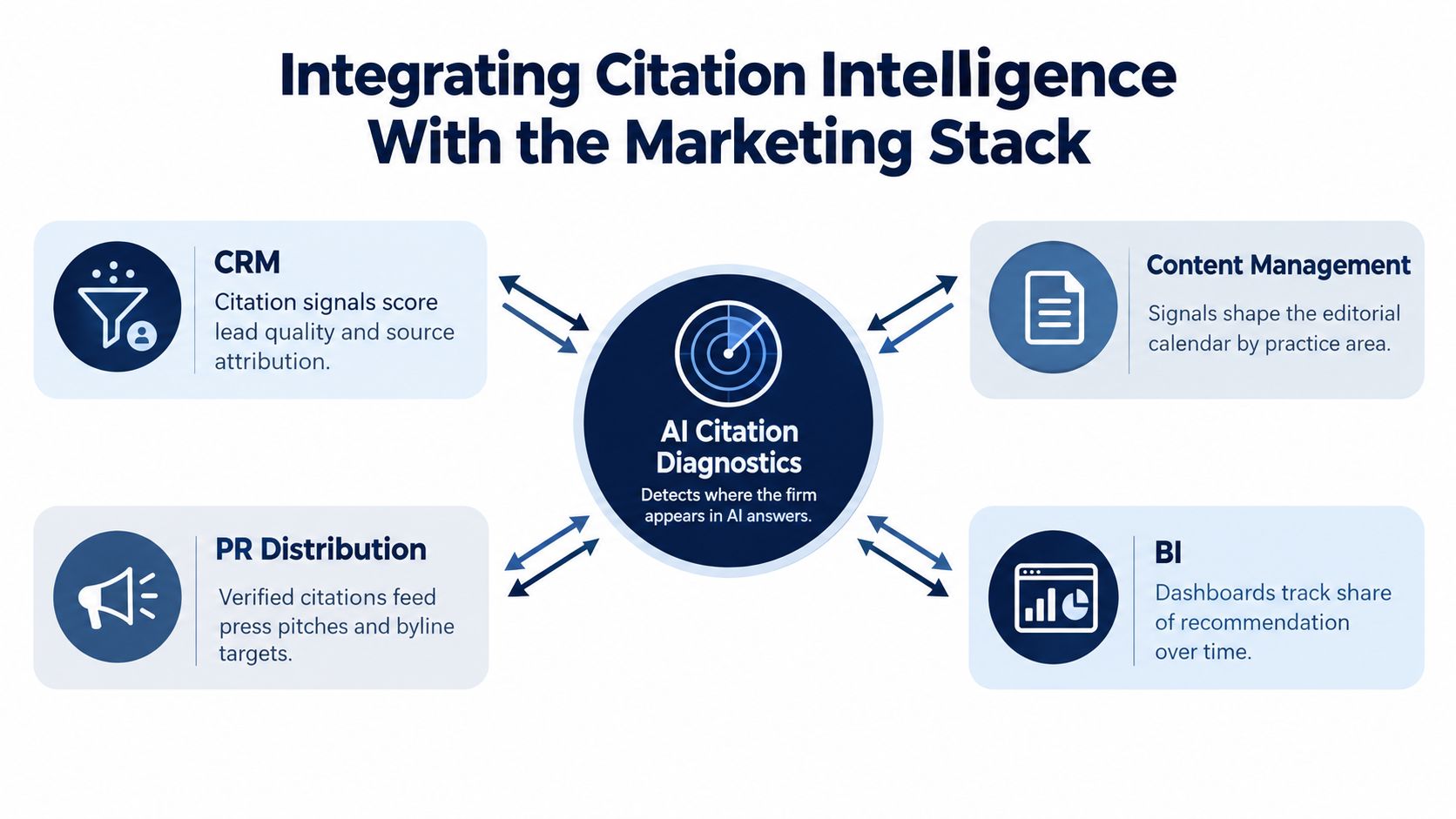
Four integration points create the feedback loop
CRM enrichment connects AI-derived discovery signals to lead records. Intake teams can record whether a prospect arrived after an AI recommendation, what matter type they described, and whether the firm's represented capability matched the inquiry.
Content management converts citation gaps into prioritized editorial work. A page shouldn't be commissioned merely because a competitor published one. It should be commissioned because the firm is underrepresented for a commercially important prompt class.
PR distribution uses authority gaps to guide source selection. A byline, interview, or professional profile has more strategic value when it reinforces an entity attribute the recommendation layer currently misses.
Business intelligence gives leadership a time series for citation presence, narrative depth, and top-3 rate by practice group. It also provides a place to test whether corrective actions affected recommendation outcomes rather than only page traffic.
Integration architecture matters more than tool count
Firms often treat AI marketing as an additional channel, alongside search, email, public relations, and referrals. That framing limits its value. The recommendation layer is better understood as a diagnostic lens that helps decide where those existing channels should concentrate effort.
The operating loop is straightforward: diagnose, prioritize, publish or correct, verify, and feed the result back into planning. The firm can then distinguish activity from progress. More content isn't the objective. Better representation at the moment of shortlist formation is.
The Narrowing Window and What to Do Next
The strategic window is narrowing because recommendation systems learn from recurring public signals, while competitors are beginning to test the same decision surfaces. Early work has an asymmetric advantage: it establishes a baseline before the firm changes its information structure, reveals gaps before they become entrenched, and gives leadership a reference point for judging whether later actions worked.
The evidence of adoption supports urgency without requiring panic. In 2025, 80% of respondents in a legal-technology survey said their firms were using or exploring generative AI, including all firms with 700 or more attorneys and 63% of firms with 50 or fewer attorneys. The Thomson Reuters report also found that law-firm use reached 28%, while only 15% of law-firm respondents said GenAI was already central to workflow. The gap is operationally important. Many firms are experimenting, but relatively few have integrated AI into the systems that determine visibility and selection.
The first decision isn't whether to produce more AI-assisted content. It's whether leadership can measure how the firm is represented before competitors define the category.
Leadership should make six decisions
Commission a baseline audit. Test the firm and its priority practice groups across relevant recommendation prompts, then record citation presence, narrative depth, entity consistency, and top-3 rate.
Assign one accountable owner. Recommendation-layer performance should sit with a named marketing or business-development leader, with attorney reviewers involved where claims or legal interpretation are affected.
Reserve a quarterly budget. Funding should cover diagnostics, source correction, authority content, governance review, and measurement. Without a defined allocation, the work will compete unsuccessfully with urgent campaign activity.
Approve governance before publication. Classify prompt data, establish review gates, prohibit matter-privileged inputs in unapproved workflows, and define what automated intake may and may not say.
Connect diagnostics to reporting. Add AI visibility indicators to the existing marketing cadence rather than creating an isolated innovation report. Segment the results by practice area, geography, and matter type.
Set a 90-day review milestone. Agree in advance on the evidence that supports continuation, revision, or suspension. The review should assess movement in recommendation metrics and the quality of representation, not output volume.
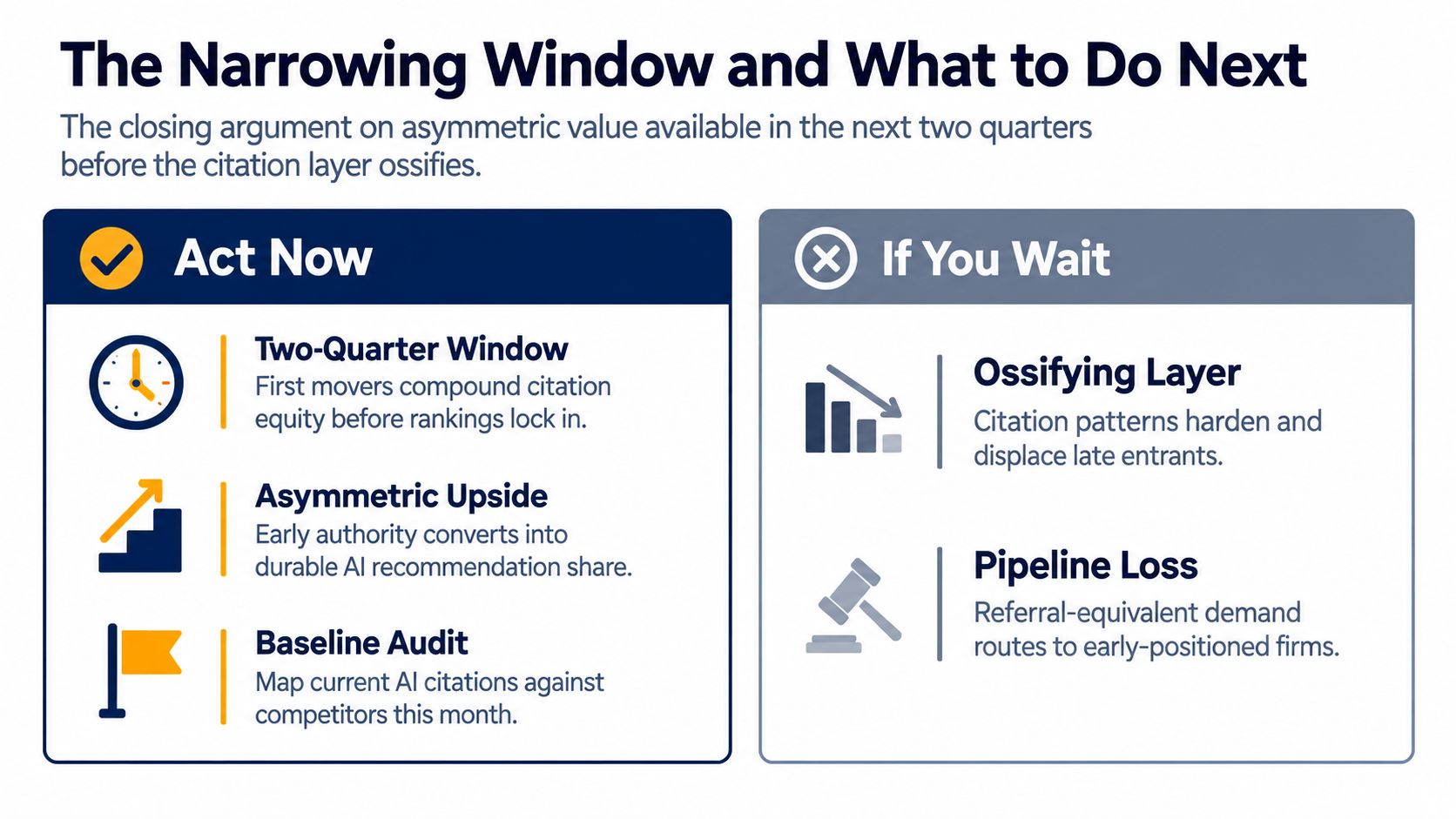
The implication is specific. SEO helps systems discover you. GEO helps systems extract and understand you. AI recommendation intelligence measures whether those systems trust and recommend you. Firms that treat the third layer as a measurable management responsibility can still shape how their capabilities enter AI-mediated shortlists. Firms that wait for referral data to reveal the shift may discover that the recommendation layer has already routed demand elsewhere.
CitationOS provides confidential AI citation audits, representation analysis, competitive benchmarking, entity consistency assessment, and ongoing measurement across AI recommendation environments. Visit CitationOS to establish a firm-level baseline for citation presence, narrative depth, and top-3 recommendation performance before setting your next marketing plan.