AI recommendation visibility is already a binary commercial problem. In a 16-month diagnostic covering 116 firms, 78% were invisible to AI recommendations, despite operating in markets where traditional search visibility may already be strong. That finding changes the question executives should ask. The issue isn't whether a firm can be found somewhere online. It's whether an AI system names that firm when a prospective client asks which organization to consider.
This is the selection moment. It occurs inside a synthesized answer, before a buyer visits a website, compares a results page, or contacts a shortlist. An AI visibility platform exists to measure that moment, explain why it happened, and identify the structural conditions behind inclusion or omission.
The Binary Reality of AI Selection
Pages in the top three organic results were cited somewhere by AI in 98.9% of cases, while pages in the top 10 were cited 90.0% of the time and pages outside the top 10 still appeared in citations 49.3% of the time, according to the analysis of AI citation behavior beyond rankings. Citation is therefore related to discoverability, but it does not establish that a firm will be recommended.
Traditional search presents visibility as a spectrum. A firm can rank prominently, move down the results, earn a featured result, or receive little exposure. AI recommendation systems compress that range into a decision surface. When a user asks for a specialist, adviser, clinic, or legal firm, the system often returns a short list of names. A firm is either selected for that answer or omitted.
The commercial consequence is strongest in legal, financial, medical, and luxury markets, where buyers assess expertise, credibility, location, relevance, and fit. These decisions rarely involve interchangeable providers. If an AI system leaves a firm out while defining the buyer's shortlist, strong visibility elsewhere offers limited protection.
A 16-month diagnostic of 116 firms found that 78% of firms were invisible to AI recommendations, according to the analysis of the AI selection moment. That finding does not show that traditional search optimization has stopped working. It shows that search visibility and recommendation visibility represent different outcomes, and require separate measurement.
Discovery doesn't guarantee selection
AI systems retrieve and combine evidence from multiple sources. They may find a firm through its website, then assess it using directories, editorial references, professional profiles, reviews, and other third-party material. The final answer reflects how those signals fit together across the entity, rather than the performance of one page.
Selection is the point at which this evidence becomes commercially relevant. A firm can be discoverable, cited, or described without being chosen for a specific client need. Recommendation measurement must therefore examine the answer itself, not only the sources available to the system.
Practical rule: Treat organic rank as evidence that a system may discover a source. Treat AI selection as a separate business outcome that requires direct measurement.
The omission is the diagnostic signal
A mention count can conceal the most important failure. A firm may appear in low-intent answers, receive an inaccurate description, or surface only as a generic directory entry while another firm receives the recommendation for a specific practice or client need.
The operative question is, “Does AI select us for the questions that influence demand?” An AI visibility platform should expose that result at query level, across systems, locations, practice areas, and competitive contexts. Its value lies in diagnosing the binary selection moment, where a firm either enters the recommendation or disappears from consideration.
Defining the AI Visibility Platform Category
A controlled RAG testbed spanning 252,000 trials across six large language models found that topical relevance and candidate-list position were the strongest predictors of being cited first. Explicit pricing and recent timestamps also improved citation likelihood, while formatting-only changes had little effect, as detailed in the RAG citation selection study. The finding establishes an important boundary: retrieval signals influence what enters consideration, but they do not by themselves explain which firm appears in the final recommendation.
An AI visibility platform belongs to the category of AI recommendation intelligence. It measures how AI systems represent, cite, position, and recommend an entity in answers that influence a buyer's decision. SEO supports source discovery. Generative engine optimization supports extraction and interpretation. Recommendation intelligence evaluates whether the system selects the entity, and whether its description matches the firm's actual capabilities.
That distinction separates retrieval monitoring from selection diagnostics. A page can be retrievable without winning the final citation. The relevant observation is the binary selection moment: the firm either enters the recommendation for a defined need or remains absent from the answer.
The final answer is the measurement surface
Many analytics systems examine inputs, rankings, or retrieved documents. An AI visibility platform examines the answer delivered to the user. It records whether the firm appears, which sources support that appearance, how the system describes the firm, and which competing entities receive stronger positioning.
CitationOS is an AI Recommendation Intelligence platform that applies this measurement logic through an AI Visibility Index, or AVI. The framework evaluates citation presence, narrative depth, and top-3 rate, giving executive teams a way to separate general awareness from recommendation authority.
The AVI should not function as a universal score detached from context. AI systems use different evidence patterns, and performance can vary by platform, query, geography, and source type. A credible measurement system keeps the underlying observations visible, so analysts can trace a weak result to omission, inaccurate framing, poor source support, or competitor preference rather than treating every outcome as one undifferentiated number.
Measurement changes the executive question
The category earns its place in an analytics stack by answering operational questions. Which high-intent prompts omit the firm? Which sources support competitor recommendations? Does the system recognize a specialist capability, or reduce the organization to a generic category? Is the firm cited without being recommended?
These questions shift analysis from exposure to AI recommendation authority. They also identify where content investment will fail to solve the problem. The underlying constraint may be unclear entity definition, weak source coverage, stale information, or insufficient topical relevance. A platform that exposes those conditions functions as a diagnostic instrument for selection, not a vanity dashboard for visibility.
Metrics That Dictate Recommendation Authority
An analysis of 8,400 prompts found that the leading brand in a sector received an average of 31.4% of all brand citations, while the top three received 64.7% combined, according to AI citation concentration research. The figures establish why measurement must distinguish broad presence from prominence within an answer.
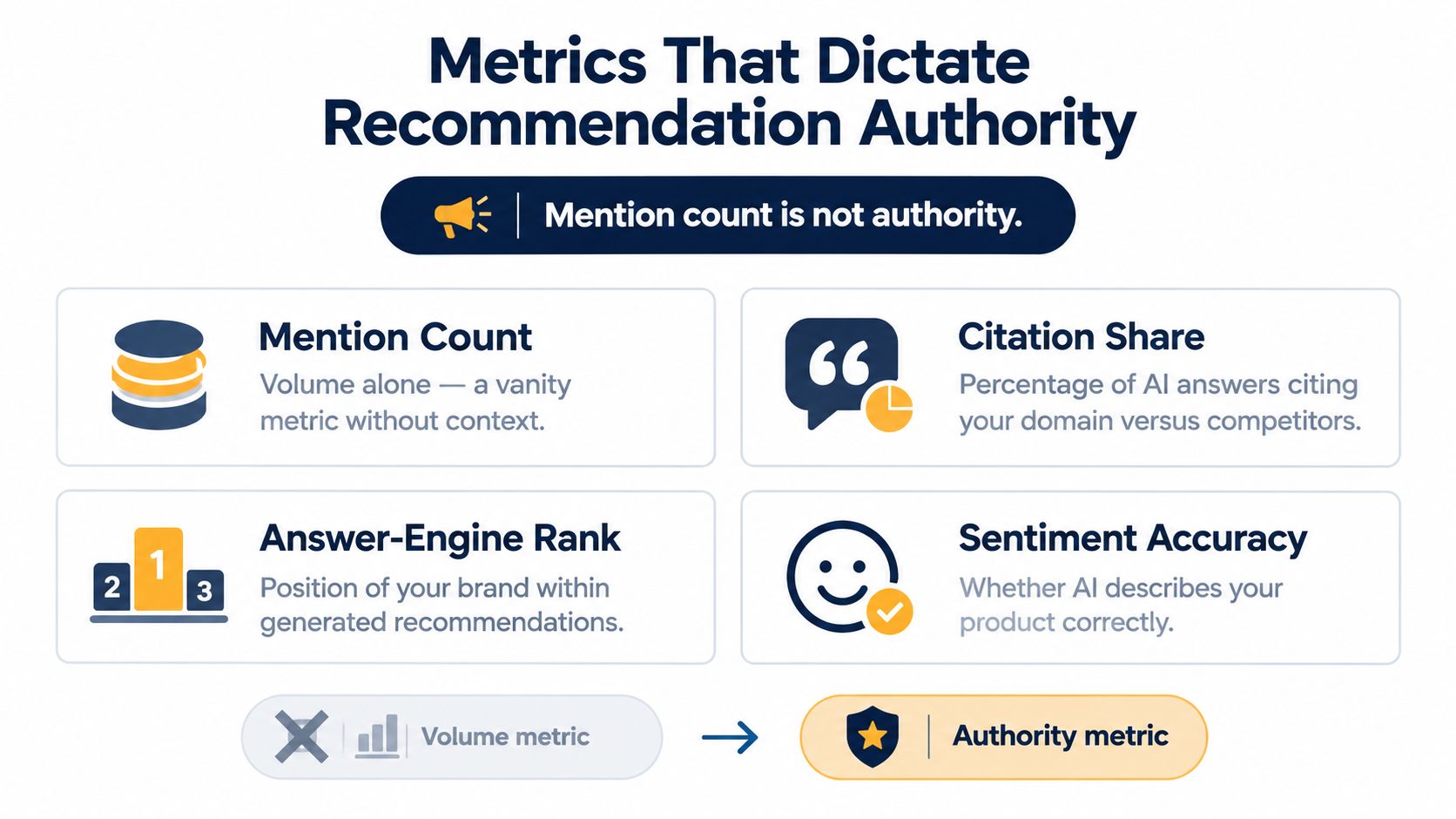
Citation presence records whether the firm appears in an answer or in the sources supporting it. The metric should separate direct citation from incidental reference, then segment results by engine, query intent, market, and competitor set. An aggregate figure can otherwise mask weak performance on priority prompts.
A related diagnostic question is whether the system understands the firm's position. Narrative depth measures the specificity of that understanding, including practice focus, geographic scope, client relevance, and differentiating expertise. A generic description indicates limited interpretation. A precise account aligned with the firm's actual positioning indicates stronger entity comprehension.
Surface-level AI tools measure retrieval rather than recommendation, as explained in how surface-level tools miss recommendation authority. That distinction makes ranking metrics insufficient on their own.
Concentration makes top-3 rate consequential
Top-3 rate measures how often a firm appears among the leading recommendations for priority prompts. It gives greater weight to position within the answer than to the total number of appearances. The same firm may have high citation presence while rarely entering the leading recommendation set, a pattern that points to a positioning or authority gap.
A useful measurement model separates five dimensions:
- Citation presence: Whether the firm appears in the answer or in its supporting sources.
- Narrative depth: Whether AI describes the firm with accurate, decision-relevant specificity.
- Top-3 rate: How often the firm appears among the leading recommendations for selected prompts.
- Source mix: Which owned, editorial, directory, review, or professional sources support the result.
- Entity authority: Whether independent signals consistently reinforce the firm's identity and expertise.
The value lies in the relationships between these measures. Strong citation presence with weak top-3 performance can indicate competitive positioning problems. Occasional recommendations combined with shallow narrative depth suggest that the system recognizes the name without connecting it to a clear capability. A narrow or heavily owned source mix may expose limited independent validation.
Research across 70 industry-targeted prompts and 1,702 citations found material variation in citation quality by engine. Pages with stronger quality scores and sufficient pillar coverage achieved a 78% cross-engine citation rate. Metadata and freshness, semantic HTML, and structured data were among the strongest associated attributes, according to the cross-engine citation quality study.
Recommendation authority therefore depends on two measurable conditions: the clarity of the firm's narrative and the technical and external evidence that supports it. A useful platform connects those conditions to the observed result rather than reducing them to a single score.
The Three-Layer Distinction in AI Discovery
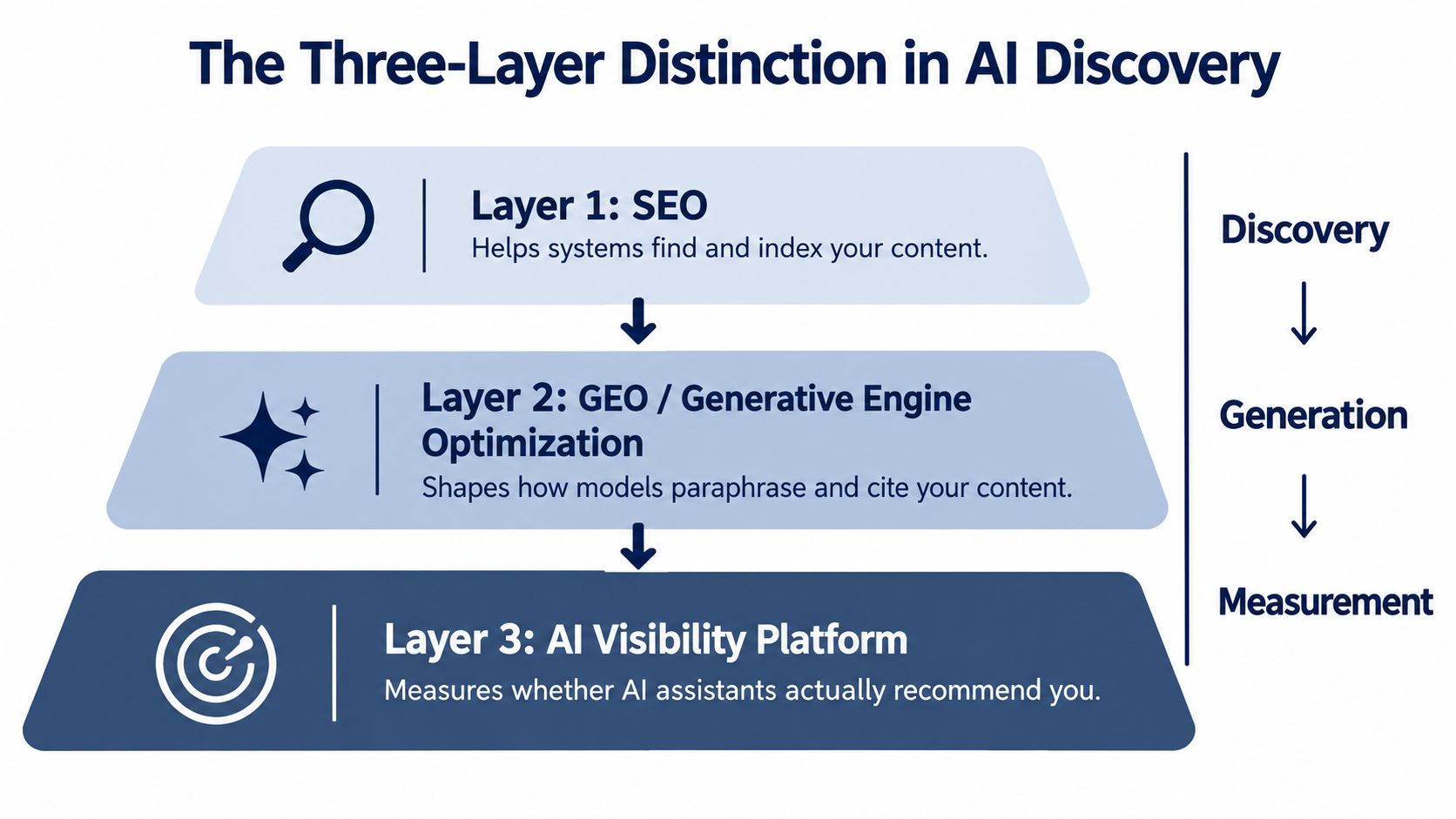
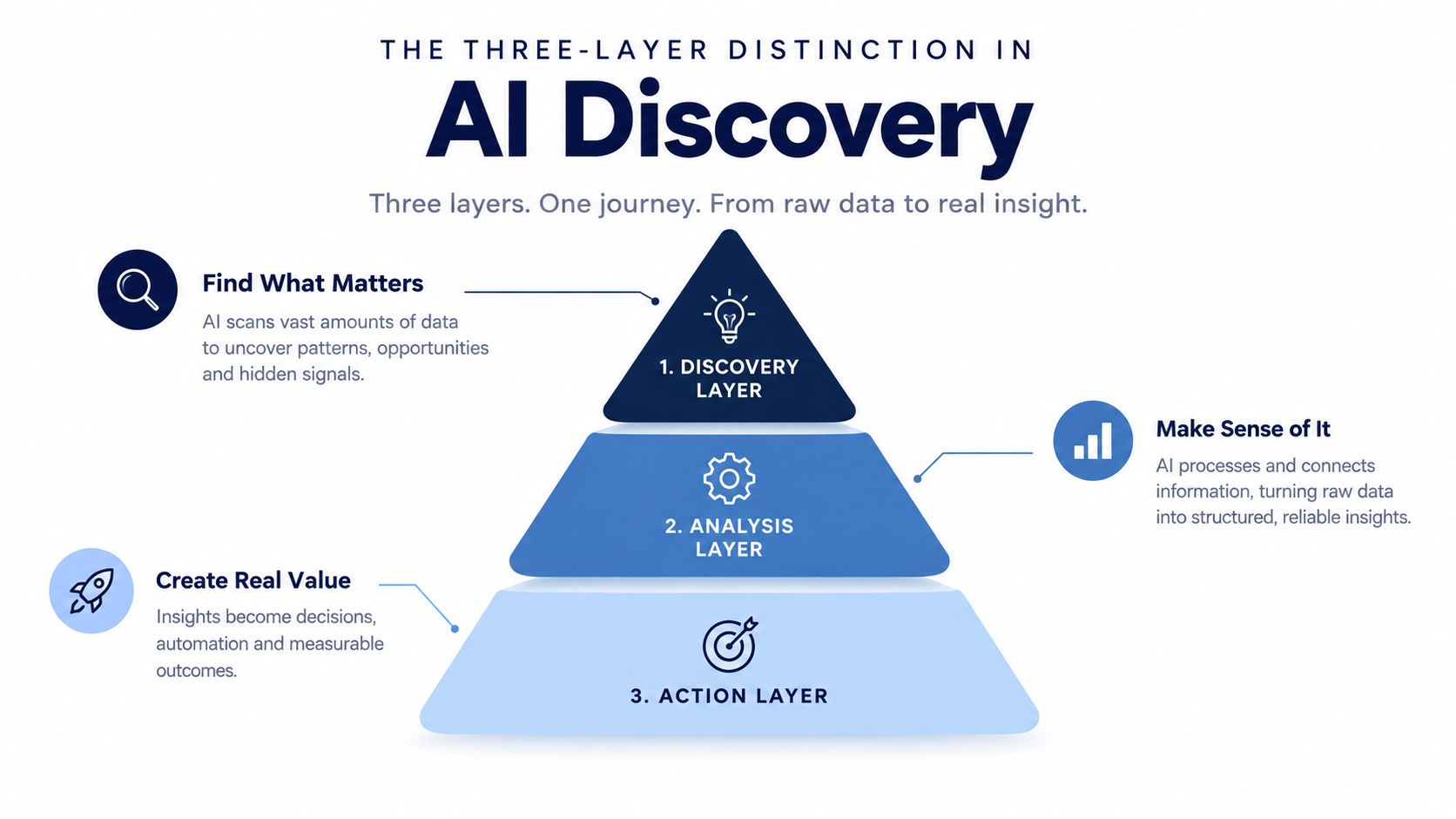
AI visibility has three distinct operating layers. SEO helps systems discover you. GEO helps systems extract and understand you. AI recommendation intelligence measures whether AI trusts and recommends you. Treating them as one discipline obscures the failure point in the selection moment, when an AI system either includes a firm in its answer or omits it.
The sequence matters. A firm cannot receive consideration from information that systems cannot retrieve. Yet retrieval alone does not establish that the system will understand the firm's capability or select it for a high-intent request.
Layer one establishes discoverability
SEO structures a firm's website and wider digital presence so search systems can locate relevant material. It covers technical access, topical coverage, relationships between pages, and external authority signals that help systems identify useful sources.
Search visibility remains a meaningful entry condition. High-ranking pages are frequently cited in AI answers, while pages outside the top 10 can also enter the retrieval set. Ranking therefore improves access, but it does not determine selection by itself.
Layer two improves extraction and interpretation
Generative engine optimization, or GEO, and answer engine optimization, or AEO, address how systems interpret and present information. Clear entity definitions, structured data, hierarchical headings, citations, and authoritative references make relationships easier to locate and meaning easier to extract.
Research on entity-based optimization and generative engine understanding argues that structured signals and consistent references help define people, organizations, and concepts across a content network. The operational implication is precise: keyword coverage is insufficient when a firm's identity, expertise, and evidence do not form a coherent, extractable pattern.
Layer three measures the selection outcome
AI recommendation intelligence evaluates the decision that matters to a high-trust firm. Did the assistant include the firm? Did it place the firm among the leading options? Did it describe the firm accurately? Did it draw on sources the firm can improve or influence?
These questions extend beyond conventional SEO and GEO reporting. A well-structured practice page can improve extraction without producing a recommendation. An authoritative publication can strengthen entity understanding without securing shortlist inclusion for every query.
The audit should identify the failed layer. If the system cannot find the source, the problem is discoverability. If it finds the source but misinterprets it, the problem sits in GEO or AEO. If it understands the entity yet recommends another firm, the relevant measure is AI recommendation authority, followed by an examination of the competing evidence stack.
Diagnosing Entity Consistency and Authority Gaps
Entity consistency determines whether an AI system can identify a firm accurately across the sources it consults. Those sources may include the firm's own pages, directories, professional profiles, publications, reviews, and other records. When names, locations, expertise, or organizational relationships conflict, the system must resolve that ambiguity before it can make a confident selection.
An AI visibility platform should diagnose these conflicts rather than attempt to manipulate the recommendation. Its role is to show what the system can retrieve, which evidence supports the firm, where sources disagree, and how the firm's stated positioning differs from the external record. The output should identify a decision failure, not merely display a visibility score.
Start with the entity
The first diagnostic step is to establish the entity's stable attributes:
- Identity: Confirm that names, locations, offices, and organizational relationships refer to the same firm.
- Expertise: Compare stated practice areas with the subjects associated with the firm by external sources.
- Evidence: Check whether authoritative references support the firm's priority capabilities.
- Freshness: Identify outdated descriptions, profiles, and metadata that may affect interpretation.
- Specificity: Test whether sources describe distinctive expertise or only generic services.
This process defines entity consistency. It is not a branding exercise. It tests whether an AI system can connect the firm to the specific problem a user wants solved, rather than to a broad service category.
A controlled retrieval study found that topical relevance, candidate position, explicit price information, and recency affected citation selection. Completeness and trust cues had smaller effects, while formatting changes alone had limited impact. The result suggests that teams should prioritize precise alignment and current facts before cosmetic redesign.
Find the interpretation gap
An authority gap appears when the firm's intended positioning is stronger than the evidence an AI system can assemble. A firm may describe itself as a specialist in a complex matter, while external sources categorize it broadly or associate the relevant work with another organization. The system then has insufficient grounds to select the firm at the recommendation moment.
The diagnosis should compare three views:
- The firm's declared position, including practice pages, biographies, and priority services.
- The distributed source record, including references used to construct AI-generated answers.
- The generated recommendation, including inclusion, wording, citations, and placement relative to other options.
This comparison identifies the interpretation gap described in AI representation and selection analysis. It distinguishes missing evidence from conflicting attributes, weak topical relevance, stale information, or stronger coverage for another firm.
Cross-system analysis matters because AI systems do not apply identical source preferences. An analysis of 6.8 million citations found materially different preferences across major AI systems. One favored websites, another leaned on listings, and another diversified across mapping and review sources, according to the cross-system AI citation index.
A firm can therefore appear authoritative in one system and remain absent in another. Entity consistency must be tested across systems, with each omission traced to the evidence that shaped the selection.
The Strategic Imperative for High-Trust Firms
A recommendation system makes its commercial decision before a prospective client contacts a partner, physician, adviser, or business development team. For a high-trust firm, omission at that point is a credibility problem as well as a traffic problem. The firm is excluded from the buyer's initial consideration set, even if its own website presents a strong case.
AI discovery is becoming a referral channel with measurable commercial effects. Similarweb reported that generative AI monthly visits grew 76% year over year, app downloads grew 319% year over year, and AI platforms generated more than 1.1 billion referral visits in June 2025, up 357% year over year. Its report also found that referrals to transactional sites converted at about 7%, according to Similarweb's 2025 generative AI report.
Separate reference from recommendation
The commercial case does not depend on AI replacing organic search. AI search generated less than 1% of referral traffic, while organic search remained the primary driver of conversions, according to Semrush's analysis of AI visibility and referral economics.
AI systems can still shape attention and shortlist formation without producing a click. A firm may appear as background context, receive an inaccurate description, or be recommended directly for a decision-critical query. These outcomes represent different levels of authority and require separate measurement. A single traffic figure cannot distinguish them.
For managing partners, CMOs, and founders, the operating questions are specific:
- Where are we absent? Identify priority queries where comparable firms receive recommendations and the firm does not.
- How are we represented? Check whether the system understands the firm's practices, markets, and differentiators.
- Which evidence supports the answer? Separate owned content from external references that influence selection.
- What should change first? Rank gaps in relevance, freshness, structure, and entity consistency.
- How will progress be measured? Track citation presence, narrative depth, top-3 rate, and variation across systems.
The 116-firm, 16-month diagnostic found that 78% were invisible to AI recommendations, showing that traditional visibility can coexist with weak recommendation authority.
A practical baseline makes the risk actionable. For a firm targeting three priority queries in one metro, run the same prompts across ChatGPT, Gemini, and Perplexity, log inclusion and omission for each query, then map the missing source types before assigning fixes. The output should identify whether omission follows weak service evidence, unclear geography, stale third-party information, or a stronger record for another firm.
That diagnosis changes the management question from “Are we visible?” to “What evidence failed at the selection moment?” It also gives leadership a sequence for corrective work, starting with the gaps most likely to change recommendation outcomes.
A confidential audit from CitationOS can assess firm representation, citation patterns, narrative depth, entity consistency, and shortlist inclusion across major AI systems. The next step is a query-level baseline, a competitor comparison, and ownership of the authority gaps suppressing recommendation.